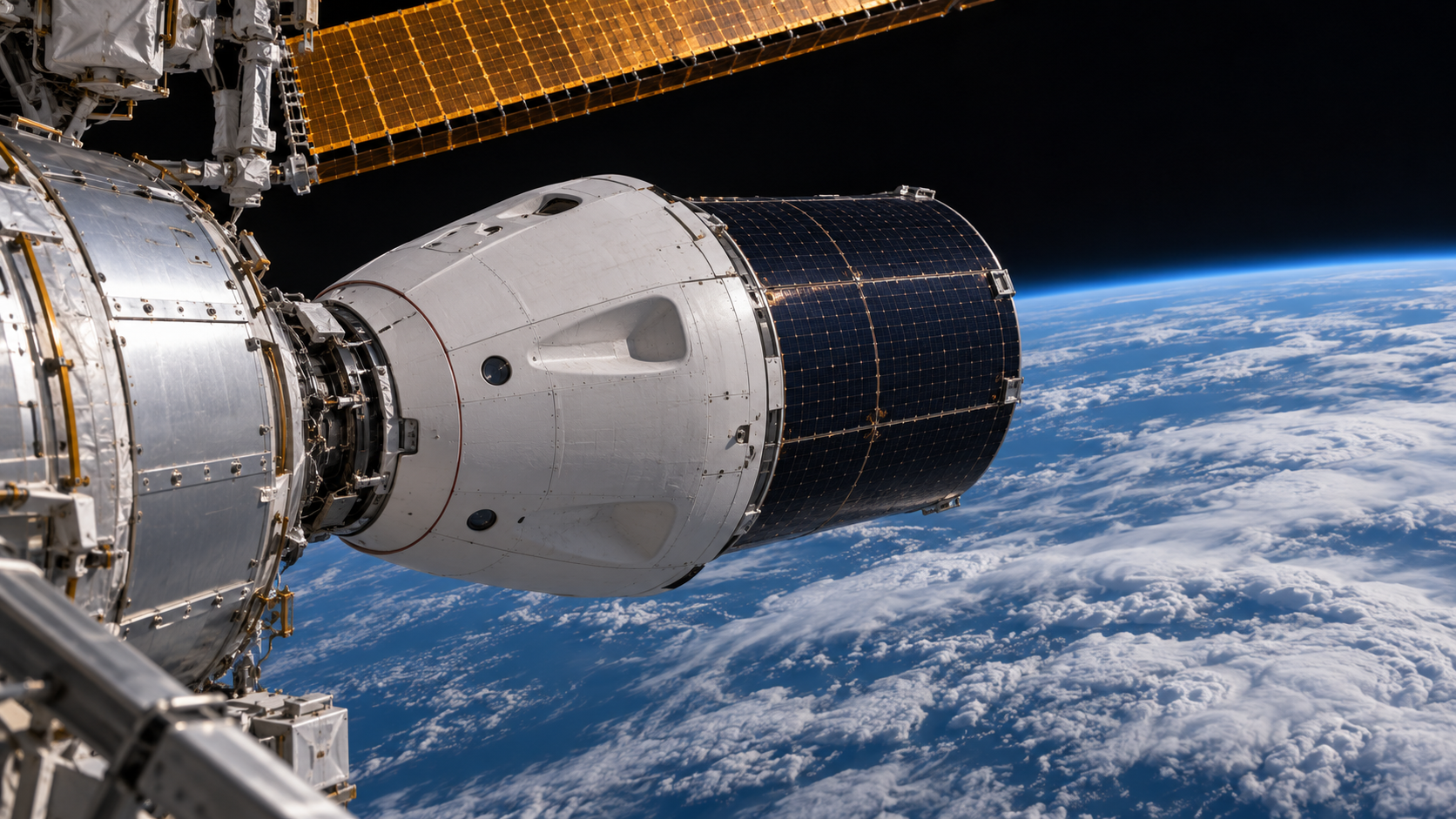
Why California’s Weather Is Holding a Spacecraft at the Space Station
The Weather Off California Is Keeping Dragon In Orbit.
SpaceX’s Dragon cargo spacecraft could leave the International Space Station at 5.05pm UK time on Thursday 19 November 2026. That is 12.05pm on the US East Coast and 9.05am in California. NASA identified Thursday as the next available opportunity after calling off Wednesday’s departure. The decision depends on the forecast for the Pacific waters where recovery crews will retrieve the capsule.
NASA and SpaceX scheduled their next weather review for 5pm UK time on Wednesday 18 November. In its announcement postponing the flight, NASA gave a possible undocking time for Thursday and left the new splashdown time open.
Why Does the Weather Matter Before Dragon Even Leaves?
Dragon is docked to the space-facing side of Harmony, one of the station’s connecting modules. To begin the journey home, controllers at SpaceX’s facility in Hawthorne, California, will send the command for it to undock. Before they do, the teams need a suitable forecast for the other end of the journey.
The original timetable shows how far ahead that judgement has to reach. NASA had planned for Dragon to leave the station at 8.05am California time on Wednesday and reach the Pacific at 10.50pm that night. The forecast therefore had to cover a recovery operation nearly 15 hours after departure. Once conditions at the proposed splashdown sites ruled out that plan, NASA and SpaceX chose to wait with Dragon still attached to the station.
For anyone following from Britain, Thursday at 5.05pm is the earliest time to watch for undocking. The splashdown time in NASA’s earlier advisory belonged to the cancelled Wednesday flight. In its 18 November update, the agency attributed the delay to weather at the recovery sites and gave no more specific cause, such as high winds or rough seas.
What Is Dragon Bringing Back to Earth?
This is an uncrewed flight, SpaceX’s 35th commercial resupply mission for NASA. Dragon delivered more than 6,300 pounds of supplies, science equipment and other hardware on 15 October. That figure describes the load it took up to the station. For the journey home, NASA describes thousands of pounds of cargo, including research samples that scientists are waiting to examine on Earth.
One of those samples is a blood vessel made by 3D bioprinting. Researchers used the vessel to study how blood vessels age, work that could help scientists understand cardiovascular disease. Another experiment is returning frozen tumour organoids, small laboratory-grown models of tumours. Researchers treated them aboard the station and will examine them on Earth to learn more about how tumours respond to treatment.
Some of the returning equipment has spent considerably longer in orbit than Dragon. A lighting system designed to reproduce the changing patterns of natural daylight is coming home after more than three years of testing. Its purpose was to help regulate astronauts’ sleep aboard a station where the view from a window offers little resemblance to a day on Earth.
How Do Astronauts Pack a Spacecraft for Splashdown?
For the station crew, preparing Dragon involves deciding where each item should sit and when it should go aboard. On 12 November, NASA astronauts Anil Menon and Jessica Watkins began loading payloads into the capsule. Menon later worked with Canadian astronaut Joshua Kutryk to rearrange and secure cargo. The distribution of that weight helps keep the capsule balanced during re-entry and splashdown.
The scientific samples have their own packing order. NASA’s plan called for the crew to transfer time-sensitive material in portable freezers and incubators during the final stage of loading. For researchers awaiting a frozen tumour sample, a successful return means recovering it in a condition that preserves what happened to it in orbit.
NASA will post timing updates on its space station blog. The next decision to look for is the outcome of Wednesday’s weather review. If the forecast supports Thursday’s departure, the next useful detail for people following from the ground will be when the capsule and its cargo are expected off California.
Sources
NASA — NASA, SpaceX Stand Down from Dragon’s Undocking on Wednesday — The reason for the delay, Wednesday’s weather review and Thursday’s earliest departure time.
NASA — NASA to Cover 35th SpaceX Resupply Mission Space Station Departure — The original flight timetable, undocking procedure and research samples due back on Earth.
NASA — Crew Packs Dragon with Science and Cleans Spacesuits — The crew’s loading work, temperature-controlled samples and lighting experiment.
Next Reads
SpaceX Starship Catch Explained: How Flight 15 Came Home — How SpaceX recovered a very different spacecraft after 14 orbits.
ISS Medical Evacuation: Why the “First” Changes the Rules for Deep Space — What an early crew return reveals about the limits of medical care in orbit.
SpaceX’s Mars Timeline: When Humans Could Land and What Must Happen First — Why delivering cargo and bringing people home pose different challenges for a Mars mission.
