OpenAI Is Building An AI That Designs Computer Chips — And The Feedback Loop Could Be Enormous
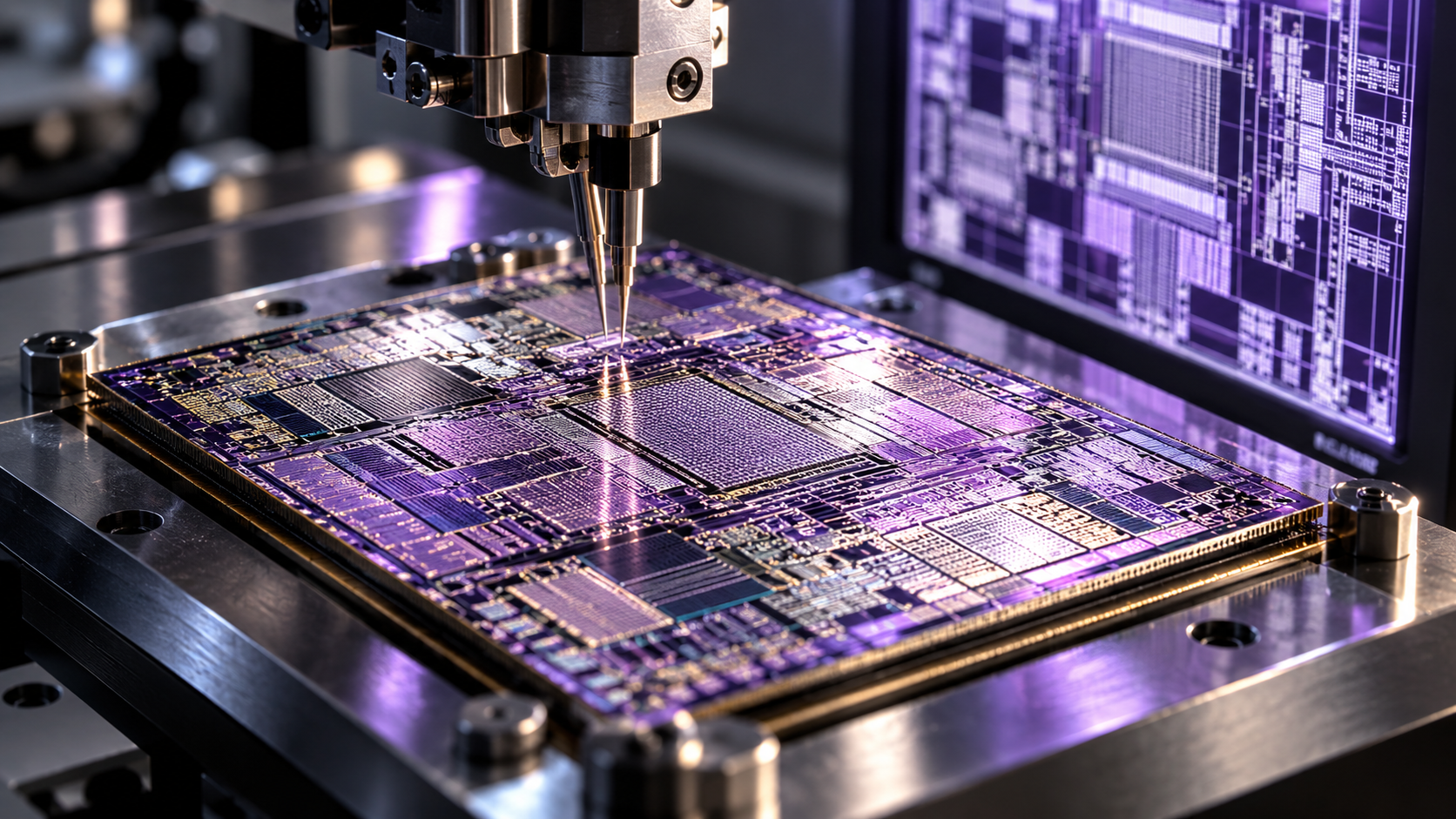
AI Could Help Design Its Next Generation Of Hardware. Here Is What That Means
When AI Helps Design Silicon
GPT-Synopsys will bring frontier models into engineering workflows, while the promise of faster progress still depends on verification and manufacturing.
OpenAI and Synopsys announced a partnership on 30 September 2026 to develop GPT-Synopsys, a specialised model for semiconductor design. Its intended role is to operate engineering tools, assess their results and improve designs for engineers to review.
The implication reaches beyond faster engineering. If AI helps improve the hardware running AI, useful gains could feed back into the next round of development. That is a plausible route to acceleration, rather than evidence that progress will become automatic or unlimited.
What Designing A Chip Actually Involves
A computer chip begins with requirements. Engineers must decide what it should calculate, how quickly it should respond and how much electricity it can use. Those choices must eventually become circuits that can be manufactured and tested.
Electronic design automation, usually shortened to EDA, supplies the software for that journey. Tools simulate behaviour, convert descriptions into circuit structures, arrange components and check the connections between them. They also help establish whether a design meets its electrical and manufacturing constraints.
Improving one property can damage another. A faster arrangement may consume more power. Reducing the space occupied by a circuit can complicate its connections. A successful design must balance these trade-offs rather than win a single benchmark.
Consider an illustrative task: reducing a circuit’s energy use while preserving its speed. An engineer could investigate several implementations, compare their outputs and reject candidates that break the requirements. Automating more of that investigation could make a wider search practical. It would not make every candidate useful.
From Answering Questions To Running Experiments
The important distinction is between suggesting a change and checking it. A language model can offer a plausible explanation without establishing that the explanation is correct. Engineering requires an observable result.
Synopsys had already announced its Autopilot platform and AgentEngineer portfolio on 28 September. It describes agents that plan and execute engineering workflows, supported by tools, engineering context and controls. The company also published customer accounts of productivity improvements. Those accounts provide background to its approach; they do not establish the performance of the newly announced partnership.
This is how AI agents use tools: they take an action, inspect what happened and choose a next step. In chip design, the quality of that loop depends on the tests as well as the model.
A system given the wrong objective could optimise the wrong thing very efficiently. A system judged against incomplete tests could produce a convincing improvement that fails elsewhere. Human review therefore needs to examine the requirements and evidence, rather than merely approve a polished summary.
OpenAI Says AI Already Helped Build Jalapeño
OpenAI has described a concrete example in its own hardware programme. In an engineering update dated 25 August 2026, it said AI helped develop Jalapeño, its custom inference chip, and enabled the team to move from initial design to tapeout in nine months.
Tapeout is the point at which the final design is handed over for manufacturing. It is an engineering milestone, not proof that production, qualification and deployment are complete.
The company said AI helped explore implementations and optimise arithmetic circuits. Its account supports a narrower, useful conclusion: AI contributed to a real chip-development process. It does not provide a controlled comparison showing how long the same team would have taken without those tools.
Inference means running a trained model to produce an answer. Improving inference hardware can make services more responsive or economical without directly increasing a model’s underlying reasoning ability. That distinction matters when assessing what better silicon might deliver.
How The Feedback Loop Could Grow
The potential gains can compound through several mechanisms.
First, better engineering tools could reduce the effort required to explore a design. A team might complete the same project sooner, or use the available time to investigate alternatives it previously could not afford to test.
Second, a successful hardware improvement could make computational experiments cheaper. Researchers working within a fixed budget could then conduct more trials, provided the hardware suits those workloads.
Third, lessons from deployed systems could inform the next design. A processor that looks strong in an isolated test may encounter a different bottleneck when it runs a complete service. Understanding where time and electricity actually go can guide a more useful revision.
These are conditional mechanisms. A shorter design cycle matters less if manufacturing is the dominant delay. Extra computing capacity matters less if the next advance requires a better research idea. An efficient chip can also disappoint when the software using it is poorly matched to its architecture.
The broader debate over self-improving AI concerns whether such contributions could eventually accelerate research beyond effective human supervision. A hardware partnership alone cannot establish that outcome. It gives the debate a specific engineering process to examine.
The Factory Remains Part Of The Equation
Design automation does not remove fabrication. A verified design still has to become physical hardware, and finished chips must meet their intended standards.
This creates a practical limit on the idea of an instant feedback loop. Software changes can sometimes be tested rapidly. A proposed circuit improvement has to pass through a longer chain before its benefit is available in a working machine.
Energy efficiency also needs careful interpretation. Using less electricity for each calculation does not necessarily mean using less electricity overall. If lower costs encourage much greater demand, total consumption can rise even while each task becomes more efficient.
For customers, the benefits would therefore depend on delivery and pricing. Lower operating costs could support cheaper services, more generous usage allowances or improved supplier margins. None follows automatically from a better design tool.
The Results That Would Make This Significant
The useful questions are measurable. Does the system reduce total engineering time after review and rework? Do improvements survive verification and appear in manufactured chips? How much computing expense is required to obtain them?
A fair assessment would compare similar tasks, disclose the amount of human intervention and count failed attempts. It would also distinguish a gain in one circuit block from a gain across an entire processor or service.
Until those results are available, the strongest conclusion is that an important experiment is under way. The decisive evidence will be a design that reaches production, performs as intended and saves enough time or resources to justify the process that produced it.
Sources
Synopsys — OpenAI And Synopsys Announce GPT-Synopsys — The 30 September 2026 partnership announcement, intended workflow and engineer review.
OpenAI — Jalapeño’s First Results Show Industry-Leading Speed And Efficiency In AI Inference — The company’s 25 August 2026 account of AI-assisted chip development; company claims require that qualification.
Synopsys — Powers Autonomous Engineering With Long-Horizon Agents And Autopilot — Earlier engineering-agent capabilities and customer statements, distinct from GPT-Synopsys performance.
Next Reads
AI Insiders Warn Self-Improving Systems Could Outrun Human Control — The wider debate about AI helping advance AI.
How Do AI Agents Work? Tools, Permissions, Mistakes And Human Oversight — Why tool access and review determine what an agent can safely accomplish.
How AI Actually Learns: Training Data, Predictions And Hallucinations — The difference between generating a plausible answer and establishing that it is correct.
