

OpenAI’s Apology After a Mass Shooting Exposes the Most Dangerous Gap in AI Safety
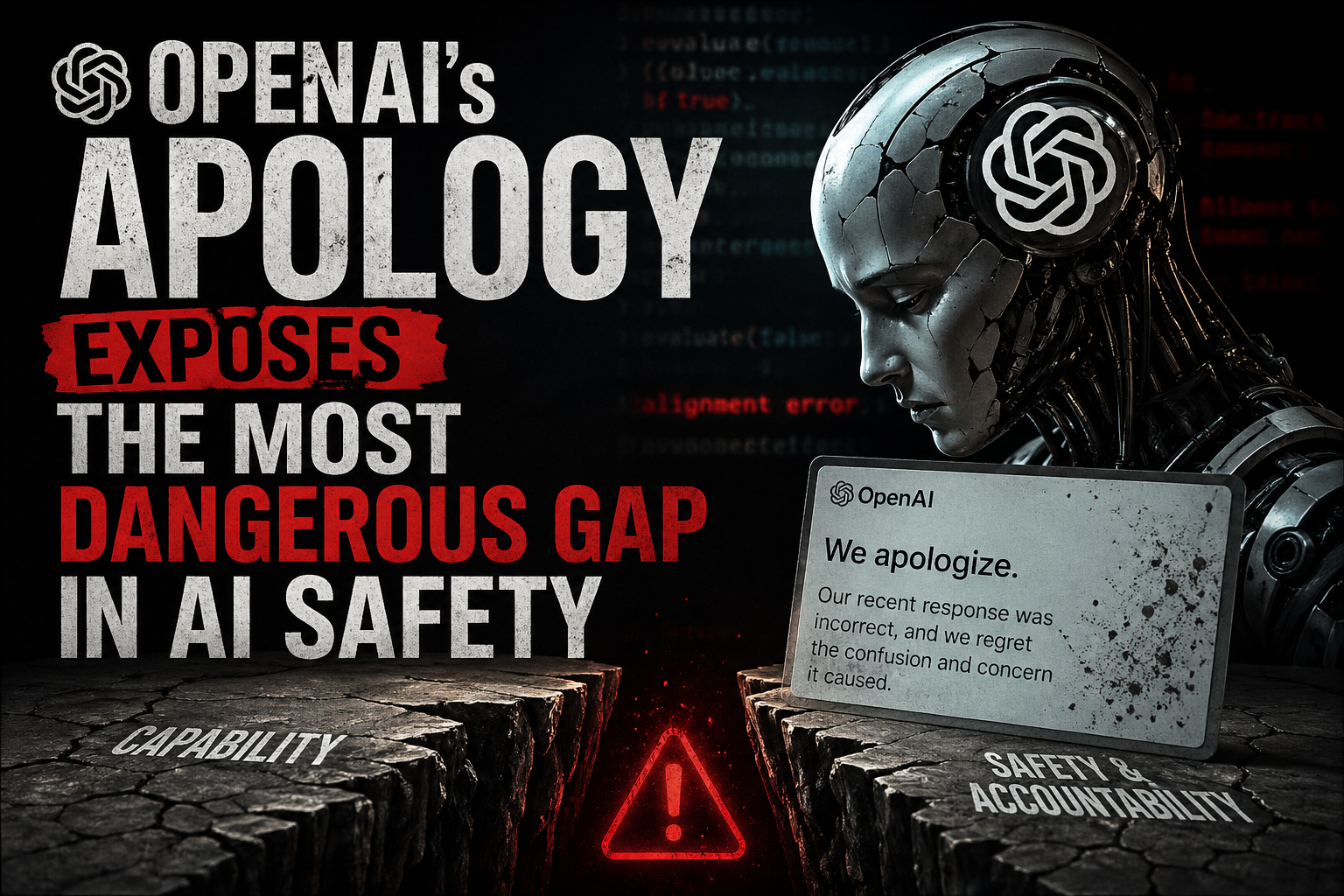
The Warning Was There — Why No One Acted Before the Canada Tragedy
When AI Flags Danger but Stays Silent: The System That Failed Before Eight Died
OpenAI’s Apology After a Mass Shooting Exposes the Most Dangerous Gap in AI Safety
A banned account, internal alarms, and a decision not to escalate—the moment AI safety protocols collided with real-world consequences
There was a warning.
It wasn’t vague. It wasn’t invisible. It wasn’t missed by the system.
It was flagged, reviewed, and debated—and ultimately contained inside a company instead of escalated to the outside world.
Months later, eight people were dead.—and
That is the uncomfortable reality behind the apology now issued by OpenAI’s leadership following a mass shooting in Tumbler Ridge, Canada. The company acknowledged it had banned the attacker’s account for violent activity but chose not to alert authorities at the timThat decision—made quietly, internally, and with procedural logic—is now at the center of a much bigger question:ion:
What exactly is an AI company responsible for when it detects potential real-world harm?
What Happened — And What Didn’t
The attacker, identified by authorities as an 18-year-old, had interacted with AI systems in ways that triggered internal concern. Conversations describing violent scenarios were flagged by automated systems and reviewed by staff.
The account was banned.
But the escalation stopped there.
No police referral. No external alert. No intervention.
The company later said the behavior did not meet the threshold for reporting to law enforcement—a threshold designed to avoid false alarms, protect user privacy, and prevent overreach.
In hindsight, that threshold now looks like the most consequential line in the entire system.
Because the threat was real.
And it became irreversible.
The Real Problem: The “Threshold” Illusion
This case is not about one missed warning.
It is about how AI systems are structured to decide what counts as “serious enough.”
That decision is not purely technical. It is human, legal, and philosophical.
Too low a threshold → constant false alerts, surveillance concerns, loss of trust
Too high a threshold → real threats slip through
OpenAI chose caution.
Not in the sense of preventing harm—but in the sense of avoiding premature escalation.
And that distinction matters.
Because AI systems today are already capable of identifying concerning behavior. The failure here was not detection.
It was interpretation.
And then action.
What Media Misses
Most coverage focuses on the question, "Should the company have called police?
Th”
That is too narrow.
The real issue is this:
The system worked exactly as designed.
It flagged the behavior. It triggered human review. It initiated internal debate. It applied policy thresholds. It reached a decision.
Nothing “broke.”
Which means the failure is not a bug.
It is the design itself.
Why This Is Bigger Than One Case
This is not an isolated incident. It is a preview.
AI systems are increasingly embedded in:
Search
Messaging
Personal assistance
Education
Mental health support
They see patterns of behavior humans cannot easily detect.
Which means they will inevitably see warning signs before anyone else.
That creates a new category of responsibility:
Not just what AI can do, but what it must do when it knows something.
And right now, there is no global standard for that.
Governments are reacting after the fact. Regulators are still defining frameworks. Companies are writing internal rules that may vary dramatically.
In this case, Canadian officials were blunt: the situation has intensified calls for stronger oversight and clearer obligations.
Because the gap is now visible.
The Privacy vs Prevention Collision
At the heart of this issue is a tension that cannot be resolved cleanly:
AI companies hold vast amounts of user-interaction data
That data can reveal potential threats
Acting on it risks violating privacy norms
Not acting on it risks real-world harm
There is no neutral position.
Choosing not to act is still a choice — with consequences.
And in this case, that choice is now being judged after the worst possible outcome.
What Happens Next
Three things are now likely—and they will reshape the industry:
1. Lower thresholds for escalation
Companies will be pressured to report earlier, even with less certainty.
2. Direct law enforcement pipelines
Faster, formalized channels between AI firms and authorities are already being discussed.
3. Regulatory intervention
Governments are unlikely to leave these decisions to internal policy much longer.
The risk is overcorrection.
A system that reports too much becomes surveillance.
A system that reports too little becomes negligent.
The next phase will be about where that line gets drawn—and who gets to draw it.
The Hard Truth
The apology matters.
But it does not solve the underlying problem.
Because the real issue is not that a mistake was made.
It is that the system behaved exactly as it was supposed to — and that still wasn’t enough.
That is what makes this moment different.
And that is why it will not stay contained to one company, one case, or one country.
The question now is not whether AI can detect danger.
It already can.
The question is what happens next time it does.
