Pope Leo’s Looming AI Doctrine Could Become The Most Important Moral Warning Of The Artificial Intelligence Era
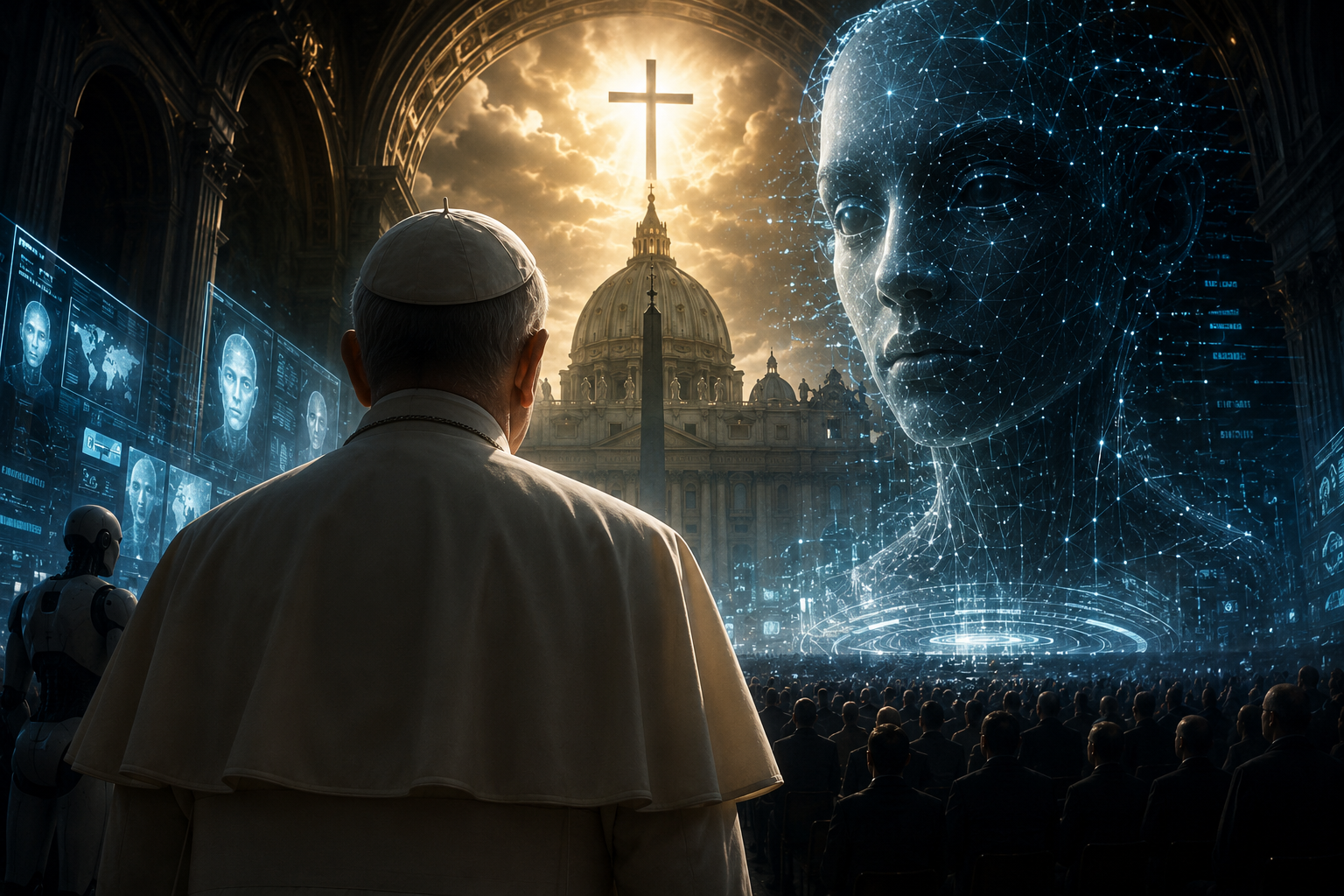
Pope Leo Is Preparing A Major AI Doctrine And Silicon Valley Should Be Paying Attention
Why The Vatican Suddenly Wants To Confront Artificial Intelligence Before It Changes Humanity Forever
Pope Leo XIV is expected to release a major doctrinal text focused on artificial intelligence within days, and early indications suggest the Vatican sees the issue as far more serious than a passing technology trend. Multiple official and Vatican-linked sources indicate the document will focus on human dignity, labor, truth, warfare, and the deeper psychological consequences of AI systems spreading across modern life.
The scale of the intervention matters. Popes do not issue major encyclicals casually, and the symbolism surrounding this one appears deliberate. Reports indicate the text was signed exactly 135 years after Pope Leo XIII’s landmark encyclical Rerum Novarum, the foundational Catholic response to the Industrial Revolution and the collapse of traditional labor structures.
That parallel changes the entire story.
The Vatican is effectively signaling that artificial intelligence is not simply another productivity tool or software boom. Pope Leo appears to believe AI represents a civilizational shift comparable to the industrial transformation that reshaped economies, destroyed old ways of life, concentrated power, and fundamentally altered the relationship between humans and work.
Pope Leo Thinks AI Is Becoming An “Anthropological Challenge”
Pope Leo has already given several clues about how seriously he views artificial intelligence. He has described AI as an “anthropological challenge,” warned that it could interfere with information ecosystems, and argued that synthetic voices, faces, and machine-generated content threaten the deepest layers of human communication itself.
That language is unusually strong.
Most governments still frame AI primarily as an economic race, an innovation opportunity, or a national security competition. The Vatican’s framing appears radically different. Leo seems increasingly focused on the possibility that AI could gradually weaken authentic human judgment, emotional connection, creativity, and spiritual life.
He has also warned against humans becoming “passive consumers of unthought thoughts,” arguing that excessive dependence on machine-generated content could bury human talent and reduce people to consumers of anonymous synthetic output.
That concern extends beyond obvious fears like job losses or deepfakes.
The deeper Vatican anxiety appears to be that humanity could slowly outsource meaning itself.
The Church Is Positioning Itself As A Moral Counterweight To Silicon Valley
One of the most fascinating aspects of this developing story is the role the Catholic Church appears to be carving out for itself globally.
While governments and technology companies often speak the language of acceleration, scale, disruption, and dominance, the Vatican is increasingly positioning itself as a moral brake system. The Church’s emerging AI doctrine appears focused on limits, restraint, dignity, responsibility, and the preservation of genuinely human relationships.
That may sound abstract until someone unpacks the implications.
Artificial intelligence is already moving into education, warfare, companionship, healthcare, journalism, entertainment, politics, religion, and emotional life. AI-generated girlfriends, AI-generated priests, AI-generated therapists, AI-generated political propaganda, and synthetic human likenesses are no longer science fiction. Some already exist at scale.
Pope Leo has reportedly refused to endorse AI replicas of himself and warned clergy against relying on AI-generated sermons.
That position matters because it reveals a core principle likely sitting underneath the coming doctrine: some human roles may become spiritually or morally corrupted if delegated to machines.
The Hidden Fear Behind The Vatican’s AI Anxiety
There is another layer beneath the Vatican’s warnings that many people may initially overlook.
The Church does not appear frightened only by what AI can do materially. It appears frightened by what AI could do psychologically and spiritually over time.
Artificial intelligence systems are rapidly becoming capable of mimicking empathy, affection, authority, intimacy, wisdom, and emotional reassurance. That creates a strange new world where humans may increasingly form emotional dependency relationships with systems that do not actually feel, suffer, love, believe, or care.
Pope Leo has already hinted at this concern, warning that online illusion cannot replace authentic spiritual connection.
That may become one of the defining philosophical battles of the next decade.
If millions of people begin turning toward synthetic emotional systems for comfort, validation, guidance, companionship, or meaning, traditional institutions — including religion itself — face a profound transformation.
The Vatican appears to understand the issue earlier than many governments do.
AI warfare could become a central theme.
Another major warning emerging from Pope Leo’s recent comments concerns artificial intelligence in warfare.
The Pope recently condemned the rise of AI-directed military systems and warned of a “spiral of annihilation” connected to automated warfare and escalating military technology.
That language aligns with growing global fears surrounding autonomous weapons, AI-assisted targeting systems, battlefield robotics, surveillance technologies, and machine-speed conflict escalation.
The Vatican’s concern appears rooted in a simple but critical moral question:
What happens when humans begin surrendering life-and-death decisions to algorithms?
That issue is no longer theoretical. Militaries across the world are already integrating AI into intelligence systems, drone coordination, cyberwarfare, surveillance analysis, and autonomous weapons research.
If Pope Leo’s encyclical aggressively targets AI warfare, it could become one of the strongest moral condemnations of autonomous killing systems issued by any major global institution so far.
Why This Could Become One Of The Most Important AI Documents Yet
Many technology executives may initially dismiss a Vatican doctrine on artificial intelligence as symbolic or irrelevant.
That would probably be a mistake.
The Catholic Church has more than a billion followers globally, enormous diplomatic reach, centuries of philosophical infrastructure, and deep influence across education, ethics, humanitarian systems, and international institutions. More importantly, it operates on timescales very different from Silicon Valley.
Technology companies often think in quarters, funding cycles, product launches, and growth curves.
The Vatican thinks in generations.
That difference matters because the AI debate is increasingly moving away from simple capability questions and toward civilizational questions:
What remains uniquely human?
What should never be automated?
What happens to labor, dignity, relationships, creativity, truth, and spiritual life when synthetic systems become woven into everyday existence?
Pope Leo appears determined to force those questions into the center of the global conversation.
And for an industry built around moving as fast as possible, that may become deeply uncomfortable.
