Quantum Battery Claims Are Triggering A Huge Energy War Over The Future Of Power
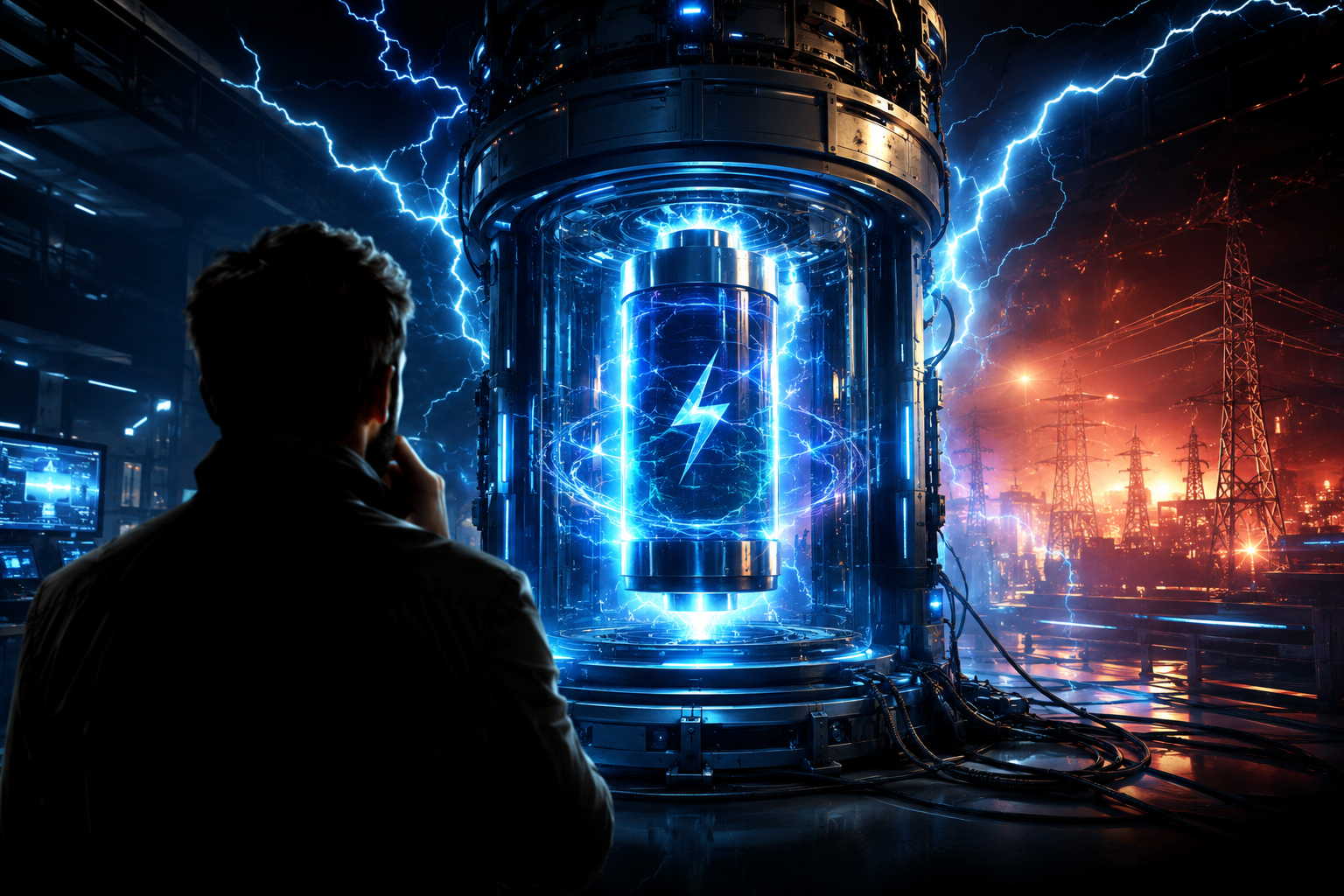
The Race For The Quantum Battery Is Becoming A Battle Over The Future Of Electricity
Quantum Battery Claims Are Triggering A Huge Energy War Over The Future Of Power
A new wave of quantum battery breakthroughs is reigniting one of the biggest technology debates in energy storage—because if even part of the promise is real, the global power industry could change dramatically.
The phrase “quantum battery” still sounds like science fiction to most people. But behind the futuristic branding is a very real and increasingly serious scientific race involving universities, physics labs, energy researchers, and advanced materials specialists around the world. The central claim is explosive: quantum mechanics could eventually allow batteries to charge faster, transfer energy differently, and potentially outperform some limits associated with conventional energy storage.
That possibility is now colliding with skepticism, hype concerns, infrastructure realities, and an uncomfortable question hanging over the entire sector: are quantum batteries the early foundations of a genuine energy revolution or the beginning of another overinflated technology cycle?
The Claim That Suddenly Changed The Conversation
Quantum batteries are not simply “better lithium-ion batteries.” The concept is fundamentally different. Researchers are exploring whether quantum effects such as coherence, entanglement, and collective charging could allow energy systems to behave in ways classical batteries cannot.
Recent papers have intensified interest in the field. One newly published study described methods for “coherence-enhanced” charging and stabilization of stored energy inside quantum systems, while another explored remote directional charging across quantum networks.
The language is highly technical, but the implication is simple enough to understand: scientists are attempting to find ways for energy storage systems to behave faster, smarter, and more efficiently than conventional physics models would normally allow.
That immediately turns quantum batteries into more than a laboratory curiosity. Energy storage is one of the defining bottlenecks of the modern world. Renewable energy expansion, electric vehicles, AI infrastructure, data centers, grid stability, military systems, aerospace engineering, and future robotics all depend on better storage technology.
The reason the debate is escalating so quickly is because energy storage has become one of the most strategically important technologies on Earth.
Why The Energy Industry Is Watching So Closely
Modern energy systems have a major weakness: inconsistency.
Solar energy disappears at night. Wind power fluctuates with weather systems. Electricity grids experience demand spikes that require huge balancing operations. Governments and industry leaders increasingly accept that large-scale storage will determine whether long-term clean-energy ambitions actually work in practice.
That is why battery technology has become such a geopolitical and industrial battleground. Countries are competing over lithium supply chains, rare-earth access, battery manufacturing, grid storage, and next-generation chemistry development.
Quantum batteries enter this environment almost like a wildcard technology.
If future versions genuinely allow dramatically faster charging or radically improved efficiency, the consequences could ripple across almost every advanced industry simultaneously. Electric vehicles could theoretically charge far faster. Grid-scale energy systems might become more responsive. Portable electronics could evolve again. Entire assumptions about power delivery could change.
That does not mean those breakthroughs are imminent.
But even the possibility is enough to attract serious attention.
The Problem Buried Beneath The Hype
The biglargestnger in the quantum battery conversation is the gap between theory and deployment.
Researchers themselves repeatedly stress that fully functional large-scale quantum batteries do not yet exist. Much of the field remains experimental, theoretical, or highly constrained to laboratory conditions.
Some scientists are also warning that parts of the broader quantum-information world can drift into exaggerated claims detached from engineering reality.
That matters because energy technology has seen this pattern before.
The battery industry is filled with announcements about “breakthroughs” that later collide with manufacturing limits, safety concerns, scalability problems, extreme costs, or disappointing real-world performance. Recent debates around solid-state battery claims have already highlighted growing frustration inside the sector about overstated performance promises and weak testing standards.
Quantum batteries now risk entering that same dangerous territory.
The phrase itself is almost perfectly designed for hype. It combines two emotionally powerful ideas: “quantum” and “energy revolution.” That creates massive attention instantly, especially online.
But attention is not deployment.
The stark reality is that even conventional battery systems still face major unresolved problems around safety, mineral dependence, infrastructure costs, and long-duration storage capability.
Quantum systems are vastly more delicate and complex.
The Real Story Is Bigger Than One Battery
The deeper significance of the quantum battery debate may not be the battery itself.
It may be what the debate reveals about the next technological era.
For decades, digital innovation dominated global investment. Software scaled faster than physical infrastructure. But the world is now moving back into an age where hard engineering problems matter again: electricity generation, semiconductors, AI compute power, mineral supply chains, nuclear energy, advanced manufacturing, and grid resilience.
Energy storage sits directly at the center of that shift.
That is why governments, research institutions, and corporations are suddenly treating battery innovation as strategic infrastructure rather than a niche technology sector. The wider energy-storage market is already under intense pressure as countries attempt to stabilize increasingly electrified economies.
Quantum batteries therefore represent something psychologically powerful even before they become commercially viable. They symbolize the hunt for the next leap forward—the idea that humanity may still discover entirely new ways to control, transfer, and store energy.
That possibility is commercially irresistible.
The Question Nobody Can Yet Answer
The most important question surrounding quantum batteries is brutally simple: how much of the claimed “quantum advantage” survives contact with reality?
That is where the scientific battle is now intensifying.
Some theoretical models suggest genuine advantages may exist under certain conditions. Other researchers argue that earlier excitement about the advantages of quantum charging was overstated or misunderstood.
The field is evolving rapidly, but uncertainty remains enormous.
What is already clear, however, is that the global energy system desperately wants a breakthrough. Governments are debating long-duration storage policy, grid resilience, and battery deployment at increasingly urgent levels because the pressure on electricity infrastructure is accelerating.
That creates a dangerous combination inside emerging technologies: huge incentives, massive investor excitement, strategic competition, and public fascination.
Historically, environments like that often produce both genuine breakthroughs and major disappointments at the same time.
Why This Debate Is Only Going To Get Bigger
Quantum batteries may still be years — or even decades — away from practical large-scale use.
But the debate around them is already becoming a preview of the next global technology race.
Energy is no longer just an engineering issue. It is becoming a civilization-scale pressure point tied to AI growth, military power, industrial competitiveness, climate targets, transport systems, and geopolitical stability.
Any technology promising to change energy storage immediately becomes bigger than science.
That is why quantum battery headlines are spreading so aggressively despite the technology remaining highly experimental. People intuitively understand the stakes. A breakthrough in energy storage would not simply improve gadgets. It could reshape infrastructure, economics, national strategy, and everyday life simultaneously.
For now, the quantum battery remains suspended somewhere between frontier physics and future possibility.
But the argument it has triggered is very real already.
And that argument is only getting started.
