SpaceX Unveils $100bn Louisiana Starship Mega-Base Eight Times the Size of Manhattan
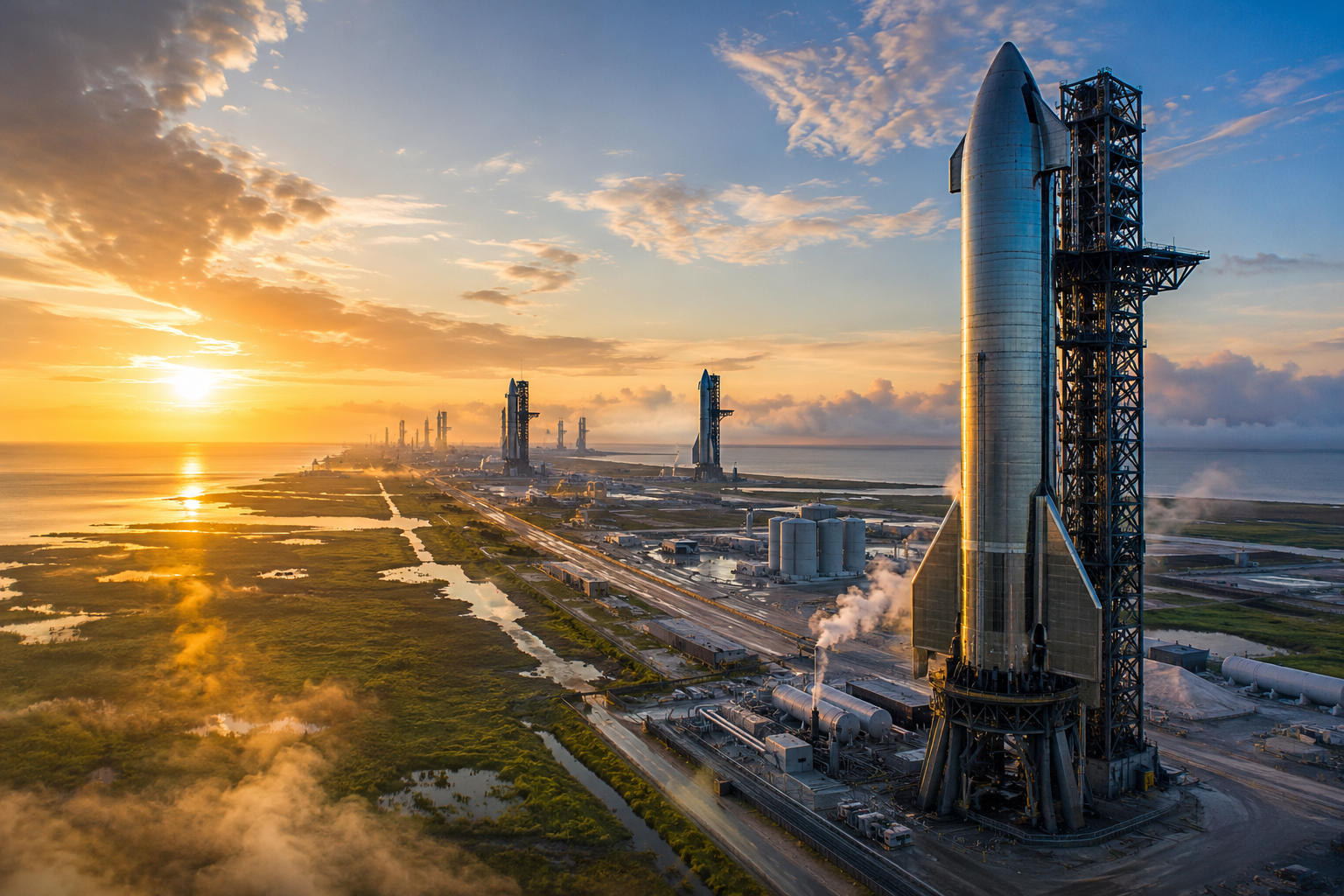
Elon Musk Is Building the Biggest Spaceport on Earth — And Its Scale Is Almost Absurd
SpaceX’s $100bn Gateway to Mars
Elon Musk’s vision of turning rocket launches from rare national events into something closer to an industrial transport network has just acquired an extraordinary new home. SpaceX plans to invest $100 billion in Starbase Louisiana, a sprawling 125,000-acre complex designed to become the largest spaceport in the world and ultimately support thousands of Starship flights every year.
The numbers are difficult to comprehend. At roughly 195 square miles, the Louisiana site is more than eight times Manhattan’s land area. But its extraordinary footprint begins to make sense when the plan is viewed not as another conventional launch site, but as an attempt to build an entire vertically integrated spaceflight industry around Starship.
SpaceX Is Building Something Far Bigger Than a Launch Pad
Starbase Louisiana is planned for Pecan Island in Vermilion Parish on Louisiana’s Gulf Coast. At full buildout, Louisiana Economic Development says it is expected to contain five separate launch complexes, each containing two launch pads and its own propellant farm — giving SpaceX ten pads across the site.
Around those pads will sit much of the infrastructure required to keep an enormous reusable rocket fleet moving. Plans include propellant production, dedicated power generation, vehicle processing facilities and housing for employees and their families. SpaceX has also described deep-water shipping capabilities and an airport as components of the self-sustaining spaceport.
That distinction matters. Traditional spaceports are principally places from which rockets depart. Musk and SpaceX appear to be designing Louisiana around the idea that rockets eventually need to be processed, fuelled, launched, recovered, serviced and launched again at a frequency closer to transportation infrastructure than today's aerospace industry.
It is an approach that follows the logic behind SpaceX itself. The company has repeatedly reduced its dependence on external suppliers and infrastructure by bringing more capabilities in-house. At Starbase Louisiana, that philosophy is being applied to the spaceport itself.
Why Does SpaceX Need 125,000 Acres?
At first glance, 125,000 acres sounds almost comically excessive. It becomes more rational when SpaceX's intended Starship launch rate is considered.
The company says Louisiana is being designed to support thousands of SpaceX flights annually. Musk has gone further, saying the eventual site could contain more than a dozen launch towers and enable more than 30 Starship flights per day — an aspiration rather than an established operational capability today.
Even a fraction of that cadence would fundamentally change how a spaceport has to operate.
Multiple pads allow rockets to be prepared simultaneously. They provide redundancy if one launch complex requires maintenance. Large separation distances become useful when enormous quantities of methane and liquid oxygen are being stored and handled. Vehicle processing, power generation, transport corridors, employee facilities and environmental buffers all consume additional space.
Louisiana also offers something SpaceX cannot easily manufacture: enormous amounts of largely undeveloped land beside the Gulf.
The existing Starbase operation in South Texas evolved from a considerably smaller project and operates under significant geographic constraints. Louisiana gives engineers the opportunity to begin with an almost blank sheet of paper and design infrastructure around the scale SpaceX thinks Starship could ultimately reach rather than the scale at which it operates today.
Not every acre will be covered in concrete. SpaceX President and COO Gwynne Shotwell has said very large portions of the property will remain natural wetlands without infrastructure, an important qualification when comparing its area with Manhattan.
The Real Goal Is Industrial-Scale Starship
The importance of Louisiana becomes clearer when viewed alongside Starship itself.
Starship is not intended simply to replace Falcon 9 with a larger rocket. SpaceX is trying to make both stages of the system rapidly and fully reusable, turning the economics of getting huge quantities of material into orbit upside down.
SpaceX has said Starship V3 is expected to carry around 100 metric tons of payload, with future versions potentially reaching approximately 200 metric tons. The company argues that full reusability and dramatically increased flight frequency could eventually reduce launch costs by orders of magnitude compared with historical spaceflight.
If that works, the bottleneck changes.
Building one powerful rocket is no longer enough. SpaceX would need factories producing vehicles continuously, vast quantities of methane and oxygen, processing facilities capable of extremely rapid turnaround and enough launch infrastructure to prevent a queue of reusable spacecraft forming on the ground.
That is the problem Starbase Louisiana appears intended to solve.
Musk has spent years arguing that reusable rockets should eventually operate more like aircraft than expendable launch vehicles. A ten-pad complex with its own fuel production, power infrastructure, shipping links and airport looks remarkably like infrastructure designed around taking that claim seriously.
What Will All Those Starships Actually Launch?
There is another reason SpaceX needs scale: it increasingly has its own enormous demand for launches.
Starlink already gives SpaceX something unusual among rocket manufacturers — a major internal customer capable of absorbing launch capacity. The next generations of SpaceX satellites are expected to become larger and more capable, making Starship increasingly important to the constellation.
But SpaceX's ambitions now extend far beyond broadband.
The company has outlined plans around orbital AI computing infrastructure, with Starship's extraordinary payload capacity considered central to putting large quantities of computing hardware into space. Louisiana is expected to support those satellite ambitions alongside conventional Starlink deployment.
The scale could eventually be staggering. SpaceX has contemplated an orbital network involving as many as one million AI-related satellites, although that represents an enormous proposed future system rather than infrastructure currently sitting in orbit.
Then there is NASA.
Starship remains central to the United States' Artemis lunar programme, with a modified Starship selected as a lunar landing system. SpaceX's longer-term objective is more ambitious still: sustained transportation between Earth and the Moon, followed eventually by large-scale missions to Mars.
This is where Louisiana's significance goes beyond another piece of corporate expansion.
If Starship remains a rocket that flies several dozen times a year, much of this capacity would be unnecessary. If Musk is correct that reusable spacecraft can eventually fly hundreds or thousands of times annually, SpaceX will need infrastructure unlike anything the traditional space industry has built.
Louisiana is effectively a physical bet on the second outcome.
A $100bn Bet on SpaceX’s Biggest Idea
The announced investment is extraordinary even by the standards of modern industrial megaprojects.
Louisiana describes the commitment as exceeding $100 billion, making it the largest capital investment announced in the state's history. The project is expected to generate more than 3,000 direct jobs during its first decade, with an average annual salary of about $92,600, while the state estimates another 8,100 indirect jobs could follow. Peak construction employment is projected at more than 34,000.
Those figures underline what SpaceX is proposing. This is not simply a few launch towers surrounded by empty marshland. The project is approaching the scale of a new industrial region.
For Louisiana, landing such an investment could create an aerospace ecosystem around a part of America more traditionally associated with energy, petrochemicals and offshore engineering. Those industries also give SpaceX access to workers already familiar with huge infrastructure projects, marine logistics, pipelines and complex industrial facilities.
Natural gas availability is particularly relevant because Starship's Raptor engines burn methane with liquid oxygen. Deep-water access could meanwhile allow enormous rocket components and industrial equipment to move by ship or barge rather than relying entirely on roads.
The location therefore combines land, coastline, energy infrastructure and industrial skills in a way few American sites could reproduce.
Musk Is Trying to Solve the Next Problem Before It Exists
This is arguably the most characteristically Musk-like element of the project.
SpaceX does not yet launch Starship thousands of times each year. It has not demonstrated 30 launches a day. Full rapid reuse of the entire Starship system still has to be achieved, and regulatory, engineering and environmental obstacles between today's programme and that level of operation remain enormous.
Yet waiting until those problems have all been solved before building the infrastructure required for mass operations would itself create another bottleneck.
SpaceX is instead beginning work on the assumption that Starship will succeed.
That is a risky strategy. It is also remarkably similar to the approach that allowed SpaceX to overturn assumptions elsewhere in the launch industry. Reusable Falcon 9 boosters once appeared unnecessarily ambitious; today booster recovery has become routine enough that watching one land can feel almost ordinary.
Starbase Louisiana represents another attempt to build ahead of demand rather than after it.
If SpaceX waits until hundreds of Starships are ready before creating places to launch them, years of potential capacity could be wasted. Building Louisiana now gives the company a chance to develop rockets and the infrastructure supporting them simultaneously.
The Environmental Challenge Cannot Be Ignored
The scale that makes Louisiana attractive also produces one of the project's biggest potential obstacles.
Pecan Island sits within environmentally sensitive coastal wetlands supporting migratory birds and other wildlife. Conservation organisations have already raised concerns over the potential effects of development, dredging, roads, intense lighting, noise and launch activity.
SpaceX says it intends to work with Louisiana and federal agencies on habitat protection and coastal restoration. The company has also pointed to severe shoreline erosion in the region and says it intends to contribute to restoration efforts.
That environmental balance will matter because a theoretical capacity for thousands of launches means little without the approvals required to conduct them. The eventual flight rate will depend not only on whether Starship works technically, but on regulation, airspace, environmental reviews, demand and the enormous logistical challenge of operating rockets at unprecedented frequency.
A pro-SpaceX assessment does not require pretending those obstacles do not exist. The significance of Louisiana is that the company is constructing infrastructure on the assumption that they can eventually be overcome.
Construction Begins Next Year
SpaceX says construction is expected to begin in 2027 and is targeting the first Starship launch from Louisiana as soon as 2029. Louisiana's economic development agency gives a slightly more conservative benchmark, saying initial operations are expected to come online around 2030.
The full complex will take considerably longer to realise. Ten pads, multiple launch towers, processing infrastructure, propellant production, housing, power generation and transport facilities represent a long-term industrial buildout rather than a single construction phase.
The result could eventually leave SpaceX operating a network of major Starship bases across the American Gulf and Atlantic coasts, with Texas, Louisiana and Florida providing different combinations of testing, manufacturing and operational capacity.
That redundancy could become critical as Starship moves from experimental flights towards commercial operations.
Why Starbase Louisiana Could Be Historically Important
The easiest reaction to a $100 billion spaceport eight times the size of Manhattan is to marvel at its scale.
The more important point is why SpaceX believes it may need one.
Musk's objective has never been merely to possess the world's biggest rocket. The real ambition is to collapse the cost and increase the frequency of space transportation until entirely new industries become economically possible.
Starlink was an early demonstration of that model: SpaceX built cheaper reusable launch capacity, then created an enormous satellite network capable of exploiting it. Orbital computing, lunar infrastructure and eventually Mars settlement represent vastly more ambitious versions of the same strategy.
Starbase Louisiana therefore amounts to an industrial declaration of intent.
For decades, spaceports were designed around scarcity. Rockets were expensive, launches were infrequent and each mission represented a major event.
SpaceX is now attempting to build infrastructure around the opposite assumption: rockets are reusable, launches become abundant and putting massive quantities of hardware into orbit becomes a routine industrial activity.
Whether SpaceX reaches 30 Starship launches a day remains an extraordinary unanswered question. But the company is no longer merely talking about what an era of mass spaceflight might look like.
It is starting to build the place from which that era could launch.
