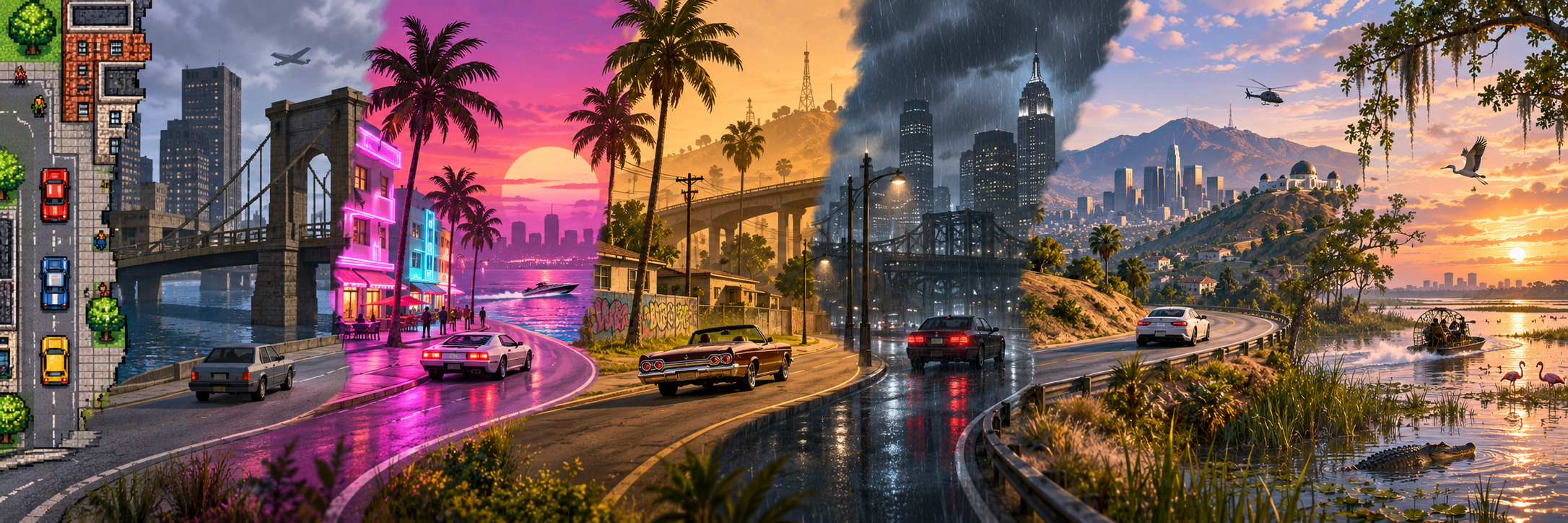
Vice City Was in the First GTA. Why Did It Take 29 Years to Get Here?
Vice City Was Already On The Map In 1997.
A player who bought the first Grand Theft Auto in 1997 could visit Liberty City, San Andreas and Vice City in a single game. The cars looked like toys viewed from a tower block. Jobs came through ringing telephones. Yet there, on one disc, were the names Rockstar would spend the next three decades turning into places that millions of people know their way around.
On Thursday 19 November 2026, Grand Theft Auto VI is scheduled to take players back to Vice City on PlayStation 5 and Xbox Series X|S. Pre-loading is already under way. The new game follows Jason and Lucia across Leonida, Rockstar’s fictional version of Florida. It arrives more than 13 years after GTA V, an extraordinary interval for a series that once went from Liberty City to Vice City in barely a year.
The strangest part of that history is how often GTA changed by going back over familiar ground. Liberty City has been a grid seen from the sky, a maze of elevated railway tracks and a place where an immigrant goes bowling with his cousin. Vice City has been a handful of pixels and an entire generation’s idea of 1980s Miami. To understand what GTA 6 inherits, it helps to go back to Dundee, where the people making the first game were still entertaining the idea of letting you be the police.
The Scottish Game That Began on Both Sides of the Law
In the mid-1990s, Dundee studio DMA Design was already known for Lemmings. Programmer Mike Dailly was working on an engine that developed into a project called Race ’n’ Chase. Its early design allowed players to take the side of the police or the criminals. Racing, collisions and multiplayer all figured in the plan. Anyone reading the proposal would have had a hard time predicting Tommy Vercetti, a functioning nightclub business or a radio station hosted by Iggy Pop.
What survived was the pleasure of choosing your own route through traffic. A conventional racing game could tell you exactly where to turn. A city let you make a bad decision, clip another vehicle and discover that getting out of trouble was more entertaining than reaching the destination. The original GTA gave those accidents consequences. Stealing a car changed how fast you could travel. Attracting the police changed which streets looked inviting. Abandoning a damaged vehicle meant taking your chances with whatever passed next.
The overhead camera gave players a peculiar advantage. You could see a junction and the traffic approaching from the side, almost as though you had the plans for a getaway spread across a table. But at speed, the visible stretch of road ahead disappeared remarkably quickly. One moment you were the architect of a brilliant escape. A moment later you were a tiny figure scrambling out of a wreck.
Even the ringing phones served a purpose that a modern mission menu struggles to reproduce. Work existed at a physical point in the city. You had to go there and answer. In a game remembered for letting players do outrageous things, one of its most effective invitations was a perfectly ordinary sound.
When Grand Theft Auto Came to Britain
There really has been a British GTA. In 1999, London 1969 took the original game’s overhead format to the capital. London 1961 followed, moving the setting another eight years back. For anyone who has spent years asking whether Rockstar might one day set Grand Theft Auto in London, there is an enjoyable complication. The series has already done it twice.
Driving on the left was a small adjustment with an immediate effect. An American city had begun to feel like the natural habitat for GTA’s stolen cars and police pursuits. Changing the side of the road made the setting apparent at the first junction. London also established an idea that Vice City would later exploit far more extravagantly. Choosing a year could give a GTA game as much character as choosing a location.
GTA 2, also released in 1999, went in another direction. Its gangs paid attention to who you worked for. Raising your standing with one faction could make another hostile, and a district that had once been convenient to cross could acquire a new significance. The game still looked down on its streets, but the player now had to read a second map made up of allegiances. Where you had been and whom you had helped could follow you home.
GTA III Brought the Camera Down to Street Level
Grand Theft Auto III arrived on PlayStation 2 in 2001. Lowering the camera sounds like a straightforward technical advance until you consider what it took away. The player lost that commanding view of the crossroads. A building could hide a turning. An overhead railway could become the landmark that got you home. Suddenly it mattered what Liberty City looked like from the pavement.
The radio helped players learn it. A journey between missions had enough room for a song, an advert or a stretch of talk radio. You could reach the destination and keep driving because you wanted to hear how a ridiculous conversation ended. That experience depended on two groups doing their jobs well. Someone had to write and record something worth hearing. Someone else had to build streets worth driving around while it played.
Some of the details that made Liberty City feel inhabited were remarkably cheap. Former Rockstar technical director Obbe Vermeij recalled adding windblown rubbish because the streets looked too clean. The artists supplied four textures, two newspapers and two leaves. A passing scrap of paper could suggest the wind, the weather and the people who had recently been there. It took very little artwork to make an empty stretch of pavement feel used.
Then there was the moon. Aim a sniper rifle at it in GTA III and a shot can change its apparent size. According to Vermeij, artists had differing views about how large it ought to look. He gave them a way to cycle through sizes while he was working on the rifle. The adjustment survived into the released game. Players inherited a tool for settling an art-department disagreement and spent years wondering what secret they had uncovered.
Vice City Made a Decade Playable
In 2002, Vice City sent Tommy Vercetti to a Miami-inspired coastal city in 1986. Ray Liotta gave Tommy a voice, a temper and the weary impatience of a man surrounded by colleagues he considers incompetent. After GTA III’s largely silent lead, even a telephone conversation could now tell the player something about the person holding the receiver.
Vice City understood how people remember a decade. Few players could identify the precise architectural features of an Ocean Beach hotel. Give them pastel façades, a sports car, palm shadows and the opening bars of a familiar record, and they could place themselves almost instantly. Music did some of the historical work that another game might have entrusted to a page of exposition.
Tommy’s rise also gave familiar premises a second life. A print works or a film studio could begin as scenery, become somewhere to visit on business and eventually bring in money. By the end, knowing the city meant understanding who owned which part of it. Returning to Vice City in GTA 6 therefore raises an interesting question. What does the place sound and feel like when those 1980s records belong to its past?
San Andreas Put Distance Between Home and Everywhere Else
Grand Theft Auto: San Andreas opened in 2004 with Carl “CJ” Johnson returning to Los Santos following his mother’s murder. Its 1992 setting stretched across three cities, with countryside and desert between them. Los Santos drew on Los Angeles, San Fierro on San Francisco and Las Venturas on Las Vegas. The gaps between those cities were among the game’s best decisions.
After learning the streets around Grove Street, a player could find themselves on an unfamiliar rural road with a poor choice of vehicle and a long journey ahead. A skyline appearing after a drive through the desert meant something because it had been absent. Las Venturas earned its entrance. A menu offering instant access to three urban maps could never quite have produced that first arrival.
CJ gave the player another way to register time passing. His clothes, haircut and physique could change. A bicycle, a lowrider and an aircraft offered very different relationships with the same terrain. And however far the story carried him, Grove Street remained a place the player could recognise from the bend in the road. The bigger the state became, the more valuable that little cul-de-sac was to the story.
The Handheld Games Preserved a Different Kind of GTA
Between the numbered releases came a branch of the family that is easy to overlook. Liberty City Stories reached the PSP in 2005, followed by Vice City Stories in 2006. Both revisited familiar places earlier in their fictional histories. Players could arrive with an unusual advantage over the protagonists. They already knew what some of these neighbourhoods, businesses and criminal relationships would eventually become.
Chinatown Wars made a bolder choice on Nintendo DS in 2009. It brought back an elevated viewpoint and gave the touchscreen actual criminal work to do. Stealing certain cars involved manipulating the ignition with the stylus. An action that players had performed thousands of times with a button press briefly became a little scene of its own.
The DS game is worth remembering whenever the history of GTA is told as a steady march towards photographic realism. On a small handheld screen, your attention could be held by the few inches between a steering wheel and its ignition. That was a perfectly good place to look for a new Grand Theft Auto idea.
GTA IV Built Three Stories Around One City
In 2008, Grand Theft Auto IV rebuilt Liberty City around Niko Bellic, who arrives from Eastern Europe to join his cousin Roman. Roman’s descriptions of his American success have prepared Niko for a rather better life than the one waiting for him. An apartment and a cab business can tell that joke more effectively than a speech. The player gets to look around.
The cars suited Niko’s city. They carried weight into corners, making a hurried turn in a large vehicle feel like a decision taken several seconds too late. Bridges funnelled traffic between boroughs. An evening spent driving a friend around could teach the same streets that a later pursuit would demand you navigate at speed. Few games have asked players to hold such different feelings about giving their cousin a lift.
Rockstar then told two more stories in that city. The Lost and Damned followed biker Johnny Klebitz. The Ballad of Gay Tony took Luis Lopez into the nightclub business. Events crossed between the stories, allowing players to recognise an encounter while finally understanding what somebody else had brought to it. Rockstar had found a way to expand a map the player already knew. Give another person the keys.
GTA V Gave Los Santos a Life After the Credits
Grand Theft Auto V returned to Southern California in September 2013. Michael, Franklin and Trevor occupied different corners of its economy and could be switched between during the story. In quieter moments, switching characters felt like dropping in on somebody without warning. During a heist it let Rockstar hand the player several jobs in one operation, each with a different view of what was going wrong.
GTA Online opened that October. Its historical importance becomes clearer when you consider what happened to earlier cities. A player who finished Vice City could return and drive around, but Tommy’s world was essentially the one on the disc. Someone who left GTA Online and returned years later could find major activities that had never existed during their first visit.
The distinction still mattered in July 2026, when the existing GTA Online received its Kortz Center Heist update. More than twelve years after launch, Rockstar was still giving people fresh reasons to visit the old Los Santos while selling them on a new Vice City. That helps explain why the 13-year gap between numbered releases felt so different depending on how you played. For a fan of single-player campaigns it was a long wait. For a group meeting regularly online, Los Santos had been changing around them.
When Does GTA 6 Release, and What Comes After It?
As of 13 November 2026, Rockstar lists Thursday 19 November 2026 as the GTA 6 release date for PlayStation 5 and Xbox Series X|S. Take-Two repeated the date in its November financial results. The confirmed launch centres on a single-player story. Rockstar has opened pre-loading ahead of release, so a copy installed on a console this week can still be waiting for launch day.
Jason and Lucia begin with a job that goes wrong and draws them into a criminal conspiracy stretching across Leonida. Modern Vice City gives Rockstar a different Florida to work with from the one Tommy knew. The contrast is particularly sharp in the way people watch one another. In 2002, Tommy could make an extraordinary spectacle of himself on the seafront. The phones and social footage featured in GTA VI’s promotional material suggest a place where bystanders have their own reasons to turn up and look. How far that idea reaches into play is something the finished game will have to show.
There is no confirmed GTA 6 PC release date in Rockstar’s launch listing. GTA V eventually came to PC, giving players a sensible reason to expect the question to return. The interval between console and PC versions of an earlier game cannot supply a date for this one. The same distinction applies to multiplayer. A 2027 window has been discussed publicly outside Rockstar, but the publisher has yet to put a date to a GTA VI online launch.
As for GTA 7, Take-Two’s announced release slate contains no seventh numbered game. There is no confirmed city, protagonist or release year. The series’ history leaves several credible possibilities for what could happen before another numbered sequel. Liberty City received substantial standalone stories. Los Santos received years of online additions. The handheld games found new ways to play in both. Each is a precedent, and none is a promise about Leonida.
For now, there is a much better question waiting six days down the road. Once the first mission lets you go, which way will you turn? In 1997, choosing the wrong street could be the most memorable thing that happened all evening. After nearly thirty years of bigger cities, better actors and vastly more convincing cars, that is still an unusually good reason to play Grand Theft Auto.
Sources
Rockstar Games — Grand Theft Auto VI, release platforms, story and pre-load announcements. Rockstar Games
Take-Two Interactive — November 2026 results, released updates and announced game slate. sec.gov
The Guardian — The original developers on making Grand Theft Auto in Dundee. The Guardian
GameSpot — The original Race ’n’ Chase design document. GameSpot
GamesRadar+ — How GTA III’s changing moon began as a development tool. GamesRadar+
GamesRadar+ — The four textures behind Liberty City’s windblown litter. GamesRadar+
PC Gamer — Where the 2027 multiplayer claim came from. pcgamer.com
