Trump Just Blinked On AI — And Silicon Valley May Have Won The Biggest Power Battle Of The Decade
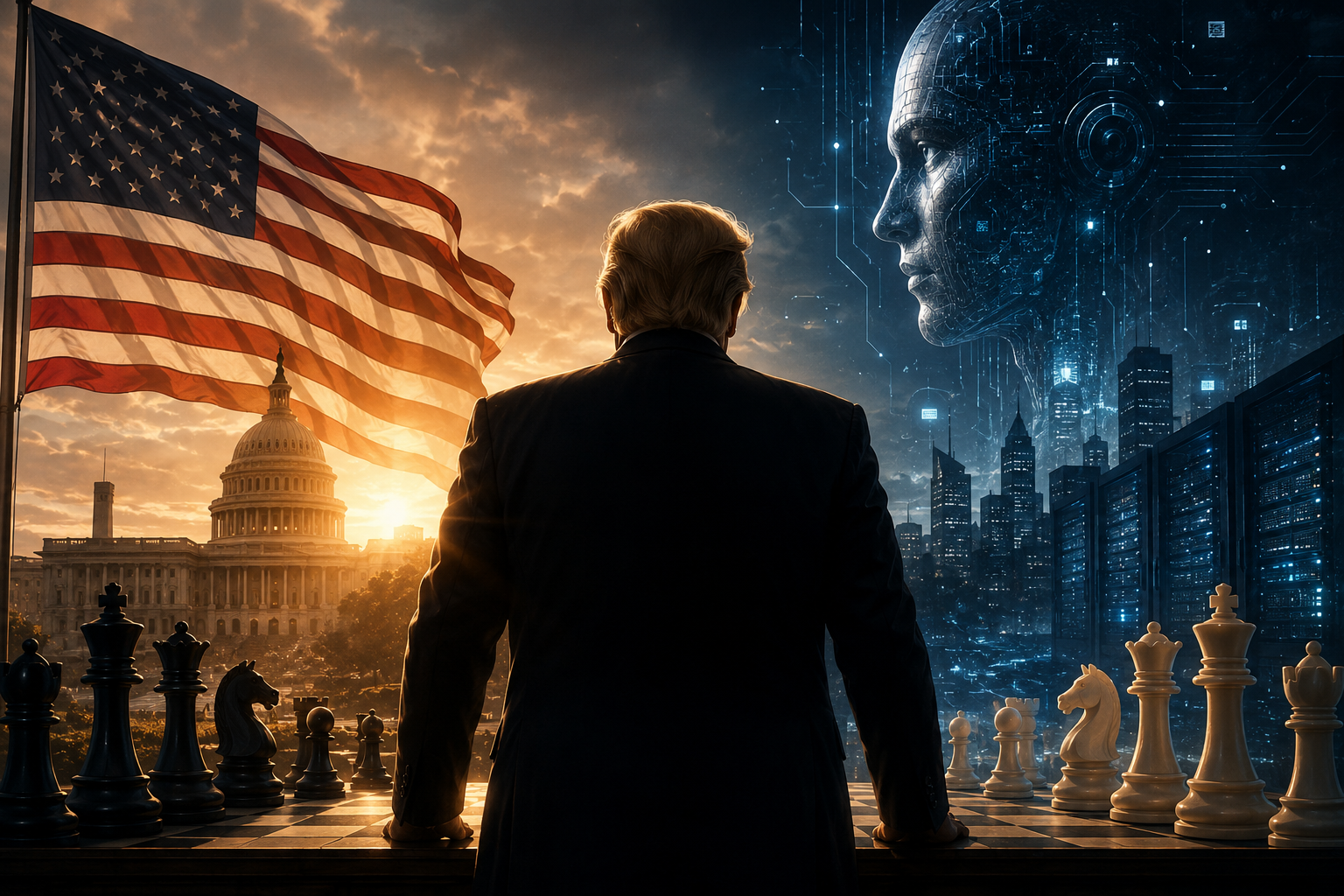
Trump’s AI U-Turn Changes Far More Than Silicon Valley
Trump Retreats From AI Oversight Pressure As America Doubles Down On The Race Against China
For years, AI discussions were dominated by warnings. Experts warned about misinformation, cyber attacks, job displacement, autonomous systems, and increasingly powerful models operating beyond normal human understanding. Calls for safety frameworks grew louder as AI capabilities accelerated.
But another fear has steadily overtaken those concerns inside parts of the American political system: losing. Losing technological leadership. Losing investment. Losing talent. And ultimately losing strategic advantage to China. Public reporting suggests a proposed AI oversight framework was paused after concerns emerged that additional review processes could slow American AI development during an increasingly intense global race.
For many pro-Trump voices, that concern is not paranoia. It is strategy.
Why Trump’s Base Sees Regulation As A Threat
The Trump political movement has increasingly framed artificial intelligence through the same lens it applies to energy, manufacturing, and economic growth. The argument is straightforward: excessive regulation creates barriers, slows innovation, increases costs, and gives competitors an opening.
The White House has repeatedly argued that American AI companies need freedom to innovate without being trapped inside fragmented regulatory systems. Official policy documents have emphasized concerns about burdensome regulation and state-level rules creating obstacles for developers and startups.
From that perspective, AI oversight is not merely a safety issue. It becomes a competitiveness issue. Every additional review process, approval requirement, compliance obligation, or regulatory hurdle is viewed by supporters as a potential drag on American momentum.
That framing resonates strongly with many business leaders, investors, founders, and technology advocates who believe the United States cannot afford a slower pace while rivals continue advancing.
The China Factor Changes Everything
Without China, the AI debate would likely look very different.
The central argument from many advocates of a lighter-touch approach is that AI is rapidly becoming a national power asset. Advanced AI systems increasingly influence military planning, cybersecurity, intelligence gathering, industrial productivity, scientific research, and economic growth.
Several reports indicate concerns about Chinese competition played a significant role in resistance to stronger oversight measures. Trump himself reportedly expressed concern that new restrictions could affect America's position in the global AI race.
That creates a difficult political reality.
Every proposal for additional oversight can immediately be challenged with a simple question: what if it slows America down while China keeps moving?
For supporters of Trump’s approach, the answer is obvious. The greater risk is not moving too fast. The greater risk is falling behind.
Silicon Valley And The New Republican Alliance
One of the most striking developments of recent years has been the growing alignment between parts of Silicon Valley and the Trump movement.
Technology leaders increasingly share common ground with Republicans on issues such as deregulation, domestic investment, energy expansion, industrial growth, and technological competition with China. Reports surrounding the paused AI oversight framework suggest major technology figures pushed aggressively against stronger federal intervention.
That does not mean all technology leaders oppose safeguards.
Many support voluntary safety testing and cooperation with government agencies. The dividing line is often between voluntary frameworks and mandatory controls. The moment regulation begins looking like licensing, approval systems, or restrictions on deployment, opposition becomes significantly stronger.
The result is a coalition that sees AI dominance as a national priority rather than primarily a regulatory challenge.
The Hidden Political Calculation
There is another layer beneath the policy debate.
Trump has long built political support around the idea that American institutions frequently overregulate success. Whether discussing business, energy, manufacturing, or technology, the message remains remarkably consistent: remove barriers, unleash growth, and trust competition.
Artificial intelligence fits naturally into that worldview.
A heavily regulated AI sector would appear inconsistent with broader Trump-era economic messaging. A rapidly expanding AI sector generating jobs, investment, infrastructure spending, and technological prestige fits it perfectly.
That does not mean safety concerns disappear. Even figures inside the administration have reportedly expressed concerns about advanced AI risks and national security implications.
The question is which risk policymakers fear more.
America Has Chosen Its Direction
The deeper significance of Trump’s apparent retreat from additional AI oversight is not that regulation is dead. Regulation will continue. States, Congress, courts, agencies, and future administrations will all remain part of the AI story.
The real significance is the signal.
The signal is that the United States increasingly appears willing to tolerate greater uncertainty in exchange for greater speed. The signal is that AI is being treated less like a conventional consumer technology and more like a strategic national asset.
For supporters of Trump, that is exactly the right choice. They see AI as the next industrial revolution and believe America must lead it rather than regulate itself into second place.
Whether history ultimately views that decision as visionary or reckless remains unknown.
What is already clear is that the battle over artificial intelligence is no longer about software alone.
It is about who controls the future.
