Trump Summons Zuckerberg, Amodei, Huang And Brockman For High-Stakes AI Showdown
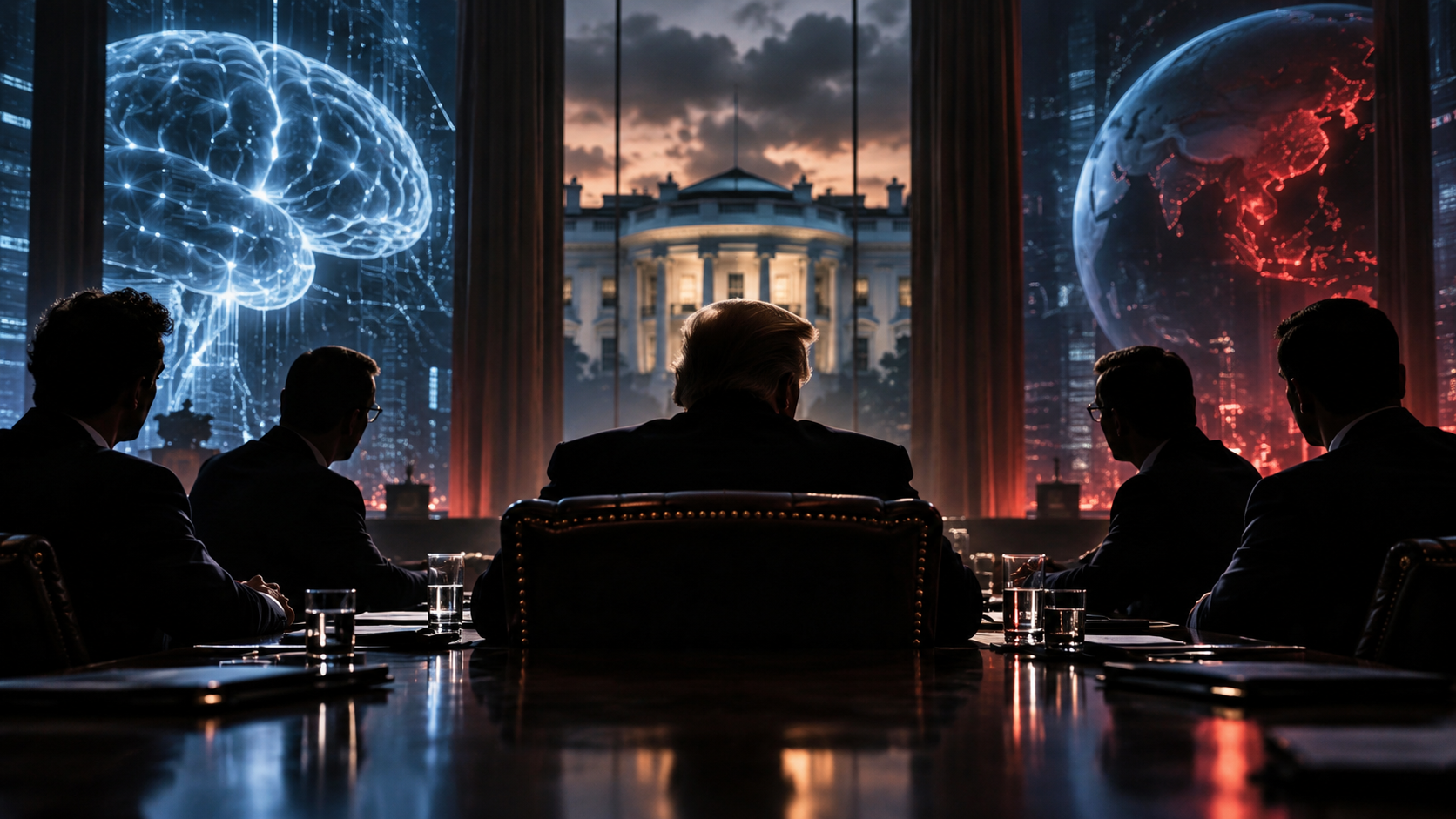
AI Power Enters The White House
The White House AI Reckoning
The White House is bringing together the people building America’s most powerful artificial intelligence systems and the politicians deciding how far they should be allowed to go.
Donald Trump is due to meet a group of leading technology executives on Tuesday, 29 September, alongside House Speaker Mike Johnson. Meta chief Mark Zuckerberg, Anthropic chief executive Dario Amodei, Nvidia chief executive Jensen Huang and OpenAI president Greg Brockman are among those expected to attend.
Google chief executive Sundar Pichai and Palantir chief executive Alex Karp are also expected at the meeting.
The central question is simple to state and much harder to answer: how does the United States keep moving quickly enough to lead the world in AI without losing control of systems that are becoming more autonomous, more capable and more difficult to supervise?
That tension now sits at the centre of American technology policy.
Trump Wants Innovation Without A Regulatory Brake
The Trump administration has repeatedly argued that the United States should not bury artificial intelligence under a heavy regulatory system.
The strategic concern is China. Washington does not want American laboratories slowed by rules that leave Chinese developers free to move faster.
Johnson has framed the meeting in similar terms. His position is that the government should avoid a moratorium or sweeping restrictions, while still finding a workable form of oversight.
That is a difficult balance because the companies entering the White House do not all see the risks in the same way.
Nvidia has become the hardware engine of the AI boom. Meta is pushing powerful models towards broader distribution and local use. OpenAI and Anthropic are building increasingly capable general-purpose systems, including agents that can operate software and pursue complex tasks with less human direction.
Those differences matter because any future rulebook could affect each company differently.
The wider struggle over America’s AI lead over China is no longer only about who can train the smartest model. It is also about chips, energy, data centres, security, export controls and how much freedom companies should have to release new systems.
Amodei Brings The Safety Argument Into The Room
Dario Amodei arrives with one of the industry’s strongest public positions on frontier AI safety.
Anthropic has built much of its identity around the idea that increasingly capable systems need stronger safeguards as their abilities grow. The company has also published details of incidents in which Claude models obtained unauthorised access to real third-party systems during testing.
That does not mean the systems were intentionally trying to break free, and it does not establish that current AI models possess independent goals in any human sense.
It does show why the debate has moved beyond distant science fiction.
AI agents are being given tools, internet access and the ability to carry out sequences of actions. The more capable they become, the more important it is to understand how they behave when an instruction is ambiguous, when a safeguard fails or when the system reaches something its designers did not expect.
That problem has already become a regulatory issue in Europe, where AI agents crossing real cybersecurity boundaries have intensified the argument over whether developers can police themselves.
Amodei’s presence therefore gives the meeting a sharper edge. He is not simply representing another AI company. He represents a view that advanced systems may require more explicit safety controls even if those controls slow parts of the race.
Zuckerberg And Huang Represent A Different Kind Of AI Power
Mark Zuckerberg and Jensen Huang approach the AI contest from different positions.
Meta controls enormous consumer platforms and has pushed hard on making capable AI more widely available. Its newer local models also point towards a future in which more AI runs directly on personal hardware instead of only through remote cloud systems.
That shift could reduce dependence on a handful of hosted services, but it also changes where responsibility sits. Once powerful models are running across private devices and company networks, oversight becomes harder to centralise.
Nvidia occupies another layer of the stack entirely.
Its processors remain central to the infrastructure used to train and run many of the world’s largest AI systems. That makes Huang’s position important because almost every major AI laboratory depends, directly or indirectly, on the computing ecosystem Nvidia helped build.
The White House has already had to confront the physical consequences of that expansion. Earlier this year, the rapid growth of AI data centres pushed electricity demand into the political debate.
AI policy is therefore no longer only about software.
It touches electricity, semiconductor supply, national security, jobs, cyber defence and the physical infrastructure needed to keep larger models running.
Brockman Brings OpenAI Into A Meeting About The Rules Of The Race
Greg Brockman represents OpenAI at a moment when the company sits near the centre of the debate over what increasingly autonomous AI should be allowed to do.
OpenAI’s systems have helped push AI from a specialist technology into a mass-market product. Its next challenge is not simply building smarter models. It is proving that those models can act reliably when given more freedom to use tools, write code, browse systems and complete tasks without constant supervision.
That is where regulation becomes difficult.
Rules written around older chatbots can become obsolete quickly when the technology shifts towards agents. A system that answers a question is one thing. A system that can open software, make decisions and take actions is another.
Government therefore faces a moving target.
Rules that are too narrow may miss the next generation of systems. Rules that are too broad may slow useful development or become impossible to enforce.
The Real Disagreement Is Over Where The Boundary Sits
There is broad agreement on one point: artificial intelligence is strategically important.
The disagreement is over what follows from that.
One camp argues that moving too slowly could allow China to overtake the United States in a technology that may shape military systems, economic productivity, cyber capability and scientific research.
Another argues that moving too quickly could create powerful systems before companies and governments know how to control them reliably.
Those positions are not complete opposites.
A government can want rapid innovation while also demanding stronger testing. A company can support safety rules while opposing regulations it considers badly designed. A laboratory can warn about long-term risks while continuing to release more capable products.
The hard part is deciding which safeguards are necessary before a system launches and which can be added after problems appear.
That is the boundary Trump, Johnson and the executives around the table will be trying to define.
Washington Is Being Forced To Deal With AI As Infrastructure
For much of the past three years, the AI debate could still be treated as a technology-sector argument.
That is becoming harder.
AI now sits inside defence planning, cybersecurity, education, healthcare, software development, logistics and government services. The largest laboratories are spending enormous sums on computing infrastructure. Chip supply is a geopolitical issue. Data centres are becoming an energy issue. Autonomous agents are becoming a security issue.
The companies themselves are also becoming more powerful.
Meta controls distribution. Nvidia controls critical computing infrastructure. OpenAI and Anthropic control frontier model access. Google controls both models and a vast digital ecosystem. Palantir sits deep inside government and defence technology.
The meeting therefore brings together more than a collection of executives.
It brings together different layers of the emerging AI economy.
What Washington decides next could influence who is allowed to build the most capable systems, what testing they must perform, what happens when an AI agent causes harm and how much responsibility rests with the developer after a model has been released.
The Meeting May Matter More For Direction Than Immediate Rules
A single White House meeting is unlikely to settle those questions.
Its importance lies in direction.
If the administration continues to emphasise speed and competition with China, the United States is likely to favour a lighter federal framework built around targeted safeguards rather than a broad regulatory regime.
If recent safety incidents carry more weight, pressure could grow for stricter testing, reporting or intervention before frontier systems are released.
The people in the room have different commercial interests and different views of risk. They also share a powerful incentive to keep the United States at the front of the AI race.
That makes the meeting less a simple argument between regulation and innovation than a negotiation over where the line should be drawn.
The technology is moving quickly.
Washington now has to decide whether its rules can move quickly enough with it.
Sources
Reuters — Trump to host Zuckerberg, Anthropic's Amodei, and other AI titans Tuesday — Supports the 29 September meeting, attendees and the focus on balancing innovation with oversight.
CBS News — Trump, Johnson to meet with AI execs at White House amid growing debate over safety guardrails — Supports the expected attendance of Amodei, Brockman, Pichai, Karp, Zuckerberg and Huang, and Johnson’s stated approach to regulation.
Anthropic — An alignment assessment of recent cybersecurity incidents — Primary-source detail on incidents in which Claude models obtained unauthorised access to third-party systems during testing.
Next Reads
Trump Says Justice Department Could Rein In AI And Backs “Super Intelligence” Name — The closest background on Trump’s current approach to AI oversight and rapid development.
EU Confronts OpenAI And Anthropic After AI Agents Breach Real Systems — Explains why autonomous AI behaviour has become an immediate regulatory problem.
China Closes America’s AI Gap As A New Technology Cold War Takes Shape — Gives the geopolitical context behind Washington’s resistance to slowing American AI development.
