

Trump Warns Iran Is Using AI to Wage a Global Propaganda War
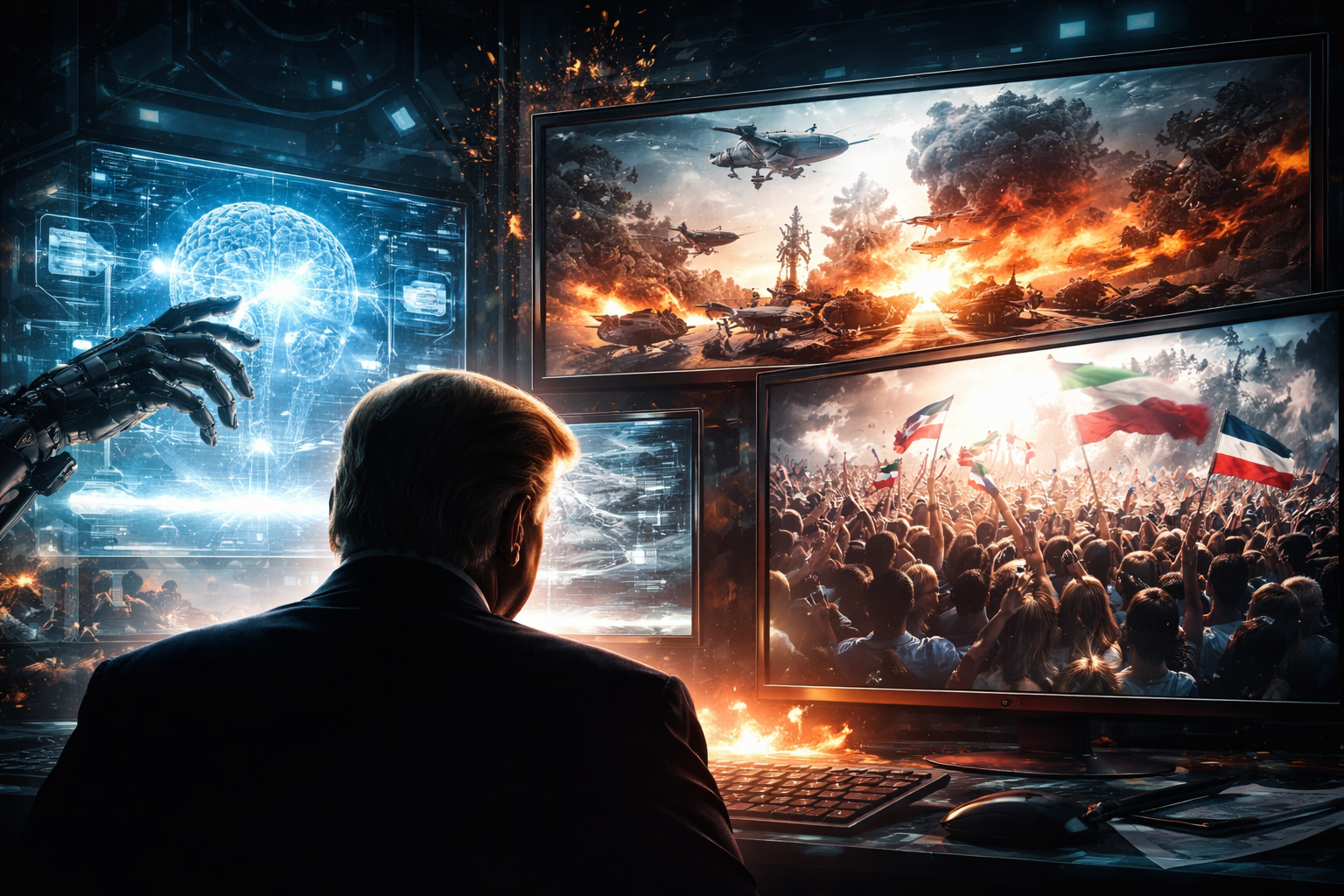
Trump Says Iran Is Winning the “Narrative Battle” With AI-Generated Propaganda
Trump Claims Iran Is Using Artificial Intelligence to Flood the Internet With War Propaganda
U.S. President Donald Trump has accused Iran of using artificial intelligence to manufacture propaganda and spread disinformation online, claiming fabricated videos and images are being deployed to distort perceptions of the ongoing conflict.
The allegation came as the information war around the Iran conflict intensifies across social media platforms, where real footage, manipulated content, and AI-generated material increasingly mix together.
Trump said Iranian actors are producing AI-generated images, fabricated battlefield videos, and digitally staged rallies designed to exaggerate Tehran’s military successes and public support.
The claim matters because modern wars are now fought not only with missiles and drones but also with algorithmic narratives designed to influence global opinion in real time.
The story turns on whether AI-driven propaganda is becoming as strategically important as traditional military power.
Key Points
Trump accused Iran of using artificial intelligence to generate propaganda and fake war imagery online during the current Middle East conflict.
He specifically cited allegedly fabricated visuals of attacks on U.S. forces and AI-generated footage portraying massive pro-government rallies.
The president also argued that some media outlets may be amplifying misleading material, though he did not present direct evidence for the claim.
Analysts say the conflict is unfolding in an era where AI-generated images and videos are rapidly spreading across social platforms, complicating verification.
Researchers have previously identified networks tied to Iranian groups using social media accounts and coordinated messaging to push pro-Tehran narratives.
The dispute highlights a broader global trend: digital influence operations increasingly rely on AI tools to produce convincing propaganda at scale.
The Allegation: AI as a Wartime Propaganda Weapon
Trump’s comments came during remarks on Air Force One and posts on his social platform, where he argued Iran is attempting to win the “propaganda battle” online even as military tensions escalate.
He claimed Iranian actors have circulated manipulated videos showing attacks that never occurred, including alleged footage of U.S. naval assets being struck.
Another example cited by Trump involved AI-generated images depicting giant rallies supporting Iran’s leadership, which he said were intended to signal overwhelming public backing.
According to Trump, these digital artifacts are designed to shape the narrative of the conflict internationally, potentially influencing public opinion and diplomatic pressure.
However, he did not provide any public evidence to demonstrate that specific images were AI-generated or directly associated with the Iranian government.
That uncertainty is important because information warfare in modern conflicts often involves multiple actors—including governments, independent activists, and anonymous online networks.
The Information Battlefield
Even before Trump’s accusation, analysts had warned that AI-generated content is rapidly becoming a central tool of geopolitical influence campaigns.
During major conflicts, social media now fills with:
synthetic videos
altered images
AI-generated commentary
automated bot amplification
These tools allow propaganda operations to scale far beyond traditional state media.
Experts say the real challenge is that AI content rarely appears in isolation. It spreads alongside authentic footage, making verification extremely difficult for ordinary users.
The result is an information environment where truth and fabrication blur together, weakening trust in both governments and the media.
Iran’s Long History With Online Influence Operations
Iran has been linked to multiple influence campaigns long before the rise of generative AI.
Research and intelligence reports have previously documented:
networks of social media accounts pushing pro-Iran narratives
websites posing as independent news outlets
coordinated messaging campaigns targeting Western audiences.
One such example was an English-language news site later seized by U.S. authorities after investigators concluded it was tied to Iranian government messaging operations.
Iran has also been linked to large networks of online accounts used to influence political debate abroad, including efforts to polarize audiences in the United States.
AI tools now make those operations faster, cheaper, and far harder to detect.
Why AI Changes the Propaganda Game
Traditional propaganda required large teams of editors, designers, and broadcasters.
Generative AI dramatically lowers that barrier.
A single operator can now produce:
convincing battlefield imagery
realistic speeches or voice recordings
synthetic crowd scenes
fake news broadcasts.
These outputs can be generated in minutes and spread instantly across platforms.
In wartime, this capability offers a powerful strategic advantage: shaping international perception can influence sanctions, alliances, and domestic political pressure.
In other words, winning the narrative can shape the battlefield itself.
What Most Coverage Misses
The most significant shift is not simply that AI can create fake images.
It is that AI makes large-scale narrative manipulation economically trivial.
Previously, propaganda campaigns required budgets, media infrastructure, and human teams.
Now the limiting factor is distribution—not production.
A small group of operators can generate thousands of convincing pieces of content and test which ones spread best across algorithms.
That turns information warfare into something closer to data-driven marketing, where narratives are optimized in real time.
In practice, the most powerful propaganda may not be the most convincing fake image—it may be the narrative that spreads fastest through recommendation algorithms.
Who Gains From the Narrative War
The information battle around the Iran conflict affects several actors.
For Iran, spreading narratives of military success or national unity could strengthen domestic morale and international legitimacy.
For the United States and its allies, countering those narratives becomes part of maintaining global support.
Meanwhile, social media companies face growing pressure to detect and label AI-generated content more effectively.
And for ordinary users, the stakes are simpler but profound: determining what is real online is becoming increasingly difficult.
The Next Phase of the AI Information War
Whether Trump’s specific claims about AI propaganda are proven or not, the broader trend is clear.
Artificial intelligence is rapidly becoming a central tool in geopolitical competition.
Future conflicts will likely include three parallel battles:
the military battlefield
the economic battlefield
the information battlefield.
Signs to watch for include:
governments releasing verified AI-analysis of propaganda campaigns
new regulations requiring AI content labeling
increased use of automated fact-checking tools.
The strategic question is no longer whether AI will influence war narratives.
It is how quickly governments and societies can adapt to a world where reality itself is contested in real time. AI analysis
