What Happens When Quantum Computing And AI Finally Collide?
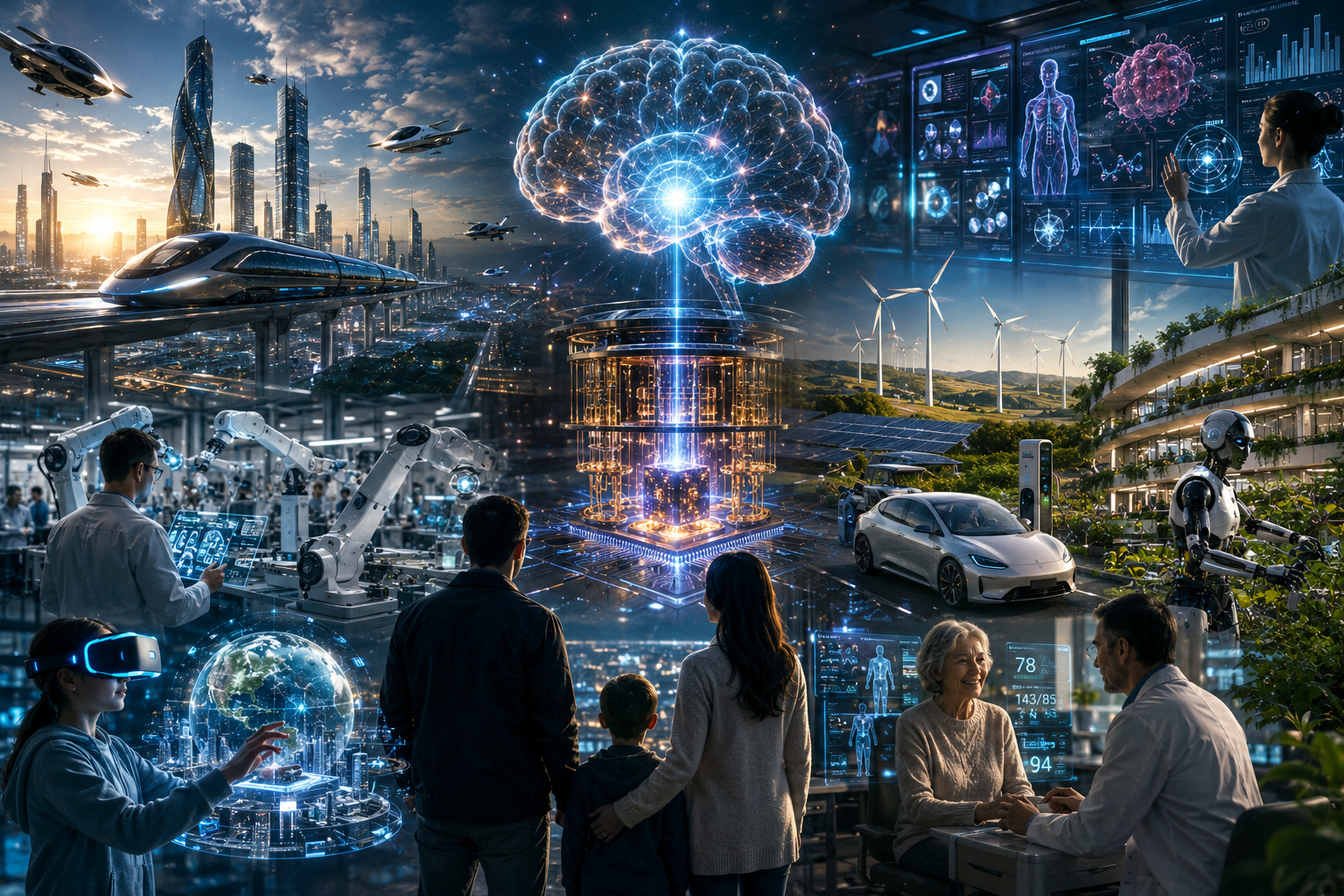
The Coming Quantum AI Shock: What It Could Unlock And Why The Timeline Matters
Quantum AI Is Not Just Faster AI: The Technology Fusion That Could Rewrite Science, Medicine, Security And Everyday Life
Artificial intelligence is already changing how people write, code, search, learn, diagnose, design and make decisions. But most AI today still runs on classical computing: enormous data centres, specialised chips, and mathematical shortcuts that search for patterns in vast quantities of information. Quantum computing is different. It uses the strange behaviour of quantum systems — superposition, interference and entanglement — to process certain kinds of information in ways classical machines cannot easily copy.
That does not mean a quantum computer will replace your laptop, phone or office server. The more realistic picture is stranger and more powerful: quantum computers become specialist engines attached to classical supercomputers and AI systems. The AI handles language, planning, pattern recognition and user interaction. The quantum system attacks the deep mathematical core of problems involving chemistry, materials, optimisation, cryptography and simulation.
This matters because many of the hardest problems in the world are not hard because humans are stupid. They are hard because nature itself is computationally brutal. Molecules, proteins, catalysts, batteries, climate systems and financial networks contain too many interacting variables for ordinary computers to model exactly. Quantum AI is the idea that AI could guide the search while quantum processors calculate parts of reality that classical machines struggle to represent.
Google’s Willow processor was a major signal that the field is moving from theatrical “quantum supremacy” demonstrations toward the harder problem of error correction. In a Nature paper, researchers reported below-threshold quantum error correction on Willow, meaning the logical error rate fell as the error-correcting code became larger — a crucial step toward scalable machines. Google described Willow as the first processor where error-corrected qubits become exponentially better as they grow, although this is still not the same as a useful universal quantum computer.
The Real Fusion Is AI For Quantum First
The first major revolution may not be “quantum computers making AI superhuman.” It may be AI helping to build quantum computers in the first place. Quantum machines are extraordinarily fragile. Their qubits lose coherence, accumulate noise, and require constant calibration. Every tiny drift in hardware behaviour can corrupt the computation. That makes quantum engineering less like normal software and more like trying to conduct an orchestra during an earthquake.
This is where AI becomes immediately useful. Machine learning can help tune quantum devices, identify noise patterns, design better control pulses, improve error-correction decoding, optimise circuits, and search for better hardware configurations. A 2025 Nature Communications review frames this as “AI for quantum”: using modern AI techniques across the quantum hardware and software stack, from device design to applications. The review is careful to distinguish that from the more speculative “quantum for AI” direction, where quantum computers one day accelerate machine learning itself.
That distinction is essential. AI is already useful to quantum computing because quantum systems generate messy, high-dimensional, difficult-to-model data. AI is good at finding structure in exactly that sort of complexity. A human physicist may understand the theory; an AI system can watch the machine misbehave millions of times and learn the best practical correction strategy.
This means the first serious impact of quantum AI is likely to be industrial and invisible. The public may not see a “Quantum ChatGPT.” Instead, quantum labs may become more automated. Quantum chips may be tuned by AI agents. Error correction may be managed by machine-learning systems. Research cycles may compress from months into weeks because AI can propose, test and refine new quantum-control strategies at machine speed.
Timelines: What Could Happen And When
The near-term period, roughly 2026 to 2030, is about proving whether quantum systems can become reliable enough to do useful work beyond narrow demonstrations. IBM’s public quantum roadmap says it is targeting near-term quantum advantage by the end of 2026 and a large-scale fault-tolerant quantum computer by 2029. IBM has also laid out a framework for building a fault-tolerant machine called Starling, with error correction as the central challenge.
That is ambitious, not guaranteed. The industry has a long history of impressive claims followed by slow engineering reality. Microsoft’s 2025 Majorana 1 announcement, for example, claimed progress toward topological qubits, a potentially more stable form of qubit. But the claim has faced scepticism and further challenge in scientific coverage, with some physicists questioning whether the evidence supports the strongest interpretation. The lesson is not that Microsoft is wrong forever; it is that quantum progress must be treated with scientific caution.
A realistic timeline looks like this. From now to around 2030, expect better quantum chips, better AI-assisted calibration, more hybrid quantum-classical experiments, and some niche commercial value in chemistry, optimisation and materials research. From 2030 to 2035, if error correction scales, quantum computers may begin producing meaningful advantage in specialised scientific and industrial tasks. Beyond 2035, if fault-tolerant systems become large, stable and accessible, quantum AI could become a general research accelerator for medicine, energy, materials, logistics and security.
The key phrase is “if error correction scales.” Today’s quantum computers are still noisy. Many useful algorithms require far more reliable logical qubits than current machines can provide. That is why the revolution will probably not arrive as a single overnight moment. It will arrive unevenly: first in research labs, then in cloud platforms, then in pharmaceutical companies, materials firms, defence systems, financial modelling and national infrastructure.
What Quantum AI Could Actually Allow
The biggest prize is simulation. Classical computers struggle to model quantum systems because molecules are quantum systems. That creates a brutal mismatch: we use classical machines to approximate quantum reality. Quantum computers could eventually model quantum behaviour more naturally. Add AI to that, and you get a powerful loop: AI proposes candidate molecules or materials, quantum computers evaluate their behaviour more accurately, then AI refines the next generation of candidates.
That could transform drug discovery. Instead of screening enormous chemical libraries with imperfect approximations, researchers could model molecular interactions more precisely. AI could design possible drugs, proteins or catalysts; quantum computers could help evaluate the underlying chemistry; human scientists could test the most promising options. This would not abolish clinical trials, biology, safety testing or regulation. But it could make the early discovery stage faster and less wasteful.
Materials science may change even more dramatically. Better batteries, cleaner fertiliser, more efficient solar cells, stronger lightweight materials, improved carbon capture and new superconductors all depend on understanding complex quantum interactions. If quantum AI can help discover materials with properties we cannot currently predict, the effect could ripple through energy, transport, defence, medicine and manufacturing.
Optimisation is another major target. Many real-world systems involve impossible trade-offs: routing trucks, allocating energy across grids, balancing financial portfolios, scheduling factories, designing supply chains or managing air traffic. AI can already help with these problems, but quantum methods may one day improve the search through huge possibility spaces. The impact would not feel like science fiction. It would feel like cheaper logistics, fewer delays, better energy usage, more resilient infrastructure and smarter planning.
The Security Shock Is Already Underway
The most urgent quantum impact may arrive before useful quantum AI exists. Large enough fault-tolerant quantum computers could threaten widely used public-key cryptography, including systems based on RSA and elliptic-curve cryptography. That does not mean today’s quantum computers can break the internet. They cannot. But governments are already preparing because of the “harvest now, decrypt later” problem: encrypted data stolen today could be stored and decrypted in the future if quantum code-breaking becomes practical.
NIST finalised its first three post-quantum cryptography standards in August 2024, creating an official baseline for quantum-resistant encryption and digital signatures. The standards include ML-KEM for key establishment, ML-DSA for digital signatures, and SLH-DSA as a stateless hash-based signature scheme. That move shows the security world is not waiting for the quantum threat to become visible before acting.
AI makes this security shift more complicated. AI can help migrate systems, detect vulnerable cryptographic assets, automate software updates and model cyber risk. But AI can also help attackers find weak implementations, automate phishing, exploit old systems and accelerate reconnaissance. Quantum plus AI therefore creates a double pressure: stronger defensive tools and more dangerous offensive capability.
For ordinary people, the security impact will be mostly hidden but enormous. Banking, messaging, passports, medical records, government files, cloud storage and digital identity systems all depend on cryptography. If quantum-safe migration is handled well, most people may barely notice it. If it is handled badly, old data, legacy systems and poorly maintained infrastructure could become long-term liabilities.
Taylor Tailored has already covered this wider pressure in its analysis of post-quantum security being declared before it fully exists, where the real story is not just mathematics but procurement, trust and institutional readiness.
Would It Make AI Conscious Or Superintelligent?
No serious answer should jump straight from quantum computing to conscious machines. Quantum effects are real physics, but “quantum” is also one of the most abused words in technology. A quantum computer does not magically think. It does not automatically become alive. It does not give AI a soul, intention or consciousness.
What it could do is expand the class of problems AI systems can usefully attack. Today’s frontier AI models are powerful pattern engines. They learn from data, compress relationships, generate outputs and increasingly use tools. Quantum computing could eventually become one of those tools: a specialist engine that helps AI solve specific mathematical, chemical or optimisation problems.
That could still be revolutionary. A scientist using AI today might ask for hypotheses. A scientist using quantum AI tomorrow might ask for hypotheses, simulations, candidate molecules, predicted reaction pathways, materials designs and experiment plans. The intelligence would not come from quantum mysticism. It would come from linking language models, scientific AI, automated laboratories, classical supercomputing and quantum processors into one discovery loop.
Taylor Tailored’s wider explainer on what artificial intelligence is and why it matters is useful here because the core issue remains inference. AI systems infer patterns from data. Quantum computers may eventually provide better access to patterns buried inside nature itself.
How It Could Change Ordinary Lives
Most people will not own a quantum computer. They will experience quantum AI through products and institutions. Medicines may be discovered faster. Batteries may last longer. Energy grids may become more efficient. Weather and climate modelling may improve. Financial risk models may become more complex. Logistics systems may become less wasteful. Cybersecurity standards may change quietly in the background.
Healthcare could be one of the deepest changes. Quantum AI might help identify drug candidates for diseases that are currently hard to treat, design personalised therapies, model protein interactions, and reduce the failure rate of early-stage research. This does not mean instant cures. Biology is messy, clinical trials are slow, and human bodies are not clean mathematical systems. But even a modest improvement in discovery efficiency could affect millions of lives over decades.
Energy could be equally important. Better catalysts could reduce the energy cost of industrial chemistry. Better battery materials could make electric transport cheaper and more practical. Better modelling could help fusion, carbon capture or grid storage. The public would not see “quantum AI” on a label. They would see cheaper power, better devices, cleaner manufacturing or longer-range vehicles.
Work would also change. Quantum AI would create demand for hybrid experts: people who understand AI, physics, software, data, cybersecurity and domain science. It could also concentrate power in companies and countries with access to the rarest hardware, talent and infrastructure. That echoes the current AI race, but with an even higher barrier to entry. Quantum systems require cryogenics, specialised fabrication, deep physics expertise and national-scale investment.
The social side of this acceleration in how AI will reshape society faster than most people realise. Quantum AI would intensify that pattern: not just replacing tasks, but changing what institutions can know, optimise and control.
The Revolutionary Scale Depends On One Bottleneck
The honest verdict is that quantum AI could be one of the most revolutionary technology fusions of the century, but only if hardware crosses the reliability threshold. AI has already crossed into mass adoption because it runs on scalable classical infrastructure. Quantum computing has not. It remains a race between breathtaking physics and unforgiving engineering.
If quantum error correction works at scale, the consequences could be enormous. Science could become faster. Drug discovery could become more targeted. Materials research could become less trial-and-error. Security systems would need rebuilding. Governments would treat quantum capability as strategic infrastructure. Companies with access to quantum AI could gain deep advantages in research, optimisation and modelling.
If progress stalls, quantum AI may still matter, but in narrower ways. AI will continue helping quantum engineers. Quantum-inspired algorithms may improve classical computing. Specialist quantum devices may assist certain scientific workflows. But the world-changing version — the one that alters medicine, energy, security and industrial design — depends on building large, fault-tolerant machines.
The most likely future is neither instant utopia nor total hype. It is a staged revolution. First, AI makes quantum computers easier to build. Then quantum computers help AI explore parts of science that classical machines struggle to model. Then the fusion becomes a hidden engine inside medicine, energy, finance, security and national power.
That is why this story matters. Quantum AI is not just another tech buzzword. It is the possibility that artificial intelligence gains a new kind of microscope — not for seeing cells or galaxies, but for seeing the mathematical structure of reality more directly than ever before.
