GTA 6 Was Already Being Researched in 2015. What Took Rockstar So Long?
Rockstar Had Already Visited Miami Before It Finished The Game That Kept It From Vice City.
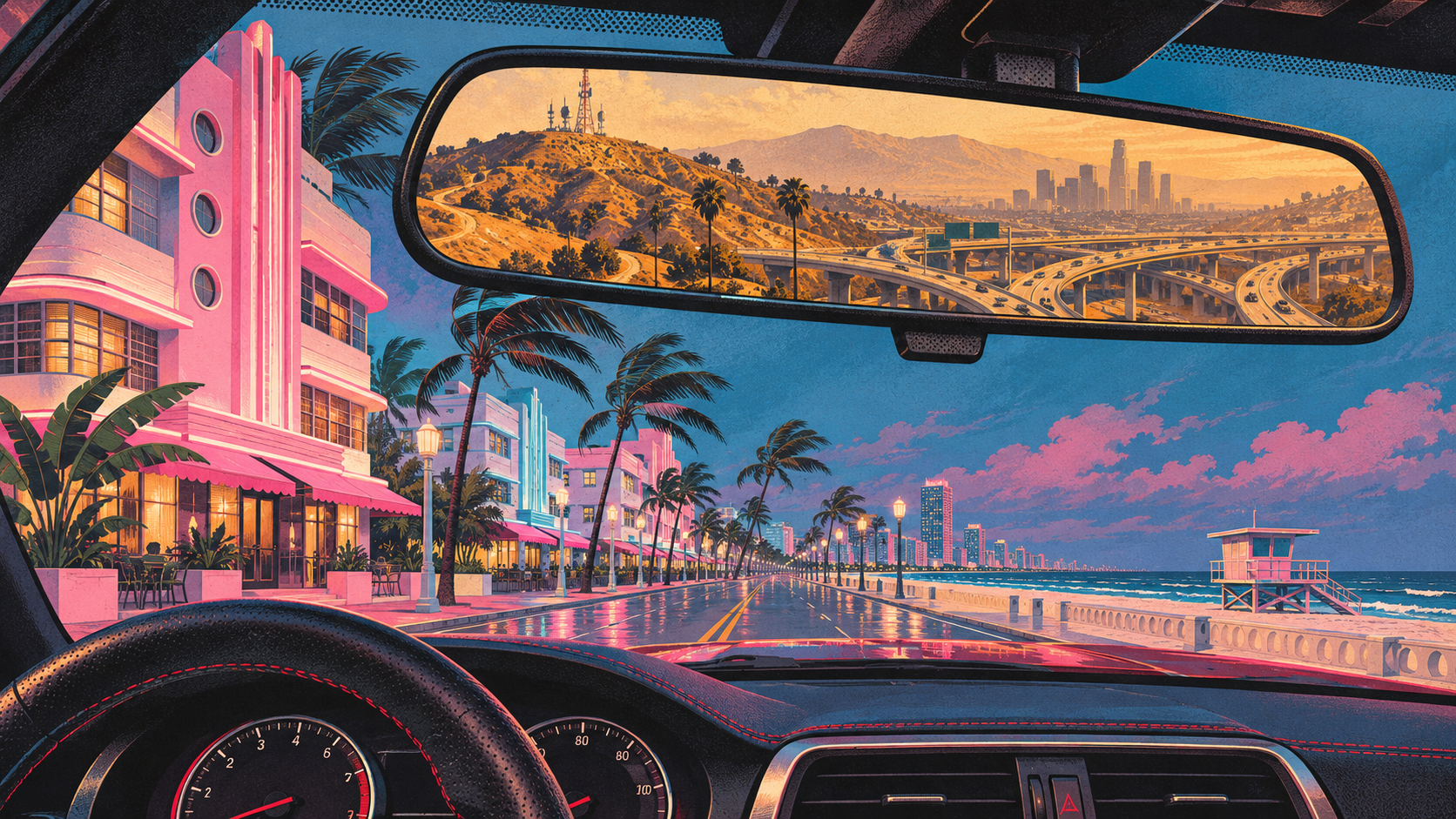
In 2015, Rockstar developers travelled to Miami to research the next Grand Theft Auto. GTA V was barely two years old. The plan was for Rockstar North in Edinburgh to work on its next crime game while colleagues in San Diego made Red Dead Redemption 2. Had that division of labour held, players might have returned to Vice City years earlier.
The western grew large enough to need both teams. Rockstar redirected developers, reconsidered a GTA map that once stretched across parts of two continents, and began work in earnest on the game we now know around 2019. The pandemic then interrupted performance capture. By the time Rockstar had publicly promised a release window, it faced a more surprising difficulty. It still had an extraordinary number of ordinary people to put on the streets of Leonida.
That is how the wait reached 13 years. The clock for players started on 17 September 2013, when GTA V arrived. Inside Rockstar, research, full production and the final push to finish the game began at different points. As of 16 November 2026, GTA VI is scheduled for Thursday 19 November on PlayStation 5 and Xbox Series X|S. The 13 years and two months between those dates contain several quite different stories.
2013–2015: Los Santos Found a Reason to Stay Open
The original GTA V arrived on PlayStation 3 and Xbox 360. Players met Franklin, Michael and Trevor, learned the roads of Los Santos, and discovered how much trouble three men could make for one another even when a robbery went to plan. Someone who finished the campaign that autumn could reasonably have wondered where Rockstar would go next. Five years had separated GTA IV from GTA V. In the PlayStation 2 era, Vice City had followed GTA III in a single year.
Then, on 1 October 2013, GTA Online opened. Two friends could meet in a Los Santos car park, get into the same car and spend the evening in a city they already knew from playing alone. Rockstar could give those friends a new reason to come back without building another city or writing another protagonist. When online heists arrived in 2015, the familiar roads acquired a different use. Now the person you were relying on to drive the getaway car might be somebody you actually knew.
Los Santos also travelled further than the hardware on which it began. GTA V reached PlayStation 4 and Xbox One in 2014, PC in 2015, and PlayStation 5 and Xbox Series X|S in 2022. A teenager opening the game on a new console could be discovering Franklin’s neighbourhood for the first time almost a decade after somebody else had memorised the route out of it.
This is the basis for the most popular explanation of the wait. GTA Online kept making money, so why hurry a sequel? There is evidence for the first half. By May 2026, Take-Two reported more than 225 million copies of GTA V sold into retail and digital distribution worldwide. Its July release calendar still included a new GTA Online heist. The publisher could keep selling Grand Theft Auto throughout the interval between numbered games.
The second half asks more of those figures than they can deliver. Sales accounts cannot tell us when a writer became available or why a milestone slipped. The 2015 Miami trip offers a better clue to what happened first. While GTA Online was finding its audience, Rockstar was already spending time and money deciding where its next single-player game should go.
2015–2018: Red Dead Redemption 2 Changed the Plan
The early GTA project carried the working name Project Americas. Rockstar considered a world spanning parts of North and South America. Miami was a place its researchers could visit, photograph and study while the much larger question of the game’s boundaries remained open.
Meanwhile, Red Dead Redemption 2 was becoming too large for the arrangement Rockstar had envisaged. The western needed people from across the company. According to co-head of development Rob Nelson’s account of those years, the intention to make the two games alongside one another gave way as developers joined the effort to finish Red Dead.
That staffing decision explains something a list of release dates can obscure. A publisher may own several studios and still have only one group with precisely the experience a particular problem requires. Moving experienced people onto a western can help finish the western. It also means the crime game they were investigating has fewer people in a position to turn an idea into something playable. Money gives a studio choices about whom to hire. It takes time for the people it hires to learn how to make a Rockstar game together.
Red Dead Redemption 2 arrived on 26 October 2018. By then, more than five years had passed since GTA V. Almost two-fifths of the eventual wait had elapsed by the time Rockstar released Arthur Morgan’s story.
The western also left an uncomfortable question for the people who had made it. Its release brought public scrutiny of prolonged overtime, known in the industry as crunch. Rockstar publishing executive Jenn Kolbe later described a determination to finish the next GTA differently. Managers revised schedules and made changes to how extra hours were recognised. Kolbe acknowledged that individual teams could have different experiences. Nobody outside the production can put a reliable number of months against that change, but it matters when asking why Rockstar could not simply have finished sooner. For developers who had already worked long evenings and weekends on Red Dead, the word simply was doing a great deal of work.
2019–2021: A Smaller Map Gave Rockstar a Harder Question
By the end of 2019, the outline of Jason and Lucia’s story had taken shape. The project that emerged centred on Vice City and the surrounding state of Leonida. Rockstar had narrowed its geographical ambition considerably. It still had to decide what a player would find compelling enough to stop for on any one street.
Vice City offered a particularly tricky inheritance. In the 2002 game, a few bars of a song on the radio could place the player in the 1980s before Tommy Vercetti had travelled a block. Its Miami was filtered through crime films, television, pop music and the pleasure of recognising all three. Bringing back the palms and pastel hotels would satisfy a memory. It would say very little about who lived there now.
The modern setting gave Rockstar another way into the city. In GTA VI’s first trailer, people record and circulate the kind of public spectacle an earlier GTA might have left to a radio presenter to describe. An alligator entering a shop is one joke. Somebody deciding the occasion calls for a video is another. The joke depends on recognising a habit that barely existed when the original Vice City appeared.
The wider state gave the writers room to get away from the beach. The Florida geography behind Leonida includes island roads, wetlands and working waterfronts. A wrong turn in a downtown street grid costs a driver a block. A missed turn on a chain of islands can leave them looking at water for quite some time. Both landscapes earn their place in a driving game even if the player never stops to admire the view.
Then the pandemic disrupted one of the least portable parts of the production. Performance capture involves actors physically performing scenes so their movements can be translated into the game. A writer can revise a conversation at home. Recording the way two actors move around one another requires performers, equipment and a stage. Interruptions to that work left some parts of production able to advance while others had to wait. Rockstar has never published a defensible figure for how much of the overall delay belongs to Covid.
2022: Players Saw the Workshop Before They Saw the Trailer
In February 2022, Rockstar publicly confirmed that development of the next Grand Theft Auto was well under way. Nearly nine years had passed since GTA V. It was the first clear public acknowledgement of work that had already consumed years inside the company. Rockstar gave no release date.
That September, stolen development footage circulated online. It gave players an extraordinary view of unfinished work and a poor instrument for deciding how close the game was to release. A character moving through a recognisable location establishes that somebody has built the location and made that character move through it. It tells the viewer very little about what happens if the player arrives from another direction, abandons a task halfway through or brings an unexpected passenger.
A finished trailer has the opposite limitation. Its editor can select the few seconds in which everything looks exactly as intended. Neither form of footage gives an outsider the information a producer needs to set a launch date.
The leak belongs in the timeline because it changed how millions of people first encountered the game. Its role in delaying release is much harder to establish. At the time, Take-Two said it did not expect a long-term effect on development. The company had yet to announce a launch window that the incident could be shown to have pushed back.
2023–2024: The First Trailer Finally Put a Year on the Wait
In December 2023, Rockstar released its first official GTA VI trailer. There was Lucia in prison, a brief exchange about trust, and a sweep through beaches, waterways and roads crowded with people going about their business. Then came the detail that made the largest practical difference to anyone waiting to play. The game was due in 2025.
In May 2024, Take-Two narrowed that window to autumn 2025. For the first time, players could estimate the wait in seasons. They could also look back at ten years of speculation and distinguish it from an actual commitment. Rockstar had never promised a new GTA for 2018, however natural that year may have seemed to someone counting forward from the gap between GTA IV and V.
One of the trailer’s most effective shots also hinted at a problem that would become clearer much later. It showed an ordinary crowded beach. The viewer could take in the sunbathers, umbrellas and bathers in a glance. Making those people hold up to the attention of a player who could walk over and interrupt them was a different proposition.
2025: Why Rockstar Moved the Release Date Twice
On 2 May 2025, Rockstar moved GTA VI from its 2025 window to 26 May 2026. Four days later, a second trailer gave players a closer look at Jason Duval and Lucia Caminos. It was possible to see more of the game than ever before and, in the same week, learn that it was further from release than expected.
On 6 November 2025, Rockstar moved the date again, this time to 19 November 2026. The second postponement alone added 177 days. The studio’s public explanation was that it needed more time to achieve the quality it wanted. Later interviews with the developers gave that broad explanation a much more interesting meaning.
One of Rockstar’s difficulties was the sheer volume of work required for the people who populate Leonida. These are the non-player characters, or NPCs, whose lives intersect with the player’s for a few seconds at a time. The workload became substantial enough for Rockstar to establish a Los Angeles team of writers, producers and directors dedicated to them. Nelson recalled the alarm caused by estimates of how much remained to do. Fellow development lead Phil Hooker described the choice facing the studio as parts of the game fell behind schedule. Rockstar could meet a date by accepting compromises it did not want to make.
It is easy to hear the word polish and imagine someone adjusting the shine on a bonnet. Consider instead what it takes to let a player interrupt two strangers talking. Someone writes the original exchange, decides how each speaker might respond to an interruption and records those lines. The game has to recognise when the player is close enough to be addressing them. A character needs to turn towards the speaker at a believable moment. If both strangers resume their conversation, somebody has to decide where they pick it up.
The player experiences the result as a brief exchange on a pavement. If it works particularly well, they may forget anybody had to make it. Repeat that ambition across a city and it becomes easier to see why an estimate for background characters could trouble the people responsible for a release date. They were trying to finish scenes whose leading actor might drive straight past.
November 2026: What the Extra Time Looks Like on a Vice City Street
Shortly before launch, a press demonstration offered a small example. During a walk through the city, Jason could stop and interact with a woman and her dog. Passing conversations could be overheard and interrupted. Down by the beach, a gull perched on a post could be identified with binoculars and entered in a wildlife log.
Of those details, the dog is perhaps the most revealing. In a trailer, a person walking a dog helps a pavement look occupied. In the demonstration, a player could choose to make the encounter the point of the walk. That choice changes the job of almost everyone involved in creating the scene, from the person writing the owner’s reply to the animator deciding how Jason bends down.
There is a limit to what a demonstration can establish. Rockstar chose what to show, and an encounter that works on one street cannot tell us how much variety players will find after forty hours. It does, however, make the development story unusually tangible. An entire Los Angeles team worked on people players might meet by chance. Here was one of the chances they were making.
Take-Two’s 9 November release schedule still listed GTA VI for 19 November on PlayStation 5 and Xbox Series X|S. It listed no PC date. For console players who bought GTA V at its first release, the interval will be 13 years, two months and two days if Rockstar meets that schedule. For PC players, the end of the wait remains undated.
There is a pleasing irony in where some of those last months went. Since 2013, players have been asking when Rockstar would finally let them get to Vice City. Once they arrive, one small measure of what the studio did with the time will be whether a stranger on the pavement can persuade them to get out of the car.
Sources
Bloomberg — Inside the Making of Grand Theft Auto 6 — Developer interviews on the Miami research trip, the competing demands of Red Dead Redemption 2 and the work of populating Leonida.
The Guardian — Ten years, thousands of staff and a billion dollars: the exclusive inside story of Grand Theft Auto VI — A pre-release visit documenting the pavement encounters and wildlife demonstration.
Take-Two Interactive — Second-quarter fiscal 2027 results — The dated console release schedule and the July 2026 GTA Online update.
Next Reads
The History of Grand Theft Auto: How a Dundee Car Chase Led to GTA 6 — Follow the series from its Scottish origins to the three protagonists of Los Santos.
Which Parts of GTA 6’s Vice City Are Based on Real Florida? — See where the hotels, island roads and working ports of Leonida have recognisable counterparts.
GTA 6 Preload on PS5: Why You Need 212 GB Free and When You Can Actually Play — A practical guide to getting the console ready for launch.
