Will AI Lead to a New Renaissance?
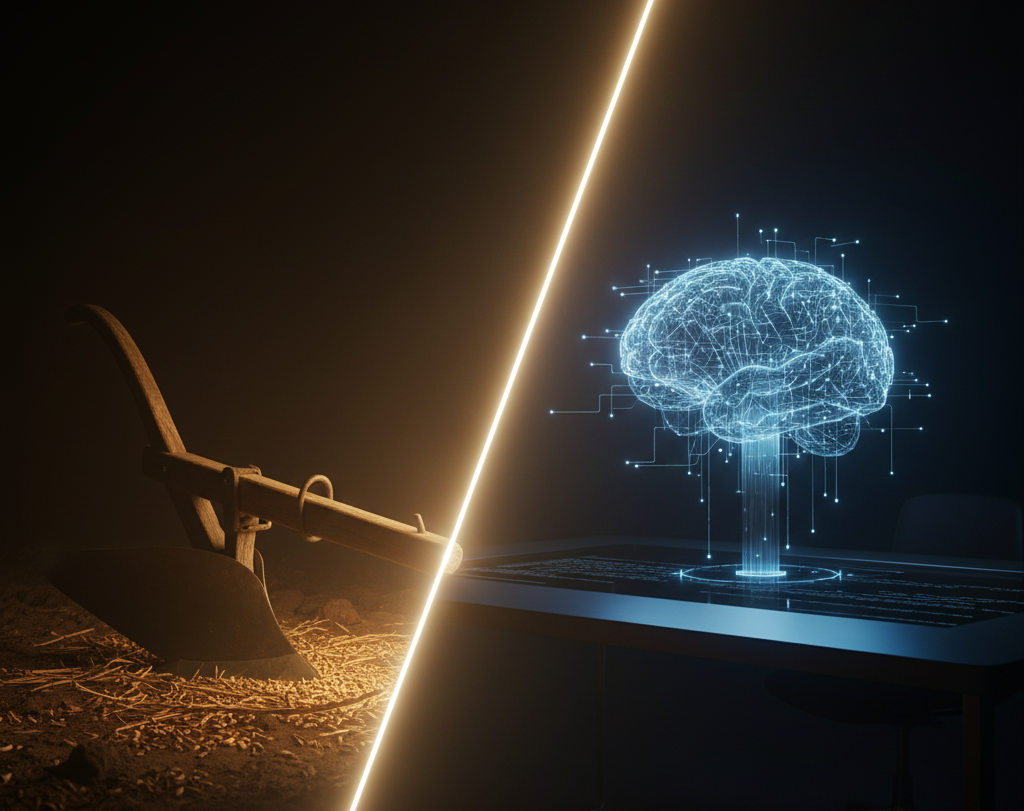
Artificial intelligence is often sold as a revolution in productivity. But beneath the hype sits a deeper question: could AI spark something closer to a new Renaissance, a broad flowering of art, science, and human creativity rather than just a wave of cost-cutting?
The comparison is not as far-fetched as it sounds. The first European Renaissance did not appear from nowhere. It grew out of slow but powerful changes in how people worked the land, moved goods, and processed information. New agricultural machinery, better tools, and early industrial techniques freed millions from subsistence farming and opened space for cities, universities, and studios to flourish.
Today, AI promises to do for mental labor what mechanical plows, seed drills, and mills once did for physical labor. The stakes are not just about which jobs disappear, but about what people and societies choose to do with the time and surplus that AI might create.
This piece explores how agricultural innovation helped set the stage for the last great leap in human creativity, and whether AI could play a similar role now. It weighs the politics, the economics, the cultural risks, and the quiet choices that will decide whether this is a new Renaissance or just a sharper, faster version of the status quo.
The story turns on whether AI-driven efficiency becomes collective freedom or simply a new way to squeeze more out of people for less.
Key Points
Past renaissances were rooted in practical innovations, including agricultural machinery that freed people from subsistence work.
AI could play a similar role for mental and creative labor, but only if institutions and policies channel its gains into broader opportunity.
Without guardrails, AI may deepen inequality, concentrating power and wealth while flooding culture with low-quality content.
Governments and companies are racing to set AI rules, but debates often focus on headline risks rather than long-term social design.
The biggest missed question is what people will do with time and surplus if AI does remove routine work at scale.
Whether AI leads to a new Renaissance will depend less on algorithms and more on education, ownership, and how societies value human creativity.
Background
The Renaissance is remembered for paintings, sculptures, and breakthroughs in science and philosophy. Behind the famous names, though, sat quieter forces. Over centuries, Europe’s farmers adopted heavier plows, improved harnesses, crop rotation, and later early mechanized tools. These changes increased yields and reduced the amount of human labor needed just to survive.
As agricultural productivity rose, more people could leave the fields. Towns grew. Trade expanded. Wealth accumulated in cities, where merchants, bankers, and rulers began to fund workshops, churches, and scholars. The printing press multiplied ideas, but it was the prior surplus of food and labor that made large reading publics possible in the first place.
In that sense, the Renaissance was not simply an explosion of genius. It was the cultural surface of a material shift. New machinery and methods changed how people worked and what they had time for. The arts, sciences, and new philosophies filled that space.
AI now sits in a similar position, but for a very different kind of work. Instead of lifting sacks of grain or pulling plows, AI models sort data, draft text, generate images, summarize documents, and help design code or circuits. They are tools for cognitive and creative tasks that once required many hours of human effort.
The key question is whether this wave of “mind machinery” will open new space for human flourishing, or whether its benefits will be locked into narrow pockets of power.
Analysis
Political and Geopolitical Dimensions
Countries are treating AI as a strategic technology. Some see it as a core part of national security, economic strength, and cultural influence. That pressure shapes whether AI becomes a public good or a tool of control.
On one side, governments talk about using AI to improve public services, accelerate scientific research, and help with everything from climate modeling to healthcare. On the other, there are clear incentives to use the same tools for surveillance, information control, and automated weapon systems.
The original Renaissance shifted power from feudal lords to emerging city-states and trading powers. Guilds, universities, and new forms of patronage created different centers of influence. With AI, there is a risk of the opposite pattern: a small number of firms and states controlling the most powerful models and the data they depend on.
If the emerging “AI order” is centralized, it will look more like a digital empire than a Renaissance. If, instead, many countries and communities can build, adapt, and govern their own systems, AI might support a more plural and creative world.
Economic and Market Impact
Mechanized agriculture replaced huge amounts of manual labor but also created new industries, from food processing to machinery manufacturing. Over time, workers moved into factories, services, and later white-collar roles. The path was uneven and often brutal, but the long arc brought higher average incomes and longer lives.
AI threatens to unsettle a different layer of the economy. Routine office work, basic content creation, and some professional tasks can now be automated or heavily assisted. Companies see a chance to cut costs and speed up workflows. Some roles will vanish. Others will be reshaped into “human in the loop” supervision and coordination.
For a new Renaissance to emerge, productivity gains need to turn into broad-based opportunity, not just higher profits or executive bonuses. That could mean shorter working weeks without pay cuts, new forms of income support, and heavy investment in education, art, and research.
Markets alone rarely deliver that outcome. Left to themselves, they tend to reward those who own the most valuable assets: in this case, the models, the data, and the computing infrastructure. That is why questions about AI ownership, open models, and public investment are so central to whether this becomes a liberating or narrowing transformation.
Social and Cultural Fallout
The first Renaissance was, in part, a response to new tools for making and sharing images and texts. Painters experimented with perspective. Printers spread religious and political ideas far beyond elite circles. Literacy rose, and with it a more active public sphere.
AI now generates words, pictures, music, and even video on demand. That opens doors for people who lack formal training but want to tell stories, design products, or express themselves. A teenager with a basic laptop can now create visuals that once required a studio.
At the same time, the cultural landscape is flooded with content. It becomes harder to tell what is authentic, who made what, and which voices to trust. There is a risk that AI flattens culture into a blur of “good enough” outputs, making it harder for original, slow-crafted work to stand out.
A new Renaissance would require the opposite: tools that widen access, paired with education and norms that deepen taste, critical thinking, and appreciation for the human hand and mind behind the work.
Technological and Security Implications
Renaissance breakthroughs in navigation, engineering, and mathematics helped ships cross oceans, armies reshape battlefields, and merchants knit continents together. The same tools that enabled trade also intensified conflict and colonization.
AI carries a similar double edge. It can accelerate medical discovery, improve disaster response, and help manage complex infrastructures. It can also supercharge cyber attacks, make deepfake propaganda cheap, and automate aspects of warfare.
Security debates often focus on extreme scenarios. But the most likely risks are more mundane and persistent: automated scams, targeted manipulation, and critical systems that fail in opaque ways. A society that leans heavily on AI without building resilience and oversight may find its basic trust and stability eroded.
For AI to underpin a Renaissance rather than a slow crisis, technical progress needs to move in step with safeguards, public understanding, and transparent governance.
What Most Coverage Misses
Most debates about AI circle around jobs: which ones disappear, which ones survive, and how fast. That is an important question, but it misses a deeper one that the agricultural and industrial revolutions already raised: what should people do with time and capacity when survival is less tightly tied to constant labor?
In many countries, productivity has grown for years without a matching rise in leisure or security for most workers. The benefits have been captured at the top, while everyday life remains rushed, stressed, and precarious.
If AI systems can handle more routine tasks, societies could choose to cut working hours, expand access to lifelong learning, and fund art, science, and care work that markets undervalue. Or they could choose to maintain current work patterns and simply raise expectations for output.
The Renaissance was not just about wealth; it was about what that surplus was spent on. Today’s equivalent would be deliberate investment in culture, science, and community life, matched by policies that give people the time and stability to use them.
Why This Matters
The question of whether AI leads to a new Renaissance is not a distant philosophical puzzle. It shapes decisions being made now in parliaments, boardrooms, and classrooms.
In the short term, workers face uncertainty as employers test AI tools in customer service, design, and administration. Students and teachers are already adapting to a world where essays, lesson plans, and feedback can be partly automated. Regulators are drafting rules on data use, transparency, and liability.
Over the longer term, the structure of the economy and culture is at stake. Will gains from AI be used to entrench existing hierarchies or to widen access to education, healthcare, art, and participation in public life? Will whole regions be left behind as AI clusters form in a few tech hubs, or will infrastructure and skills be spread more evenly?
Key events to watch include new AI regulations, major labor negotiations involving automation, public investment plans in digital infrastructure and education, and elections where AI, work, and inequality become central issues.
Real-World Impact
Consider a mid-sized grain farmer using AI-driven tools to plan planting, manage machinery, and track global prices. The software can reduce waste and improve yields, echoing the way earlier generations used mechanical seed drills and harvesters. The difference is that decisions once made on experience alone now rest on invisible algorithms, changing who holds expertise on the farm.
A freelance designer in a crowded city might use image and layout generators to pitch more ideas, faster, to clients around the world. The tools lower barriers to entry, allowing someone without formal training to compete. But they also increase competition, as clients expect more options for less money, and as generic designs flood the market.
A secondary school teacher may lean on AI to draft lesson plans, quizzes, and tailored explanations for students with different needs. This can free time for direct support and creativity in the classroom. It can also create subtle dependence on systems whose biases and blind spots are hard to see.
A customer support worker in a service center could find that AI handles most basic queries, leaving only escalated cases. The job shifts from routine scripts to complex, emotionally demanding calls. Pay may not rise to match the new demands, even as the employer benefits from higher efficiency.
These are not science-fiction cases. They are early signs of how AI changes the texture of work and daily life, for better and for worse.
Road Ahead?
Whether AI leads to a new Renaissance will not be decided by a single breakthrough or headline. It will emerge from countless choices about ownership, regulation, education, and culture.
The historical lesson is clear. When agricultural machinery and other innovations freed people from constant physical labor, societies that invested in cities, schools, and the arts unlocked extraordinary creativity. Where surplus was hoarded, progress was narrower and more fragile.
AI offers a similar fork in the road. It can become a set of tools that widen human possibility, or a set of levers that tighten existing pressures. The technology itself leans toward neither outcome. It is social design that will tip the balance.
The clearest signs of which path is winning will be simple to spot: whether working hours fall or rise, whether creative and educational opportunities broaden or narrow, and whether ordinary people feel they have more or less real control over their time and future. Those signals, more than any promise from a lab or a boardroom, will show whether this is truly a new Renaissance or just a sharper version of the old order.
