Quantum Diamonds Are Turning Quantum Sensing Into Real Hardware
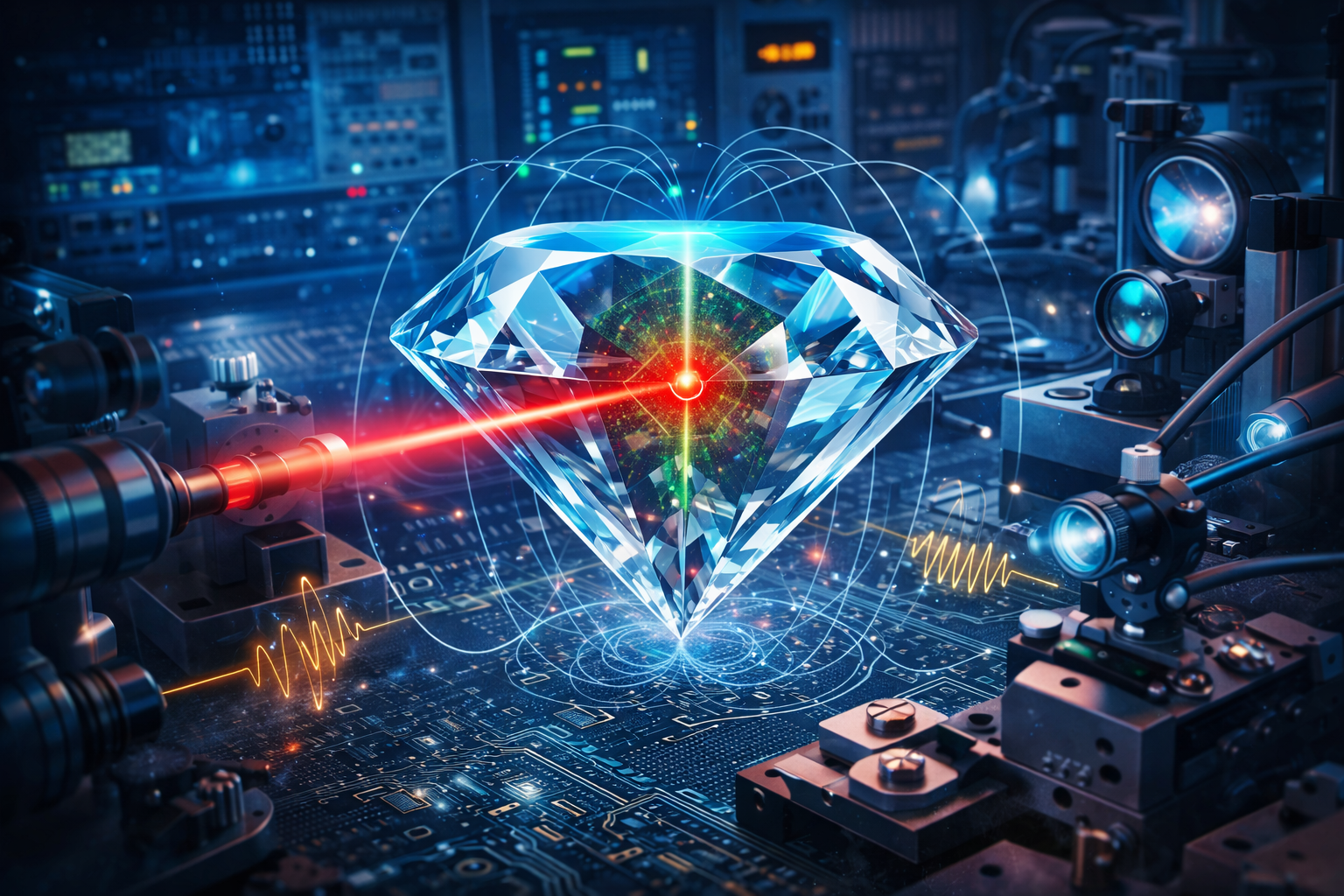
Quantum sensing has spent years in a familiar place: dazzling lab demonstrations, a few niche deployments, and a long list of “soon” applications. What is changing now is not a single breakthrough headline, but a pattern of practical moves that signals a shift from physics experiments to product pipelines. Synthetic “quantum diamonds” engineered with nitrogen-vacancy (NV) centers are being built into sensors that work at room temperature, survive real environments, and can be manufactured in repeatable ways.
That matters because sensing is where quantum can win without asking the world to rebuild its infrastructure. A quantum diamond magnetometer can, in principle, measure magnetic fields with extreme precision using a defect in a crystal and a compact optical readout. That translates into applications people already pay for: navigation when GPS is jammed, medical measurements that are difficult to capture non-invasively, and industrial diagnostics where you need to see what is happening inside sealed systems.
The central tension is straightforward. Quantum diamonds promise lab-grade sensitivity in devices that are robust and scalable. But they must cross three unforgiving hurdles at once: integration (optics, microwaves, electronics), noise (the world is magnetically messy), and economics (a sensor that is brilliant but too expensive will not leave the pilot stage).
This piece explains how NV-center diamond sensing works, why recent industry moves point to commercialization, where the strongest near-term markets are likely to be, and what constraints could still slow adoption.
The story turns on whether quantum diamonds can scale from exquisite prototypes into boring, reliable sensors that beat classical alternatives on cost, size, and trust.
Key Points
Quantum diamonds use NV centers—tiny defects in synthetic diamond—to sense magnetic fields (and related signals) at room temperature with optical readout.
Recent investments, contracts, and manufacturing announcements suggest the supply chain is shifting from “custom lab diamonds” toward standardized, quantum-grade materials and devices.
The most immediate commercial pull may come from industry: semiconductor inspection, battery diagnostics, and navigation-grade magnetometry, where budgets are large and pain points are acute.
In medicine, the promise is non-contact measurement of biomagnetic signals, but clinical deployment will hinge on safety, workflow fit, and regulatory evidence.
For navigation and security, diamond magnetometers could strengthen resilience in GPS-denied environments—but performance will depend heavily on mapping, calibration, and platform integration.
A major technical bottleneck remains packaging: shrinking lasers, optics, and microwave components into rugged, low-power modules without losing sensitivity.
Competing approaches—especially optically pumped magnetometers and alternative solid-state defects—may win certain use cases first, shaping where diamond sensors land.
Background
“Quantum diamonds” are not exotic gemstones. They are engineered synthetic diamonds whose crystal lattice contains controlled defects. The most widely used defect for sensing is the nitrogen-vacancy center: one carbon atom is replaced by nitrogen, and an adjacent lattice site is empty. That defect hosts electron spin states that can be manipulated and read out.
In simple terms, the NV center behaves like a microscopic compass that responds to magnetic fields. A green laser excites the NV center, and the diamond emits red fluorescence. When microwave radiation is tuned through the NV center’s resonant frequencies, the brightness changes in a way that depends on the local magnetic field. That optical signal becomes the measurement.
Why diamond? Diamond is mechanically robust, chemically inert, and it can operate at room temperature. The same material properties that make it durable in industry also make it stable for sensing in harsh environments. It can be fashioned into bulk sensors, thin layers for imaging, or nanodiamonds for biological tagging.
The result is a platform technology: one material system that can be aimed at magnetometry, temperature sensing, electric-field sensing, strain sensing, and imaging—depending on how the NV centers are engineered and how the device is packaged.
Analysis
Technological and Security Implications
The most legible “why now” signal is integration. The field is moving from tabletop optics toward compact prototypes that resemble real products: integrated modules, standardized diamonds, and designs that anticipate manufacturing constraints rather than ignoring them.
Navigation is a prime example of why quantum sensing attracts security interest. Magnetic navigation uses detailed maps of Earth’s magnetic anomalies to estimate position even when GPS is unreliable. A diamond magnetometer is not a full navigation system on its own, but it can become a high-quality input to inertial systems and map-matching algorithms. In a world of jamming and spoofing, a dependable magnetic sensor is strategically useful because it changes the attacker’s job: you can interfere with radio signals, but you cannot easily rewrite geology.
The catch is that real platforms generate their own magnetic noise. Vehicles, power electronics, and moving metal all create interference that can swamp the signal you care about. The practical battle is not only sensitivity, but also subtraction: calibration, compensation, sensor placement, and software that can separate “platform magnetism” from “planet magnetism.”
Economic and Market Impact
Quantum diamonds are starting to look like an ecosystem rather than a research niche. That matters because sensors are bought, not admired. The markets that pull hardest tend to be the ones where measurement problems are expensive: chip manufacturing yield, battery reliability, subsurface imaging, and high-value navigation.
Semiconductor inspection is an especially strong candidate for early scale. The value proposition is concrete: non-destructive localization of faults in complex, three-dimensional chip stacks, without cutting the device open. If diamond-based magnetic imaging can shorten debug cycles or raise yields, it earns its place in the fab toolchain.
On the supply side, the shift toward dedicated quantum-diamond manufacturing capacity reduces one of the silent blockers: inconsistent materials. For years, many labs effectively ran on bespoke diamonds. Scaling requires repeatable diamonds with known NV density, coherence properties, and packaging compatibility—plus a credible path to volume.
The competitive landscape is also clarifying. Some players are building the diamonds, others are building the sensors, and others are building the applications around them. The winners are likely to be the teams that can lock down all three layers: materials, device integration, and a use case with budgets large enough to sustain iteration.
Social and Cultural Fallout
Medicine is the most compelling story to the public because it promises new ways to “see” the body without cutting it open. Diamond magnetometry is part of a broader push toward biomagnetic measurement that can be done without cryogenics. The near-term promise is not science fiction mind-reading. It is more mundane and more valuable: better measurement of cardiac activity, improved detection of subtle neurological signatures, and potentially new point-of-care diagnostics.
But clinical adoption is ruthless. Hospitals do not buy elegance; they buy outcomes. A sensor has to fit into workflows, prove reproducibility across patients, and survive regulatory scrutiny. It also has to compete with other fast-improving technologies, including room-temperature magnetic sensors that do not require lasers pointed at diamonds.
There is also a privacy dimension that will arrive faster than most coverage suggests. As sensors become smaller and cheaper, the question shifts from “Can this be done?” to “Who controls the data?” Biomedical signals, industrial signatures, and geophysical maps all have sensitive implications when captured at scale.
Political and Geopolitical Dimensions
Once sensors matter for navigation resilience, chip sovereignty, and critical infrastructure monitoring, they stop being “just hardware.” Countries that already treat semiconductors as strategic assets will view advanced metrology tools the same way, because metrology and yield are competitive advantages.
That dynamic favors investment in domestic capability: not only quantum research, but also diamond growth, device packaging, and manufacturing know-how. It also raises the likelihood of export controls, dual-use scrutiny, and procurement nationalism—especially if quantum magnetometry is framed as part of defense-grade navigation or intelligence collection.
Three Scenarios for What Happens Next
Scenario one: Industrial metrology becomes the breakout market.
Trigger: Diamond-based magnetic imaging proves it can reliably find faults in advanced packaging faster than existing tools.
Who benefits: Chipmakers, tool vendors, and supply-chain players that standardize quantum-grade diamonds.
First visible sign: Multi-site deployments in high-volume manufacturing, not just R&D labs, followed by repeat orders.
Scenario two: Navigation resilience drives defense-adjacent adoption.
Trigger: Field trials show stable performance on aircraft, drones, or maritime platforms with workable calibration and compensation.
Who benefits: Defense integrators and navigation suppliers; operators in contested environments.
First visible sign: Procurement language shifts from “research program” to “capability insertion,” with budget lines tied to positioning, navigation, and timing resilience.
Scenario three: Medical sensing advances, but through narrower pathways.
Trigger: A focused application—such as cardiac measurement in a controlled clinical setting—shows clear benefit over standard approaches and clears regulatory hurdles.
Who benefits: Specialized medtech firms and early-adopting hospitals.
First visible sign: Clinical studies that emphasize reproducibility and workflow fit, paired with devices designed for routine use rather than showcase demos.
What Most Coverage Misses
The hardest part is not “quantum.” It is packaging. The NV center needs optical excitation and readout, and often microwave control. Shrinking that into something power-efficient, rugged, and inexpensive is an engineering marathon. The story is less about magical sensitivity and more about aligning lasers, filters, photodiodes, microwave antennas, thermal stability, and calibration in a mass-producible module.
The second overlooked point is that the best early markets may not be the most glamorous. Semiconductor inspection and battery diagnostics have an advantage: they can pay for expensive tools if the return is measurable. Success there can subsidize the cost-down curve that eventually makes medical and consumer applications realistic.
Finally, diamond is not the only solid-state platform chasing biosensing. NV centers require green light, which interacts strongly with biological tissue. That limitation is pushing serious research into alternative defects and materials that operate in more biologically friendly wavelengths. The “diamond wins everything” narrative is unlikely; the future looks more like a portfolio of quantum sensors matched to specific constraints.
Why This Matters
In the short term, the biggest winners are likely to be industries where measurement errors are already costly: semiconductor manufacturing, aerospace navigation, and high-value industrial monitoring. These are the sectors most willing to fund prototypes, tolerate complexity, and iterate quickly.
In the longer term, the stakes widen. If quantum diamonds enable practical biomagnetic sensing at scale, they could reshape diagnostics, monitoring, and early detection. If they enable resilient navigation, they become part of the infrastructure of security and mobility in contested environments.
Concrete moments to watch next are not single “reveal days,” but the places where engineering turns into products. Early 2026 is crowded with venues where sensor developers typically show real prototypes and performance claims, including SPIE Photonics West (17–22 January 2026) and the APS Global Physics Summit (16–20 March 2026). Later in the year, Quantum World Congress (22–24 September 2026) is a common stage for commercialization announcements.
Real-World Impact
A chip reliability engineer in Taiwan is chasing a defect that only appears under load in a dense 3D package. If quantum diamond magnetic imaging can map buried current paths without destroying the chip, the debug loop shrinks from weeks to days, and an expensive line stop becomes avoidable.
A cardiology team in California wants richer measurement without adding wires and adhesive sensors for every patient. A compact biomagnetic sensor that sits near the chest could reduce setup time and improve comfort, but only if it performs consistently across body types and noisy hospital environments.
A drone operator in the Baltic region faces periodic GPS disruption. A navigation stack that can fall back on magnetic map-matching reduces the likelihood of losing the platform, but only if the sensor can separate the drone’s own electromagnetic noise from external signals.
A team monitoring carbon storage in the North Sea is trying to confirm site integrity over time. If quantum magnetometers can detect subtle changes associated with infrastructure or fluid movement, they become another tool in a verification toolbox that is increasingly demanded by regulators and insurers.
Road Ahead
Quantum diamonds are moving toward practicality because the ecosystem is starting to resemble a supply chain: standardized materials, compact prototypes, targeted applications, and credible capital behind scaling. NV centers give diamond sensors a rare combination of sensitivity and room-temperature operation, and that combination maps cleanly onto real-world problems.
The fork in the road is not whether the physics works. It does. The question is whether the engineering and economics can keep up: miniaturization without losing performance, calibration without fragile procedures, and pricing that matches the market’s willingness to adopt.
The next year will show which path is opening. The clearest signs will be repeatable field trials, multi-site industrial deployments, and products that look less like laboratory rigs and more like instruments a technician can use without a PhD.
