Ancient Crystals Are Rewriting Earth’s Origin Story — And the Timeline of Our Planet May Be Wrong
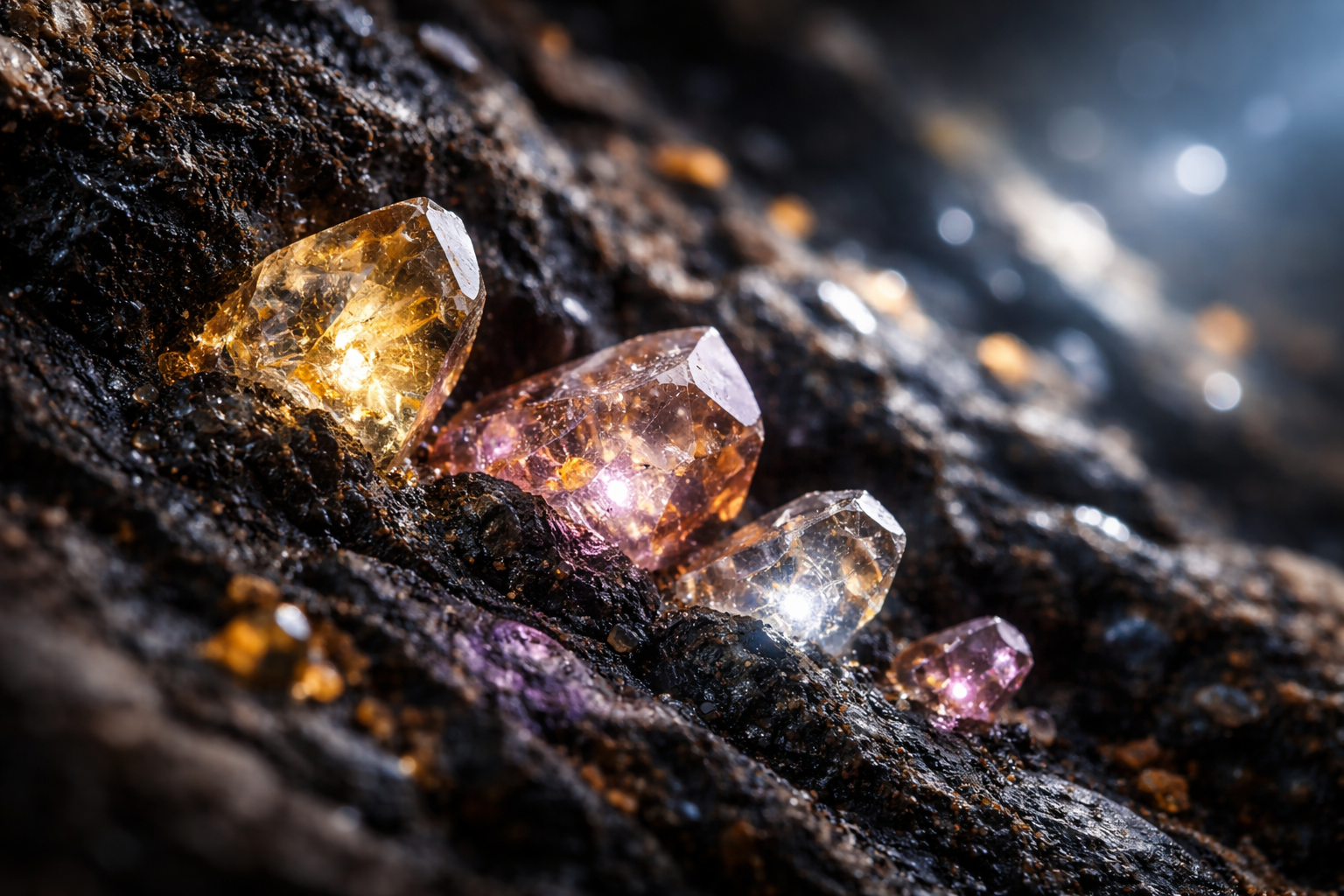
Scientists Discover Ancient Crystals That Challenge Earth’s Origin Story
A handful of microscopic crystals, forged more than four billion years ago, are forcing scientists to rethink the earliest chapter of Earth’s history.
New analyses of ancient zircon minerals are revealing a planet that may have been far more complex—and far more Earth-like—much earlier than long believed.
These grains are among the oldest surviving materials on Earth, some dating back about 4.4 billion years, close to the planet’s formation itself. Because most rocks from that era have long since been recycled by geological activity, zircons act as rare time capsules preserving chemical clues about conditions on the young planet.
The new work suggests two surprising possibilities: Earth’s surface chemistry changed earlier than expected, and plate tectonics may have begun much sooner than traditional models assumed.
If confirmed, the implications reach far beyond geology. They reshaped when continents formed, when oceans stabilized, and potentially when the conditions necessary for life first appeared.
The story turns on whether these tiny crystals truly preserve evidence that Earth’s modern-style geology began hundreds of millions of years earlier than scientists believed.
Key Points
Ancient zircon crystals up to 4.4 billion years old preserve chemical records from Earth’s earliest surface environment.
New analyses suggest oxidation and geological recycling processes began earlier than long-standing models predicted.
Evidence hints that plate tectonics may have started at least 3.35 billion years ago, earlier than many previous estimates.
These findings contradict the traditional notion that a rigid, stagnant crust with minimal geological activity dominated early Earth.
If Earth developed continents and recycled its crust earlier, it could indicate the emergence of habitable environments sooner than previously assumed.
Earth formed roughly 4.5 billion years ago during the chaotic birth of the solar system. For decades, scientists imagined the earliest era—known as the Hadean eon—as a violent, molten world covered by magma oceans and relentless asteroid impacts.
Direct evidence from this period is extremely rare. Billions of years of geological activity have destroyed or transformed almost all original rocks.
That is why zircon crystals are so valuable.
Zircons form inside cooling magma and are exceptionally durable. Their crystal structure traps trace elements and isotopes that act like microscopic records of the environment in which they formed. In effect, they are geological black boxes.
Many of the oldest known zircons come from the Jack Hills region of Western Australia, where grains embedded in younger rocks have been dated to about 4.4 billion years old, making them the oldest minerals ever discovered on Earth.
By analyzing elements inside these crystals—including uranium, titanium, and oxygen isotopes—scientists can reconstruct conditions that existed on Earth long before most rocks formed.
Recent work has taken this analysis further by studying zircon cores and later crystal rims, allowing researchers to reconstruct multiple episodes in Earth’s early geological history.
The result is a far more dynamic picture of the young planet.
Technological and Scientific Implications
Modern geochemistry tools are turning zircons into one of the most powerful probes of Earth’s earliest history.
New analytical methods can measure trace elements inside crystals just fractions of a millimeter wide. These measurements reveal the temperature of the magma in which they formed and the chemical conditions surrounding them.
That data now suggests oxidation—the process that alters rock chemistry and can influence atmospheric development—happened earlier than many models predicted.
This matters because oxidation is tied to how Earth’s crust interacts with water, volcanic gases, and the mantle beneath the surface. Earlier oxidation could mean the planet’s chemical cycles stabilized sooner than expected.
Several scenarios are now being debated among geologists:
One possibility is that early Earth developed proto-continents far earlier than assumed.
Another scenario is that tectonic recycling—the process in which crust sinks back into the mantle and new crust forms—began earlier but operated differently from modern plate tectonics.
A third possibility is that the evidence reflects localized processes rather than global tectonics.
Each scenario would reshape how scientists model the planet’s early evolution.
Economic and Market Impact
At first glance, a study of ancient crystals might appear purely academic. But the implications extend into industries tied to Earth sciences.
Understanding how early continents formed affects models of mineral formation, including the distribution of rare metals and geological resources. Many valuable deposits form through long-term tectonic processes that concentrate elements in the crust.
If those processes started earlier, it may reshape geological exploration models used by mining companies and national resource agencies.
Better models of early tectonics also improve simulations of planetary evolution—tools increasingly used in planetary science and space exploration.
Social and Cultural Fallout
For decades, textbooks depicted early Earth as a hostile world with little resemblance to the planet we know.
These new findings hint at something different: a planet that may have begun developing complex geology—and potentially stable environments—much earlier.
That change in perspective carries wider cultural resonance.
The earlier Earth became geologically dynamic, the earlier oceans, continents, and stable climates could have formed. And that in turn affects theories about the origin of life.
If habitable conditions existed sooner than previously believed, it strengthens the idea that life may emerge relatively quickly when conditions allow.
What Most Coverage Misses
The most important shift here is not just the age of the crystals—it is what zircons reveal about processes rather than moments.
Traditional narratives about early Earth focus on dramatic events: asteroid bombardments, magma oceans, and catastrophic impacts.
Zircons tell a quieter but more powerful story.
Because these crystals grow inside magma and then survive for billions of years, they record the chemical environment of Earth’s crust at specific moments in time. By comparing cores and later crystal growths, scientists can reconstruct cycles of crust formation, recycling, and metamorphism.
That means the crystals do not simply tell us when rocks formed. They reveal whether Earth’s geological engine was already running.
If early tectonic recycling really occurred more than three billion years ago—or even earlier—it implies the young planet was not a stagnant shell of rock.
It was already behaving more like the modern Earth.
That single shift changes almost every downstream assumption about the planet’s early evolution.
Why This Matters
The implications stretch across several scientific frontiers.
In the short term, the findings will drive new debates about when plate tectonics truly began. That question has divided geologists for decades.
Researchers will now look for additional evidence in ancient rocks, meteorites, and other zircon deposits worldwide.
In the longer term, the study influences how scientists understand planetary habitability.
If continents, oceans, and crust recycling had emerged earlier, Earth may have developed stable environments suitable for life sooner than assumed.
Upcoming research will focus on:
Additional zircon analysis from ancient geological regions
Improved isotope measurement techniques
Models of early mantle convection and tectonic behavior
Each could confirm—or challenge—the new interpretation.
The Tiny Crystals That May Redraw Earth’s Timeline
For most of human history, the earliest chapters of Earth’s story were unknowable.
The rocks had vanished. The evidence seemed lost.
But microscopic crystals, no larger than grains of sand, survived billions of years of planetary violence.
Inside them lies a record of magma chambers, chemical cycles, and possibly the first hints of tectonic motion.
If those clues hold up under scrutiny, they will not merely refine Earth’s timeline.
They will rewrite the opening act of the planet itself.
