Annular Solar Eclipse “Ring of Fire” Today: Where It’s Visible—and the Eye-Safety Trap
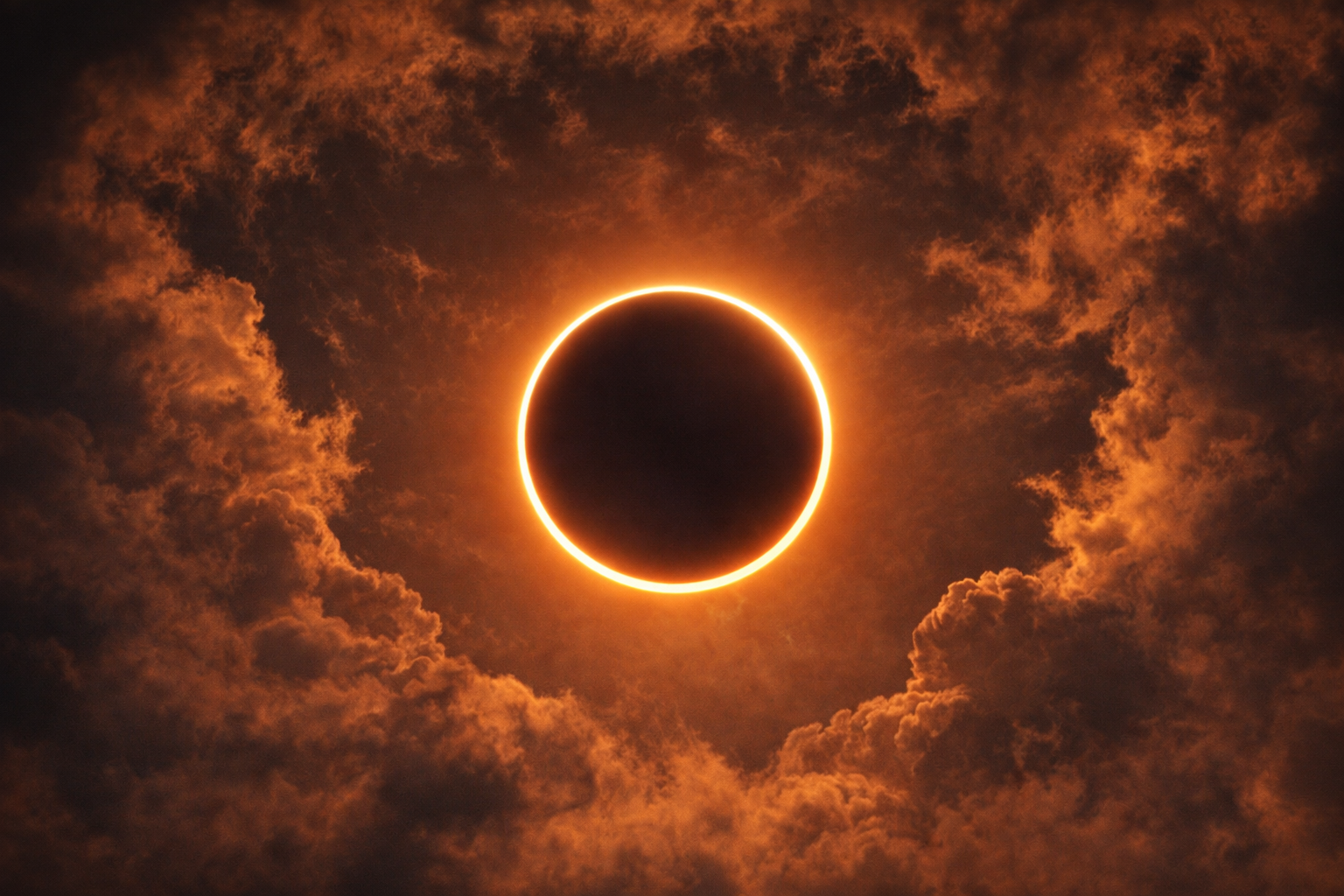
The “Ring of Fire” Eclipse Is Happening Now: Who Can See It, What Time, and How Not to Hurt Your Eyes
The Ring of Fire Eclipse Has No “Safe Moment”—Here’s How to Watch Without Guessing
A bright ring around a black disk is one of the most convincing illusions in the sky: it looks gentle, like a halo. It isn’t.
On Tuesday, February 17, 2026, an annular solar eclipse is in progress, creating the “ring of fire” effect along a narrow track—while much larger regions see only a partial bite taken from the Sun.
The tension is straightforward: huge attention, limited visibility, and a safety rule that does not loosen even at the peak.
The story depends on whether people recognize this is not a total eclipse.
Key Points
This is an annular solar eclipse, meaning the Moon covers the Sun’s center but leaves a bright outer ring in locations on the annularity path.
The eclipse’s global timeline (UTC) runs from 09:56:26 (partial begins somewhere) to 14:27:42 (partial ends somewhere), with maximum eclipse at 12:12:04 UTC.
Annularity is visible in Antarctica (example: Concordia Station), where annularity lasts about 2 minutes 5 seconds near the local maximum.
Many Southern Hemisphere locations get a partial eclipse only, such as Cape Town (2:01–3:24 pm local) and Punta Arenas (7:07–7:51 am local).
Eye protection is required the entire time for annular and partial eclipses. There is no “glasses off” window in annularity.
If you are outside the visibility region, the practical way to follow it is live coverage and livestreams rather than trying to “catch it anyway.”
Background
A solar eclipse happens when the Moon moves between Earth and the Sun. In a total eclipse, the Moon appears large enough to cover the Sun completely for a brief period. In an annular eclipse, the Moon appears slightly smaller, so a thin ring of sunlight remains visible around the Moon at maximum.
That “ring of fire” is not a special kind of sunlight. It is still the Sun. The same basic hazard applies: unfiltered viewing can injure your eyes, even if the sun looks partly covered.
The visibility bottleneck: a ring of fire for very few, partial for many
The annular path is tight by design. For this eclipse, time-and-date visibility summaries put the “at least partial” footprint across the far south of Africa, the far south of South America, parts of the Southern Ocean basins, and Antarctica.
Concrete examples show the scale difference. Concordia Station, Antarctica, is on the annular path, with the eclipse locally running from 6:48 to 8:45 pm and annularity lasting a little over two minutes near 7:47 pm.
Meanwhile, places far from the annular centerline see a modest partial event. Cape Town runs 2:01–3:24 pm local with a small magnitude listed for maximum.
The size illusion: why the Moon can’t “finish the job” today
The “annular vs. total” split is a geometry problem, not a drama problem. The Moon’s orbit is not a perfect circle, so its distance from Earth varies. When it is farther away, its apparent size shrinks just enough that it cannot fully cover the Sun, leaving a ring at peak alignment.
That is why the annular phase is both striking and uncommon in any one place: you need the alignment to be central and the apparent sizes to land on the wrong side of “just barely covers.”
The risk boundary: why your eyes don’t care that it’s “almost covered”
If you remember one rule, make it this: for annular and partial solar eclipses, you must use safe solar viewers the entire time you look at the Sun. Regular sunglasses do not count.
NASA’s guidance is blunt: you need eclipse glasses or a handheld solar viewer, and safe viewers should comply with ISO 12312-2.
The missing lever: no totality window means no glasses-off moment
This is the hinge people skip because the visuals feel similar. In a total eclipse, there is a brief period of totality where it can be safe to view the Sun without filters (with strict timing and only when the Sun is fully covered). In an annular eclipse, the Sun is never fully covered at maximum, so there is no safe moment to remove eye protection while looking at the Sun.
That single difference changes behavior. It is why many experienced eclipse watchers treat annularity as a continuous “partial phase” from a safety standpoint, even though it looks more dramatic.
The signal test: what live feeds and local timings should confirm
If you are tracking this as it unfolds, there are a few clean signals that separate real-time confirmation from recycled hype.
One is the global timing spine: partial begins at 09:56:26 UTC, full/annular phase begins somewhere at 11:42:54 UTC, maximum at 12:12:04 UTC, annular phase ends somewhere at 12:41:29 UTC, and partial ends at 14:27:42 UTC. Live coverage should line up with that progression even as local clocks differ.
Another is city-level consistency in regions with partial visibility. For example, Punta Arenas lists a tight partial window from 7:07 to 7:51 am local time with a maximum at 7:28 am.
A third is the annularity confirmation from on-path Antarctic locations like Concordia Station, where the “ring” duration is on the order of minutes, not tens of minutes.
What Most Coverage Misses
The hinge is simple: an annular eclipse never gives you a “glasses off” moment.
The mechanism is safety logic, not hype. Because a bright ring of photosphere remains visible at peak, the hazard does not drop the way it does during true totality. That means the correct viewing method is the same before, during, and after maximum: ISO 12312-2 compliant eclipse glasses or a proper solar filter on optics.
Two fast signposts will confirm whether coverage is helping or harming. First, watch whether reputable explainers explicitly say “no naked-eye moment” for annularity. Second, watch for reminders about ISO 12312-2 compliance and warnings that standard sunglasses are unsafe.
What Happens Next
In the next 24–72 hours, the immediate aftermath is mostly social: highlight clips, time lapses, and reposted “ring” shots, plus corrections about where it was actually visible. The core consequence is predictable because attention outruns geography: lots of people who could not see it directly will still try to watch something.
Over the longer horizon of months to years, today is a reminder about eclipse literacy ahead of bigger events later in 2026. The reason it matters is not romance—it is risk management: the more “eclipse-like” something looks, the more likely people are to improvise unsafe viewing unless the guidance is repeated, plain, and consistent.
The decision points to watch are practical: whether major livestreams and media explainers consistently lead with the safety rule, and whether local institutions (schools, clubs, and observatories) share ISO-standard guidance instead of vague “be careful” phrasing.
Real-World Impact
A research team in Antarctica treats it like a timed experiment: filters, cameras, strict checklists, and a two-minute peak that is over almost as soon as it starts.
A family in Cape Town gets a modest partial eclipse and a big lesson in expectations: the Sun looks “mostly normal,” so the temptation is to glance without protection.
A teacher uses projection rather than direct viewing because it scales: one pinhole setup lets a whole group see the changing crescent safely.
An amateur astronomy club spends more time on safety triage than on the eclipse itself: verifying viewer standards, inspecting scratches, and keeping unfiltered optics off faces.
The closing consequence: a viral event with a simple rule
The core dilemma is not whether the eclipse is real—it is whether people respect the boundary between spectacle and safety.
If you are in the partial zone, treat it like a partial eclipse the whole time. If you are not in the visibility footprint, watch a credible livestream rather than forcing a “maybe I can see it” moment.
The signposts are concrete: verified local timing pages, consistent global UTC milestones, and safety guidance that names ISO 12312-2 and says “no glasses-off moment” for annularity.
This moment will be remembered less for how many people saw the ring in person and more for whether a mass audience learned the right rule at the exact moment it mattered.
