Astronomers Study Planet That Survived the Death of Its Star
Astronomers Study Planet That Survived the Death of Its Star
The Planet That Should Have Been Destroyed but Wasn’t
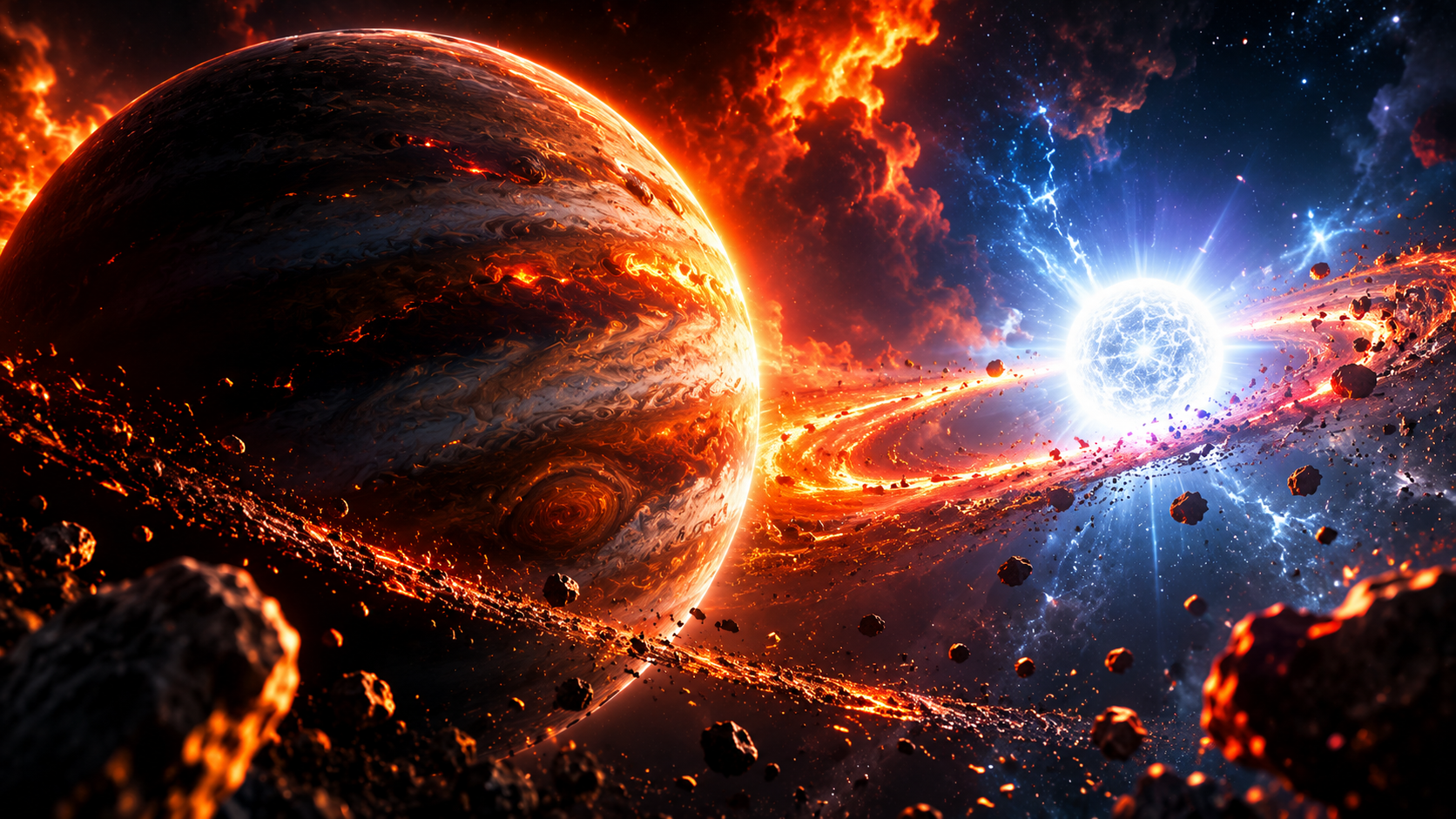
Astronomers have studied a planet that should, by simple expectation, have been destroyed when its star died. Instead, WD 1856 b is still there: a giant world orbiting the burnt-out core of a once Sun-like star at extraordinary speed and at a distance that looks almost impossible.
The importance is not just that the planet survived. The deeper importance is that scientists can now use it as a real-world preview of what may happen to the outer planets of our own solar system after the Sun swells, sheds its outer layers, and ends as a white dwarf billions of years from now.
A Planet Orbiting a Dead Star
WD 1856 b is a gas giant roughly the size of Jupiter, but its star is no longer a normal star. Its host, WD 1856+534, is a white dwarf: the dense remnant left behind after a Sun-like star runs out of fuel, expands into a red giant, ejects its outer layers, and leaves its hot core behind.
That death process is violent for planets. A star entering its red giant phase can swell enormously, engulfing nearby worlds, stripping atmospheres, destabilising orbits, and turning once-stable planetary systems into wreckage fields. Any planet found very close to the leftover white dwarf therefore creates an immediate problem: either it somehow survived being swallowed, or it arrived there later.
WD 1856 b is especially striking because it orbits the white dwarf every 34 hours. It sits less than 2 million miles from the dead star, around 50 times closer than Earth is to the Sun. If it had been sitting there when the original star expanded, it should not have remained intact.
That is why the finding matters. Astronomers are not just looking at another strange exoplanet. They are looking at a surviving object in a place where survival once looked extremely difficult.
Did Scientists Think This Was Possible?
Scientists already knew that some planetary material can survive around dead stars. White dwarfs often show signs of rocky debris, destroyed asteroids, or material falling into the star. Those clues suggested that planetary systems do not simply vanish when a star dies.
But a large intact planet in such a tight orbit around a white dwarf is a harder question. The problem is not whether planets can exist somewhere around dead stars. The problem is whether a giant planet can avoid destruction, remain whole, and then end up extremely close to the stellar corpse without being torn apart.
WD 1856 b was therefore not impossible in the broadest sense, but it was deeply puzzling. A giant planet might survive if it began far enough from the star, beyond the danger zone of the red giant phase. Yet that leaves the next mystery: how did it later fall inward to an orbit so tight that it now circles the white dwarf in less than two Earth days?
This is where the new Webb observations become crucial. The telescope did not merely confirm that the planet exists. It measured enough about the planet’s atmosphere, heat, and mass to help reconstruct its history.
How Webb Found the Survival Clue
The James Webb Space Telescope studied WD 1856 b as it passed in front of its white dwarf host. That transit allowed astronomers to examine how light changed across different wavelengths, giving them information about the planet’s atmosphere and temperature.
The results showed evidence of hydrocarbons, aerosols, and methane in the atmosphere. Webb also detected thermal emission from the planet’s nightside, meaning the planet is radiating heat in a way that can be measured even as it crosses the tiny white dwarf.
That heat is the key. WD 1856 b is warmer than expected if it had simply been sitting calmly around the white dwarf for billions of years. Its measured effective temperature is far above what would be expected from the weak light of the white dwarf alone.
That means the planet appears to have been reheated. The question then becomes when, and by what mechanism.
How It Probably Survived
There are two broad routes that could explain the planet’s current position. The first is the most dramatic: WD 1856 b may have been engulfed during the red giant phase and somehow survived inside the outer layers of the dying star. That kind of “common-envelope” survival would be extreme, violent, and scientifically fascinating.
The second route is cleaner and now looks more likely. WD 1856 b probably began much farther away from the star, far enough to avoid destruction when the star expanded. Only later, after the star had already become a white dwarf, gravitational interactions pushed the planet onto a stretched, eccentric orbit that brought it close to the dead star.
Over time, tidal forces would have drained energy from that orbit. The planet would have moved inward, its orbit would have become more circular, and the process would have heated the planet. In this version, WD 1856 b did not survive because it sat close to the star during the death event. It survived because it stayed away from the danger, then migrated inward later.
The Webb data support that second explanation because the planet’s heat appears to point to a reheating event billions of years after the star became a white dwarf. That timing makes a late migration scenario more convincing than survival through direct engulfment.
Why This Matters for Other Planets
This discovery changes the meaning of dead-star systems. A white dwarf is not necessarily the end of a planetary story. It can be the start of a second phase, where surviving planets, moons, asteroids, and debris are rearranged around the stellar remnant.
That matters because most stars in the galaxy will end as white dwarfs. If planets can survive and migrate after stellar death, then the galaxy may contain many more post-death planetary systems than once assumed. Some could contain gas giants. Some could contain rocky remnants. Some could contain moons or debris shaped by surviving giant planets.
It also matters for the long-term future of our own solar system. In around five billion years, the Sun is expected to exhaust the hydrogen in its core, expand into a red giant, shed its outer layers, and eventually become a white dwarf. Mercury and Venus are expected to be destroyed, while Earth’s ultimate fate remains more uncertain. The outer giants, including Jupiter and Saturn, are more likely to avoid direct engulfment.
WD 1856 b offers a possible preview of what could happen to those distant giants. They may survive the Sun’s death, but their orbits may not remain peaceful forever. Gravitational nudges from other planets, passing stars, or leftover orbital instabilities could move them into new configurations long after the Sun has become a remnant.
What Could Be Discovered Next
The next major prize is atmosphere. Webb has already shown that a planet orbiting a dead star can still have an atmosphere that can be studied. That opens a new observational category: not merely finding planets around white dwarfs, but reading their chemical signatures.
Future observations could show whether WD 1856 b’s atmosphere resembles Jupiter, Saturn, Neptune, or something more unusual. Methane and aerosols are already important clues, but deeper measurements could reveal more about its carbon chemistry, cloud structure, vertical mixing, and thermal history.
Astronomers may also discover whether WD 1856 b is rare or simply the first clear example of a wider population. If more planets are found around white dwarfs, scientists can begin comparing their masses, orbits, atmospheres, and temperatures. That would help reveal whether post-star-death migration is common or exceptional.
There is also a deeper question: could smaller, potentially rocky worlds survive or arrive in stable orbits around white dwarfs? A white dwarf is faint, but it can have a habitable zone very close in, where a planet could receive enough energy for liquid water under the right conditions. That does not mean WD 1856 b is habitable; it is a giant planet, not a second Earth. But the system proves that planetary survival around stellar remnants is not science fiction.
The Bigger Meaning
The most powerful part of this discovery is that it turns stellar death from a full stop into a transition. A dying star can destroy planets, but it may not erase the entire planetary system. Some worlds may escape, wait, migrate, heat up, and settle into strange new orbits around the remnant.
For astronomy, WD 1856 b is a case study in survival under extreme conditions. It tells scientists that planetary systems can remain dynamically alive long after their stars have died. The planets may not stay where they formed, and their histories may be written in heat, chemistry, and orbital scars.
For our solar system, the discovery is unsettling but valuable. The Sun’s death is not tomorrow’s problem, but it is the final chapter of the system we live in. WD 1856 b gives astronomers a distant laboratory for that future, showing that even after a star dies, some planets may continue circling the remains, carrying evidence of the catastrophe they escaped.
