Black Holes Explained: What They Are, What We Can Prove, and Why the Paradoxes Won’t Go Away
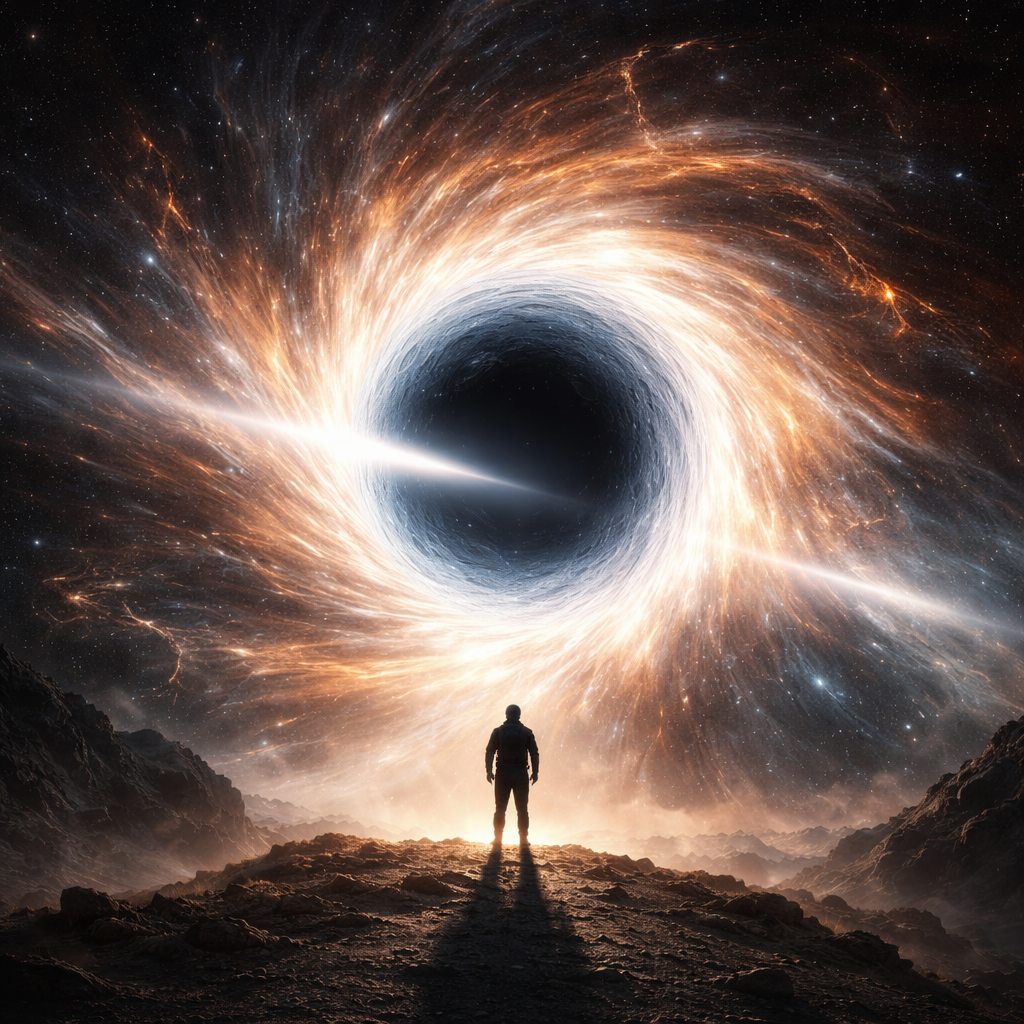
Black Holes Explained: Event Horizons and Physics Paradoxes
Black Holes: What They Are, and Why They Still Baffle Physicists
Black holes are regions of space where gravity is so strong that nothing that crosses a certain boundary can get back out—not even light. That boundary is called the event horizon, and it marks a point of no return for signals, matter, and cause-and-effect as seen from the outside.
Black holes are significant due to their intersection with two of our most influential theories: general relativity, which explains gravity and the large-scale universe, and quantum mechanics, which governs the microscopic world. Each theory works brilliantly on its own. Combining these theories at the edge or core of a black hole leads to a clash in logic.
This explainer will show what a black hole actually is, how it forms and behaves, what we can measure from the outside, and where the deepest puzzles live—especially the question of whether information is truly lost.
“The story turns on whether information can escape a black hole in any form without breaking the rules of physics.”
Key Points
Black holes are not cosmic vacuum cleaners; they are objects with a boundary (the event horizon) beyond which escape is impossible.
General relativity describes black holes cleanly from the outside using a small set of properties like mass and spin.
The inside is the problem: relativity predicts a singularity, where known physics stops making testable predictions.
Quantum theory suggests black holes should emit faint radiation, implying they can slowly lose mass over time.
That radiation creates a crisis: if it carries no information, quantum mechanics breaks; if it does, our picture of horizons must change.
Observations now probe black holes directly through gravitational waves and horizon-scale imaging, tightening the tests of relativity.
The bafflement is not that black holes exist—it’s that they force a choice between principles we usually treat as non-negotiable.
What Are They?
A black hole is a compact object defined by an event horizon: a surface in spacetime where the escape speed equals the speed of light. Paths still exist outside that surface, which lead outward. Inside it, all possible future paths point deeper inward, meaning no signal can reach an outside observer.
It helps to separate the black hole itself from the environment around it. Many of the dramatic pictures people associate with black holes—glowing rings, jets, and spiraling disks—are not the hole. They are hot gas and magnetic fields outside the horizon, heated by friction and gravity as matter falls in.
What makes a black hole “black” is not that it is a dark material object. It is that the horizon prevents light that crosses it from returning, so the interior cannot send information back out in the ordinary way.
What Aren’t They?
A black hole is not an empty hole in space. It is a region where spacetime is curved so intensely that the usual notion of “getting out” stops making sense once you are inside the horizon.
It does not act like a one-way suction effect, pulling in everything nearby. Far from a black hole, gravity behaves like the gravity of any object with the same mass. If the Sun were replaced by a black hole of the same mass, Earth’s orbit would not suddenly spiral in.
How They Work
Black holes form when enough mass gets packed into a small volume that gravity overwhelms every other force that might resist collapse. For stellar-mass black holes, the usual pathway is the death of a massive star: the core collapses after nuclear fuel runs out, and if the remnant is heavy enough, it can pass the threshold where no stable object can hold it up.
Once a horizon forms, the external story becomes simple. General relativity says the gravitational field outside a settled black hole can be described by a few macroscopic parameters, most importantly mass and spin (and electric charge in principle, though astrophysical black holes are expected to have negligible net charge). From far away, that simplicity is part of the black hole’s weirdness: vast complexity falls in, yet the exterior can look almost featureless.
The environment around the horizon is where most observable action happens. Gas falls in, heats up, and can form an accretion disc. Magnetic fields have the ability to twist and intensify, and in certain systems, they contribute to the launch of narrow jets that propel energy outward at speeds close to light. None of that requires the interior to be visible; it is powered by gravity’s ability to convert falling mass into heat, light, and motion outside the horizon.
So where does the bafflement come from? The confusion arises from pushing these mechanisms to their logical conclusion. Relativity predicts that continued collapse leads to a singularity—roughly, a region where curvature becomes extreme and the equations no longer supply a physically meaningful answer. Quantum mechanics, meanwhile, dislikes boundaries that erase information. Black holes appear to demand both.
Numbers That Matter
The speed of light is about 300,000 kilometers per second. The event horizon is defined by the idea that, at that boundary, the escape velocity reaches this cosmic speed limit. Move inward past it, and “escaping” would require faster-than-light travel, which our current physics forbids.
The Schwarzschild radius is the simplest estimate of a black hole’s horizon size when it is not spinning. It scales directly with mass: roughly 3 kilometers per solar mass. That means the Sun’s Schwarzschild radius would be about 3 kilometers, while Earth’s would be about the size of a marble in thickness—on the order of millimeters. This scaling is a reminder that a black hole is not defined by mass alone, but by mass packed into a sufficiently small radius.
A related distance is the photon sphere: for a non-spinning black hole, it lies at 1.5 times the Schwarzschild radius. This is where light can orbit in unstable circles. It matters because horizon-scale images are shaped not only by the horizon itself, but by how light bends and piles up around this region.
Accretion efficiency is one reason black holes are among the brightest engines in the universe—outside the horizon. In simplified thin-disk models, the maximum fraction of rest-mass energy that can be radiated away by matter spiraling down to the innermost stable orbit is about 5.7% for a non-spinning black hole, and it can rise toward about 42% for an extremely rapidly spinning one. If that efficiency shifts, it changes how much light and heat you get for the same amount of infalling matter.
The Planck length is about 1.6 × 10^-35 meters. This is a scale where quantum effects of gravity are expected to become unavoidable. We do not expect astrophysical black holes to be “Planck-sized,” but we do expect the classical picture to fail when curvature becomes extreme, which is why singularities are treated as a signpost: “new physics required here.”
Hawking temperature is the temperature associated with Hawking radiation, and it scales inversely with mass. A black hole with the Sun’s mass would have a Hawking temperature of roughly 6 × 10^-8 kelvin—far colder than the cosmic microwave background. That is why Hawking radiation is not expected to be directly observable for normal astrophysical black holes.
Evaporation time grows extremely fast with mass. A solar-mass black hole would take on the order of 10^67 years to evaporate via Hawking radiation in the simplest calculations. If that estimate is even roughly right, then for most black holes, evaporation is irrelevant on any practical cosmic timescale—yet conceptually it is central, because it forces the information question.
Where It Works (and Where It Breaks)
Black holes “work” beautifully as solutions to general relativity. The theory predicts horizons, strong gravitational lensing, orbital dynamics near compact objects, and the characteristic gravitational-wave “ringdown” after two black holes merge. These are the parts of black hole physics that can be tested from the outside, and modern observations increasingly probe exactly that regime.
They also work as astrophysical engines. Accretion disks, relativistic jets, and high-energy emissions from near-horizon environments can be modeled with a mix of gravity, plasma physics, and radiation transport. The models are hard, but the difficulty is largely about complexity and computing power, not about the basic rules breaking down.
Where black holes break our understanding is at two boundaries: the center and the horizon. The center problem is the singularity, where the classical theory predicts infinite curvature or a breakdown in predictability. Physicists generally read this as “general relativity is incomplete,” not as “infinities physically exist.”
The horizon problem is subtler and, in some ways, more disturbing. Classically, the horizon is not a physical surface; an infalling observer need not notice anything special at the moment of crossing (for a sufficiently large black hole). But quantum theory assigns the black hole a temperature and entropy, as if the horizon has microscopic degrees of freedom. This suggests that the horizon may be more than a mathematical boundary, even if it doesn't act like matter.
The hardest trade-off is this: keep quantum mechanics intact and information must be preserved, but then the horizon cannot behave the way classical relativity says it does. Keep the classical horizon intact and information seems to be lost, but then quantum mechanics fails in a foundational way. The tension is not about missing details. It is about incompatible principles.
Analysis
Scientific and Engineering Reality
From an engineering standpoint, a black hole is a gravitational field plus an environment. What we measure is always mediated by something outside the horizon: starlight from orbiting stars, radiation from accreting gas, or gravitational waves from mergers. The “black hole” is inferred as the simplest object consistent with those signals.
The exterior geometry is the most pristine aspect of the system. General relativity presents precise predictions for how clocks run, how paths bend, and how waves propagate in strong gravity. Many current tests focus on whether real black holes match those predictions, especially during mergers where gravity is most extreme.
What must be true for the usual claims to hold is that general relativity remains valid at the scales we probe, and that the messy astrophysics is modeled well enough not to fake a “new physics” signal. If a simulation of hot plasma is wrong, you can misread the image. If detector noise is misunderstood, you can overstate what the waveform implies.
A key falsifier would be persistent, repeatable deviations from relativity’s predictions in multiple channels—imaging, gravitational waves, and orbital dynamics—where the same alternative explanation fits all of them. Single anomalies are rarely decisive because the environments are complicated. Converging evidence is the standard.
Impact
Black hole science is not a consumer market, but it creates high-value capabilities. Gravitational-wave detectors demand extreme precision in lasers, vibration isolation, and signal processing. Horizon-scale imaging pushes techniques in interferometry, timing, and distributed computing.
The near-term payoff is often technological spillover: better sensors, better time synchronization, better imaging algorithms, and better ways to extract weak signals from noisy data. These tools travel into adjacent domains like geophysics, communications, medical imaging, and any field that needs precision metrology.
For wider practical adoption of the methods, the bottlenecks are cost and infrastructure. Giant detectors and global telescope networks are expensive, maintenance-heavy, and politically complex. The total cost of ownership is not just hardware; it is also staffing, data pipelines, calibration, and long-term operations.
Longer-term, black holes also act as a forcing function for fundamental physics. If a quantum theory of gravity becomes testable through black hole observations, the downstream effects could be large—but that pathway is uncertain and depends on whether nature offers measurable deviations from classical predictions.
Black hole research has limited potential for direct misuse in the conventional sense. The instruments are not weapons, and the objects themselves are not usable technologies. The more realistic risk is epistemic: overclaiming, misunderstanding, or turning speculative ideas into certainty in public communication.
Misuse also shows up as pseudo-scientific narratives. Black holes are culturally powerful symbols, which makes them attractive for misinformation, mysticism, or poorly grounded analogies used to sell ideas that do not deserve credibility.
Guardrails matter mostly in communication norms: clear separation of what is observed, what is inferred, and what is speculative. Within science, replication across instruments and independent analysis pipelines plays the role that “audit” plays in other fields.
Impact
Black holes reshape public understanding of what physics is. They force people to confront the idea that space and time are not a stage, but an active participant that can bend, twist, and trap information. That shift changes how science education frames reality.
They also influence research culture by encouraging cross-disciplinary work. Black hole physics is not just “astronomy.” It blends relativity, quantum theory, plasma physics, computation, and statistics. That mix has become a template for other frontier problems.
At a deeper level, black holes are a cultural test of intellectual humility. They are objects where even expert language (“singularity,” “information,” “horizon”) runs up against the limits of what we can operationally define and measure. That tension is healthy when it is handled carefully.
What Most Coverage Misses
Most coverage treats the black hole as the mystery. In practice, the exterior is often the least mysterious part. The bafflement is concentrated in a narrow zone: what, exactly, the event horizon means when quantum mechanics is taken seriously, and what, if anything, replaces the singularity.
Another common miss is the difference between an observational black hole and a theoretical one. Observationally, we test “is this compact object behaving like general relativity’s black hole?” The answer increasingly looks like “yes, within current sensitivity.” The theoretical crisis can remain even if every observation matches relativity, because the paradoxes are about consistency at the deepest level.
Finally, people often underestimate how strong the “information” constraint is. In everyday life, information loss feels normal because we ignore microscopic details. In quantum theory, information loss is not just practical—it can be a violation of the basic rule that the present fully encodes the past. Black holes are baffling because they threaten to make that rule optional.
Why This Matters
In the short term, black holes are laboratories for strong gravity. They let us test general relativity in conditions that cannot be replicated on Earth and that are far more extreme than anything in the solar system. Each new observation tightens the bounds on where relativity works and where cracks might appear.
In the long term, black holes are one of the clearest signposts toward a unified theory. Any theory that claims to merge quantum mechanics and gravity must explain what a horizon “is,” why black holes have entropy, and how information behaves during evaporation. A credible answer would reverberate across physics.
Milestones to watch are not about calendars so much as capabilities. Better horizon-scale imaging that tracks changes over time would sharpen our picture of near-horizon plasma and magnetic fields. More precise gravitational-wave measurements—especially of the post-merger ringdown—would test the structure of the final object. Any credible observational hint of Hawking-like effects, or any strong evidence for new compact objects that mimic black holes but lack horizons, would force a rethink.
Real-World Impact
A data scientist using modern imaging methods may never work on a black hole, but the algorithms that reconstruct weak signals from incomplete data are shaped by problems like horizon-scale interferometry and gravitational-wave extraction.
An engineer working on lasers, optics, or vibration isolation may find their field advanced by the demands of gravitational-wave detection, where nature’s signal is faint and the measurement environment is brutal.
A student choosing whether physics is “finished” encounters a clear answer in black holes: there are still foundational questions with real stakes, not just incremental refinements.
A science publisher or educator sees a practical lesson in trust: black holes are a case study in how careful inference can reveal objects we cannot see directly, without turning uncertainty into theater.
FAQ
Are black holes real, or just mathematical objects?
They are real astrophysical objects in the sense that we see compact masses behaving exactly as black holes are expected to behave. We observe their gravitational effects on nearby matter and, in some cases, direct signatures from their environments.
What remains “mathematical” is the interior description. The existence of an event horizon and a singularity is a prediction of classical relativity, but the singularity is widely treated as a sign that the theory is incomplete at extreme conditions.
Do black holes absorb everything as if they were a vacuum?
No. Far away, a black hole’s gravity acts like the gravity of any object with the same mass. Orbits can be stable, and objects do not get pulled in unless they lose energy or get too close.
The danger is local. Near the horizon, tidal forces and the loss of escape paths make it challenging to avoid falling in once you cross certain trajectories.
If light cannot escape, how can we “see” a black hole?
We do not see the black hole directly. We see light from hot gas outside it, and we see how gravity bends that light, creating a shadow-like feature against bright background emission.
Gravitational waves also let us "see" black holes. These waves carry information about the masses and motions of the objects during a merger.
What happens to time near a black hole?
To a distant observer, processes near the horizon appear slowed due to gravitational time dilation. Signals take longer and longer to escape as they originate closer to the horizon.
For an infalling observer, the experience can be completely unique. In classical relativity, crossing the horizon need not feel special in the moment for a sufficiently large black hole, even though the outside universe may look distorted and accelerated.
What is the black hole information paradox?
It is the clash between black holes and quantum mechanics. Hawking’s calculation suggests black holes emit thermal radiation that depends only on a few macroscopic properties, seemingly erasing the detailed information about what fell in.
If that information is truly destroyed, it violates a core principle of quantum theory that the evolution of states preserves information. Resolving the paradox likely requires a deeper theory of quantum gravity.
Do black holes evaporate?
In theory, quantum effects cause black holes to emit Hawking radiation and lose mass extremely slowly. For ordinary astrophysical black holes, this effect is expected to be negligible compared with the surrounding cosmic environment.
The evaporation idea still matters because it sharpens the information question: if a black hole can disappear, where does the information about what formed it go?
Could a black hole appear near Earth and destroy us?
There is no evidence that such a scenario is realistic. Black holes form from massive stars or exist as long-lived remnants; they are not expected to pop into existence nearby under normal conditions.
Even if a black hole with the mass of a mountain existed, its gravity would be dangerous only at very close range. The risk is not “suction”. It is extreme gravity within a small region.
Are black holes the key to a theory of everything?
They are one of the best stress tests for fundamental physics. Any theory that unifies quantum mechanics and gravity must explain horizons, entropy, and information.
Whether black holes are the single “key” is unknown. However, they serve as a unique arena where our existing theories must confront each other.
The Road Ahead
The future of black hole physics is likely to be a story of narrowing options rather than sudden revelation. As observations improve, they will either keep confirming general relativity with higher precision or begin to expose small inconsistencies that point toward new principles.
If we see increasingly detailed agreement between horizon-scale imaging, gravitational-wave ringdown measurements, and orbital tests, it could lead to a stronger case that classical black holes are correct in the regimes we can probe. That would not solve the paradoxes, but it would tell us where new physics is absent.
If we see repeatable deviations in strong-field gravity—especially in the post-merger behavior of gravitational waves—it could lead to evidence that black holes have additional structure or that horizons behave differently than classical relativity predicts.
If we see theoretical progress that makes the information story operational—clear predictions for subtle correlations in radiation or new, testable signatures of horizon microphysics—it could lead to a bridge between the abstract math and measurable phenomena.
The core dilemma is still open: black holes look simple from the outside, but they may be hiding the mechanism that reconciles gravity with quantum theory. What to watch next is not just bigger telescopes or better detectors, but whether multiple lines of evidence begin to constrain the same deep question: what a horizon really is.
