Could Dinosaur Blood Make Jurassic Park Possible?
The Dinosaur That Left Molecular Traces
A Brazilian fossil contains remarkable evidence associated with ancient blood, but recovering biological traces and recreating an extinct animal require very different things.
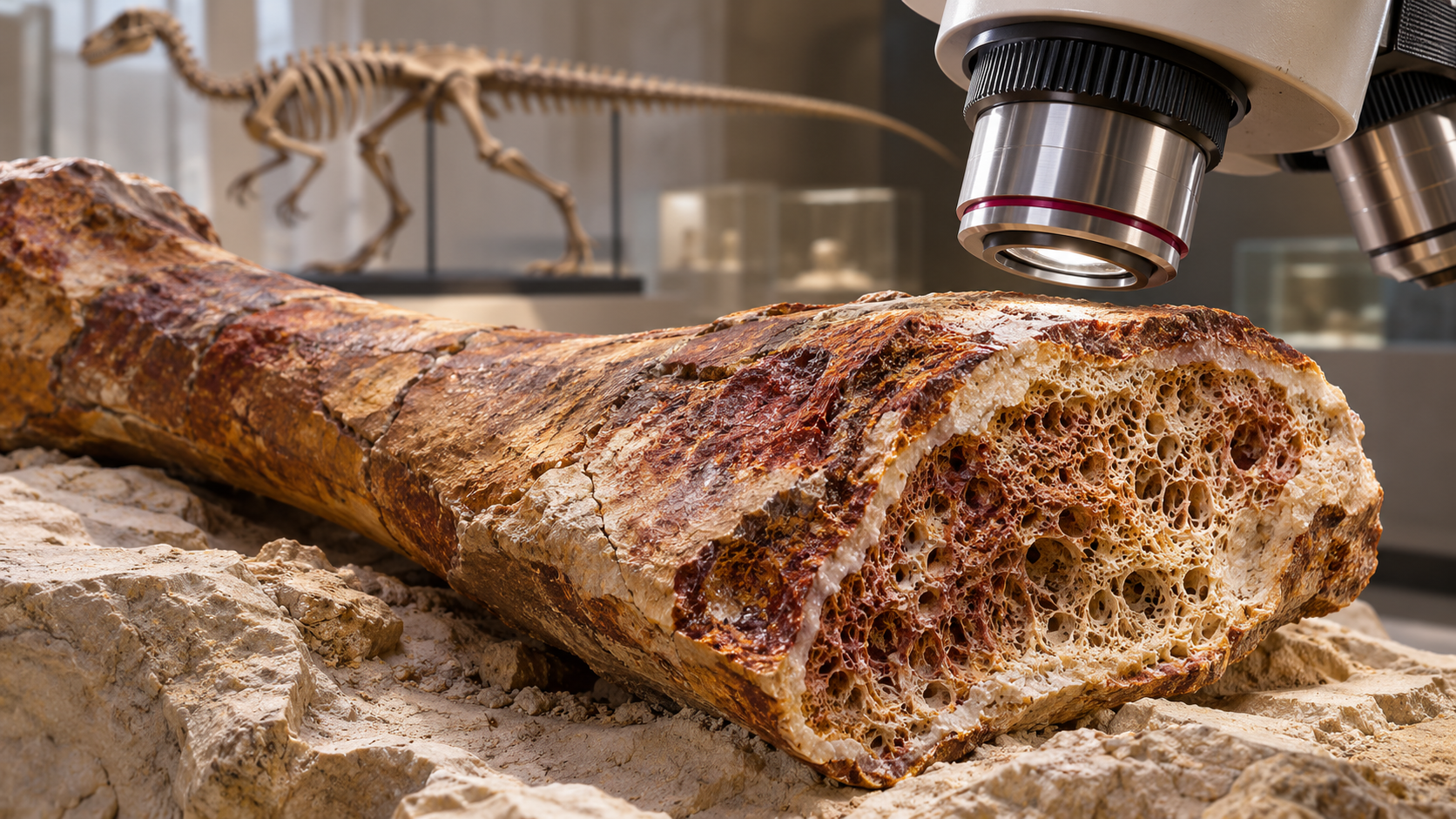
Inside the limb bones of a dinosaur that lived around 115 million years ago, researchers have identified microscopic structures and chemical signatures they interpret as fossilised red blood cells.
The animal was Aratasaurus museunacionali, a meat-eating dinosaur from what is now Brazil. A team led by Curtin University reported the discovery in research published online on 2 November 2026 in Proceedings of the National Academy of Sciences.
Could scientists use it to bring dinosaurs back? No: this discovery does not provide the usable genetic material needed to recreate the animal. Its significance concerns what ancient bones can preserve about biology, rather than a demonstrated route to resurrection.
That distinction begins with what “blood” means after more than a hundred million years.
What Actually Survived Inside the Dinosaur Bone?
The researchers report two connected findings: tiny structures within channels that once accommodated blood vessels, and chemistry associated with haem, the iron-containing component of haemoglobin.
Haemoglobin is the protein that enables red blood cells to transport oxygen. Haem is one component of that system. Detecting haem-related material does not establish that an entire haemoglobin protein, functioning cell or complete blood sample has survived.
The structures were mineralised. The team identified hausmannite, a manganese oxide mineral, associated with their preservation. The university’s account also describes amino acids associated with collagen, a structural protein found in bone.
These are different categories of evidence. A mineralised shape can preserve information about a former structure. A chemical remnant can indicate something about its original composition. Neither should automatically be described as a living cell waiting to be revived.
The useful question is how much original information remains within material that has undergone profound chemical change.
Why Chemistry Makes the Finding More Interesting
An object resembling a blood cell under a microscope is a starting point. Establishing its origin requires more.
The study’s abstract describes chemical analysis identifying haem B and a chemically altered derivative in the bone extract. The surrounding material showed a different chemical pattern, associated with chlorophyll and bacteriochlorophyll.
That comparison matters because fossils exist within environments containing other organisms and molecules. Researchers must distinguish material originating in the dinosaur from substances introduced during burial, decay or later contamination.
The team also used spatially resolved techniques to investigate the relationship between chemical signals and the microscopic structures themselves. Their argument therefore combines location, appearance, mineral composition and molecular evidence.
This makes the claim more substantial than resemblance alone. However, identifying a structure’s biological origin still involves interpretation. The paper itself describes the structures as inferred red blood cells in its abstract. A careful account should preserve that distinction rather than present a microscope image as self-explanatory proof.
How Could Blood-Related Material Last So Long?
The researchers propose that rapid burial in an environment with little oxygen and abundant microbial activity helped create unusual preservation conditions. Mineralisation may then have stabilised structures and associated chemical material before decomposition erased them completely.
That explanation does not require every component of the original cell to survive.
A useful way to understand the process is to separate preservation of form from preservation of function. A fossil can retain the outline of a biological structure while losing the machinery that once made it work. Chemical traces can persist after the larger biological system has broken down.
The proposed preservation process therefore concerns selective survival. Different materials follow different chemical pathways, and the survival of one does not establish the survival of another.
This is precisely why a discovery involving haem cannot, by itself, answer the separate question of whether DNA remains.
Why Blood Evidence Does Not Mean Dinosaur DNA
DNA contains sequence information used in an organism’s growth and functioning. A blood-related molecule does not contain the animal’s complete genetic instructions.
The distinction has already mattered in earlier dinosaur research. Natural History Museum researchers examining structures interpreted as red blood cells in Cretaceous fossils investigated whether DNA was present, but did not find it.
DNA deteriorates after death, and any ancient genetic claim also has to exclude modern contamination. Finding something that once belonged to an animal is therefore a different achievement from recovering an authenticated, readable genetic sequence from it.
For the resurrection question, that creates a hard evidential boundary: this fossil cannot be treated as a source of a dinosaur genome simply because some of its chemistry is consistent with ancient blood.
What Would Cloning Actually Require?
Animal cloning provides a useful comparison because it shows how much biological material the word “cell” can conceal.
In the established mammalian procedure known as somatic cell nuclear transfer, researchers place genetic material from a donor body cell into an egg whose own nucleus has been removed. Development must then proceed successfully, including gestation in a suitable animal.
The process begins with usable genetic material. It does not begin with the mineral outline of a cell or a chemical component once associated with blood.
The Aratasaurus finding supplies no demonstrated equivalent of that donor nucleus. Nor does it establish a reproductive system capable of turning reconstructed dinosaur genetic material into a healthy animal.
These are separate problems. Even a future discovery of authentic DNA fragments would not automatically solve genome reconstruction, embryo development or reproduction. Each step would need its own evidence of feasibility.
What About DNA That Is Millions of Years Old?
Ancient DNA research has achieved remarkable results, but comparisons need to preserve the difference in timescale.
A study published in 2022 recovered environmental DNA from deposits in northern Greenland dated to around two million years ago. The fragments helped researchers reconstruct an ecosystem containing plants and animals, including evidence associated with mastodons, reindeer and hares.
The authors suggested that binding to mineral surfaces helped the DNA survive.
That discovery shows why preservation research remains open to surprises. It also illustrates the distance between detecting ancient genetic fragments and possessing an intact organism suitable for cloning.
The Aratasaurus fossil is approximately 57.5 times older than those Greenland deposits, using the reported ages of 115 million and two million years. That calculation is a comparison of age, not a universal expiry date for DNA.
The Greenland result does not establish that genetic information can remain recoverable through the much longer history represented by this dinosaur. Nor did reconstructing its ancient ecosystem mean that researchers could recreate every organism detected within it.
Could Scientists Fill the Missing Gaps?
The familiar fictional solution is to recover fragments, identify what is missing and substitute genetic material from another animal.
But substitution and recovery are different operations. If the original sequence is unknown, inserting a plausible replacement does not demonstrate that the extinct animal’s sequence has been restored.
The Natural History Museum identifies incomplete genetic information as a fundamental difficulty with the Jurassic Park scenario. Knowing where fragments belong, what is absent and how the complete genome was organised cannot simply be assumed.
This is also a useful distinction when considering how far gene editing could go. An ability to change biological material does not, by itself, identify the historically correct changes.
As an inference, an engineered animal designed to resemble an extinct species would not automatically count as a recovered example of that species. Resemblance would need to be distinguished from demonstrated genetic reconstruction.
What Would Make This Discovery Valuable Without Resurrection?
Fossils already allow scientists to investigate anatomy, movement, feeding and reproduction through bones, tracks, teeth, eggs and other evidence. Molecular information could add another source of knowledge alongside those records.
The immediate task is to establish exactly which structures and chemical signatures are original, how they were preserved and how reliably comparable evidence can be identified in other specimens.
Further work would then need to connect particular measurements to particular biological conclusions. Detecting blood-related chemistry does not automatically reveal an animal’s metabolic rate or activity level.
The broader lesson is that different scientific questions require different kinds of surviving information. A chemical trace may help establish what a tissue once contained even when it cannot reveal the genetic sequence that produced it.
The next decisive advance would be reproducible evidence showing what these preserved features can reliably tell us about living dinosaurs. That would give the fossil a new scientific value without requiring it to become the starting material for a new animal.
Sources
Curtin University — Dinosaur Blood: Oldest Discovery Rewrites What Fossils Can Reveal About the Past — Research team’s account of the specimen, mineralisation and blood-related chemistry.
Grice and Colleagues — Heme Signatures in Mineralized Red Blood Cells Within Vascular Canals of a 115-Million-Year-Old Dinosaur Bone — Original study; the accessible abstract describes the analytical evidence. Full paper access was unavailable during preparation.
Natural History Museum — Can We Bring Back Dinosaurs? — Distinction between preserved blood-related material and recoverable DNA. Its older DNA-age benchmark is superseded here by the Greenland research.
National Human Genome Research Institute — Cloning Fact Sheet — Genetic material and developmental processes used in established animal cloning.
Kjær and Colleagues — A 2-Million-Year-Old Ecosystem in Greenland Uncovered by Environmental DNA — Primary research supporting the ancient-DNA comparison.
Natural History Museum — Beyond Jurassic World: What We Really Know About Dinosaurs and How — How different fossil evidence supports investigations of dinosaur biology.
Next Reads
New Dinosaur Hidden in Museum Collection for a Century Reveals Europe’s First Megaraptoran — How researchers distinguish preserved anatomy from a reconstruction.
Why Is CRISPR Such a Revolutionary Discovery — And How Far Could Gene Editing Go? — The difference between editing DNA and achieving a complete biological outcome.
Was Mars Once Habitable? What Perseverance Has Discovered — Why ancient chemical signals need geological context and careful interpretation.
