

Sugar-Free January: What Happens When Ultra-Processed Food Drops Out
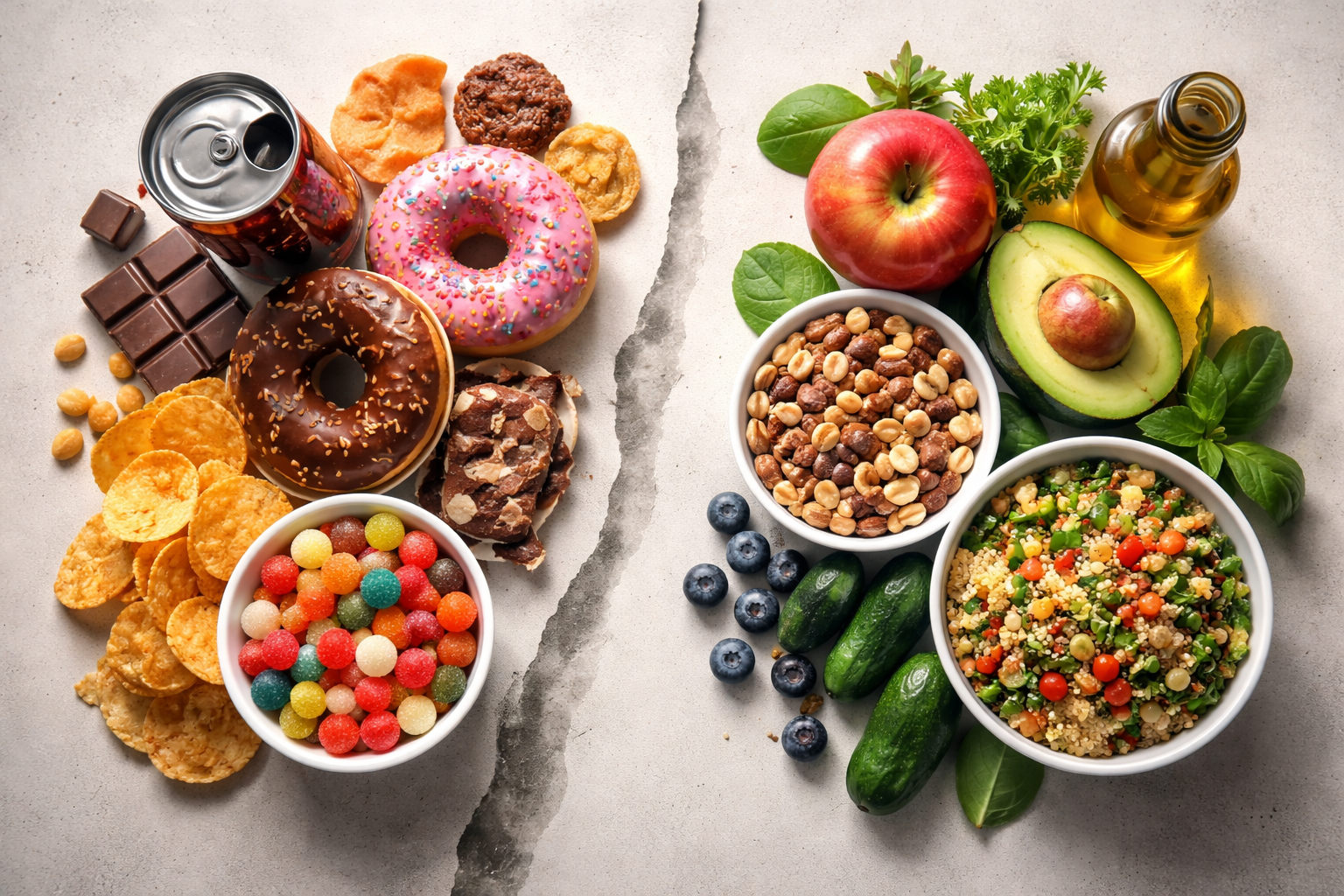
January has become the world’s month of self-experiments. This year, “Sugar-Free January” is popping up alongside Dry January and Veganuary—and many people are pairing it with something harder: cutting ultra-processed foods, too.
That combination matters, because most “sugar-free” attempts fail in a predictable way. People remove obvious sweets, then backfill the gap with “no added sugar” snacks, diet drinks, protein bars, and packaged convenience foods. The label changes, but the food environment stays the same.
When ultra-processed food drops out, the experiment changes from a willpower test into a systems test. Appetite, routines, spending, and social friction all shift at once.
This piece explains what tends to change first, what rarely changes at all, and why the benefits depend less on moral purity and more on the substitutions you make.
The story turns on whether Sugar-Free January becomes a high-friction restriction—or a redesign of defaults that can last past January 31.
Key Points
Sugar-Free January works very differently when ultra-processed foods also drop out; the most significant change is often appetite and eating pace, not just “less sugar”.
The first week can feel worse before it feels better: cravings, irritability, and low energy are common, especially if calories drop unintentionally.
Many early “wins” come from removing liquid sugar and snack grazing, which can quietly eliminate hundreds of daily calories without a formal diet plan.
Ultra-processed foods are not identical to “junk food”, and the line is debated; what matters most is what replaces them—fiber, protein, and minimally processed staples tend to help.
Some improvements (sleep quality, bloating, blood sugar swings) may show up quickly for some people, but dramatic body recomposition in 31 days is unlikely.
The hidden constraint is time and logistics: cooking, shopping, and planning can become the real barrier, not motivation.
The risk of rebound is significant: if January focusses on deprivation rather than establishing new eating habits, February may lead to compensatory eating and intensified cravings.
Background: Sugar-Free January Meets the Ultra-Processed Food Era
“Sugar-free” means different things in different kitchens. Some people remove only added sugars. Others cut all sweeteners, including honey and fruit juice. A few go further and treat it as a broader reset: fewer packaged foods, fewer snacks, and more simple meals.
Ultra-processed foods are commonly defined using the NOVA framework, which groups foods by the level and purpose of processing. The ultra-processed category generally includes industrial formulations made with refined ingredients and additives designed to improve shelf life, texture, or hyper-palatability. But the concept is contested. Critics argue that “ultra-processed” can lump together foods with very different nutritional profiles and that nutrient content and overall dietary pattern still matter.
The evidence base is also mixed in an important way. Large observational studies often make the strongest claims about ultra-processed foods, linking high intake with worse health outcomes. These studies alone are unable to definitively establish a cause and effect relationship. But a smaller number of tightly controlled feeding studies suggest a plausible mechanism: certain ultra-processed diets can drive people to eat more calories, faster, even when nutrients are matched on paper.
While sugar plays a role in this narrative, it is not the sole explanation. Many ultra-processed foods are not sweet. And some “sugar-free” products are still ultra-processed. So the practical question for January is not “Is sugar evil?” It is: what happens when the easiest calories in your environment become harder to access?
Analysis
Appetite, Reward, and the Pace of Eating
When ultra-processed foods drop out, many people accidentally change the speed and structure of eating. Packaged snacks and ready-to-eat foods reduce friction: they are fast, portable, and easy to overconsume without noticing. Home-prepared foods tend to require plates, pauses, and a bit of effort—small speed bumps that matter.
That is why the early “benefit” some people feel is not mystical detox. It is often a quieter pattern: fewer grazing moments, fewer liquid calories, fewer hyper-palatable triggers, and fewer meals eaten at a sprint.
Taste can recalibrate, too, but it is not guaranteed. Some people report that sweet foods start tasting aggressively sweet after a couple of weeks off added sugar. Other research suggests sweet preference is more stable than people assume, especially if sweetness is replaced with non-sugar sweeteners rather than reduced overall. In practice, the most reliable shift is not “I stopped liking sweet things.” It is “sweetness stopped being everywhere.”
A common early trap is under-eating. If someone removes their usual breakfast bar, mid-morning latte sugar, afternoon snack, and dessert—then replaces them with nothing substantial—fatigue and irritability are predictable. The body is not protesting virtue; it is reacting to a sudden drop in energy intake, often paired with less convenient access to quick carbs.
Economic and Market Impact
January challenges are not isolated incidents. Food companies meet demand where it forms. Sugar-Free January tends to produce a flood of “no added sugar” messaging and reformulated products that keep the same convenience and branding while swapping ingredients.
That can help some people reduce added sugar, but it can also create a false sense of progress. A “no added sugar” badge does not automatically mean a food is low in calories, high in fiber, or filling. And the marketing can steer people toward ultra-processed substitutes that keep the snacking rhythm intact.
Policy is moving here, too. Several countries are tightening how high-sugar, high-salt, and high-fat products are presented and promoted. The direction of travel is toward clearer front-of-pack signals and tighter advertising rules, especially around children. For consumers, this implies a gradual shift away from a default sugar-forward environment. However, this transition will be uneven, and product innovation will strive to stay ahead of the rules.
Social and Cultural Fallout
Sugar-Free January with fewer ultra-processed foods changes how a person shows up in social life. It is not just “no dessert.” It is fewer takeaways, fewer quick lunches, fewer shared snacks at work, and fewer default treats in family routines.
That can be socially costly. People do not just eat calories; they participate in rituals. Removing the packaged, sweet, and convenient categories can make someone feel difficult, self-conscious, or isolated—especially in workplaces where food is the easiest social glue.
There is also a mindset risk. When the month is framed as purity, it can slide into shame: one cookie becomes “failure”, and failure becomes permission to abandon the whole effort. The more durable framing is functional: identify the foods that hijack appetite, then design a month where those foods are not the easiest option.
Technological and Security Implications
January challenges increasingly run through apps, wearables, and tracking tools. For some people, that creates clarity and accountability. For others, it creates noise and obsession.
There is a quieter issue, too: data. Food logs, glucose graphs, and habit trackers can reveal health patterns that people would rather keep private and that companies may want to monetize. The more “biohacked” Sugar-Free January becomes, the more it nudges personal eating behavior into the world of persistent data trails.
Used well, technology helps by reducing decision fatigue: shopping lists, meal templates, recurring orders of staples. Used poorly, it turns eating into an always-on performance review.
Scenarios: What Happens Next
Scenario 1: The Default Reset
Trigger: A person builds two or three repeatable meals and removes the most common snack cues (desk snacks, car snacks, late-night sweets).
Who benefits/loses: The individual benefits; convenience food spending often drops. Time pressure is the main cost.
First visible sign: Fewer “white-knuckle” moments by week two, because the environment stops presenting constant decisions.
Scenario 2: The Processed Swap
Trigger: Added sugar is removed, but ultra-processed “better-for-you” substitutes become the backbone—bars, shakes, sweetened zero-sugar drinks, packaged snacks.
Who benefits/loses: The individual may reduce sugar, but appetite and snacking rhythm remain; the food industry benefits most.
First visible sign: Cravings persist, and meals feel optional because snacks keep filling the gaps.
Scenario 3: The February Rebound
Trigger: The month is built on restriction without replacements: fewer calories, fewer carbs, fewer comforting routines, little planning.
Who benefits/loses: Short-term scale weight may drop, but rebound eating risk rises; mood and sleep can worsen.
First visible sign: A “treat day” becomes a “treat week” after January, with higher-than-baseline intake.
What Most Coverage Misses
The real limiter is not knowledge. It is capacity. A low-sugar, low–ultra-processed month is easier for people with flexible schedules, kitchens, stable incomes, and predictable access to groceries. It is harder for shift workers, parents, and anyone living in a food desert or relying on workplace vending options.
There is also a second-order effect that rarely gets named: food waste. When people abruptly buy fresh produce and cook more without a planning rhythm, they often throw more away. Waste then becomes guilt, guilt becomes frustration, and frustration becomes “this lifestyle isn’t for me.”
The overlooked win is not perfection. The overlooked win is not achieving perfection; rather, it is establishing a few low-friction defaults that make the healthier option the easiest choice, even on the most challenging days.
Why This Matters: Sugar-Free January in a Changing Food System
In the short term, the people most affected are those with diet-sensitive conditions—prediabetes, type 2 diabetes risk, high triglycerides, fatty liver risk, and dental issues—as well as parents trying to shape kids’ snack norms.
In the long run, the implications extend beyond individual weight loss. Ultra-processed foods are a dominant calorie source in several high-income countries, and governments are increasingly experimenting with labeling and advertising rules that try to shift the environment, not just personal responsibility.
Concrete events to watch next:
January 5, 2026: New UK restrictions on advertising “less healthy” food and drink on TV and paid online media come into force.
January 1, 2026: Canada’s mandatory front-of-package nutrition symbol requirements reach full compliance, putting “high in” signals directly on many packages.
Early 2026: The next iteration of the U.S. Dietary Guidelines is expected after a delay.
May 2026 (expected): The U.S. FDA is scheduled to finalize a front-of-package nutrition labeling rule.
Real-World Impact
A night-shift nurse in Chicago tries Sugar-Free January and drops sugary coffee drinks and vending-machine snacks. The first week feels rough—headaches, irritability, low energy—until she adds a real meal before her shift and keeps protein-and-fiber staples on hand. The change that sticks is not “no sugar”. It is “no emergency eating.”
A single parent in Birmingham wants to cut ultra-processed foods for the household but can’t add an hour of cooking. The month works only when the goal becomes “two repeat dinners on rotation” and “snacks that look boring.” The main barrier is not cravings. It is time poverty.
A small café owner in Toronto watches customers start asking about “high in sugar” symbols on packaged items. Sales don’t collapse, but purchasing shifts: more demand for simple yogurt, nuts, and fruit, less for candy-like snack bars. The business adapts by changing what is visible at the counter.
A remote worker in Austin replaces sweets with “sugar-free” treats and diet drinks. The amount of added sugar decreases, yet the habit of snacking persists. The month feels like deprivation without relief because the reward loop never resets. The fix is counterintuitive: fewer substitutes, bigger meals.
Conclusion
Sugar-Free January becomes meaningful when it is not just subtraction. Cutting added sugar can remove obvious excess, but removing ultra-processed foods changes the structure of eating itself—pace, cues, convenience, and default decisions.
The fork in the road is simple. One path is a month of restriction that relies on willpower and ends in a rebound. The other is a month of redesigned defaults that lowers daily friction and quietly changes behavior.
The signs that tell you which way it is breaking are visible early: fewer snack “interruptions”, fewer emergency hunger moments, steadier energy, and a grocery basket that looks boring in the best way.
