If an Asteroid Hits the Moon in 2032, Could Earth Be in the Firing Line?
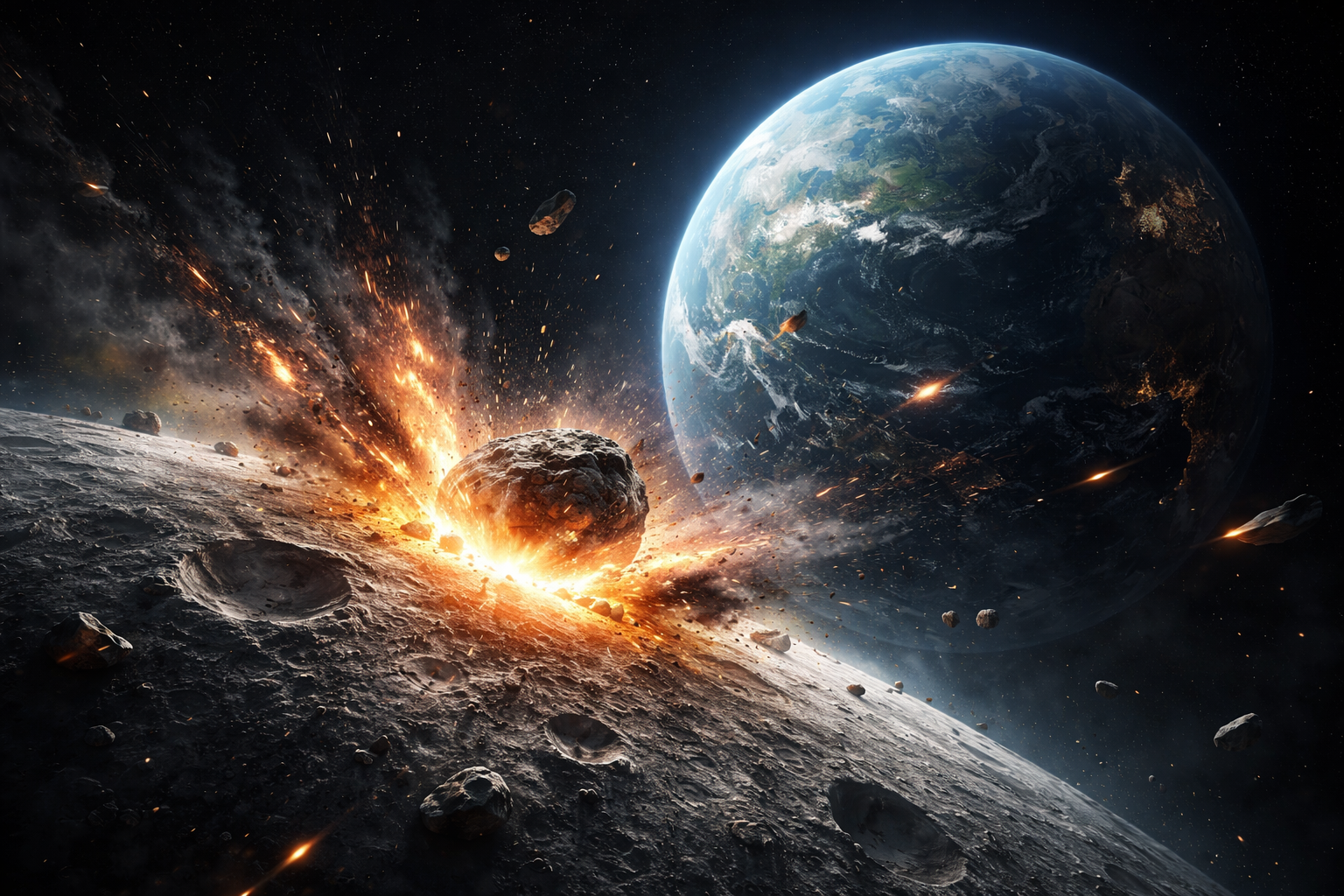
Asteroid Hits the Moon in 2032? What Could Reach Earth
An Asteroid, the Moon, and Earth: How Close Is “Too Close” ”?
A specific scenario is getting recirculated again: a ~60-meter near-Earth asteroid, 2024 YR4, has a small but non-zero chance of striking the Moon on December 22, 2032. The question people keep asking is simple: if it hits, could anything from that impact reach Earth—and should anyone be worried?
The short, disciplined answer is: Earth’s surface is overwhelmingly likely to remain safe, even in the impact case. But there is a narrower, more technical lane where risk can rise: space infrastructure—satellites, spacecraft, and operations in near-Earth and cislunar space—because tiny fast fragments don’t need to “hit the ground” to cause problems.
The story turns on whether a lunar impact corridor and ejecta geometry line up to deliver an unusual amount of moon material into the Earth–moon system.
Key Points
The “2032 Moon impact” talk is mainly about asteroid 2024 YR4 and a low-probability impact window on December 22, 2032.
More observations reduced Earth-impact concerns; the remaining public interest is about a possible Moon strike and what follows.
A moon impact can throw debris outward, but most ejecta falls back to the lunar surface; only a small fraction escapes the moon’s gravity.
If debris reaches Earth, it is most likely to arrive as tiny particles that burn up—potentially producing unusual meteor activity, not ground damage.
The more realistic operational concern is risk to satellites and spacecraft, because millimeter-scale debris can still be destructive at orbital speeds.
A key practical issue: the asteroid’s orbit and distance mean probability updates may not meaningfully improve until the next strong observing window.
The official track to watch is the NASA/ESA planetary defense ecosystem (risk lists, orbit refinements, and observation window updates).
Background
When people say “an asteroid hits the Moon in 2032,” they’re usually not talking about a random new object. They’re talking about 2024 YR4, discovered in late 2024 and briefly discussed as a small Earth-impact risk before additional observations substantially reduced that concern. The same data refinement that quieted the Earth narrative left a new curiosity: a lunar impact probability that remains low but existent.
Two basics matter here.
First, the Moon is already an impact record—its surface is a museum of craters. A new crater is not inherently alarming. What makes this case “sticky” online is that a ~60 -meter impactor is large enough to be energetic and observable, and it sits in a calendar year people can imagine.
Second, the Moon has low gravity and no atmosphere. That makes it easier for an impact to launch high-speed ejecta. But “ejecta can escape” is not the same as “ejecta will reach Earth in dangerous form.” The pathway is narrower than most viral summaries admit.
Analysis
The Scenario Being Discussed
The public recirculation usually frames this as “There’s a chance an asteroid hits the Moon in 2032—could Moon debris hit Earth?”
That’s the right question, but it needs a more careful translation:
The event is a possible lunar impact on December 22, 2032.
The uncertainty is not just “hit vs. miss,” but where on the Moon it could strike if it hits.
The outcome is dominated by ejecta physics and geometry, not cinematic shockwaves.
Even if the asteroid does impact, the Moon’s orbit is not going to be knocked out of place. The stakes are about material, trajectories, and exposure.
Probability: How to Think About It (Without Losing the Plot)
A low percentage can be psychologically misleading in both directions.
Some people treat it as “basically guaranteed.” It is not.
Others treat it as “so small it’s meaningless.” That’s also not quite right—because even low-probability events can justify monitoring if the consequences touch expensive systems (like satellites) or rare scientific opportunities.
A healthy mental model is this: probabilities move with data. Early in an object’s tracking life, the orbit is fuzzier; as observations accumulate, uncertainty narrows. The number you see today can be less like a prophecy and more like a snapshot of current measurement limits.
The practical implication is that “no big update lately” doesn’t always mean “nothing happening.” Sometimes it means the observing geometry isn’t giving trackers much new leverage right now.
Impact Energy and Ejecta Basics
A ~60 m rocky asteroid striking the Moon at typical solar-system encounter speeds carries city-scale kinetic energy. On the lunar surface, that translates into:
A bright impact flash (potentially observable)
A new crater on the order of hundreds of meters to around a kilometer, depending on speed, angle, and composition
A plume of ejecta with a wide size range: from dust up through boulder-scale fragments
The crucial filter is escape speed. To leave the Moon entirely, debris must exceed the Moon’s escape velocity (about 2.4 km/s). Most ejecta does not. It arcs and falls back, repainting the local terrain.
But a fraction can exceed escape speed, especially in the fastest components of the plume. That escaping fraction becomes the raw material for any “Could it reach Earth?” discussion.
Could Debris Reach Earth? The Real Pathways
There are three main pathways people imagine—only one tends to matter.
1) Direct transfer into Earth-crossing space
Some escaping particles can enter trajectories that cross Earth’s orbital neighborhood quickly. If they intersect Earth, the atmosphere is the dominant shield. For most fragment sizes likely to arrive, the outcome is ablation—burning up as meteors.
2) Temporary capture or extended residency in near-Earth space
Some material may not hit Earth immediately but could remain in near-Earth orbital space for a while. This matters because satellites don’t have a thick atmosphere protecting them. Even millimeter-scale particles can damage spacecraft at orbital velocities.
3) “Big chunks hitting the ground”
This is the viral mental picture—and it’s the least plausible. The combination of launch statistics, dispersion, and atmospheric entry makes large, intact moon rocks reaching the surface from this kind of event very unlikely. If any survivable fragments existed, they would be rare edge cases, not a widespread hazard.
So the sober conclusion isn’t “nothing can reach Earth.” It’s that what reaches Earth is overwhelmingly likely to be small, and the more relevant risk domain is orbital, not ground-level.
What We Would Detect First
If this scenario ever tightens, detection would lead with measurement, not spectacle.
Orbit refinement: tracking networks would narrow the uncertainty and rapidly converge on “hit vs. miss.”
Impact-corridor mapping: if impact remains possible, analysts would focus on where on the Moon it might occur, because location strongly affects ejecta delivery.
Operational alerts: if models suggested elevated debris flux near popular orbital altitudes, the first real-world “action” would be about space traffic planning: tracking, shielding posture, and risk windows.
If an impact occurred, visible phenomena would likely include a flash and subsequent dust plume on the Moon, followed later by potential meteor activity on Earth—if the geometry cooperated.
What Most Coverage Misses
The hinge is this: the biggest uncertainty is not “impact energy”; it’s the combination of impact location and geometry that controls whether ejecta efficiently reaches near-Earth space.
That changes incentives and timelines because it turns a dramatic public question (“Will Earth get hit?”) into an operational one: “Do we need to plan for a temporary spike in debris risk to satellites and missions?” The Earth-surface story is mostly a distraction; the real planning value is for space operators, not backyard shelters.
Two signposts would confirm this is becoming more than a recycled curiosity:
A sharpened impact corridor that stays consistent across independent tracking updates and keeps the Moon within the uncertainty region as the event approaches.
Explicit operational language in official updates about cislunar/near-Earth debris modeling, satellite exposure, or time-bounded hazard windows.
Why This Matters
For the public, this matters because it is a clean example of how risk actually works in planetary defense: probabilities update with observation geometry, and consequences live on a spectrum. The likely outcome is still “miss,” and even “hit” does not translate into apocalypse.
For space systems, it matters because a lunar impact is one of the few natural events that could plausibly create a short-term increase in small-particle flux through parts of the Earth–Moon environment. That risk would be time-bound and altitude-dependent, and it would primarily affect satellites, crewed missions, and operations planning—because impacts in orbit don’t need to be large to be costly.
The main consequence is not fear. It’s planning, because the protective actions—tracking, conjunction assessment, and mission scheduling—only work if they start from clear, early signposts.
Real-World Impact
A satellite operator gets asked to brief leadership on whether a “moon impact” could threaten assets and then has to translate hype into a simple operational answer: “Surface risk is minimal; orbital risk is conditional; watch the corridor updates.”
A university observatory team preps public outreach materials for a possible impact flash and lunar plume—because if it happens, it’s a rare chance to observe crater formation physics in real time.
A space insurer quietly re-runs models on debris exposure assumptions for late 2032 windows, because a short spike in particle impacts can change loss expectations even if it never becomes a mass-casualty story.
A mission planner building a late-2032 timeline (science, lunar relay, or commercial operations) adds a contingency note: “Monitor lunar-impact probability updates; revisit shielding and timing if flux forecasts rise.”
The Sensible Conclusion: Watch the Trackers, Not the Takes
If an asteroid hits the Moon in 2032, the most plausible “Earth effect” is a sky effect—unusual meteor activity—and a more technical, conditional effect: elevated debris risk in near-Earth space for satellites and spacecraft.
Most scenarios stay low-risk because the filters are strong: a miss is most likely, most ejecta doesn’t escape, and Earth’s atmosphere protects the ground. The remaining risk is narrower and more manageable: a potential, temporary debris environment change that would be handled by monitoring and operational planning.
The historical significance isn’t that the Moon might get another crater. It’s that we’re learning to treat the Earth–Moon system as a shared operating environment—where “planetary defense” is as much about space infrastructure resilience as it is about doomsday headlines.
