Is There Life After Death? What Science Actually Knows About the Final Moments of Consciousness
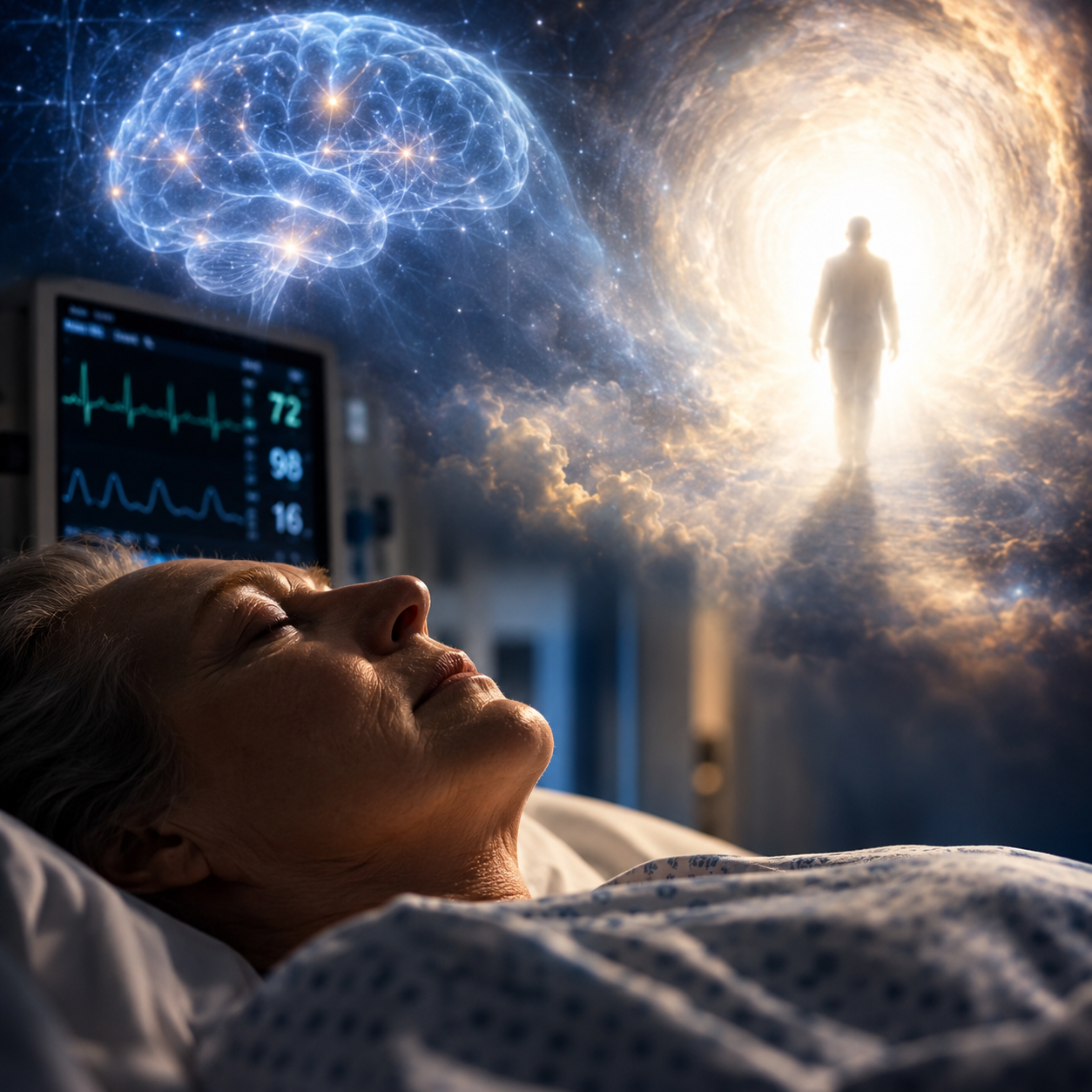
The Final Moments of the Human Mind
What Would Actually Prove an Afterlife?
For almost all of human history, death has marked the border science could approach but never cross. Religions described souls, heavens, reincarnation and judgment; materialism offered a colder answer in which the brain stops and the person disappears. Modern medicine has complicated both pictures, because death is increasingly understood not as one instantaneous event but as a biological process during which the heart, circulation, brain and consciousness can fail at different speeds.
And something unexpected has emerged from that narrow territory. Scientists have recorded organised electrical activity in some dying human brains, detected patterns associated with higher neurological processing during prolonged cardiopulmonary resuscitation, and interviewed cardiac-arrest survivors who describe extraordinarily vivid experiences from periods in which they appeared unconscious. None of this proves an afterlife. But neither does modern science possess an experiment capable of declaring the mystery closed.
Death Is a Process, Not a Single Moment
The popular image of death is an electrical switch: alive one second, dead the next. Biology is messier. When the heart stops during cardiac arrest, effective circulation collapses and the brain rapidly loses the oxygen and glucose required to maintain normal function.
Conscious responsiveness can disappear within seconds, while electrical activity measured at the scalp becomes profoundly suppressed. Yet cardiac arrest can sometimes be reversed, especially when CPR maintains partial circulation and defibrillation or other treatment restores a viable heartbeat. That creates an extraordinary scientific situation: people can cross surprisingly far into the physiological process of dying and subsequently return to describe what, if anything, they remember.
That distinction matters whenever anyone claims somebody was conscious while “dead.” Clinical death, cardiac arrest, coma, brain death and irreversible biological death are not interchangeable concepts. A person successfully resuscitated from cardiac arrest was, by definition, not irreversibly dead.
The scientific question is therefore narrower but no less fascinating: can meaningful conscious experience persist, emerge or re-emerge during the extreme physiological breakdown surrounding death?
The People Who Remember Something
Most people successfully resuscitated after cardiac arrest do not report an elaborate near-death experience. But a minority do.
A 2024 review of prospective cardiac-arrest studies found reported rates ranging from 6.3% to 39.3%, although the studies differed considerably in methodology, populations and definitions. Common themes have included extraordinary peace, bright light, altered perceptions of space and time, apparent separation from the body, life review and the feeling of entering another place.
These experiences can be psychologically enormous. A 2025 systematic review found that positive experiences are often followed by reduced fear of death, increased appreciation of life, greater compassion and spiritual change, while distressing experiences can leave confusion or lasting emotional difficulties.
That does not prove their metaphysical interpretation. Dreams, psychedelic experiences and hallucinations can also feel overwhelmingly real and permanently change a person's worldview.
But near-death experiences are scientifically important precisely because some occur around one of the most extreme disturbances the human brain can survive.
The Extraordinary AWARE II Experiment
One of the largest attempts to investigate the problem directly was the AWARE II project, conducted across 25 hospitals.
Researchers studied 567 in-hospital cardiac arrests while attempting something rarely possible during emergency medicine: measuring brain electrical activity and cerebral oxygenation during CPR while also using audiovisual tests designed to determine whether surviving patients had perceived information around them.
Only 53 of the 567 patients survived. Twenty-eight were sufficiently well to complete interviews. Eleven of those 28 reported memories or perceptions suggesting some form of conscious experience associated with the arrest. Six described what researchers classified as a transcendent “recalled experience of death.”
Those figures need careful interpretation because the final interviewed group was small. They certainly do not mean that 21% of everyone who dies consciously experiences an afterlife.
But the physiological recordings produced another result that may ultimately prove even more important.
Brain Activity Can Return During Resuscitation
Researchers detected EEG patterns normally associated with organised neurological activity during prolonged CPR.
Despite severe reduction in cerebral oxygenation, activity involving delta, theta and alpha frequencies sometimes emerged as far as roughly 35 to 60 minutes into resuscitation. The researchers argued that these patterns could indicate the temporary return of network-level cognitive activity.
This changes a simplistic assumption that the brain necessarily falls permanently silent seconds after cardiac arrest begins.
CPR is not normal circulation, and a patient receiving CPR is not functioning normally. But chest compressions can generate limited blood flow. The brain may therefore move through fluctuating states of severe suppression, partial reperfusion and temporary network recovery rather than following one clean descent into nothingness.
That possibility makes the fundamental mystery of consciousness particularly important. Neuroscience can correlate mental states with brain states remarkably well, yet science still lacks a universally accepted explanation for why particular patterns of biological information processing produce subjective experience at all.
The Strange Gamma Surge Around Death
Even stranger evidence has come from brains recorded during the process of dying itself.
In a remarkable 2022 case, doctors were continuously recording an 87-year-old man's brain with EEG when he suffered cardiac arrest and died. Researchers detected changes in neuronal oscillations around the arrest, including gamma activity and interactions between gamma, alpha and theta rhythms.
Gamma oscillations attract attention because they have been associated with processes including perception, attention and memory. Yet one dying patient with serious neurological injury cannot establish what a healthy brain normally does at death.
Another small study examined four comatose patients whose ventilatory support was withdrawn after treatment had been judged futile. Two of the four showed striking surges of gamma activity, particularly involving posterior regions associated with sensory integration.
Again, this is not evidence that two people entered another world.
It is evidence that the dying brain may sometimes become electrically more complicated at the very point when an older model might have expected nothing but progressive shutdown.
Does That Mean Someone Is Conscious?
No. This is one of the most important distinctions in the entire debate.
A brain signal associated with consciousness under ordinary conditions is not automatically proof of conscious experience under extraordinary conditions. Gamma activity can have multiple origins, recordings around death are vulnerable to physiological disturbance and artefact, and none of the patients displaying the most striking terminal gamma surges survived to report what they experienced.
Scientists therefore have one side of the equation without the other.
They have occasional recordings of remarkable brain activity from people who died and subjective reports from other people who survived.
What science does not yet possess is the perfect experiment: a person experiencing a precisely monitored episode of profound physiological shutdown, displaying a clearly identifiable neural event at a known second, surviving, and accurately describing an experience that can be time-locked to exactly that event.
That missing link is why the science of near-death experiences remains so contested.
Why Near-Death Experiences Are So Difficult to Explain
The central problem is timing.
Suppose somebody's heart stops. They lose consciousness. CPR begins. Their brain moves through changing levels of oxygen deprivation and partial reperfusion. Their heart eventually restarts. They remain unconscious before waking several hours or days later and describe travelling through darkness toward a brilliant light.
When did that experience happen?
It may have occurred while circulation was collapsing. It may have emerged during CPR. It may have happened as cerebral circulation returned. It could have developed during coma or early recovery. Fragments could even have been assembled into an apparently continuous memory as consciousness returned.
The survivor usually cannot answer that question because subjective time itself may have become radically distorted.
This is why the existence of the experience is much easier to establish than its biological timing.
Could the Brain Manufacture the Experience?
There are several plausible neurological ingredients.
Extreme oxygen deprivation alters neuronal function. Carbon-dioxide levels can change profoundly. Neurotransmitter systems become disrupted. Normal sensory information breaks down. Brain networks responsible for integrating body position, vision, memory, emotion and sense of self may operate abnormally.
Researchers have therefore explored models involving hypoxia, disinhibition, REM-like processes, memory mechanisms and unusual patterns of cortical activity.
The fact that similar elements can occur without genuine proximity to death strengthens the argument that the brain possesses machinery capable of producing at least parts of the near-death experience.
Out-of-body sensations, altered time, overwhelming connectedness, bright imagery and encounters with apparently autonomous entities can all appear in other altered states.
But reproducing parts of an experience does not necessarily identify the complete mechanism behind every NDE.
That distinction is crucial.
The DMT Question
The psychedelic drug DMT produces some of the most intriguing parallels.
Research comparing DMT experiences with near-death experiences has found overlapping themes including disembodiment, tunnel-like structures, bright lights, encounters with entities, a sense of dying, void-like environments and life-review-like experiences.
That is scientifically valuable because DMT demonstrates something beyond reasonable dispute: a functioning biological brain can generate experiences bearing remarkable similarities to reports traditionally interpreted as journeys outside the body.
It does not, however, prove the popular claim that the brain releases a huge quantity of endogenous DMT when humans die and that this causes NDEs. Evidence establishing such a mechanism in dying humans does not currently exist.
The psychedelic comparison therefore supports the brain's capacity to generate extraordinary states without demonstrating that every near-death experience is produced through the same chemistry.
The Problem With Out-of-Body Claims
The most potentially revolutionary evidence would not be somebody describing a tunnel or feeling that they met a deceased relative.
It would be independently verified perception of information that could not plausibly have reached the person's brain through conventional sensory pathways.
That is why experiments have attempted to hide visual targets around resuscitation areas.
AWARE II provided no dramatic confirmation. Nobody among the interviewed survivors correctly identified the visual image used in the experiment, although one person identified the auditory stimulus.
That matters.
Extraordinary anecdotal cases continue to be debated, but anecdotes cannot carry the evidential weight required to establish consciousness outside the brain. Timing can be uncertain, environmental information can sometimes be heard despite apparent unresponsiveness, memories can be reconstructed, and dramatic cases inevitably receive more attention than unsuccessful ones.
A genuine repeated demonstration of inaccessible information being correctly perceived during rigorously documented loss of brain function would change the debate almost overnight.
Science does not currently have that demonstration.
Terminal Lucidity Adds Another Mystery
Death research contains another phenomenon that is much less famous but equally strange.
Families and medical professionals have sometimes reported severely cognitively impaired people becoming unexpectedly lucid shortly before death. A person who has barely communicated because of advanced dementia may temporarily recognise relatives, speak coherently or behave more like their previous self.
Recent reviews confirm that such episodes have been reported and studied, but the empirical literature remains sparse. A 2025 scoping review found only ten qualifying studies after screening thousands of records, with much of the evidence coming from case reports and caregiver observations.
Terminal or paradoxical lucidity therefore should not be turned into proof that a soul is “breaking free” from a damaged brain.
But it poses an excellent neurological question.
If severe neurodegenerative disease has apparently destroyed the mechanisms needed for coherent communication, what temporary change allows meaningful function sometimes to reappear?
The answer could eventually reveal hidden resilience or alternative network pathways inside the damaged brain. For now, nobody has a complete explanation.
The Strongest Argument Against an Afterlife
The strongest conventional scientific argument is straightforward.
Virtually everything researchers know about ordinary consciousness demonstrates an intimate relationship between experience and brain function.
Anaesthetics can switch awareness off. Brain injuries can alter personality. Stimulation of particular neural systems can produce sensations and memories. Degenerative disease can erode cognition. Drugs can radically transform perception. Sleep changes consciousness as brain dynamics change.
Damage the machinery and the mind changes with it.
From that evidence, the most economical scientific assumption is that consciousness depends on brain activity and ends when the brain becomes irreversibly incapable of supporting it.
That is a powerful argument.
It is not quite the same thing as experimental proof that subjective existence becomes impossible after death.
The Strongest Argument Keeping the Question Open
The unresolved part begins with consciousness itself.
Science can identify increasingly sophisticated neural correlates of conscious states, but there remains no universally accepted theory explaining why physical processing produces first-person experience at all.
That does not constitute evidence for souls.
It does mean that declaring the metaphysical problem solved goes beyond what neuroscience has actually demonstrated.
Near-death research adds another layer. Some people report highly structured experiences around periods of extreme brain dysfunction. Organised electrical activity can sometimes persist or re-emerge farther into the dying process than earlier simplistic models implied. Terminal bursts of activity have been observed in a tiny number of dying brains.
Every one of those observations may ultimately receive a conventional neurological explanation.
But science has not reached that final explanation yet.
What Would Actually Prove an Afterlife?
Science could never simply put “heaven” into a scanner. It would need testable consequences.
Imagine that researchers repeatedly documented people acquiring specific information while brain function was demonstrably incapable of supporting perception, with the information hidden from normal sensory access and the experiment independently replicated across hospitals.
That would be extraordinarily difficult to explain within present neuroscience.
Alternatively, researchers might eventually discover some measurable process allowing information constituting consciousness to persist independently of the biological brain.
No such process has been established.
The correct scientific position is therefore neither “the afterlife has been disproved” nor “near-death experiences prove we survive.”
Both claims outrun the evidence.
So Is There Life After Death?
Science does not currently know.
It knows an enormous amount about dying and increasingly more about what the brain does near death. It knows that consciousness normally depends profoundly on brain function. It knows that people can undergo vivid, structured and life-changing experiences around cardiac arrest. It knows that parts of the dying brain can sometimes display surprising organised activity rather than simply fading smoothly into electrical silence.
What science has never demonstrated is continued personal consciousness after irreversible death of the brain.
That leaves an enormous gulf between “unexplained” and “supernatural.”
Near-death experiences occupy that gulf.
They may eventually teach us that the human brain is capable of one final extraordinary burst of internally generated experience as its normal organisation collapses. They may reveal previously unknown transitional states of consciousness. Better experiments may strip away much of the mystery.
Or researchers may eventually encounter evidence that the brain-centred model cannot explain.
That would rank among the most important discoveries in human history.
For now, death's deepest mystery remains intact. The frontier has moved: scientists can watch parts of the brain's final struggle in real time and occasionally hear from people who travelled remarkably far into that process and returned.
But the one person who could settle the question completely — someone who passes irreversibly beyond that boundary — cannot come back to report what happened next.
