Mars Didn’t Need Warm Air to Host Lakes—Thin Ice May Have Done the Job
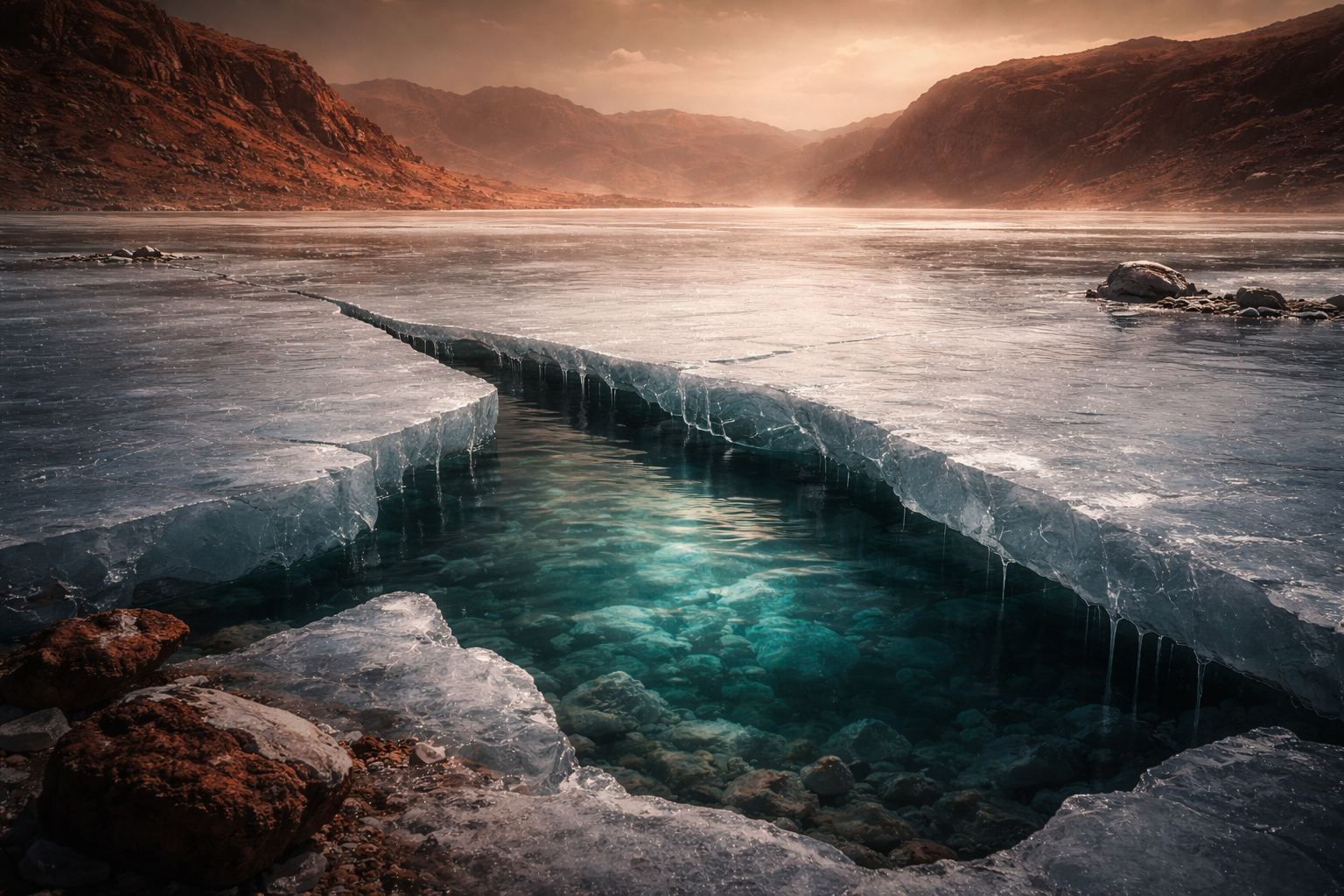
Mars Lakes Under Thin Ice: New Habitability Window Model
Cold Mars, Liquid Water: The Ice-Covered Lakes Forcing a Rethink of Where We Search for Life
A new modeling result is reshaping a familiar Mars argument: you may not need warm air to keep a lake liquid. The study suggests small ancient Martian lakes could have stayed liquid for decades beneath a thin, seasonal ice “lid” that traps heat and throttles evaporation, even while the atmosphere stayed well below freezing.
This issue issue matters now because “habitability windows” drive hard choices: which crater gets the next rover, which samples get prioritized, and which orbital signatures we treat as best-in-class for biosignature preservation. The headline is not “Mars was warm.” It says, "Mars could be cold and still wet locally for long enough to matter."
Here’s the hinge most people skip: the same ice that keeps water liquid can also act as a physical and chemical filter that changes what gets preserved—and what instruments are most likely to detect it.
The story turns on whether thin, seasonal ice can reliably stabilize liquid water long enough to build (and preserve) detectable chemical and textural fingerprints in sediments.
Key Points
A lake does not need a warm planet if it can hide under a thin seasonal ice cover that reduces heat loss and evaporation while still letting sunlight in.
If lakes persisted for decades in cold conditions, Mars’ “habitable moments” may have been more common—but more localized—than warm-and-wet scenarios imply.
The best places to look for signs of life are now sediments created at the edges of calm, ice-covered lakes, as well as shallow layers below the surface that are
Exploration strategy changes: prioritize places where orbital mineralogy and geomorphology suggest stable lacustrine deposition without strong evidence of thick, long-lived glaciation.
Instruments that excel at fine-scale mineral context and organics in sheltered samples become the payoff tools: Raman, fluorescence, micro-imaging, evolved gas analysis, and drilling.
The model makes falsifiable predictions about what we should (and should not) see: limited glacial scouring, specific seasonal layering patterns, and mineral assemblages consistent with freeze–thaw cycling.
Background
Mars is covered in relics of ancient surface water: deltas, layered lake beds, shore-like benches, and channels. The long-standing tension is simple: many climate simulations struggle to keep early Mars warm enough, long enough, to support persistent surface lakes.
This new work addresses the mismatch with physics, not nostalgia. Instead of asking, “How did Mars stay warm?” it asks, “How could water persist anyway?” The proposed mechanism is seasonal ice that is thin enough to transmit sunlight (so the lake can gain energy) but continuous enough to suppress evaporation and slow heat loss (so the lake doesn’t freeze solid).
The specific case used in public summaries centers on Gale Crater—the same basin explored by Curiosity—because it has unusually rich ground-truth constraints from rover observations and well-studied sedimentary sequences.
Analysis
The Physics: Why Thin Ice Can Be a Heater, Not Just a Freezer
A thick, permanent ice cap tends to lock a lake away from sunlight and can drive it toward complete freezing. Thin, seasonal ice behaves differently. It can:
Reduce evaporative loss by sealing the surface during cold, dry periods.
Insulate by slowing heat exchange between liquid water and the frigid air above.
Transmit sunlight if the ice is relatively clean and not too thick, letting energy penetrate and warm the water/ice interface during brighter seasons.
The core intuition is counterintuitive but testable: you can get a “cold climate, liquid interior” outcome when the surface boundary condition changes from open water (fast evaporation, fast heat loss) to an insulating ice lid (slow loss), while still allowing seasonal energy input.
What “Decades of Liquid Water” Really Means for Habitability
Decades is not geologic time, but it is biologically meaningful time if conditions repeat. Repeated seasonal cycling can create:
Stable chemical gradients (oxygen, sulfur, iron, carbon chemistry) at interfaces: water–sediment and ice–water.
Low-energy deposition occurs when fine grains settle down, trapping organics and microtextures.
Recurring "reset" events, such as partial melting and refreezing, can concentrate salts, alter pH levels, and trigger mineral precipitation, which ensnares biosignatures.
This reframes habitability from a single long warm era to many smaller, repeated windows. For life detection, repeated windows can be better than one short flood because they build layered archives.
Landing-Site Priorities: Where Preservation Gets Easier
If thin seasonal ice is plausible, the most attractive targets are not simply “places that once had water.” They are places where water could have persisted with minimal physical disturbance and strong preservation potential.
Look for basins with:
Look for basins that exhibit clear lacustrine stratigraphy, characterized by rhythmic layering, deltaic foresets, and quiet-water mudstones.
The mineralogy of these basins is consistent with aqueous alteration and burial, with clays being particularly effective at trapping organics.
The evidence of heavy glaciation is limited due to the potential for thick, erosive ice to erode fine laminations and complicate the biosignature context.
Shallow subsurface access (natural scarps, recent impacts, eroded buttes) that exposes once-buried sediments without requiring deep drilling.
In plain strategy terms: ice-moderated lakes push you toward fine-grained sedimentary rocks that were quickly buried and later re-exposed, rather than rugged terrains dominated by later erosion and oxidation.
Instruments: What You’d Fly If You Believe the Ice-Lid Story
An ice-lid, cold-lake scenario favors instruments that can (1) read mineral context at the micron scale, (2) detect organics without being fooled by contamination, and (3) access protected material below the most radiation-damaged surface.
Priority capabilities:
Raman/fluorescence spectroscopy to spot organics and diagnose key minerals in situ.
We use high-resolution micro-imaging to identify laminations, microtextures, and potential stromatolite-like fabrics, while maintaining caution against abiotic lookalikes.
Mineralogy mapping (VNIR/IR from orbit; close-up spectroscopy on the ground) locates clays, carbonates, sulfates, and silica-rich units that can preserve organics differently.
Evolved gas analysis/pyrolysis GC-MS (especially when paired with strong contamination controls) to test whether organics are indigenous and how they’re bound.
We use drilling or abrasion techniques to penetrate the radiation-processed rind and obtain fresher samples.
If you can only do one thing, sample acquisition from a protected, fine-grained unit beats another panoramic proof that water existed. Water is not the mystery anymore; preservation is.
What Most Coverage Misses
The hinge is that thin seasonal ice is not just a climate “fix”—it is a preservation and detectability filter that reshapes where biosignatures concentrate and survive.
Mechanism: an ice lid stabilizes the water column and limits evaporation, but it also changes chemistry (salt concentration during freeze–thaw), sedimentation (quiet settling and fine laminations), and exposure history (burial and shielding). That combination can increase the chance that organics are trapped, mineral-bound, and later retrievable from shallow subsurface samples.
Signposts to confirm it in the near term:
More model applications to multiple basins showing similar stability without invoking global warming and identifying the narrow parameter ranges (pressure, seasonality, ice thickness) where it works.
On the ground: targeted tests for freeze–thaw sedimentary rhythms and mineral assemblages that match repeated seasonal cycling rather than one-off floods or long warm lakes.
Why This Matters
Who is most affected: mission planners, landing-site committees, and teams designing payload trade-offs for life detection and sample return.
Short term (weeks to months): this kind of result tends to re-rank candidate sites in subtle ways—less “find the biggest delta” and more “find the best-preserved fine-grained archive with a plausible shielding history,” because biosignature science is ultimately about context and preservation.
Long term (years): if cold, ice-moderated lakes were common, Mars’ habitability becomes less about a single early climate state and more about local microclimates and repeated cycles. That pushes exploration toward:
Networks of sites (multiple basins across latitudes) should be established to test repeatability.
More drilling/subsurface access as a core requirement, not a nice-to-have.
The main consequence is straightforward: landing priorities tilt toward places where an ice lid could have preserved a readable sedimentary record, because that is where biosignature detection has the highest signal-to-noise.
Real-World Impact
A rover team reviewing traverse options faces a trade: chase dramatic geomorphology, or spend weeks sampling a dull-looking mudstone that might be the best biosignature vault on the planet.
A payload team choosing between another camera upgrade and a deeper abrasion/drill system has a new argument: if surface radiation is the enemy and shallow subsurface is the prize, access tools can outperform prettier pictures.
Orbital scientists planning follow-up observations shift time toward mapping minerals and subtle layering indicators that point to long-lived, low-energy deposition rather than just identifying “wet-looking” landscapes.
A group deciding which samples to collect can choose cores from fine layers and clay-rich areas instead of more visually appealing but unclear rocks, because the ice-lid theory suggests that preservation will vary and depend on the context.
The Predictions That Would Make or Break This
If thin seasonal ice stabilized lakes, we should expect a specific pattern across Mars:
At least some basins preserve lacustrine stratigraphy without widespread thick-ice signatures, indicating that the ice was seasonal and left little trace.
The sedimentary rhythms and mineral transitions are consistent with repeated seasonal cycling, resulting in subtle, layered archives rather than chaotic flood deposits everywhere.
Better-preserved organics in protected microenvironments: clay-rich layers, buried mudstones, and sheltered outcrops where radiation damage is minimized.
If future modeling and field tests instead show that stable liquid requires either much thicker ice (which should leave clearer geomorphic fingerprints) or much warmer air (which reintroduces the climate paradox), the hypothesis narrows or fails. That is the point: it is testable, and it tells you where to look next.
