

Microplastics may be weakening the ocean carbon sink — and that changes the climate maths
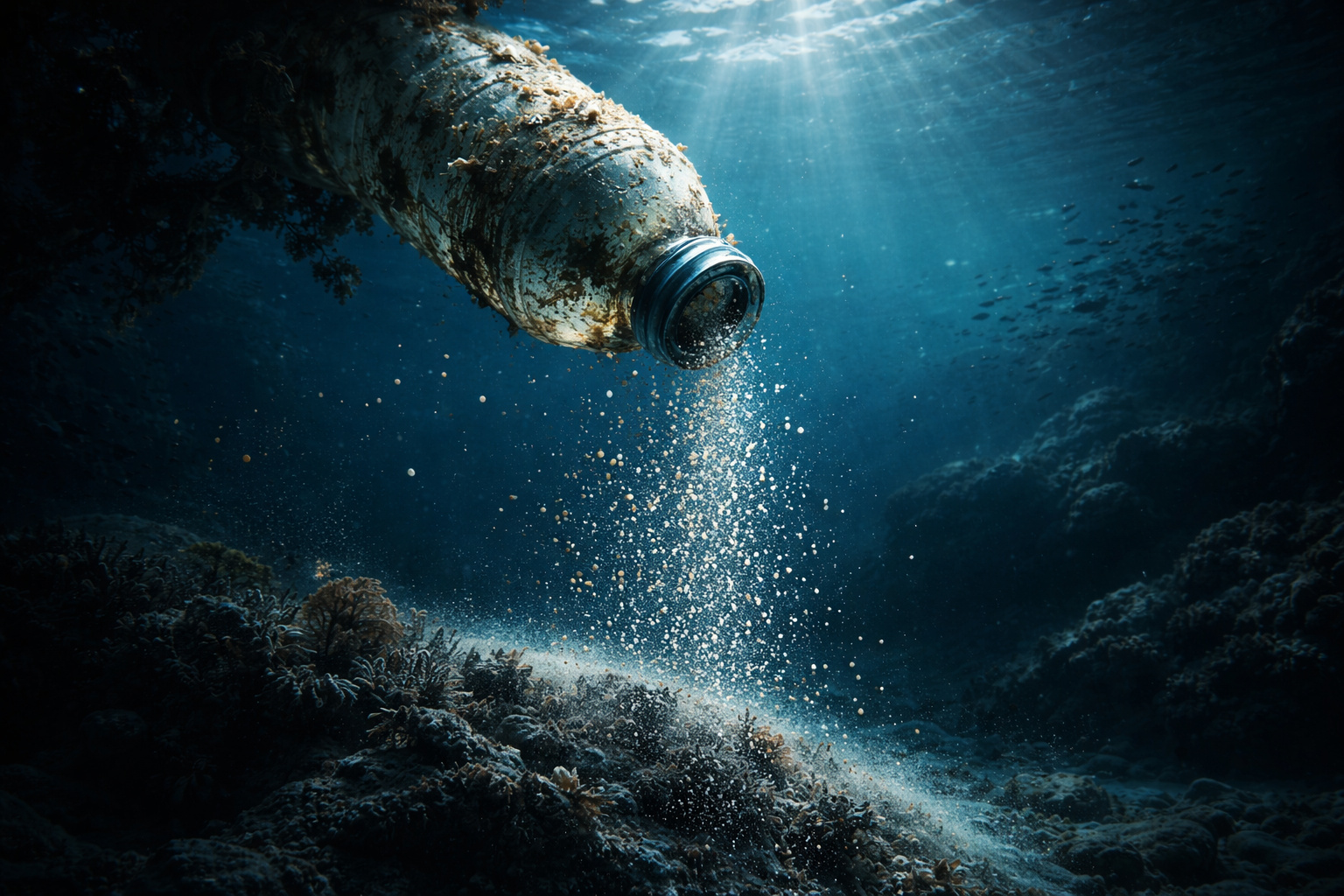
New synthesis warns microplastics could disrupt the ocean carbon sink. Here’s what’s proven vs hypothesised, and why policy shifts now.
Microplastics may be weakening the ocean carbon sink — and that changes the climate maths
The newest research synthesis making waves is not another “ocean litter” warning. It is a climate warning.
The argument is blunt: microplastics don’t just injure marine life — they can interfere with the living machinery that pulls CO₂ out of the air and locks some of it away in the deep ocean. If that machinery weakens, plastic stops being “only” a pollution problem and starts acting like a climate-risk multiplier.
That shift matters because it changes what plastic reduction means. It stops being charity-for-turtles and becomes something closer to emissions policy: a lever that protects a major carbon sink.
The story turns on whether microplastics meaningfully disrupt the ocean’s carbon-export engine at real-world scale.
Key Points
A new synthesis argues microplastics can interfere with the biological carbon pump — the chain from plankton photosynthesis to carbon sinking into the deep ocean — potentially weakening CO₂ uptake over time.
Mechanisms proposed include reduced phytoplankton performance, stress on zooplankton grazing and metabolism, and altered “marine snow” formation and sinking behaviour.
The “plastisphere” (microbes living on plastic surfaces) is flagged as another pathway that could affect greenhouse-gas dynamics and nutrient cycling, but attribution in the wild is still hard.
The evidence is layered: many effects are demonstrated in labs; field observations exist but are messy; global-scale impacts rely heavily on modelling and assumptions.
A separate modelling study suggests plastics could reduce ocean carbon uptake materially by mid-century under high pollution growth, but ranges and uncertainties remain large.
Policy implication: cutting plastic leakage (especially the hardest-to-capture microplastic sources) can plausibly be framed as climate-risk reduction, not just waste control.
What to watch next is not another viral beach photo — it’s better measurement, standardised methods, and “hotspot” field campaigns linking microplastics to carbon export.
Background
The ocean is one of Earth’s main buffers against warming: it takes up a substantial share of human CO₂ emissions and stores most of the excess heat trapped by greenhouse gases. That buffering is not automatic. It depends on physical circulation and on biology.
The biological carbon pump is the biological side of that buffering. In simple terms: phytoplankton use sunlight to turn dissolved CO₂ into organic matter; zooplankton and larger organisms package some of that carbon into particles; and a fraction sinks as “marine snow” into deeper layers where carbon can be stored for long periods.
Microplastics enter this system in two ways at once. They behave like particles in the water column, and they are also biologically active surfaces: they get eaten, colonised, and chemically weathered.
Analysis
The carbon pump is a chain — and microplastics can tug at multiple links
The key idea in the new synthesis is not that microplastics “add carbon” or “remove carbon” directly. It is that they can distort the processes that decide whether carbon stays near the surface (and returns to the air) or sinks (and stays stored).
There are multiple plausible choke points: plankton photosynthesis at the start of the chain, zooplankton grazing and respiration in the middle, and particle sinking speed at the end. The constraint is that oceans are noisy systems: warming, acidification, nutrient shifts, and overfishing already alter the same links. Untangling plastic’s unique fingerprint is difficult.
Scenario signposts to watch: coordinated time-series sites that measure microplastic load alongside primary production and carbon export; and field studies that repeat across seasons to separate “weather” from trend.
Link 1: phytoplankton under stress means less carbon enters the pipeline
Lab and mesocosm experiments have repeatedly shown that microplastics can reduce growth or photosynthetic efficiency in some phytoplankton, depending on polymer type, size, concentration, and the chemical cocktail stuck to the plastic surface.
The core mechanism is straightforward: impaired phytoplankton performance means less carbon fixation at the top of the food web. But the incentive shift for policy is subtle: microplastics are not evenly distributed. Coastal zones, shipping corridors, fisheries regions, and urban outflows are likely to be the first places where any carbon-cycle effects would show up, not the open ocean average.
Scenario signposts to watch: field campaigns in high-load coastal waters that detect consistent co-variation between microplastics and reduced plankton productivity after controlling for temperature, nutrients, and light.
Link 2: marine snow and sinking speed — the physical “export gate”
Even if phytoplankton fix carbon, it only becomes long-term storage if enough of it sinks fast enough. That is where “marine snow” matters: sticky aggregates of organic matter that fall through the water column.
A key claim in the literature is that microplastics can change how these aggregates form and how they sink — by altering particle density, changing the structure of aggregates, and modifying microbial activity that “remineralises” carbon back into CO₂ before it reaches depth. Some studies suggest microplastics can reduce the carbon content and settling velocity of marine snow, which would keep carbon in the upper ocean longer and make it more likely to return to the atmosphere.
Scenario signposts to watch: in situ measurements of aggregate sinking rates in waters with different microplastic burdens, plus sediment-trap evidence showing changes in exported carbon that track plastic loads.
Link 3: the plastisphere — a mobile microbial engine with unclear net effects
Plastic in seawater quickly becomes habitat. Microbes form biofilms on plastic surfaces — the plastisphere — and that community can carry genes and metabolisms that differ from surrounding water and sediment communities.
The climate-relevant question is not “are microbes present?” It is: do these communities change carbon and nitrogen cycling enough to move greenhouse-gas dynamics at ecosystem scale? Some work suggests plastisphere communities can be unusually active in pathways related to carbon and nitrogen cycling, which implies plastics may act like mobile biogeochemical “hotspots”. But directionality is tricky: some processes could increase CO₂ (or other greenhouse gases) locally; others could increase longer-lived dissolved organic carbon storage. Net effect is not settled.
Scenario signposts to watch: paired field studies that compare microbial function on plastics versus natural particles (like organic detritus) and track downstream effects on carbon export or gas fluxes.
What Most Coverage Misses
The hinge is that this is not one claim — it is a stack of evidence layers with different standards of proof.
Mechanism clarity matters because the climate implication is only as strong as the weakest link in the chain from microplastic exposure to reduced carbon export. Lab studies can show biological stress at controlled concentrations, but scaling that to the ocean requires knowing real exposure, how organisms adapt, and whether the effect persists in mixed natural communities. Field observations are “real” but often cannot isolate plastic from temperature, nutrients, and other pollutants. Models can integrate the system, but they bake in assumptions that may be conservative or wildly optimistic.
Two near-term signposts will decide whether this becomes a serious climate-policy lever: standardised measurement that reduces contamination and method noise, and hotspot-focused field programmes that link plastics to measurable changes in carbon export (not just organism health).
Why This Matters
In the short term, this reframing changes the policy conversation. If microplastics weaken CO₂ uptake even modestly, plastic leakage becomes climate-relevant in the same way that deforestation is climate-relevant: it degrades a sink, not just a landscape.
For the UK, the stakes are practical. The UK is part of ongoing global negotiations on a plastics treaty, and the policy debate often collapses into recycling targets and litter reduction. The emerging carbon-sink framing provides a tougher argument: reducing plastic inputs protects climate buffering capacity, especially in coastal and shelf waters where biological productivity is high and human inputs are concentrated.
Over the longer term, the message is uncomfortable: the ocean sink is already under strain from warming and acidification. If plastic pollution is another stressor on the same machinery, then “do nothing” becomes a double gamble — you lose biodiversity and you may also lose part of the planet’s CO₂ safety margin, because the sink’s efficiency is not guaranteed.
Real-World Impact
A coastal council weighing stormwater upgrades: microplastic capture stops looking like a niche environmental project and starts resembling climate-resilience infrastructure.
A seafood supply chain making sustainability claims: the risk is not only contamination headlines, but degraded local productivity if plankton and food-web dynamics are impaired.
A pension fund screening climate risk: plastics exposure becomes relevant to fisheries, coastal economies, and potentially to carbon-market narratives tied to “blue carbon”.
A policymaker facing tight budgets: upstream plastic reduction can be argued as prevention that avoids paying later for both cleanup and climate adaptation.
The new climate risk hiding in plain sight
The most important change here is mental, not technical. Microplastics are being repositioned from a visible pollution story to an invisible systems story: they may interfere with the biological processes that keep atmospheric CO₂ lower than it would otherwise be.
If future field work confirms even a modest drag on carbon export in hotspots, plastic policy gets a second justification that is harder to dodge. Not because plastic becomes the main driver of climate change — it doesn’t — but because it may chip away at a defence the planet is already relying on.
The next chapter will be written by measurement and attribution: better methods, clearer baselines, and field campaigns that connect microplastics to carbon export — not just to harm.
