Moderna’s Cancer Vaccine Breakthrough Could Usher In A New Era Of Personalised Treatment
Moderna’s Biggest Breakthrough Since Covid
A Cancer Vaccine Built For One Patient At A Time Just Passed Phase 3
Moderna has delivered what could become one of the most important validations of mRNA technology since the Covid-19 pandemic. Its experimental personalised cancer therapy, developed with Merck, has succeeded in a large Phase 3 trial involving patients at high risk of melanoma returning after surgery — pushing Moderna shares dramatically higher and moving a once-futuristic idea much closer to routine cancer medicine.
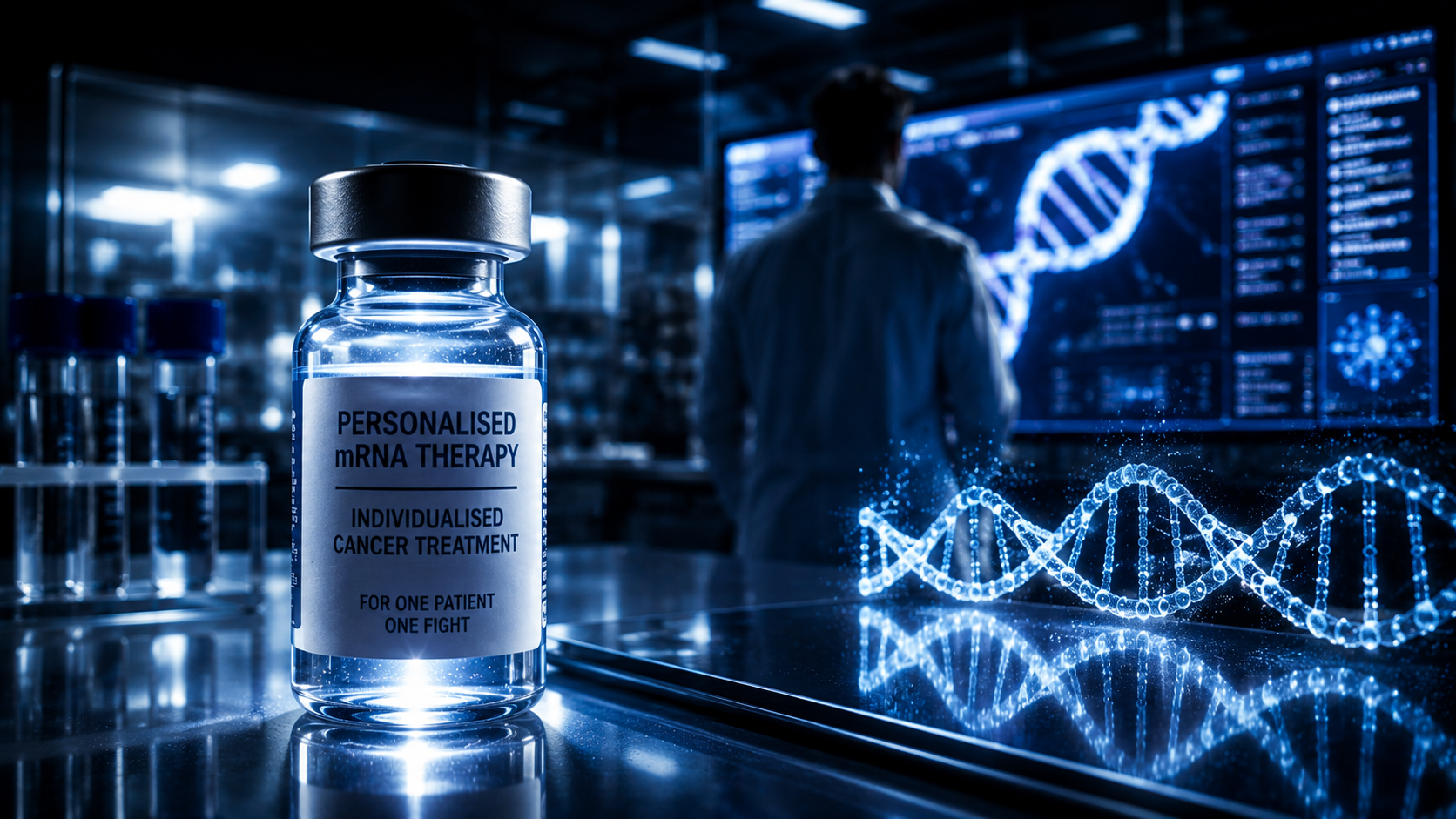
The treatment, intismeran autogene, is not a conventional vaccine designed to stop healthy people developing cancer. It is individually manufactured from the genetic characteristics of an existing patient's tumour, effectively giving the immune system a customised description of what that person's cancer looks like and helping it hunt down malignant cells that may remain after surgery.
The First Phase 3 Victory Of Its Kind
Merck and Moderna announced on August 19 that the Phase 3 INTerpath-001 trial met its primary endpoint of recurrence-free survival and a key secondary endpoint measuring distant metastasis-free survival. Patients receiving intismeran alongside the immunotherapy Keytruda performed significantly better on both measures than patients receiving Keytruda alone.
That distinction is what makes the announcement particularly important. According to the companies, it is the first positive Phase 3 trial for an individualised neoantigen therapy, the first positive Phase 3 trial for an mRNA-based cancer therapy and the first Phase 3 study in this setting to demonstrate a clinically meaningful improvement over Keytruda alone.
The study enrolled 1,137 patients whose stage IIB, IIC, III or IV cutaneous melanoma had been completely surgically removed. Participants were randomly assigned in a two-to-one ratio to receive intismeran plus Keytruda or Keytruda without the personalised therapy, with treatment continuing for approximately a year unless the cancer returned or toxicity required it to stop.
How The Personalised Cancer Treatment Actually Works
Cancer presents an unusually difficult target because it originates from a patient's own cells. Intismeran attempts to exploit something that separates tumour cells from healthy ones: the mutations accumulated inside an individual cancer.
A sample of the patient's tumour is genetically analysed to identify its distinctive mutational fingerprint. An individual mRNA therapy is then manufactured containing instructions corresponding to as many as 34 tumour-specific neoantigens — abnormal markers capable of distinguishing cancer cells from normal tissue.
Once injected, those mRNA instructions are translated inside the body and the resulting neoantigens are presented to the immune system. The objective is to generate populations of T cells capable of recognising cells carrying those cancer-specific targets.
Keytruda attacks the problem from another direction. It blocks PD-1, one of the mechanisms tumours can exploit to suppress an immune attack. In simplified terms, intismeran attempts to teach the immune system precisely what it should attack while Keytruda helps remove a biological brake preventing that attack from succeeding.
This is therefore radically different from producing one identical cancer medicine for millions of people. The underlying mRNA platform can be standardised, but the therapeutic instructions inside each patient's treatment are determined by that patient's own tumour.
How Effective Is It?
The new Phase 3 result is clearly positive, but one important piece of information has not yet been released: the actual magnitude of the Phase 3 benefit.
Moderna and Merck have announced that improvements in recurrence-free survival and distant metastasis-free survival were both statistically significant and clinically meaningful. They have not yet published the complete Phase 3 numbers showing precisely how much lower the recurrence or metastatic risk was. Overall survival also remains under evaluation as the trial continues.
That distinction matters because earlier results have already produced some extraordinary-looking numbers, but they came from a smaller Phase 2b study and should not be confused with the new Phase 3 trial.
At five-year follow-up, that earlier study found that intismeran plus Keytruda was associated with a 49% reduction in the risk of recurrence or death compared with Keytruda alone. It also showed a 59% reduction in the risk of distant metastasis or death.
Those results had already suggested the treatment might deliver a durable effect. The significance of the latest announcement is that a much larger pivotal trial has now independently cleared its principal efficacy test.
There were also no new safety signals reported in the Phase 3 study. The companies said the safety profiles remained consistent with those previously observed for the combination, although detailed Phase 3 safety results have not yet been publicly presented.
Why The Missing Phase 3 Numbers Matter
The announcement is a genuine scientific milestone, but it is not yet the complete scientific story.
The companies released topline results after a pre-specified interim analysis. Detailed figures will be presented at an international medical meeting and supplied to regulators. The study itself will continue while researchers assess additional endpoints, most importantly overall survival.
That means claims that the new Phase 3 trial has already demonstrated a specific 49% or 59% reduction would be premature. Those percentages belong to the previous Phase 2b programme.
The unanswered question is no longer simply whether personalised mRNA cancer vaccination can work in a late-stage trial. It apparently can. The question is now how large the Phase 3 benefit is, how durable it proves to be and whether longer follow-up eventually translates into more patients remaining alive.
Why Moderna's Shares Soared
Investors immediately understood that this result means much more to Moderna than another successful experimental medicine.
The company's stock more than doubled during trading following the announcement. Merck shares also climbed as investors reassessed the commercial potential of the treatment and, more broadly, the possibility that personalised mRNA medicines could become an entirely new category of oncology.
For Moderna, the implications are particularly large. The company became synonymous with mRNA after its Covid-19 vaccine, but proving the platform could repeatedly generate important medicines outside infectious disease has been one of the central questions surrounding its long-term future.
Cancer has always represented one of the enormous potential prizes.
A positive pivotal cancer trial changes that argument. It does not guarantee regulatory approval, commercial success or effectiveness against other tumours, but it provides powerful late-stage evidence that personalised mRNA therapeutics can produce clinically meaningful results against human cancer.
When Could Patients Actually Receive It?
Patients cannot currently receive intismeran as a standard approved melanoma treatment. It remains investigational.
Merck and Moderna say they intend to present the detailed results and engage regulatory authorities over filing submissions. No definitive FDA, UK, European or worldwide approval date has yet been announced.
Moderna had previously identified 2027 as the earliest potential launch window if the Phase 3 programme succeeded and regulators approved the treatment. Following the positive result, company executives have again suggested patients could potentially gain access as early as next year if the regulatory process proceeds successfully.
That makes 2027 a plausible earliest commercial target rather than a guaranteed availability date.
Regulators will need to examine the complete efficacy and safety dataset, manufacturing consistency and the unusual logistics involved in producing an individual treatment from each patient's tumour. Different countries could subsequently approve and fund the therapy at very different speeds.
Why This Could Go Far Beyond Melanoma
Melanoma may ultimately be only the beginning.
Merck and Moderna already have nine Phase 2 and Phase 3 studies evaluating intismeran across different tumour types and stages. Research extends beyond melanoma into non-small cell lung cancer, bladder cancer and renal cell carcinoma, while additional studies are exploring settings including pancreatic, gastric and other lung cancers.
That pipeline is arguably the most important reason the announcement could have consequences far beyond the patients enrolled in INTerpath-001.
Every cancer has different biology. Success in melanoma does not prove intismeran will work in lung, kidney, bladder or pancreatic cancer, and some tumours may prove substantially harder for personalised vaccines to attack.
But Phase 3 success validates a fundamental concept: researchers can sequence an individual's tumour, select relevant mutations, manufacture a bespoke mRNA therapy and use it to stimulate an immune response capable of producing measurable clinical benefit.
If that model can be repeated across cancers, oncology could gradually move from treatments primarily classified according to where a tumour originated towards therapies increasingly tailored to the molecular characteristics of each person's disease.
The Global Health Opportunity — And The Global Health Problem
More than 330,000 people worldwide were diagnosed with melanoma in 2022, and the disease remains responsible for most skin-cancer deaths. Even after apparently successful surgery, patients with high-risk melanoma can face the possibility that microscopic malignant cells remain and eventually establish recurrent or metastatic disease.
A therapy capable of eliminating more of those residual cells could therefore change treatment at one of cancer medicine's most critical moments: after surgeons have removed everything visible but before surviving cancer cells have had the opportunity to spread.
The larger global implication would emerge if the technology succeeds against several major cancers. Personalised cancer vaccination could become an additional layer of treatment alongside surgery, radiotherapy, chemotherapy, targeted medicines and checkpoint immunotherapy.
Yet personalisation also creates a problem traditional mass-produced medicines do not face.
Every course must be designed around an individual patient's tumour. That demands sequencing, computational analysis, specialist manufacturing, quality control and rapid delivery back into the clinical system. Scaling that process for potentially hundreds of thousands of patients would be fundamentally different from manufacturing millions of identical tablets or vaccine doses.
Cost and infrastructure could therefore determine how global the revolution really becomes. Wealthy healthcare systems and major specialist cancer centres may initially be far better positioned to deliver individualised therapies than poorer countries with limited genomic and manufacturing capacity.
A technology capable of making cancer treatment more personalised could, without dramatic improvements in manufacturing and access, also make advanced cancer treatment more unequal.
What Happens Next
The next major event will be publication or presentation of the complete INTerpath-001 data. Researchers will want to see the absolute recurrence rates, hazard ratios, confidence intervals, subgroup performance, adverse-event profile and the emerging overall-survival curve rather than relying solely on the positive topline announcement.
Regulatory discussions will follow. Approval would potentially establish the first mRNA-based individualised cancer therapy to reach routine clinical use, turning technology associated by most of the world with pandemic vaccination into something very different.
Then comes an even bigger test: whether melanoma proves to be the ideal tumour for this strategy or the first successful example of a platform capable of attacking many cancers.
That is why the market reaction has been so extreme. The breakthrough is not evidence that cancer has been cured, and it does not mean an mRNA vaccine will work against every tumour. It is something more precise and potentially more consequential: the first large late-stage evidence that a vaccine manufactured around the genetic fingerprint of one person's cancer can improve outcomes beyond an established immunotherapy.
If the complete Phase 3 data withstand scrutiny and the results begin appearing across other tumour types, August 2026 may be remembered as the point when personalised mRNA cancer treatment stopped looking experimental and started looking like a new branch of medicine.
