Crater or Reshaped World? Inside Hera’s Investigation of Dimorphos
Investigating a Changed World
DART Changed Dimorphos’s Orbit, but Its Battered Surface and Uncertain Mass Still Hold Answers Needed for Future Asteroid Defence.
NASA hit its target. The asteroid’s orbit changed. Four years later, scientists are preparing to inspect what the collision left behind.
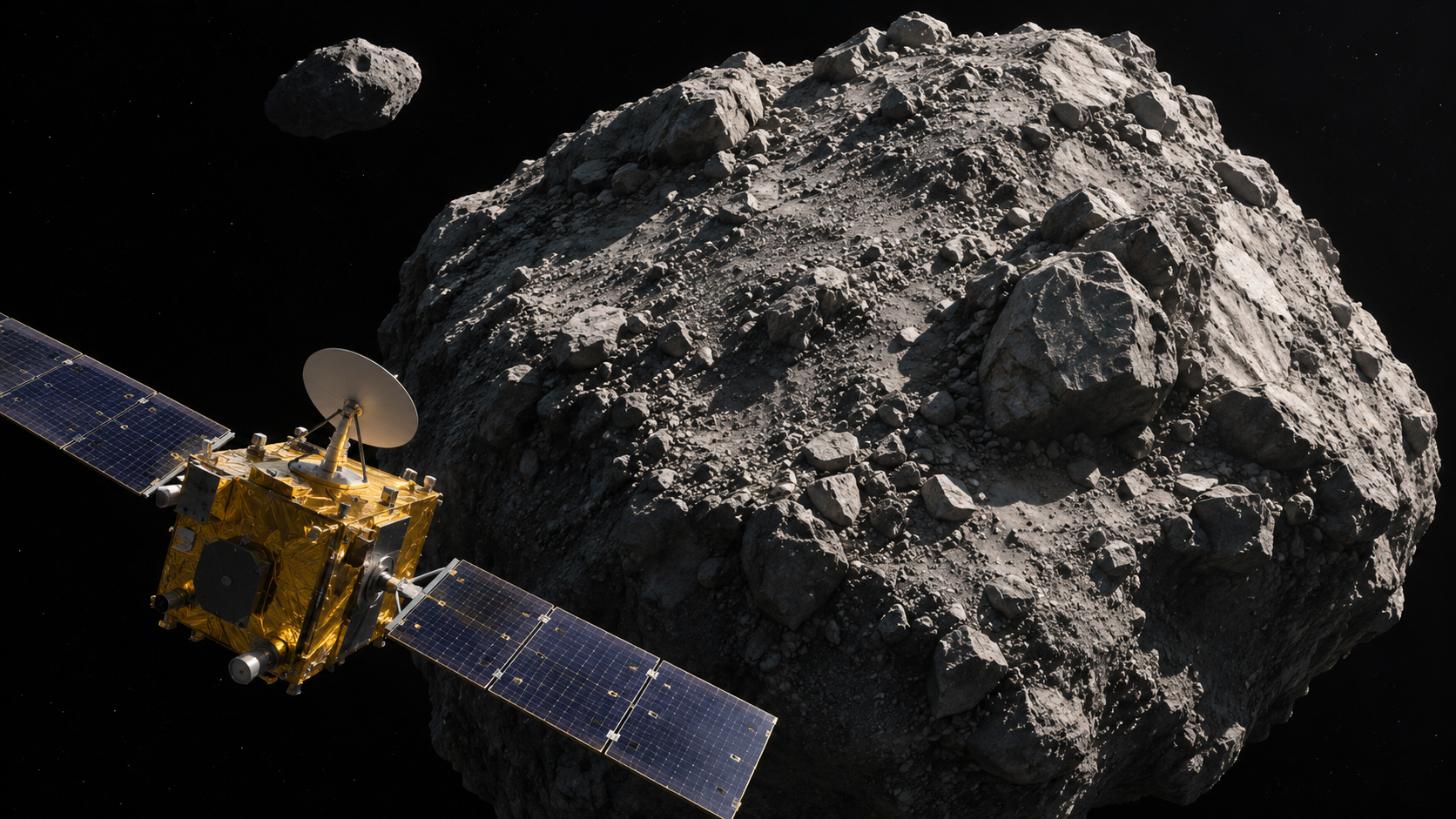
The European Space Agency’s Hera spacecraft has distinguished Didymos and its smaller companion, Dimorphos, as separate objects in its own images for the first time. It is approaching the system to investigate the aftermath of NASA’s Double Asteroid Redirection Test, better known as DART.
The central result is already established: a spacecraft can deliberately change an asteroid’s motion. Hera’s task is to measure the properties and physical changes needed to explain that result more precisely. Those measurements will help scientists judge how the same technique might perform against a different asteroid.
Neither Didymos nor Dimorphos threatens Earth. This is a planned experiment in planetary defence, with the close examination following the destructive test.
What Hera Has Actually Seen
ESA’s update of 27 October described an image taken from about 1,280 kilometres away. Dimorphos occupied roughly one pixel, but it could be distinguished from Didymos rather than disappearing into a single combined point of light.
That is an approach milestone, not yet a detailed picture of the damage. A separated dot cannot establish the size of a crater or reveal how rocks have shifted across the surface.
In an operations plan published on 2 November, Japan’s Hera project team scheduled the spacecraft to reach a position approximately 20 to 30 kilometres from the system on 4 November, using Japanese time. As of 3 November, that remains a planned milestone rather than a confirmed arrival.
ESA separately announced that detailed images of Dimorphos would be unveiled on 25 November. Arrival, scientific observations and public image releases are different events; the first does not mean all the answers are immediately available.
What NASA’s Collision Changed
DART struck Dimorphos on 26 September 2022 at about 6.1 kilometres per second. The smaller asteroid travels around Didymos, giving researchers an orbit they could monitor before and after impact.
Before the collision, that circuit took approximately 11 hours and 55 minutes. The impact shortened it by around 33 minutes. This figure describes a reduction in the time needed to complete an orbit around Didymos, rather than a distance the asteroid moved or a change in its year around the Sun.
Researchers could detect the alteration through observations made far from the asteroid. As the two bodies move around one another, their combined brightness changes. Those recurring variations help reveal their orbital timing, while radar adds information about their relative positions and motion.
DART also demonstrated the ability to navigate towards and strike a small target at high speed. A useful deflection technique needs both achievements: reaching the object and changing its movement by a measurable amount.
The Debris Supplied an Extra Push
The spacecraft’s direct impact was only part of the mechanism. Rock blasted away from Dimorphos carried momentum, producing a recoil that enhanced the asteroid’s change in motion.
This expelled material is called ejecta. It matters because an impact that throws substantial material backwards can transfer more momentum to the remaining asteroid than a collision in which the spacecraft is simply absorbed.
An early NASA analysis estimated a momentum enhancement of about 3.6, assuming that the two asteroids had the same density. A subsequent research summary gave a range of 2.2 to 4.9 depending on Dimorphos’s mass. These figures describe the extra momentum transfer, not a multiplication of the asteroid’s speed.
The dependence on mass is crucial. Researchers have measured a change in movement, but calculating the momentum involved requires knowing how much material was being moved. A better mass measurement can therefore sharpen the interpretation of a collision whose broad success is already clear.
For a future mission, that affects practical choices: how large an impactor to send and how much change in the target’s motion to expect.
Did DART Leave a Crater or Reshape Dimorphos?
A familiar impact picture involves a hole surrounded by disturbed ground. Dimorphos may have responded more extensively.
A study described by NASA in March 2024 combined spacecraft imagery, radar and changes in reflected light to model the asteroid after the collision. The results indicated that it had become more elongated and that its orbit was no longer circular.
These were deductions from several kinds of evidence, rather than a close-up survey of the entire surface after impact. Hera can test those deductions against direct observations and map features that distant measurements cannot resolve.
The distinction matters because an asteroid’s internal arrangement affects how it responds to a strike. Observations suggest Dimorphos is a loosely assembled rubble pile. Material in such a body can move and rearrange in ways that differ from an intact block of rock.
A conspicuous crater would provide one kind of evidence about the impact. Widespread deformation would provide another. The useful result is an accurate account of where the energy and material went, whatever shape the final landscape takes.
How Hera Will Examine the System
Hera carries cameras and other instruments designed to connect appearance with physical properties. Visible-light images will map the surface, while thermal measurements can constrain properties of the material through the way its temperature changes. Measurements across different wavelengths will help investigate mineral composition.
Radio tracking also serves a scientific purpose. Small changes in spacecraft motion reveal gravitational effects, helping researchers determine the masses of the bodies involved.
The operational challenge is that these asteroids exert very weak gravity. Hera must make controlled manoeuvres to remain at useful observing distances rather than relying on a simple, familiar orbit around a large planet.
ESA describes a sequence of arcs around the system, with regular corrections. Mission control in Darmstadt, Germany, directs the spacecraft, supported by deep-space communications stations. Maintaining the right geometry is part of obtaining dependable measurements: scientists need repeated views and tracking data, not just one dramatic photograph.
The November operations plan envisages progressively closer study, followed by deployment of Hera’s two small companion spacecraft, Juventas and Milani, in January 2027. Those dates remain operational plans and can change as the mission develops.
What This Means for Protecting Earth
The practical lesson from DART depends on having time. A modest change in an asteroid’s motion can build into a useful separation over a long interval. NASA’s technical account describes warning periods of many years to decades for this kind of intervention.
That makes discovery and tracking essential companions to impact technology. An effective spacecraft cannot provide years of accumulated deflection if the threatening object is found shortly before a possible collision.
There is also a limit to what one successful test establishes. Dimorphos is one object with a particular structure, mass and setting. Engineers need models that explain its response and can be adapted to other targets, with uncertainties made explicit.
Hera will supply measurements against which those models can be tested. Agreement would strengthen confidence in their predictions. A different surface or internal structure from the one expected would identify assumptions that need revising.
The most consequential finding may therefore be a number rather than an image: a better mass estimate, a clearer measure of momentum transfer, or a tighter constraint on how loosely the asteroid is held together. Those are the details that could help engineers decide how to move a future threat far enough, early enough.
Sources
ESA — First light: Hera resolves two asteroids instead of one — Approach imagery, observing distance and planned detailed-image release.
Hera-JAPAN Project — Upcoming Observation and Mission Operations Plan for the Hera Spacecraft in the Binary Asteroid Exploration Mission — Operations plan published on 2 November 2026, with dates expressed in Japanese time.
NASA — Early Results from NASA’s DART Mission — Ejecta recoil, the conditional momentum estimate and confirmation that the target system poses no threat to Earth.
NASA — NASA’s DART Data Validates Kinetic Impact as Planetary Defense Method — Deflection evidence, targeting and mass-dependent momentum enhancement.
NASA — NASA Study: Asteroid’s Orbit, Shape Changed After DART Impact — Modelled shape and orbital changes and the observations used to derive them.
ESA — Hera Frequently Asked Questions — Outstanding scientific questions, instruments and mass measurements.
ESA — Hera operations — Weak-gravity manoeuvring, mission control and communications.
NASA Technical Reports Server — Double Asteroid Redirection Test (DART) Mission — Warning time and the role of kinetic impact in planetary defence.
