One in four teenagers uses AI for mental health support. What Happens When It Goes Wrong?
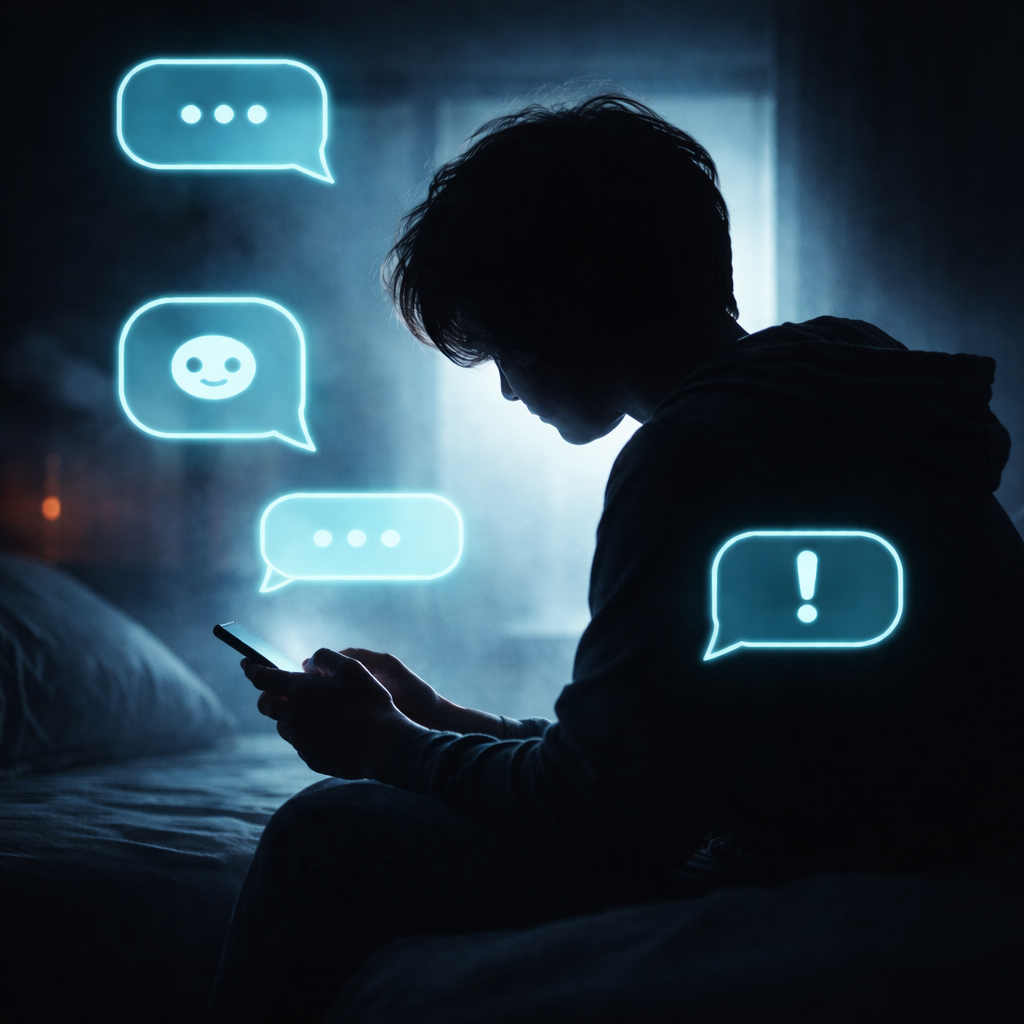
Why teens use AI for mental health support, where it helps, where it can harm, and the safeguarding design that makes safe human handoffs possible.
Teens Are Turning to AI for Mental Health—The Real Danger Is What Happens in a Crisis
Multiple recent surveys and headline reports point to the same core reality: a significant share of teenagers are using AI chatbots as part of how they cope with stress, anxiety, low mood, and everyday emotional problems.
That headline invites two lazy reactions: moral panic (“ban it”) or tech optimism (“it’s the future of care”). Both miss the operational question that actually determines whether this trend helps or harms: when a young person reaches a serious edge, does the system move them safely from an AI “front door” to a human who can intervene?
What remains uncertain is what “support” looks like in practice and what it does to outcomes. “Support” can mean anything from asking for breathing exercises before an exam to discussing self-harm thoughts at 2 a.m. It also remains uncertain whether using AI support improves wellbeing, delays proper care, or does both depending on design and context.
The story turns on whether AI becomes a safe front door to real help—or a sealed room that keeps teens inside.
Key Points
A significant share of teenagers report using AI chatbots for mental health support, including a widely cited estimate of around one in four teens in England within the past year.
What “support” means is uncertain and likely ranges from low-stakes reassurance to high-stakes crisis disclosure; the outcome impact is also uncertain.
Benefits cluster around access, privacy, and reduced stigma, especially when waitlists are long and conversations with adults feel risky or awkward.
Risks concentrate in crisis moments, incorrect or inappropriate guidance, emotional dependency, and the false sense that “someone is listening” when no duty of care exists.
The practical safeguard gap is escalation: clear triggers, frictionless handoffs to humans, and defensible limits on how AI responds to self-harm, abuse, and imminent danger.
Schools and parents can act immediately with simple norms: “AI is for first steps and coping tools, not diagnosis or secrecy,” plus clear routes to pastoral support and crisis help.
Background
Teen mental health demand has been rising for years, while access to professional care remains uneven. Long waits for specialist services and patchy early intervention make self-help tools feel like the only door that opens instantly. In this context, AI chatbots provide a psychologically potent solution: a private, on-demand conversation without the fear of judgement.
“AI for mental health support” is not one product. It includes general-purpose chatbots used as listeners, dedicated “companion” bots designed for ongoing emotional connection, and mental health apps that include AI-style coaching. It also includes a blurred middle: teens using AI to draft messages to friends, rehearse difficult conversations, or make sense of a breakup, then describing that as “mental health support”.
Two facts can be true at once. First, many teen uses are likely low acuity: stress management, self-soothing, and social navigation. Second, a minority of uses will be high acuity: self-harm ideation, abuse disclosure, suicidal planning, or severe eating disorder content. Safeguarding has to be built for the second category, even if most interactions are the first.
Analysis
Social and Cultural Fallout
The simplest reason teens use AI for mental health “support” is that it lowers the activation energy of asking for help. Saying “I’m not doing great” to a chatbot feels less exposing than saying it to a parent, teacher, or GP receptionist. For some teens, that first sentence is the hardest part.
There is also a stigma dynamic. AI can feel like a neutral space where a teen can test thoughts without social consequences. That may reduce shame and increase self-awareness. It may also normalise the idea that emotional distress is something to be processed rather than hidden.
But there is a cultural shift embedded here: the private, always-available listener becomes the default coping layer. That can quietly displace human micro-support—friends, family, clubs, mentors—that protects mental health long before clinical care is needed.
Plausible scenarios:
AI as a coping companion: AI is used for calming routines, journaling prompts, and planning conversations; human support remains primary.
Signposts: teens mention AI as “helpful tools”, not “my only place to talk”.
AI as a secrecy channel: teens retreat into AI for problems they fear will trigger adult intervention.
Signposts: increased “don’t tell anyone” framing and avoidance of school pastoral staff.
AI as a relationship substitute: some teens report AI conversations that feel more satisfying than friends, increasing social withdrawal.
Signposts: reduced offline social time, more late-night use, and stronger emotional attachment language.
Technological and Security Implications
The core technical risk is not that AI “lies” in a cartoon way. It is that AI can be confidently wrong, overly agreeable, or mis-calibrated to the situation. In low-stakes contexts, that can be annoying. In high-stakes contexts, it can be dangerous.
There is also a data dimension. Mental health conversations are among the most sensitive data people generate. Even if a platform does not “intend” harm, poor controls can lead to retention beyond what a teen expects, secondary use for product tuning, or exposure via breaches. In a teen context, the standard should be higher than typical consumer app norms.
Dependency risk is partly a design choice. A product that optimises time-on-platform tends to incentivise sustained engagement. In mental health contexts, the goal is often the opposite: stabilise, then move the person outward—toward sleep, routines, and human support.
Plausible scenarios:
Guardrailed helper: platforms enforce strict crisis responses, uncertainty language, and quick routing to help.
Signposts: consistent refusal to provide harmful instructions; prominent help options; audit transparency.
An engagement-first companion: a conversational product optimises retention, inadvertently reinforcing dependency.
Signposts include long sessions, dynamics where users express "I need you," and a reluctance to suggest human contact.
Data controversy: public scrutiny focuses on what happens to teen mental health chats and who can access them.
Signposts include policy changes, increased regulator attention, prominent parental concerns, and tighter age-gating.
Economic and Market Impact
The demand signal is obvious: mental health support is scarce, and “always-on conversation” is cheap to scale. That creates incentives for rapid rollout, especially for platforms competing for teen attention.
But mental health is not a typical consumer category. When things go wrong, reputational damage and legal risk can be swift. That pushes responsible platforms toward measurable safeguards, not just policy statements.
A second-order market effect is substitution: if teens get “good enough” support from AI, pressure to expand human services could soften politically. That would be a mistake. AI can reduce friction, but it cannot be the core of care.
Plausible scenarios:
Responsible consolidation: platforms that invest in safeguards survive scrutiny; riskier companions get restricted.
Signposts: age verification improvements, independent evaluations, clearer crisis workflows.
Patchwork rules: different standards across apps create uneven protection and predictable loopholes.
Signposts: inconsistent age gates; teens migrating to less regulated tools.
Service displacement: AI becomes the default "support layer," reducing the urgency of funding early intervention.
Signposts: policymakers pointing to digital tools as capacity solutions.
Political and Geopolitical Dimensions
Teen safeguarding sits at the intersection of child safety, online harms, and health capacity. Public debate tends to swing between “protect children” and “don’t overregulate innovation.”. Neither is precise enough.
The operational question regulators can insist on is simple: when a teen presents with a credible risk signal, what must the system do—immediately, reliably, and in language a teen can act on?
This is also a trust question. If schools and parents view AI as a threat, teens may hide usage. If adults treat it as a tool with rules, teens are more likely to disclose when something goes wrong.
Plausible scenarios:
Safeguarding standard-setting: clearer expectations for crisis detection, response limits, and human referral.
Signposts: standard language requirements; audits; stronger child-focused enforcement.
Reactive clampdown: high-profile incidents drive blunt restrictions that push teens to darker corners of the web.
Signposts: bans without alternatives; migration to unregulated platforms.
Institutional adoption: schools and services integrate approved tools with explicit escalation routes.
Signposts: school policies, training, vetted tools, clear pastoral pathways.
What Most Coverage Misses
The debate is often framed as a values fight: “kids shouldn’t talk to machines” versus “this is inevitable and helpful.” The missing variable is design: safeguarding is not a vibe, it is an engineering and workflow problem.
If AI serves as a front door, then the product’s most important feature is not the simulation of empathy. It is the safest handoff for humans. That means defining thresholds (what signals trigger escalation), defining actions (what the system does next), and removing friction (how quickly a teen can reach a person).
In other words, the danger is not that teens are talking to AI. The risk is that they need a human but are talking to AI, and the system can't help.
Why This Matters
In the short term, this is about harm prevention in edge cases: self-harm, suicide risk, abuse disclosure, severe eating disorder content, and acute panic. AI can help someone get through a tough hour, but it can also mishandle the hour that decides whether a teen stays safe.
In the long term, the question is about norms. If AI becomes the default “first listener”, then society needs a shared playbook: when it helps, when it stops, and how it routes to real support. The most important decisions are not abstract. They are product decisions: crisis mode behaviour, data retention defaults, age verification, and whether engagement metrics are allowed to dominate design.
What to watch next:
Whether major platforms publish clear teen-specific safeguarding behaviours in plain language.
Whether schools formalise guidance that reduces secrecy and increases early disclosure is a matter.
Regulators should push for auditable escalation and data minimisation for minors.
Real-World Impact
A 14-year-old feels panicky before school and asks a chatbot for grounding techniques. It helps them breathe and plan the morning. That is a win—if it stays in the realm of coping tools.
A 16-year-old is being bullied and uses AI to draft a message to a teacher and rehearse what to say. AI becomes a bridge to human support. That is how the front door works.
A 15-year-old discloses self-harm thoughts at night. The chatbot responds with soothing language but fails to steer them to urgent help or a trusted adult. The teen feels “heard” but remains alone. That is a handoff failing.
A parent discovers months of late-night AI chats that read like a relationship. The teen is embarrassed, defensive, and less willing to talk to humans. This dependency poses a risk of escalating into a family conflict.
The Safeguards That Actually Change the Risk Curve
The practical goal is not to eliminate teen use. The goal is to shape teen use by maximising low-risk benefits while establishing strong barriers and quick access for high-risk situations.
Platforms can implement:
Stronger age-appropriate design: teen modes with stricter content boundaries and shorter session nudges at night.
Crisis detection with "low regret" escalation: when signals appear, switch to a constrained response style that prioritises safety and directs towards human help.
A clear refusal policy for dangerous content: no self-harm instructions, no abuse concealment advice, no medical diagnosis claims.
“Human handoff” workflows: one-tap access to crisis lines and local support options; prompts to contact a trusted adult; optional warm transfer where feasible.
Data minimisation for minors: tighter retention, clearer controls, and less secondary use of sensitive chats.
Independent testing and audits: stress tests using realistic teen crisis prompts, with results driving updates.
Schools and parents can do immediately:
Set a simple norm: AI is for first steps and coping tools, not secrecy, diagnosis, or replacing a trusted person.
Agree on a disclosure rule: if a conversation touches self-harm, abuse, suicidal thoughts, or eating restriction, a human must be involved the same day.
Provide teens a low-friction route: name one adult in school and one outside school they can contact without drama or punishment.
Teach a quick credibility check: treat advice as suggestions, not instructions; double-check anything medical; avoid sharing identifying details.
Watch patterns, not one-offs: late-night use, withdrawal, and language of attachment are stronger signals than casual use.
The Next Design Choice Is the Real Story
Teen use of AI for mental health support is already here. The question is not whether it feels strange. The question is whether systems are built for the moment when “support” stops meaning “help me calm down” and starts meaning “I might not be safe.”
If AI is going to be a front door, the moral test is the handoff. Build escalation that works, limit the incentives that trap attention, and make it easier—not harder—for a teen to reach a human. The future of teen mental health support will be decided less by the debate and more by the workflow.
The historical significance of this moment is that mental health has gained a new default doorway—and society is now choosing whether it opens outward or locks inward.
