PFAS Forever Chemicals: The Toxic Legacy We Can’t Filter Away
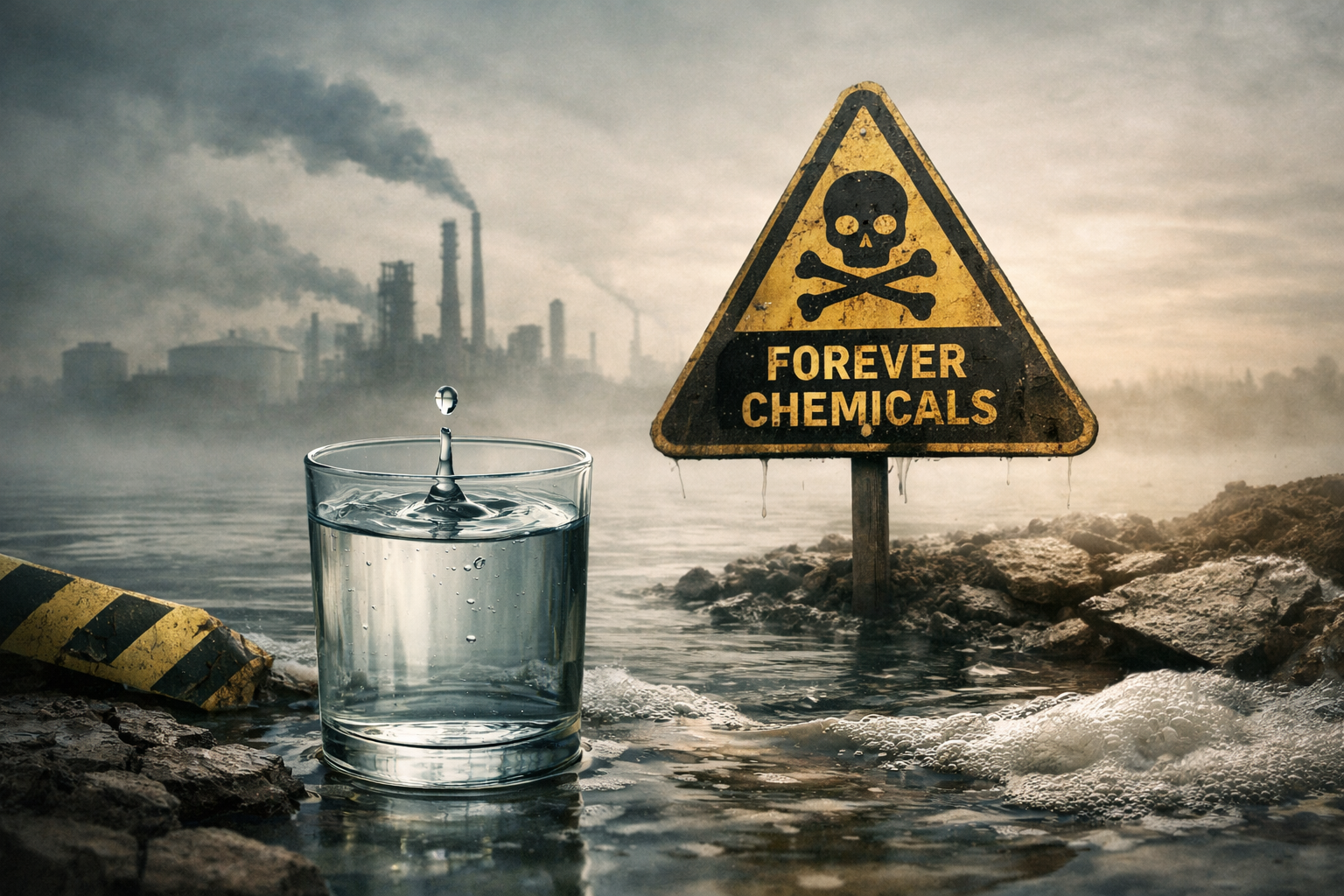
PFAS forever chemicals are persistent pollutants. Learn health risks, what filters can do, how bans work, and why “detox” is limited.
Can We Filter, Ban, or Detox Our Way Out?
PFAS forever chemicals are a vast family of human-made compounds built around carbon and fluorine, a pairing so stubborn that it resists the usual routes of decay. They were designed to repel water, grease, and heat. In the modern world, that has meant convenience and performance. It has also meant persistence in water, soil, food chains, and bodies.
The problem is not just that PFAS show up in a glass of water. Our systems were built to ignore thousands of closely related chemicals that move through industry like invisible lubricants. Regulation wants clean categories and endpoints. PFAS are messy: many sources, many pathways, slow harm signals, and expensive fixes.
Filtering can lower exposure. Bans can slow new emissions. "Detox" may seem like a personal way out. But each approach runs into the same physics: removing PFAS from one place often moves them somewhere else, unless you can truly destroy them.
By the end, you’ll understand what PFAS are, why the health risk story is both real and uneven, what filtration can and cannot do, and why regulation keeps colliding with industrial reality.
The story turns on whether we can stop PFAS at the source faster than we keep redistributing them.
Key Points
PFAS is not one chemical. They are a large class, which is why “ban one, replace with another” has been a recurring failure mode.
“Forever” is not a slogan. Many PFAS persist because the carbon–fluorine backbone is unusually hard to break under normal environmental conditions.
Health evidence is strongest for a subset of well-studied PFAS and a subset of outcomes, which complicates one-size-fits-all policy.
Drinking-water filtration can reduce exposure, but it mainly concentrates PFAS into spent media or brines that still need safe disposal or destruction.
Broad bans are politically attractive and scientifically defensible, but they collide with sectors that depend on fluorinated performance for safety, reliability, or precision.
“Detox” is not a consumer product category. The best-supported interventions are limited, context-specific, and do not solve the upstream contamination problem.
The next phase will be defined by whether regulators adopt “essential use” logic and whether destruction capacity scales beyond pilot projects.
What It Is
PFAS are per- and polyfluoroalkyl substances: a large family of synthetic chemicals that share a fluorinated carbon backbone. That backbone is the feature. It helps create materials and coatings that resist heat, stains, grease, and chemical attack.
PFAS are used in consumer products, but their deepest footprint sits upstream in industrial processes: manufacturing aids, surfactants, sealants, and specialized materials where stability is the whole point. That is why PFAS show up far from any single culprit product. They are often part of the invisible plumbing of modern production.
What it is not: PFAS are not a single toxin with a single exposure route and a single fix. The health and environmental story varies by compound, dose, duration, and pathway. And PFAS are not a problem you solve by switching brands in a supermarket aisle if the water, waste, and supply chains are still carrying the same chemistry.
How It Works
Start with the bond. Carbon and fluorine form an unusually strong pairing. In many PFAS, multiple fluorines coat a carbon chain like armour. Nature has plenty of enzymes for chewing through typical hydrocarbons. It has far fewer tools for undoing fluorinated backbones at scale.
Now add mobility. Many PFAS behave like surfactants: they can sit at boundaries between water and oils or water and air, and they can travel through water systems efficiently. Some bind to proteins in blood rather than dissolving into fat in the way many older pollutants do. That matters because it changes how PFAS distribute and how long they linger.
Then comes the modern cycle. PFAS enter the environment through industrial releases, firefighting foam use, waste streams, and the slow shedding of treated materials. Once in water, they can move into groundwater, rivers, reservoirs, and eventually treatment plants. Many treatment systems were designed for microbes, nutrients, and conventional organics, not for stubborn, low-level synthetic molecules that resist breakdown.
Finally, there is the trap: removal is not destruction. If a filter captures PFAS, you now have a filter that contains PFAS. If a membrane rejects PFAS, you now have a concentrated brine. The chemistry does not vanish. It just changes address.
Numbers That Matter
4 parts per trillion. That is the scale of some enforceable drinking-water limits set for certain PFAS. Practically, it means regulators are treating these molecules as meaningful at extremely low concentrations, which forces utilities into advanced monitoring and treatment choices.
10 parts per trillion. Some related PFAS have higher enforceable limits than the most notorious legacy compounds. That difference is not “safe versus unsafe.” It reflects how regulators weigh toxicity evidence, measurement capability, and risk frameworks for different PFAS.
A hazard index of 1. Mixtures matter because people are rarely exposed to one PFAS at a time. A hazard index approach treats combined exposure as potentially dose-additive, meaning several compounds together can be regulated as a single risk signal.
4.4 nanograms per kilogram per week. That is the scale of a tolerable intake threshold used in food-risk assessment for a group of PFAS that accumulate in the body. The key point is not the precise unit. It is that chronic exposure is the concern, because accumulation changes the math over time.
Years, not days. Human elimination for some well-studied PFAS is commonly measured in years, with estimates varying by compound and population. This is why “stop exposure and it goes away” is not how PFAS behave for many people. The body can clear them, but slowly.
Thousands. PFAS counts depend on definitions and inventories, but major lists run into the thousands and beyond. Regulation and cleanup are not just about a few headline chemicals. They are about a shifting family tree, where new cousins can appear faster than toxicology and policy can keep up.
Where It Works (and Where It Breaks)
Filtration works best when you define the target and control the water. Drinking-water treatment is the cleanest battlefield because it is a bounded system with measurable inflow and outflow. Granular activated carbon can remove many PFAS, especially longer-chain compounds, but performance depends on water chemistry and the filter’s saturation point. Ion exchange resins can be more selective and effective for a broader range, but they also saturate and require regeneration or replacement.
Reverse osmosis can remove many dissolved contaminants, including many PFAS, but it creates a concentrated waste stream and uses energy. At household scale, point-of-use reverse osmosis can cut exposure from drinking and cooking water. At municipal scale, membranes can become an expensive commitment with brine management as the hidden bill.
Cleanup breaks down in soil and groundwater because time becomes the enemy. Pump-and-treat systems can run for years. Barriers can slow migration but not erase the source. And when PFAS sit in complex matrices like landfill leachate, industrial sludge, or firefighting foam residues, separation becomes harder and the waste becomes more hazardous.
“Ban” works best when the use is nonessential and substitution is straightforward. It is easier to remove PFAS from cosmetics or certain packaging than from specialized industrial processes that rely on fluorinated performance to prevent failure. Broad bans also risk a predictable backlash: carve-outs for “essential” uses that become permanent by lobbying rather than necessity.
Detox breaks down because most of the burden is systemic. Lowering a person’s blood level does not cleanse a watershed. And even at the individual level, interventions that change PFAS elimination raise questions of who should do them, when, and with what evidence of health benefit.
Analysis
Scientific and Engineering Reality
PFAS control is a three-step puzzle: detect, capture, and destroy.
Detection is harder than it sounds because you are chasing families, not individuals. Many PFAS are not routinely measured, and mixtures complicate the signal. Engineering systems need targets and tests. Policy often outruns measurement, then has to patch the gap with proxies and class-based rules.
Capture is mostly a matter of surfaces and charges. Activated carbon offers surface area. Ion exchange offers chemical preference. Membranes offer physical separation. The limiting factor is not whether these tools work in principle. It is breakthrough, maintenance, and waste handling at real-world scale.
Destruction is the real bottleneck. Breaking carbon–fluorine backbones at scale requires energy, specific conditions, or advanced processes. Incineration, supercritical water oxidation, plasma, and electrochemical methods can destroy certain PFAS under the right conditions, but scalability, cost, and byproducts decide whether “destruction” is real or just a lab outcome.
What would falsify the optimistic story? Clear evidence that destruction methods create persistent fluorinated byproducts that escape, or that “PFAS-free” substitutes carry similar persistence and toxicity once deployed at scale. Also: proof that the biggest exposure sources are not the ones being regulated, meaning we are treating the wrong pipes in the system.
Economic and Market Impact
PFAS regulation is infrastructure policy in disguise. Utilities do not “comply” with chemistry. They comply with capital projects: pilots, procurement, construction, operations, and waste contracts. Someone pays, either through public funding, polluter liability, or higher bills.
Industry is split between two incentives. One side wants clarity and a manageable pathway: defined limits, workable timelines, and approved alternatives. The other side benefits from delay and fragmentation: if rules vary by jurisdiction and by compound, substitution can continue while responsibility stays blurred.
The market story will likely split into near-term and long-term pathways. Near term, expect a surge in monitoring, treatment deployments, and litigation-driven settlements that fund cleanup. Long term, the prize is new materials and processes that deliver fluorinated performance without fluorinated persistence, plus scalable destruction that closes the loop rather than shifting it.
Security, Privacy, and Misuse Risks
PFAS are not a classic cyber or privacy risk, but they do create a different kind of vulnerability: trust in essential systems. When drinking water becomes a chemical story, communities demand data, and the quality of that data becomes political.
Misuse tends to look mundane. “PFAS-free” marketing can exploit technical loopholes: banning a handful of PFAS while switching to unregulated cousins or using definitions that exclude major emissions sources. Another misuse vector is overclaiming remediation: presenting capture as destruction or pilot-scale results as if they are already industrial.
Standards and disclosure matter because PFAS risk is often invisible until measurement forces it into view. The strongest guardrail is transparency: what was tested, what was not, and what happens to the captured waste.
Social and Cultural Impact
PFAS has become a public lesson in how modern risks propagate. People can do everything “right” and still inherit exposure through water, food, and local history. That shifts the story from personal responsibility to systemic accountability.
The cultural impact shows up in two opposing pressures. One is a demand for sweeping bans and clean narratives. The other is a backlash against “chemicals panic”, especially when evidence varies across compounds and outcomes. Both impulses can mislead. The path that builds trust is specificity: clear terms, clear pathways, and honest trade-offs.
PFAS also reshape how society thinks about proof. For many exposures, you do not get a clean cause-and-effect story for each individual. You get risk shifts across populations. That is a harder kind of truth for public debate to hold.
What Most Coverage Misses
Most coverage treats filtration as the happy ending. But filtration is often the midpoint. If you remove PFAS from water and store them in carbon, resin, or brine, you have not solved the chemistry. You have concentrated it. The real question becomes: where does that concentrated PFAS go, and does it stay contained for decades?
Coverage also tends to frame the debate as “ban versus don’t ban”. The deeper lever is “essential use versus convenience use”. If regulators cannot define what truly needs fluorinated performance, bans turn into carve-out battles. If they can define it, bans become an engineering roadmap: remove PFAS where substitutes are easy, constrain them where they are not, and force destruction and accountability upstream.
Finally, there is a scale illusion. A household filter can feel like control. But PFAS are a watershed and supply-chain problem. Individual action can reduce personal exposure. It cannot stop emissions, leachate, and industrial discharge unless policy forces the system to change.
Why This Matters
Who is most affected is not random. Communities near PFAS manufacturing, airports, military bases, and firefighting training sites often face higher exposure risk. People using private wells can be more vulnerable because regulation and monitoring are usually weaker than for public systems. Workers in certain industries can face occupational exposure pathways. Pregnant people and children matter because developmental windows can amplify risk from exposures that seem small on paper.
In the short term, the stakes are practical: water testing, filtration upgrades, consumer product reformulations, and legal liability. Long term, the stakes are structural: whether society can prevent a repeating pattern where chemistry outruns governance, and cleanup becomes a permanent tax on the public.
Milestones to watch:
Spring 2026: U.S. regulatory revisions and compliance timelines are expected to be clarified, with potential rule changes finalized.
Sector bans with dates: restrictions on PFAS in specific applications, like firefighting foams, create real-world deadlines that force substitution and cleanup.
The pivot in "essential use" pertains to whether regulators will adopt class-based restrictions with clearly defined exemptions, or they will continue to navigate through compound-by-compound restrictions.
Real-World Impact
A water utility adds activated carbon or ion exchange to meet new limits. The visible change is cleaner finished water. The invisible change is a new waste stream that must be handled safely for years.
An airport replaces firefighting foam and excavates contaminated soil around training grounds. The hard part is not the switch. It is proving the contamination is contained and deciding how to treat the extracted waste without spreading it again.
A textile supplier removes PFAS-based water repellents from “performance” clothing lines. The trade-off is durability versus compliance. The long-term win is a supply chain that does not rely on persistent chemistry for a short-lived product.
A clinician is asked whether a PFAS blood test “means something”. The most honest answer is that it can indicate exposure history, but translating a number into an individual forecast is still limited. The most useful action is often exposure reduction and standard preventive health screening.
The Road Ahead
PFAS will not be “solved” by a single breakthrough, because the problem is not a single molecule. It is a system that learnt to rely on fluorinated persistence as a feature.
Scenario one: Source control wins. If regulators define essential use tightly and enforce class-based restrictions, emissions fall, and cleanup becomes a shrinking tail rather than an endless expansion. If we see broad, enforceable restrictions paired with upstream discharge controls, it could lead to a real decline in environmental loading.
Scenario two: Filters become the default. If politics can only agree on treating drinking water while allowing wide industrial use, exposure drops in some places, but the underlying contamination persists. If we see repeated compliance extensions and fragmented bans, it could lead to a world where cleanup is permanent infrastructure.
Scenario three: Destruction scales. If high-energy destruction methods become reliable, affordable, and verifiable at an industrial scale, the “concentrate problem” weakens. If we see large-scale facilities prove true mineralization with controlled byproducts, it could lead to closed-loop treatment rather than endless transfer.
Scenario four: Substitution backfires. If replacements are more mobile, less studied, and just as persistent, the chemical family tree keeps outrunning policy. If we see rising detection of new fluorinated byproducts alongside “PFAS-free” rebranding, it could lead to a second wave of regulation and public backlash.
The next thing to watch is not a headline about one chemical. It is whether policy, measurement, and destruction capacity finally align—so that removal means removal, not relocation.
