

Scientists Discover Plant Protein That Could Supercharge Photosynthesis and Transform Food Production
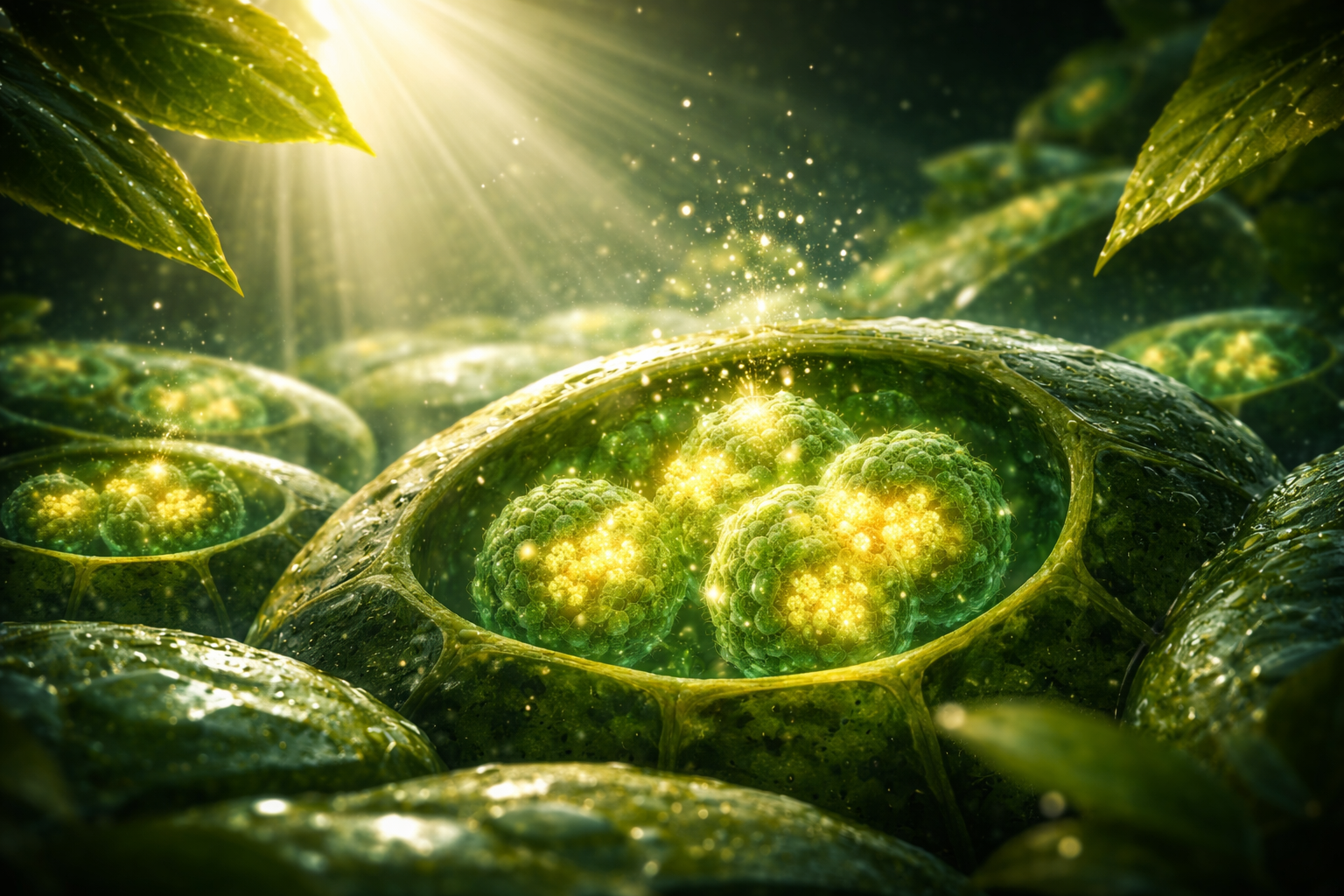
Scientists Find Photosynthesis “Hack” Hidden in Ancient Plant
The Tiny Plant Protein That Could Revolutionize Food Supply
Photosynthesis powers nearly every food chain on Earth. Yet the process that fuels life is surprisingly inefficient in most crops.
Now researchers have uncovered a tiny plant protein that could dramatically improve how plants capture carbon dioxide and turn sunlight into food. The discovery, reported in March 2026, reveals a previously unknown biological trick that may allow scientists to engineer crops that grow faster while pulling more carbon from the atmosphere.
The breakthrough centers on a molecular modification found in hornworts—small, ancient land plants that grow quietly in damp soils and forest edges. Scientists discovered that these plants possess a specialized protein extension that reorganizes the core machinery of photosynthesis in a way that boosts efficiency.
If the mechanism can be replicated in staple crops such as wheat, rice, or maize, it could reshape both agriculture and climate strategy.
The story turns on whether scientists can successfully transfer this tiny molecular trick from obscure plants into the crops that feed the world.
Key Points
Scientists discovered a unique protein feature in hornwort plants that improves how the key photosynthesis enzyme Rubisco operates.
The mechanism clusters Rubisco into dense compartments, helping it capture carbon dioxide more efficiently.
When researchers introduced the protein modification into other plants, the enzyme reorganized in a similar way.
The discovery could enable engineered crops with higher yields and improved carbon capture.
Scientists believe the mechanism may be easier to transfer into crops than previous photosynthesis-boosting systems derived from algae.
The Enzyme That Limits Life on Earth
At the center of the discovery is an enzyme called Rubisco.
Rubisco performs one of the most important reactions in biology: it captures carbon dioxide from the air and begins the process of converting it into sugars that plants use for growth. Nearly all food on Earth ultimately depends on this step.
But Rubisco has a flaw. It works slowly and often mistakes oxygen for carbon dioxide. When that happens, plants waste energy through a process known as photorespiration, reducing overall growth and productivity.
This inefficiency has long frustrated scientists. Improving photosynthesis—even slightly—could increase crop yields worldwide and help feed a growing global population.
Researchers have spent decades trying to redesign this process.
Now, a strange group of plants may have quietly solved part of the problem already.
A Clue Hidden in One of Earth’s Oldest Plants
The breakthrough emerged from research into hornworts, a little-known group of primitive land plants.
Unlike most plants, hornworts contain specialized cellular compartments that concentrate carbon dioxide around Rubisco. This allows the enzyme to work more efficiently—similar to systems found in algae.
Scientists originally assumed hornworts used the same molecular machinery as algae. Instead, they discovered something different.
Hornworts have modified the enzyme itself.
Researchers identified a unique extension on the small subunit of Rubisco called RbcS-STAR. This tail acts like molecular Velcro, causing Rubisco molecules to stick together and cluster inside the cell.
By packing the enzymes together, the plant effectively creates micro-zones where carbon dioxide becomes more concentrated, boosting photosynthetic efficiency.
It is a simple trick with potentially massive consequences.
Why Scientists Are Excited
One of the biggest barriers to improving photosynthesis in crops has been biological compatibility.
Earlier attempts focused on copying carbon-concentrating systems from algae. But those systems require complex structures and specialized proteins that do not easily function inside land plants.
The hornwort solution may avoid that problem.
Instead of building an entirely new cellular machine, the RbcS-STAR modification embeds the clustering mechanism directly into Rubisco itself.
When scientists inserted this protein modification into other plants, Rubisco reorganized in the same clustered pattern—an early indication the mechanism may transfer across species.
If this works in crops, the implications are significant.
Even modest improvements in photosynthetic efficiency could translate into major increases in agricultural output.
The Agricultural Stakes
Crop yields are approaching biological limits in many parts of the world.
Improving photosynthesis is widely viewed as one of the most promising ways to break through that ceiling.
If scientists can engineer crops to concentrate carbon dioxide around Rubisco, plants could produce more biomass using the same sunlight, water, and land.
Potential benefits include:
Higher yields from staple crops such as wheat, rice, and maize
Reduced fertilizer demand
Greater resilience to environmental stress
Increased carbon capture from the atmosphere
In theory, more efficient crops could also help offset some greenhouse gas emissions by absorbing additional carbon dioxide during growth.
What Most Coverage Misses
The most overlooked aspect of this discovery is not just that photosynthesis can be improved—it is how simple the mechanism might be to transfer into crops.
Many past attempts to engineer better photosynthesis failed because they required introducing entire cellular structures with dozens of interacting genes.
The hornwort system suggests a different path: modify the Rubisco complex itself so that the enzyme naturally organizes into efficient clusters.
That difference matters enormously. If the mechanism requires only a small number of genetic changes, it becomes far more realistic for crop breeders and biotechnology companies to deploy.
In other words, the discovery could move photosynthesis engineering from theoretical ambition to a practical agricultural tool.
The Long Road From Discovery to Farm Fields
Despite the excitement, the breakthrough is still at an early stage.
Scientists have demonstrated that the RbcS-STAR mechanism can reorganize Rubisco in other plants, but translating this into large yield gains will require years of research.
Key questions remain:
Whether the modification improves photosynthesis in major crops
How it affects plant metabolism and growth under real field conditions
Whether the genetic modification can be deployed safely and efficiently
Plant biotechnology often faces regulatory, ecological, and economic hurdles before new traits reach farms.
Still, the direction of travel is clear.
For decades, improving photosynthesis has been considered one of agriculture’s “holy grails.”
Now, a small protein hidden inside an obscure plant may have brought that goal closer to reality.
