

Scientists May Have Just Changed The Rules Of The Alien Life Hunt
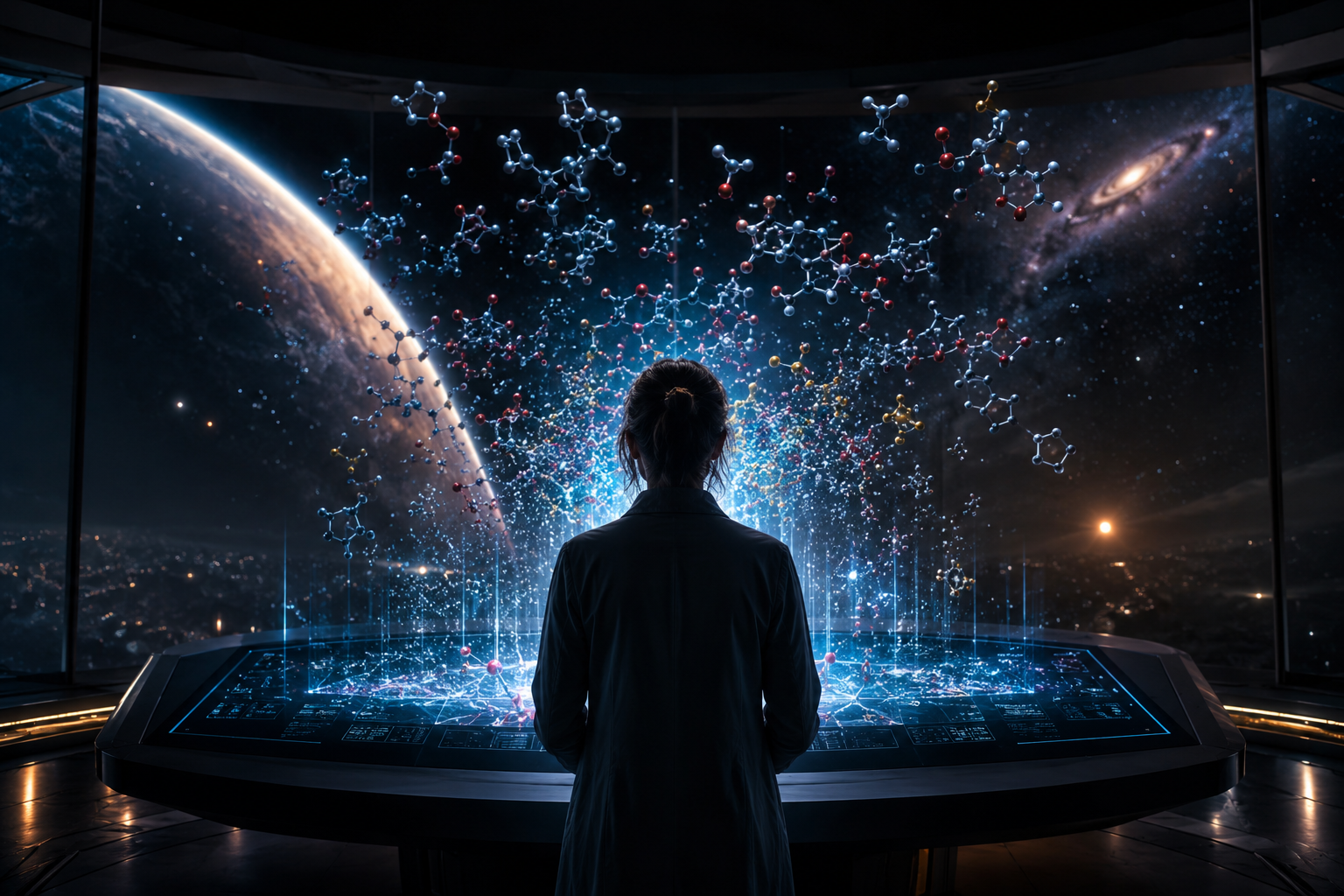
The Hidden Chemical Pattern That Could Reveal Alien Life
The Search For Aliens Has Taken A Dramatic Turn And It Is Not What Scientists Expected
For decades, the search for alien life has focused on a deceptively simple idea: find the right molecule and you may find life. Scientists have searched for oxygen, methane, amino acids, fatty acids, and other potential biosignatures across planets, moons, meteorites, and distant atmospheres.
The problem is that many of these molecules can also be created by non-living processes. A molecule that looks exciting in one context can become far less convincing when scientists discover a natural chemical pathway that produces the same result. The search has often been plagued by false positives, ambiguity, and uncertainty.
A newly proposed method suggests researchers may have been asking the wrong question all along.
The Hidden Pattern Behind Living Systems
Instead of searching for a specific chemical "smoking gun," researchers are now investigating whether life leaves behind a unique statistical pattern across collections of molecules.
The idea is surprisingly powerful. Living systems do not merely create chemicals. They organise them. Biological processes constantly select, amplify, suppress, and rearrange molecules in ways that differ from ordinary chemistry. Over time, this creates a distinctive fingerprint hidden within the overall distribution of compounds.
Researchers found that living systems consistently produce molecular distributions that differ from those created by purely non-biological processes. Rather than focusing on whether a particular amino acid exists, the new approach examines how many amino acids exist, how frequently they appear, and how they relate statistically to one another.
That may sound technical, but the implication is profound. Life may be detectable through its organisational habits rather than its ingredients.
Why This Could Be Far More Reliable
One of the biggest frustrations in astrobiology is that chemistry is messy. Many compounds once considered potential signs of life can emerge naturally through volcanic activity, radiation, hydrothermal systems, or entirely abiotic reactions.
That creates a serious problem. If scientists discover an intriguing molecule on Mars, Europa, Enceladus, or an exoplanet hundreds of light-years away, how can they know whether biology produced it?
Statistical fingerprints could help solve that dilemma. Researchers argue that non-living chemistry may generate similar molecules, but it rarely produces the same large-scale patterns of organisation seen in living systems. In effect, the method looks less at individual clues and more at the overall behaviour of the chemical system.
This shifts the search away from finding one extraordinary molecule and toward identifying chemical ecosystems that appear structured by biological processes.
The Real Opportunity Is Not On Earth
The most exciting aspect of the discovery is not what it tells us about Earth. It is what it could reveal elsewhere.
Future missions to places such as Jupiter's moon Europa, Saturn's moon Enceladus, or Mars could potentially use this approach to prioritise samples and identify locations most likely to contain evidence of life. Researchers believe the technique could be particularly valuable when dealing with degraded or incomplete samples where traditional biosignatures may have been destroyed over time.
This matters because alien life, if it exists, may not resemble Earth life closely enough to produce the exact molecules scientists expect. A statistical approach offers a potential way to detect biology without assuming aliens use the same chemistry we do.
That is a major conceptual leap. Instead of searching for life as we know it, scientists may be learning how to search for life as a broader phenomenon.
The Search For Life Is Becoming A Search For Complexity
A deeper shift is taking place beneath the headlines.
Historically, scientists searched for individual biosignatures. Increasingly, researchers are beginning to think in terms of systems, networks, complexity, and organisation. The question is evolving from "What molecules are present?" to "What kind of process created this pattern?"
That change mirrors developments across many scientific fields. Whether studying ecosystems, economies, artificial intelligence, or planetary atmospheres, researchers are finding that patterns often reveal more than isolated components.
Life may ultimately be recognised not because it contains a special ingredient, but because it generates a special kind of order.
The Biggest Question Has Not Changed
Despite the excitement, the new method does not prove alien life exists. It does not confirm that any distant planet is inhabited. It does not solve the mystery.
What it does offer is a potentially stronger way of separating biology from chemistry, signal from noise, and genuine evidence from wishful thinking. That may sound modest, but in a field where ambiguity has dominated for decades, it could be one of the most important advances in years.
The search for alien life has always been limited by a basic problem: we do not know what alien life looks like. This new approach sidesteps that challenge. Rather than hunting for a familiar molecule, it asks whether nature itself leaves behind a recognisable pattern when life takes hold. If that idea proves correct, the next great discovery may arrive not through a single extraordinary chemical signal, but through a hidden statistical fingerprint quietly waiting to be recognised.
