Scientists Win Nobel Prize For “Mirror-Image” Molecule Breakthrough That Could Transform Medicine
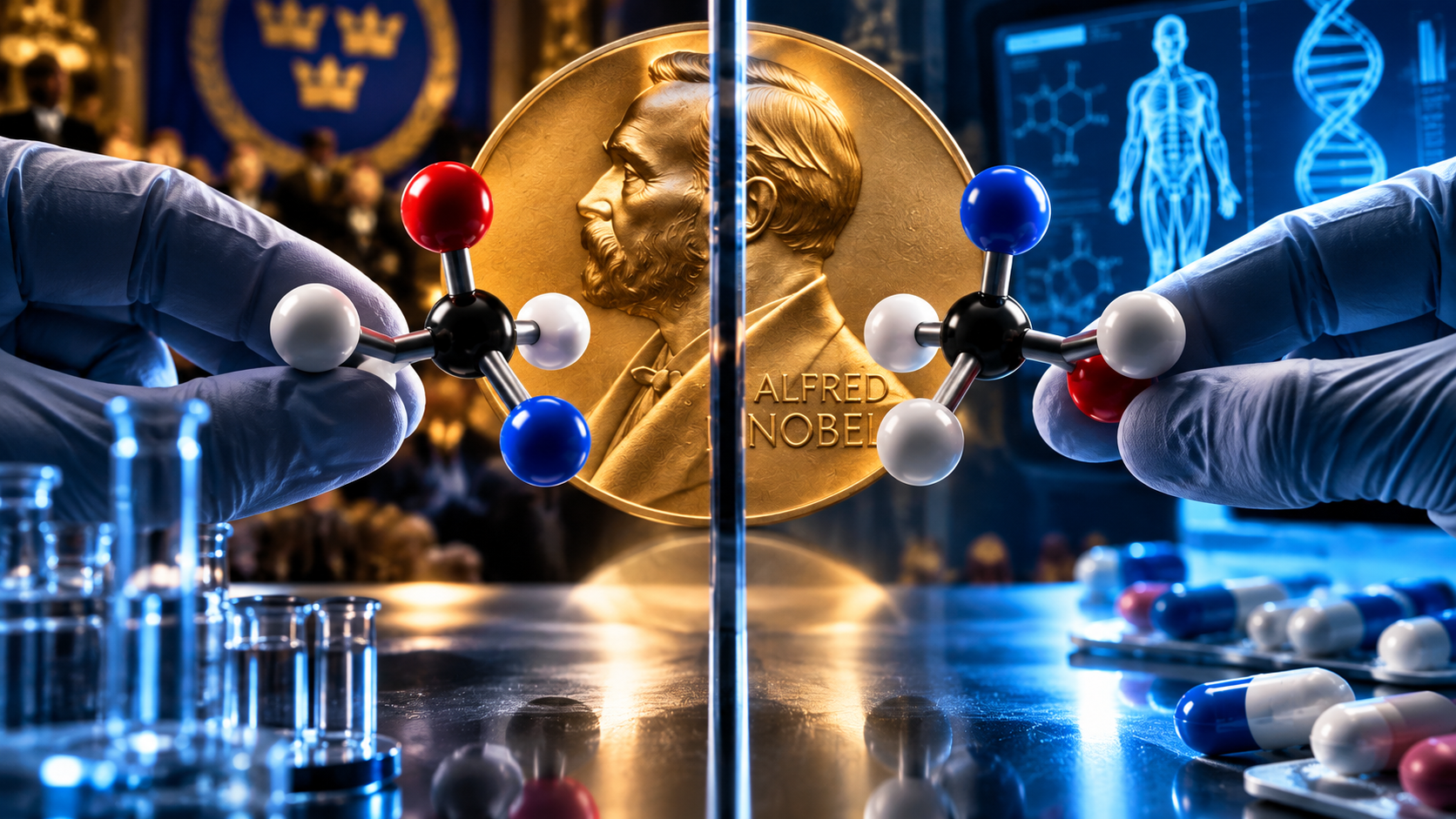
Nobel Prize Awarded For Extraordinary Discovery About The “Handedness” Of Molecules
Scientists Crack 100-Year Molecular Mystery
Scientists Henri Kagan and Kenso Soai have won one of science’s highest honours for solving a molecular mystery that stretches back more than a century — and helped transform the way modern medicines can be made.
Two scientists whose work gave chemists extraordinary control over the “left-handed” and “right-handed” versions of molecules have been awarded the 2026 Nobel Prize in Chemistry.
French chemist Henri B. Kagan and Japanese chemist Kenso Soai were announced as this year's winners by the Royal Swedish Academy of Sciences on Wednesday, 7 October.
Their work centres on something that sounds almost impossibly simple: some molecules can exist in two forms that contain exactly the same atoms but are arranged as mirror images of one another.
Think of your hands.
Your left and right hands have essentially the same components and shape — but however you rotate them, you cannot perfectly place one on top of the other.
At molecular scale, that difference can become enormously important.
One version of a molecule may behave exactly as scientists want.
Its mirror image may behave differently.
In medicine, that difference can potentially affect everything from how strongly a drug works to which proteins inside the body it interacts with.
And Kagan and Soai helped give chemists the tools to control which molecular “hand” they make.
What Exactly Did Kagan And Soai Discover?
The Nobel Committee awarded the pair the prize “for the discovery of non-linear effects and autocatalysis in asymmetric organic synthesis.”
That language sounds intimidating.
The underlying idea is much easier to understand.
Many molecules are chiral.
That means they can exist as two mirror-image versions known as enantiomers.
Chemists frequently want to manufacture only one of them.
But ordinary chemical reactions can easily produce mixtures of both.
Separating the desired version afterwards can be difficult, expensive and wasteful.
Kagan's research demonstrated fundamental ways in which incredibly small molecular imbalances could become amplified during asymmetric chemical reactions.
Soai then demonstrated something even more remarkable.
He discovered a reaction capable of amplifying its own molecular handedness.
The product of the reaction effectively helps create more of itself.
That process is known as asymmetric autocatalysis.
The result became famous as the Soai reaction.
It provided striking experimental evidence that a tiny initial preference for one molecular orientation could eventually produce an overwhelmingly one-sided result.
That was a major breakthrough.
Why Are “Mirror-Image” Molecules So Important?
Imagine creating two keys.
They contain the same amount of metal.
They have almost identical dimensions.
But one is the mirror image of the other.
Only one fits the lock.
Something similar happens throughout biology.
Proteins, enzymes and receptors inside the human body are three-dimensional structures.
Their shape matters.
A drug molecule therefore does not simply need the correct chemical ingredients.
It often needs the correct three-dimensional orientation as well.
One molecular version might slot neatly into a biological receptor.
Its mirror image might fit poorly — or interact with something else entirely.
That makes chirality hugely important in pharmaceutical chemistry.
The Nobel-winning discoveries helped scientists develop increasingly sophisticated ways of favouring the molecular form they actually want.
A Mystery Dating Back To Louis Pasteur
The problem goes back more than 170 years.
French scientist Louis Pasteur famously studied crystals of tartaric acid salts during the nineteenth century and noticed that they came in two shapes that appeared to be mirror images.
Pasteur painstakingly separated the crystals by hand.
When dissolved, the two groups rotated polarised light in opposite directions.
It was an early glimpse into what would become the science of molecular chirality.
But an even bigger puzzle remained.
Life itself seems extraordinarily biased.
Biological systems overwhelmingly use particular molecular orientations.
Proteins, for instance, are constructed almost entirely from one handedness of amino acids.
Why nature developed such a strong preference became one of chemistry's great questions.
Kagan and Soai's research did not suddenly reveal exactly how life began.
But it demonstrated powerful chemical mechanisms through which tiny initial asymmetries can be dramatically amplified.
That provides an important piece of the wider scientific puzzle.
Soai's Reaction Changed What Chemists Thought Was Possible
Soai's work became particularly famous because of its almost self-reinforcing behaviour.
Imagine beginning with an almost perfectly balanced mixture.
There is only the slightest excess of one molecular form.
Normally, that difference might seem insignificant.
But during asymmetric autocatalysis, the favoured product itself acts as a catalyst for the creation of more product with the same handedness.
A tiny imbalance therefore grows.
Then grows again.
Eventually, one orientation can overwhelmingly dominate.
That is scientifically fascinating because it offers a mechanism through which an almost imperceptible asymmetry could potentially develop into something enormous.
The Royal Swedish Academy said the two laureates had provided a solution to a chemical mystery more than a century old.
Why This Matters For Medicines
The practical implications extend far beyond academic chemistry.
Modern pharmaceutical companies routinely need to control chirality when producing drugs.
Our bodies are built from chiral biological structures.
That means two mirror-image versions of a pharmaceutical molecule can potentially have different biological properties.
One may bind effectively to its intended target.
The other may be less active, inactive or interact differently within the body.
Techniques that allow chemists to selectively manufacture one molecular orientation can therefore make drug development more precise.
Asymmetric synthesis is now deeply embedded in modern medicinal chemistry.
Kagan's pioneering work helped establish major principles behind that revolution.
The Thalidomide Warning
One of the most frequently cited examples of why molecular handedness matters is thalidomide.
The drug was widely prescribed during the late 1950s and early 1960s, including to pregnant women suffering from morning sickness.
Thousands of children were subsequently born with severe birth defects.
Thalidomide exists as mirror-image molecular forms, and the case became historically associated with the dramatically different biological behaviour that enantiomers can display.
There is an important scientific qualification.
Thalidomide's two forms can convert into one another inside the human body.
That means simply administering one purified enantiomer would not necessarily have prevented the catastrophe.
Even so, the disaster became one of the most powerful illustrations of why scientists must understand the three-dimensional behaviour of pharmaceutical molecules rather than treating molecular composition alone as sufficient.
Could This Lead To New Drugs?
The Nobel Prize recognises discoveries whose impact is already established rather than predicting a single new medicine arriving tomorrow.
But the scientific principles behind Kagan and Soai's work are highly relevant to pharmaceutical development.
Better control of asymmetric reactions can potentially mean:
more selective medicines;
fewer unwanted molecular by-products;
more efficient pharmaceutical manufacturing;
less chemical waste;
improved control over biologically active compounds; and
new ways of constructing extremely complicated molecules.
Asymmetric chemistry has become one of the essential tools available to chemists attempting to build substances with highly specific biological properties.
So this is not simply a beautiful chemistry experiment.
It sits behind an enormous field of practical molecular engineering.
Could It Help Explain How Life Began?
This is where the discovery becomes even more intriguing.
Life on Earth is remarkably selective about molecular handedness.
Why?
One of the major unanswered questions surrounding the origin of life is how an early chemical environment containing both molecular orientations could eventually develop the overwhelming preference seen in biology today.
Scientists have proposed numerous mechanisms.
They include random fluctuations, mineral surfaces, physical forces, light and even influences originating in space.
The Soai reaction showed something critical:
an extremely small initial imbalance can be chemically amplified into a very large one.
That does not prove this is how life's molecular handedness originated.
But it demonstrates that chemistry is capable of turning a microscopic preference into an overwhelming molecular majority.
That makes the work relevant not only to pharmaceutical laboratories but also to one of science's biggest questions:
Why does life look chemically the way it does?
Who Is Henri Kagan?
Henri B. Kagan is one of the major figures in modern asymmetric chemistry.
Born in France, Kagan spent decades studying ways of controlling the three-dimensional outcome of chemical reactions.
His research on asymmetric catalysis and what became known as non-linear effects helped show how the relationship between a catalyst's molecular handedness and the handedness of its products could behave in unexpected ways.
Kagan is now 95 years old.
His Nobel recognition is particularly striking because his contribution to asymmetric chemistry has been discussed for decades.
His work also featured prominently in debate surrounding the 2001 Nobel Prize in Chemistry, awarded to William Knowles, Ryoji Noyori and Barry Sharpless for catalytic asymmetric synthesis.
Twenty-five years later, Kagan now has a Nobel of his own.
Who Is Kenso Soai?
Kenso Soai, 76, is a Japanese chemist associated with the Tokyo University of Science.
His name became permanently attached to asymmetric chemistry following the discovery of the Soai reaction.
The experiment demonstrated asymmetric autocatalysis with extraordinary amplification.
In simple terms, the reaction could effectively reinforce its own molecular preference.
What initially appeared to be a tiny difference could become overwhelmingly dominant as the reaction continued.
The discovery has fascinated chemists because it bridges fundamental chemistry with questions surrounding molecular evolution and the origins of biological handedness.
How Much Do The Winners Receive?
Kagan and Soai will share prize money totalling 12 million Swedish kronor, worth roughly $1.2 million at current exchange rates.
They will also receive Nobel medals and diplomas.
The formal Nobel Prize ceremony takes place in Stockholm on 10 December, the anniversary of Alfred Nobel's death.
The Royal Swedish Academy of Sciences selects the Chemistry laureates each year.
The award has been presented since 1901 and remains one of the most prestigious honours available to a scientist.
Why This Nobel Matters
Some Nobel Prizes recognise discoveries whose significance is immediately obvious.
A new vaccine.
A revolutionary battery.
A breakthrough medical treatment.
The 2026 Chemistry Prize rewards something more fundamental.
It is about scientists learning to control matter at an extraordinarily subtle level.
Two molecules can contain identical atoms.
They can possess identical chemical formulas.
On paper, they can appear almost identical.
Yet their three-dimensional orientation can change how they interact with the living world.
Understanding and controlling that distinction helped transform modern chemistry.
Kagan showed chemists fundamental principles governing asymmetric reactions.
Soai demonstrated that molecular handedness could effectively amplify itself.
Together their work helped explain how chemistry can move from a near-perfect 50-50 molecular split towards one overwhelmingly dominant form.
That principle now reaches from the laboratory bench to pharmaceutical manufacturing — and perhaps even towards one of the deepest puzzles in biology.
Why did life choose one molecular hand over the other?
More than a century after scientists first recognised the mystery, chemistry can finally explain far more about how such an imbalance can arise.
And in 2026, that achievement has earned chemistry's highest honour.
Sources
Royal Swedish Academy of Sciences / Nobel Prize — official Nobel Prize announcement and award process.
Reuters — reporting from Stockholm on the 2026 Chemistry Prize, the work of Henri Kagan and Kenso Soai and its pharmaceutical significance.
Associated Press — reporting on molecular chirality, Kagan's work and the development of the Soai reaction.
Next Reads
2026 Nobel Physics Prize Awarded For Hunt For Mysterious “Ghost Particles” Beneath Antarctic Ice
How AI Is Transforming Drug Discovery — And Why Scientists Believe A Medical Revolution Is Coming
Could Scientists Finally Solve The Mystery Of How Life Began?
