The Biggest Physics Discoveries of the Next Century: What We’re Most Likely to Find
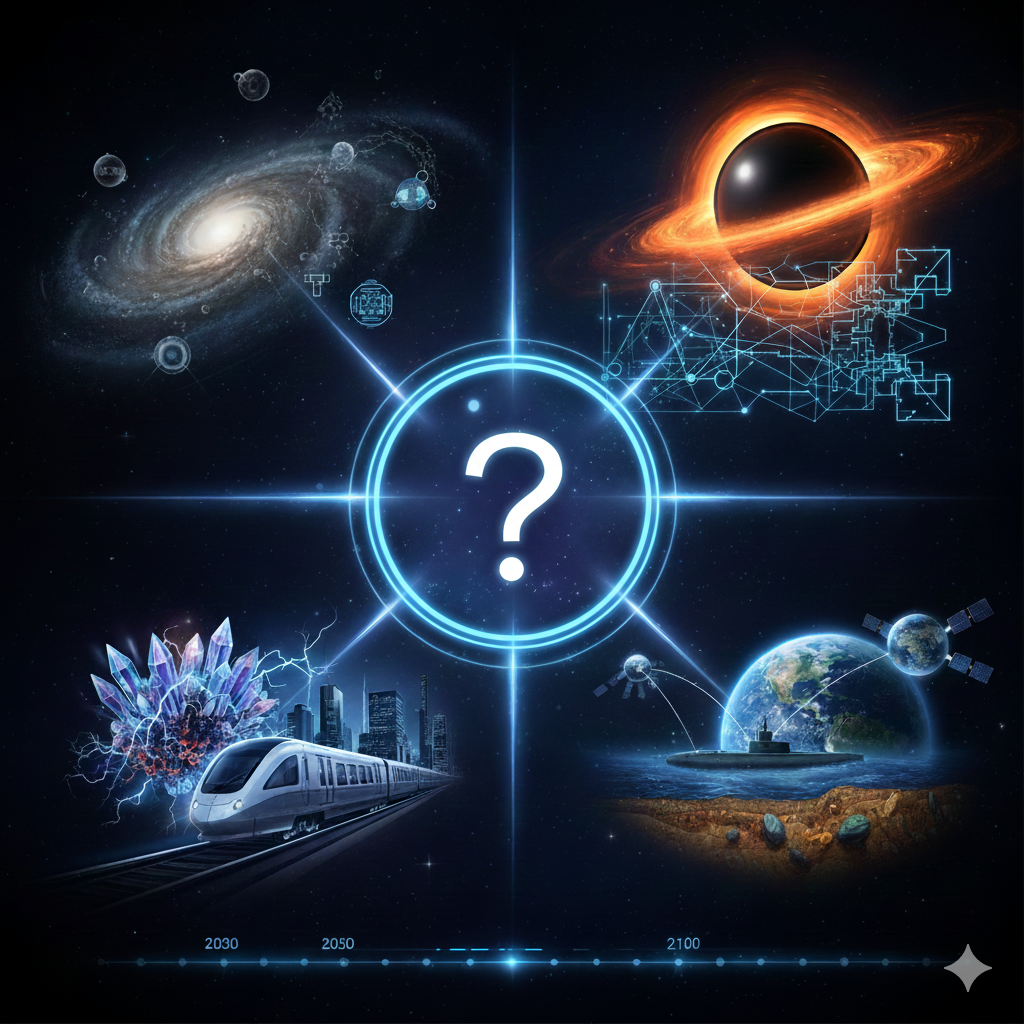
Physics is in a strange place right now. The equations work. The predictions keep landing. Yet the biggest pieces of reality are still missing from the story.
That’s why the biggest physics discoveries of the next century won’t feel like “one more particle.” They’ll feel like a rewrite of the rules. Or a sudden explanation for something everyone has been staring at for decades.
This piece maps the most plausible headline discoveries across the next 100 years, and the tools most likely to produce them. Some are close enough to taste. Others are still beyond the engineering horizon.
The story turns on whether nature is hiding new laws just out of reach, or whether we’ve misunderstood the clues we already have.
Key Points
The strongest candidates for the biggest physics discoveries cluster around a few “known unknowns”: dark matter, dark energy, neutrinos, and quantum gravity.
Progress is likely to come from three toolkits: bigger particle colliders, next-generation gravitational-wave observatories, and precision measurements that look for tiny cracks in today’s theories.
A confirmed dark matter detection would reshape cosmology and particle physics in one stroke, but there’s no guarantee it’s discoverable with any single experiment.
The next century could bring direct tests of gravity in extreme regimes, including detailed “maps” of black hole mergers and possible clues about what happens beyond horizons.
A breakthrough in quantum gravity might arrive indirectly first, through subtle fingerprints in the early universe, black holes, or high-precision clocks and sensors.
Some “discoveries” may look like engineering wins—fusion, superconductors, quantum computing—but the physics payoff could be deeper: new states of matter and new ways to control the quantum world.
Background: The Open Questions Behind the Biggest Physics Discoveries
Modern physics is built on two pillars. One is quantum theory, which describes the small and the strange with stunning accuracy. The other is general relativity, which explains gravity and the large-scale structure of space and time.
Both are wildly successful. They also refuse to merge cleanly. In the real universe, quantum stuff has gravity, and gravity acts on quantum stuff. So the mismatch is not philosophical. It is physical.
At the same time, the cosmos appears to be dominated by two invisible ingredients. Dark matter behaves like extra mass that clumps and shapes galaxies. Dark energy looks like a push that accelerates cosmic expansion. Together they outweigh ordinary atoms by a huge margin, yet neither has been directly identified.
Then there are neutrinos, the ghost particles that stream through Earth in vast numbers. They have mass, but in a way that still doesn’t fit neatly into the simplest version of the Standard Model. And there is the matter-antimatter puzzle: why anything exists at all, instead of a universe that annihilated itself into light.
These are not minor loose ends. They are signposts that the next layer of physics is real.
Analysis
Political and Geopolitical Dimensions
The largest discoveries will often be tethered to the largest machines. That means international alliances, long budgets, and patient diplomacy.
A future ultra-powerful collider or a global gravitational-wave network is not just a science project. It is industrial policy, talent strategy, and soft power rolled into one. Countries and blocs that lead these efforts set standards, attract researchers, and develop supply chains that spill into medicine, computing, sensing, and energy.
But geopolitics can also fragment the map. Parallel “physics blocs” could emerge, with duplicated facilities and restricted data flows. That slows some work down, but it can also create redundancy that speeds up confirmation. In a century where trust may be scarce, independent verification will matter as much as the initial claim.
Technological and Security Implications
If there is one theme that could define the next century, it is measurement. Physics is increasingly driven by instruments that can detect absurdly tiny effects: a minute wobble in a laser beam, a faint timing drift in an atomic clock, a whisper of energy in a deep underground detector.
Those same tools have dual-use implications. Quantum sensors can improve navigation without GPS. Precision timing underpins finance and secure communications. Superconducting technologies and advanced cryogenics cross into defence and surveillance capabilities.
The upside is that security competition can fund capability jumps. The downside is that secrecy can trap discoveries behind classification walls. The biggest physics discoveries tend to flourish in open comparison, not in silos.
Social and Cultural Fallout
Physics discoveries don’t just change textbooks. They change what people think is possible.
A direct detection of dark matter would be a cultural event because it answers a question that has quietly haunted modern astronomy: “What is most of the universe made of?” A clear handle on dark energy would shift how people imagine the fate of everything: endless expansion, a slow fade, or something more dramatic.
A workable theory that unifies quantum physics and gravity would be even bigger. It would change the mental model of reality itself—what space and time are, whether they are fundamental or emergent, and what “nothing” really means.
The risk is overreach. The public has seen big promises before. If the next century brings many “hints” but few confirmed detections, trust can erode. The communication challenge will be to separate genuine signals from statistical mirages, and to say “we don’t know yet” without sounding like failure.
Economic and Market Impact
Some of the most valuable breakthroughs may arrive wearing practical clothes.
If fusion becomes not just possible but reliable and economically scalable, it would be an energy revolution. Even partial success could reshape grids, geopolitics, and decarbonisation pathways.
If superconductors that work in everyday conditions become real, transmission losses could shrink and machines could become radically more efficient. But the deeper physics prize would be understanding the quantum behaviour that makes such materials possible.
Quantum computing might follow a similar arc. Even if it never becomes a universal replacement for classical machines, it could reveal new physics in controlled quantum systems: exotic phases of matter, new simulation techniques, and measurement methods that open fresh windows on fundamental laws.
What Most Coverage Misses
The most dramatic discoveries might not come from bigger and bigger collisions. They may come from “silent failures” where experiments keep not finding what they were designed to find.
If dark matter continues to evade direct detection, that is not just bad luck. It could mean the universe is pointing to a different kind of answer: ultra-light fields, new forces that hide in plain sight, or a need to rethink how gravity behaves on galactic scales. Non-detections can be as informative as detections when they squeeze the space of possibilities hard enough.
The other overlooked factor is cross-confirmation. The next century’s best discoveries will be the ones seen in multiple ways: a collider hint that matches an astrophysical signal, a gravitational-wave pattern that agrees with precision tests, a cosmology measurement that lines up with particle properties. The biggest physics discoveries will be less like a single “Eureka,” and more like a courtroom case that becomes overwhelming.
Why This Matters
The biggest physics discoveries will shape three groups most directly: industries that build precision technology, governments that rely on strategic science capability, and households that feel downstream effects through energy, healthcare, and computing.
In the short term, the impact looks like investment cycles: new facilities, new supply chains, and new technical jobs. In the long term, it looks like platform shifts—better sensors, better materials, and entirely new ways of processing information.
The events to watch won’t always be flashy. They’ll often be milestones: a new detector reaching its designed sensitivity, a space mission switching on, a collider upgrade crossing a performance threshold, or a measurement campaign tightening error bars enough to force theory to move.
Real-World Impact
A grid planner in Arizona faces repeated heat waves and unstable peak demand. If fusion or advanced superconducting infrastructure becomes viable, the planning horizon changes from “manage scarcity” to “build resilience,” with knock-on effects for prices and reliability.
A medical imaging team in Seoul adopts next-generation sensors originally developed for particle detectors. Scans become faster and lower dose. The physics discovery is not the scan itself, but the measurement technology that made it possible.
A logistics firm in Rotterdam deploys quantum-enhanced navigation sensors that reduce dependence on satellite signals. The day-to-day win is efficiency and security. The deeper shift is a world where precision measurement is everywhere.
A teacher in Manchester tries to explain black holes to teenagers. If gravitational-wave astronomy matures into routine “black hole spectroscopy,” the lesson stops being speculative. The universe becomes something you can listen to, classify, and test.
The Future Ahead
Over the next century, the biggest physics discoveries are likely to cluster around a few central prizes: identifying dark matter, pinning down dark energy, understanding neutrinos, and finding a consistent description of gravity in the quantum world.
The fork in the road is not just scientific. It is strategic. Do societies fund long-horizon instruments that may take decades to pay off, or do they demand quick returns and accept slower progress on the deepest questions?
The signs that the story is breaking one way or the other will be concrete: a confirmed dark matter signal that repeats across experiments, a gravitational-wave result that reveals new structure in extreme gravity, or precision measurements that show the Standard Model is no longer the whole script.
