

The Floating Pandemic Factories: Why Cruise Ships Turn Viruses Into Global Crises
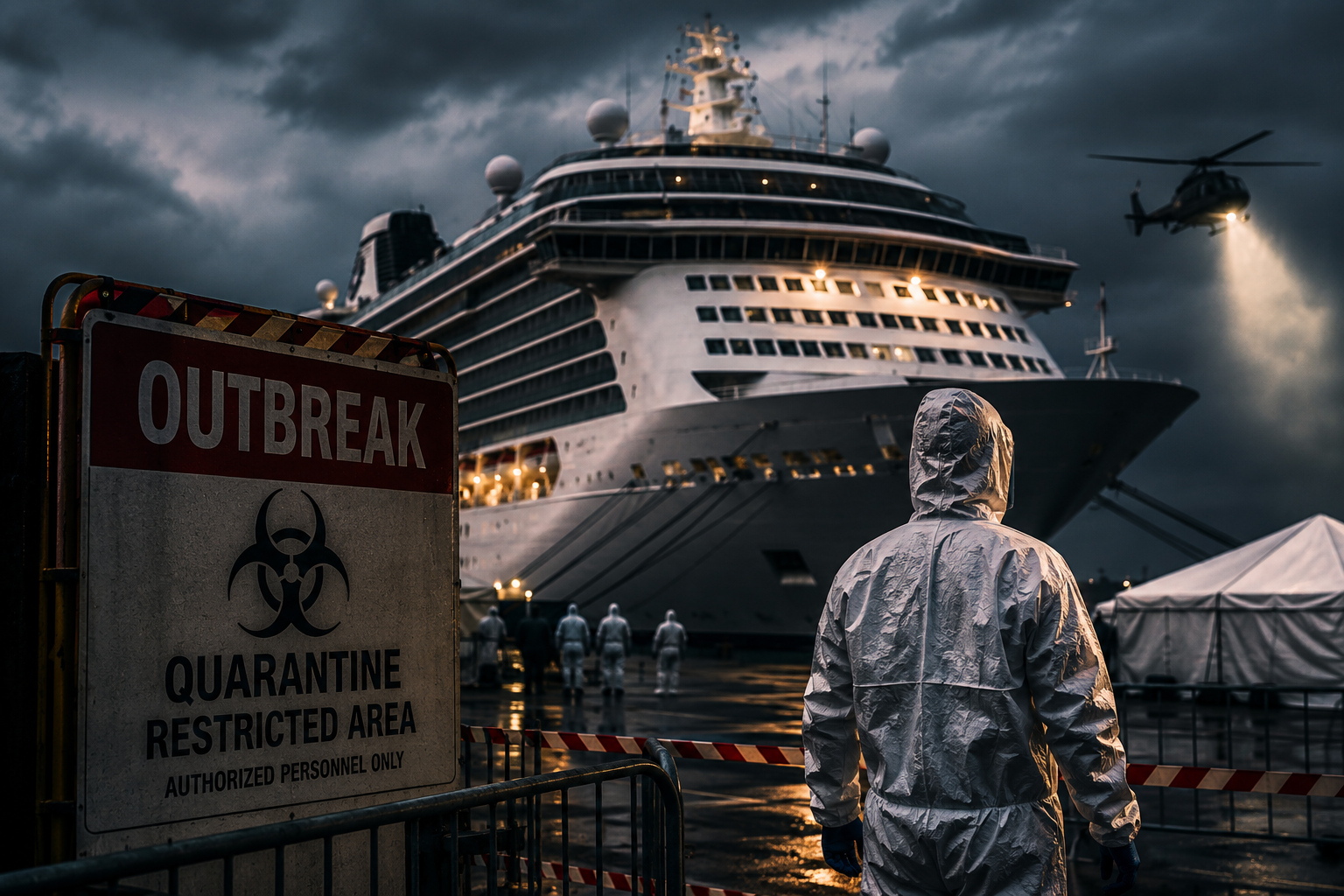
Why Cruise Ships Become Disease Explosions Faster Than Cities
The Hidden Pandemic Risk Behind Modern Cruise Ships Is Worse Than Most People Realise
The Modern Cruise Industry Accidentally Created One Of The Most Efficient Disease-Spreading Systems On Earth
A cruise ship looks like a luxury holiday. From a virus’s perspective, it looks like paradise.
Thousands of people from different countries board a floating city packed with shared dining areas, bars, elevators, theaters, casinos, pools, gyms, and enclosed cabins. They eat together, breathe the same recycled air for days, touch the same surfaces repeatedly,repeatedly, and travel from port to port while sleeping only meters apart from strangers.
Then somebody coughs.
That is why public health experts become nervous every time a cruise outbreak begins making headlines. The concern is not just the illness itself. It is the environment. Cruise ships combine nearly every condition that helps infectious disease spread rapidly: density, enclosed spaces, repeated close contact, international mixing, and delayed isolation.
The latest fear surrounding a suspected hantavirus-linked cruise outbreak has pushed that reality back into global headlines. Several deaths linked to the outbreak triggered renewed scrutiny over how quickly disease can move through ships at sea and why outbreaks aboard cruises repeatedly become international incidents.
What makes cruise ships uniquely dangerous is not simply that people are close together. Cities are crowded too. Airports are crowded. Concerts are crowded.
Cruise ships are different because passengers cannot truly leave the exposure environment once the outbreak starts.
The Floating City Problem
A modern cruise ship is essentially a compressed urban environment placed into a sealed transport system.
Large vessels can carry thousands of passengers alongside huge crews working in restaurants, housekeeping, entertainment, food preparation, and maintenance. Unlike hotels on land, people onboard repeatedly cycle through the same enclosed ecosystem for days or weeks at a time.
That repetition matters enormously in epidemiology.
A virus does not need one perfect transmission event. It's new with constant supported opportunities. Cruise ships provide them constantly. Shared elevators, buffet utensils, railings, casino chips, gym equipment, and theater seating create a continuous chain of physical interaction. Respiratory viruses gain additional advantages because passengers share indoor air circulation systems and spend long periods together in entertainment venues and dining halls.
Even worse, cruise passengers are not static groups. Every port introduces new exposure pathways.
Passengers leave the ship, interact with local environments, join excursions, eat in restaurants, and return carrying whatever pathogens they encountered. Crew rotations create additional movement between regions. The result is a constantly refreshed network for potential disease introduction.
That is why outbreaks onboard can evolve from isolated illnesses into multinational public health concerns with startling speed.
Why Norovirus Loves Cruise Ships
No disease better explains the cruise ship problem than norovirus.
The virus is so strongly associated with cruise outbreaks that many people simply call it “the cruise ship virus.” The CDC says more than 90% of gastrointestinal outbreaks on cruise ships with confirmed causes are linked to norovirus.
Norovirus is almost perfectly engineered for cruise environments.
It spreads through contaminated food, water, surfaces, and direct human contact. Infected people shed enormous amounts of virus particles. The infectious dose is extremely small. It survives on surfaces for long periods and can spread through aerosolized particles from vomiting incidents.
That means one infected passenger can unintentionally contaminate multiple locations before symptoms become severe enough for isolation.
Scientific modeling of cruise outbreaks suggests direct passenger-to-passenger spread dominates transmission onboard, while crew can act as long-term reservoirs across multiple voyages.
That creates a nightmare scenario for containment.
Passengers continue socializing during early symptoms because they assume they simply have food poisoning or motion sickness. By the time the ship identifies a true outbreak pattern, the virus may already exist across multiple decks and shared facilities.
This is why cruise operators aggressively isolate symptomatic passengers once outbreaks are detected. But by then, the invisThis scenario isread often began days earlier.
COVID Changed How The World Sees Cruise Ships
Before 2020, people usually viewed cruise outbreaks as unpleasant travel stories. COVID transformed them into symbols of how modern pandemics spread.
The Diamond Princess became one of the earliest global demonstrations of how dangerous confined viral transmission could become. What began as a contained onboard outbreak rapidly escalated into an international health emergency involving quarantines, evacuations, and global media attention.
The ship revealed something uncomfortable: cruise vessels can function like real-world laboratory environments for respiratory disease transmission.
COVID exposed how difficult it is to quarantine thousands of people inside an enclosed structure while maintaining ventilation, staffing, food supply, and medical care. Isolation becomes operationally complex when infected and non-infected individuals still rely on the same crew systems and logistical infrastructure.
It also highlighted another problem public-health experts already understood: asymptomatic spread.
Respiratory viruses become vastly harder to control when infected people feel healthy enough to continue socializing. socializing. Cruise environments multiply those opportunities through restaurants, entertainment venues, and repeated social contact.
Even after the peak pandemic years ended, cruise outbreaks continued appearing regularly in public-health monitoring systems.
The Medical Limits Nobody Thinks About
Most passengers assume cruise ships operate like floating hospitals.
They do not.
Cruise vessels have doctors, nurses, and medical facilities capable of handling many emergencies, but they are not designed to function as large-scale infectious disease treatment centers. centers.
That distinction becomes critical during serious outbreaks.
A respiratory infection requiring advanced ventilation support, large-scale oxygen access, or intensive isolation capability can overwhelm onboard resources quickly. If the ship is in a remote location, evacuation itself becomes difficult and dangerous.
The recent hantavirus-linked cases demonstrated that problem dramatically. Several infected passengers required evacuation during an outbreak unfolding across an isolated Atlantic route.
Cruise medicine works best when treating individual incidents. Pandemic-style spread creates an entirely different operational challenge.
Ships also face another issue: demographics.
Cruises remain especially popular with older adults, many of whom have underlying medical conditions. That increases the probability that outbreaks become medically serious rather than simply disruptive.
A stomach virus in a healthy younger traveler may mean two miserable days. The same infection in an elderly passenger with cardiovascular or respiratory issues can become far more dangerous.
Why Cruise Outbreaks Always Become Huge News
Cruise outbreaks receive disproportionate attention partly because they are visible.
On land, disease spreads diffusely across towns, offices, schools, and households. Cruise outbreaks happen inside a contained environment with a known passenger list, a known location, and a clear timeline.
That creates dramatic headlines.
Passengers become trapped in a floating uncertainty bubble while media outlets track infections deck by deck. Visuals of quarantined ships offshore are naturally cinematic and emotionally powerful.
But there is another reason cruise outbreaks attract such attention: they compress the fear of globalization into one image.
A cruise ship symbolizes modern international mobility. Multiple countries, nationalities, transport systems, and health networks intersect in one vessel. When disease spreads onboard, people instinctively recognize how interconnected the world has become.
The ship becomes a miniature version of pandemic-era civilization itself.
The Hantavirus Fear Explained
The recent hantavirus concerns triggered alarm precisely because hantavirus is not usually associated with cruise ships.
Most hantavirus infections are linked to contact with infected rodents or their droppings. Human-to-human transmission is considered extremely rare outside certain strains, including the Andes virus associated with South America.
That rarity is precisely why experts took the outbreak seriously.
When an unusual virus appears in an already high-risk transmission environment like a cruise ship, public health agencies immediately begin investigating whether the outbreak reflects environmental exposure, onboard contamination, or possible person-to-person spread.
Current assessments suggest global risk remains low.
But the story still matters because it reveals how quickly cruise outbreaks can escalate from isolated illness into international public health investigations involving evacuations, contact tracing, and cross-border coordination.
The cruise industry knows the risk of tracing.
Cruise operators are not ignoring the problem.
Modern ships use enhanced sanitation systems, isolation protocols, medical screening, outbreak response plans, and ventilation improvements designed to reduce transmission risk.
The industry also correctly argues that cruise outbreaks are often detected faster than equivalent outbreaks on land because stricter and more visible reporting systems exist.
That creates an issue with perception.
Cruise outbreaks feel constant partly because they are monitored aggressively and reported publicly. Norovirus outbreaks on land occur far more frequently than cruise outbreaks overall.
Still, visibility does not erase the structural vulnerability.
The same features that make cruises attractive—social interaction, shared experiences, dense entertainment environments, and global travel—also create ideal conditions for infectious spread.
That contradiction is unlikely to disappear.
The Bigger Warning Behind Cruise Ship Outbreaks
Cruise ships are not just tourism stories anymore. They are stress tests for the modern world.
They reveal what happens when hyper-connectivity collides with infectious disease. They show how quickly local exposure can become international concern. They expose the limits of medical infrastructure inside enclosed systems.
Most importantly, they demonstrate something many people still underestimate after COVID: pandemics do not spread because viruses are unstoppable. They spread because modern human systems are built for movement, density, and constant interaction.
Cruise ships simply compress all of those realities into one floating environment.
That is why every major outbreak at sea feels larger than the ship itself.
It is not just about the passengers onboard.
It is about the uncomfortable possibility that the modern world may have accidentally engineered perfect transmission systems long before it fully understood the consequences.
