The Future Particles That Could Rewrite Physics
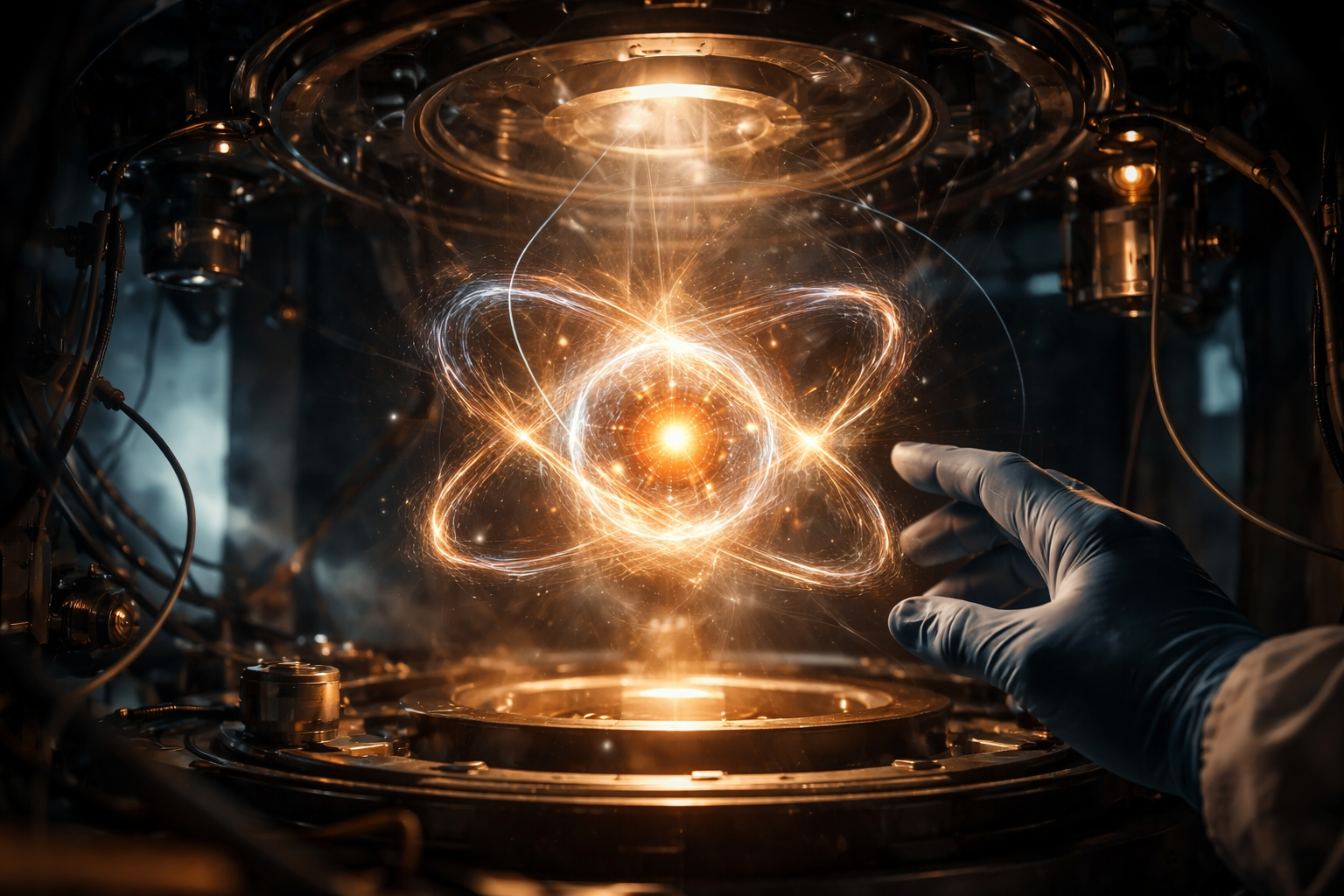
No new particle are confirmed—but axions, dark photons, and neutrino surprises could be next. Here’s what to watch.
And Where We’d Find Them…
Particle physics sits in a strange position: the Standard Model keeps winning, yet the universe keeps refusing to fit inside it. Dark matter still dominates cosmic structure, neutrinos still have mass, and the early universe still produced more matter than antimatter—none of which the Standard Model truly explains.
The next discovery is unlikely to look like a neat new “ball” added to a tidy list. It may arrive as a faint line in a microwave receiver, a rare nuclear decay that should never happen, or a displaced flash of energy far from where a collider event “should” end. The overlooked pivot is the shift in the frontier from "smash harder" to "listen better."
The story turns on whether nature’s missing pieces are hiding in weak couplings rather than higher energies.
Key Points
The most transformative “new particle” candidates map directly onto the biggest gaps: dark matter, neutrino mass, matter–antimatter asymmetry, and the strong-CP problem.
Axions and axion-like particles could solve a deep symmetry puzzle in the strong force and also make up dark matter—making them unusually “high leverage” discoveries.
Hidden-sector force carriers like dark photons would imply an entire new force structure, not just a single particle.
Neutrino-related discoveries (sterile neutrinos, heavy neutral leptons, or Majorana neutrinos) would change the rules of what “mass” is allowed to be and how the universe evolved.
Big-collider breakthroughs remain possible, but many high-probability targets are now pursued with ultra-sensitive, non-collider experiments.
The most decisive signals will be the ones that can be cross-checked across different detectors, materials, or search methods.
Background
Physicists call the Standard Model “complete” in a very specific way: it’s a closed set of particles and forces that predicts laboratory results with astonishing accuracy. But it is not a complete description of reality.
The pressure points are well known. Dark matter behaves like invisible mass that clumps and shapes galaxies. Neutrinos have mass, which the Standard Model doesn’t naturally give them. The universe’s matter dominance suggests new sources of symmetry-breaking beyond what we have measured. And the strong force has an eerie “fine-tuning” issue (the strong-CP problem) that looks like a clue, not a coincidence.
A future particle discovery matters most when it does two things at once: it explains one of these pressure points and forces a rewrite of deeper assumptions—about symmetry, conservation laws, or what kinds of interactions are even allowed.
Analysis
Axions and Axion-Like Particles: The “Two-Problem” Particle
The axion is the most efficient way to change physics with a single discovery. It was proposed to resolve the strong-CP problem, but it also naturally behaves like a dark matter candidate. That is rare: most hypothetical particles solve one headache, not two.
The reason Axion searches feel different is that they don’t rely on brute force. Many approaches treat the axion field as something you can “tune into,” like an almost unimaginably quiet radio station. The experimental game becomes engineering: extreme cryogenics, quantum-limited amplification, magnetic fields, and long integration times.
A plausible scenario is a clean, narrow signal that appears at a specific frequency and persists under repeated scanning, then shows up again in an independent apparatus. Another scenario is a long run of null results that sharply narrows the most credible mass ranges, forcing theorists to reweight which early-universe histories still make sense.
Dark Photons and Hidden Forces: A New Sector, Not a New Widget
A dark photon is conceptually simple: imagine a cousin of the ordinary photon that mediates a new force in a hidden sector. The reason it would be revolutionary is not the particle itself, but what it implies: a second “electromagnetism-like” structure that our everyday matter barely feels.
This class of ideas generalizes beyond dark photons to a broader family: light, weakly coupled mediators; “dark Higgs” particles that give mass inside the hidden sector; and long-lived particles that travel measurable distances before decaying.
There are two broad discovery paths. One is direct detection: rare scatterings or decay products in dedicated detectors. The other is collider-adjacent: particles produced in high-energy collisions that evade the main detectors but reveal themselves downstream, or through unusual displaced decays. The signposts here are distinctive event shapes: decays that happen “too late,” missing energy patterns that don’t fit neutrinos, or correlated signals across different experiments sensitive to different lifetimes and couplings.
Neutrino Surprises: Sterile Neutrinos, Heavy Neutral Leptons, and Majorana Mass
Neutrinos are already proof that our neat picture is incomplete. The question is what kind of incompleteness they represent.
Sterile neutrinos (or, in heavier form, heavy neutral leptons) would be a new kind of matter that barely interacts, yet fundamentally changes how neutrino mass works. Some versions also help explain why the universe ended up matter-dominated by introducing new ways to violate symmetries in the early cosmos.
Then there is a deeper possibility: neutrinos might be Majorana particles, meaning the neutrino and antineutrino are not truly distinct. If confirmed, that would break a long-standing conservation rule (lepton number) as an “accidental” symmetry rather than a law of nature. The cleanest signpost is a specific kind of nuclear decay—neutrinoless double beta decay—that would be difficult to explain away once observed consistently.
Here, possible outcomes include either a clear finding in a future nuclear experiment or gradually narrowing down the limits that eliminate many possibilities and change which theories about neutrino mass are still believable.
The topics of Supersymmetry, Composite Worlds, and the Return of “Missing Partners” are discussed.
Some hypothetical particles are “heavy,” not “shy.” Supersymmetry would double the particle list with partners: neutralinos, sleptons, squarks, and gluinos. Composite-Higgs models and extra-dimensional theories also imply new resonances or partner states.
A confirmed discovery in this area would be a major news event because it would appear as clear new ways particles are produced at high energy—new peaks, new decay sequences, or consistent changes in how Higgs and top quarks behave. But the modern expectation is more cautious: if these particles exist, they may be heavier or more subtle than early optimistic models predicted.
The signposts to watch are less about a single dramatic plot and more about consistency: repeated excesses across channels, clean deviations in precision measurements, and patterns that match a coherent model rather than a one-off fluctuation.
Precision as a Particle Factory: When “No Particle Seen” Still Changes Physics
Some discoveries arrive indirectly. A permanent electric dipole moment (EDM) in a fundamental particle would imply new sources of symmetry violation, strongly connected to why the universe has more matter than antimatter. Likewise, precision anomalies in magnetic moments or rare decays can point to particles that are too heavy to produce directly, because their effects leak into quantum corrections.
The plausible scenarios presented here are inherently complex. One is convergence: multiple precision measurements shift in compatible ways, and the theoretical calculations stabilize, forcing a specific kind of new physics. Another scenario involves divergence, where advancements in measurements and theory eliminate apparent anomalies, providing valuable insights by challenging established models.
What Most Coverage Misses
The hinge is that the next “particle” may be discovered as a system—a web of weak signals that only becomes undeniable when stitched together across very different experiments.
Mechanistically, this changes incentives and timelines because a single detector rarely provides the whole story. A dark photon-like mediator might show up as a long-lived particle signature at a collider-adjacent experiment while also shaping direct detection expectations and appearing under astrophysical constraints. The path to certainty becomes cross-validation, not spectacle.
The signposts are practical. First, watch for results that repeat across different targets or materials (different nuclei, different detector media, different backgrounds). Second, watch for coordinated “parameter space” closure: when multiple searches collectively squeeze the same hypothesis until only a narrow corridor remains. Third, watch for detector breakthroughs—better quantum amplifiers, lower backgrounds, higher stability—because the bottleneck is often measurement, not theory.
Why This Matters
If a new particle is confirmed, the biggest immediate impact will not be “new technology tomorrow.” It will be a new map of what is real and therefore what is worth building.
In the short term (weeks to a couple of years), the most affected groups are the big experimental collaborations and the funding bodies that decide which search strategies scale. A credible signal triggers replication, fast. Additionally, it shifts the perception of which billion-dollar projects are urgent and which are considered long-term endeavors.
In the long term (years to decades), the stakes broaden. Dark matter identification would rewrite cosmology’s input assumptions and reshape how we interpret galaxy surveys. A Majorana neutrino would change how we think about conserved quantities in nature and push model-building toward new symmetry structures. A hidden-sector mediator would open an entire new domain of “dark chemistry” possibilities, even if most of it stays forever weakly connected to us.
The main consequence is strategic: once you know what the missing piece is, you stop searching blindly and start engineering the next layer of tests because you finally know what the universe is made of.
Real-World Impact
A cryogenics engineer in a national lab spends years hunting a background that mimics the signal. A single purification improvement buys an order-of-magnitude sensitivity jump, and suddenly an entire hypothesis becomes testable.
A quantum-sensing startup recruits physicists because techniques built to detect vanishingly small particle signals translate into better amplifiers and measurement stability in other high-precision industries.
A space scientist revises mission priorities because dark matter properties change predictions for structure formation, which changes what “should” be seen in deep surveys.
A policy team monitors the dynamics of international collaboration, realizing that distributed, cross-border experiments, rather than a single flagship machine, are increasingly likely to yield the next discovery.
The Discovery That Arrives Like a Whisper
Smashing protons and observing debris still dominate the public image of particle physics. That route still matters, and it could still deliver something enormous. But the more likely near-term revolution is quieter: a weakly coupled particle, a rare decay, or a precision shift that refuses to go away.
The decision point is straightforward. Either nature gives us a clean new signal—an axion-like line, a neutrino that breaks an old rule, or a hidden force carrier with a distinctive decay—or it forces a deeper rethink about why the universe looks fine-tuned and incomplete but keeps dodging our detectors.
Watch for replication across experiments, for signals that survive detector upgrades, and for results that connect laboratory physics to cosmology in a way that narrows the story to one unavoidable explanation. If that happens, this era will be remembered as the moment physics stopped asking, “What else is out there?” and started naming it.
