The Impossible Black Hole Rewriting Cosmic History
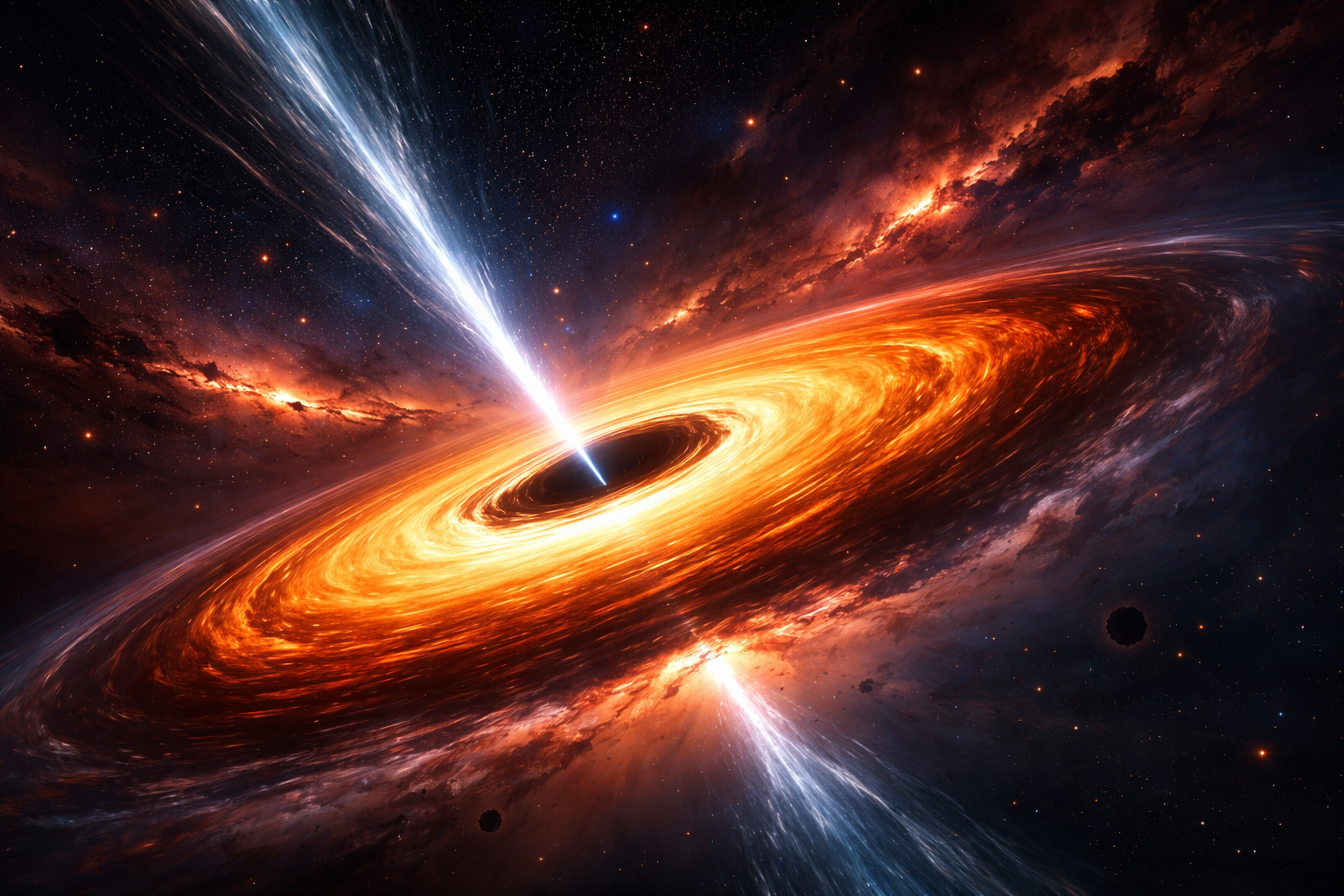
Scientists Discover Black Hole That Should Not Exist So Early
A Monster From the Dawn of Time: The Black Hole That Breaks the Rules
In the earliest chapters of the universe, cosmic structures were supposed to grow slowly. Gas condensed into the first stars. Galaxies formed gradually. Black holes—the most extreme objects in nature—were expected to emerge as relatively small seeds and take billions of years to reach enormous sizes.
Yet astronomers are now confronting a discovery that disrupts that timeline.
A newly studied supermassive black hole from the young universe appears to be growing far faster than existing physics models allow. Observations suggest it is consuming matter at a rate dramatically beyond the theoretical “speed limit” for black hole growth, potentially more than ten times faster than expected.
The finding forces astrophysicists to confront an uncomfortable possibility: either the earliest black holes formed through mechanisms we do not yet understand—or the assumptions underpinning our models of cosmic growth need revision.
The story turns on whether the universe’s first black holes grew in brief, explosive bursts rather than slow, steady accumulation.
Key Points
Astronomers have identified an early-universe supermassive black hole growing far faster than theory predicts.
Observations suggest the object may be consuming matter up to 13 times the traditional growth limit for black holes.
The discovery occurred in a quasar—a bright object powered by matter falling into a black hole—dating back to the universe’s early history.
The result challenges models explaining how black holes reached billions of solar masses within the first billion years after the Big Bang.
Scientists now suspect that early black holes may have grown in short bursts of extreme feeding rather than gradual accretion.
Where the Puzzle Begins: The Early Universe Problem
Supermassive black holes—monsters millions or billions of times the mass of the Sun—sit at the center of most large galaxies today. Even our own Milky Way hosts one.
But there has always been a major cosmological puzzle.
Astronomers have repeatedly observed gigantic black holes existing less than a billion years after the Big Bang. That should not have been possible under conventional growth models.
The standard explanation begins with a “seed” black hole formed when the first massive stars collapsed. Over time, the seed grows by pulling in surrounding gas. This process—known as accretion—is limited by a physical boundary called the Eddington limit, where radiation pressure from the feeding black hole pushes matter away.
Under steady conditions, that limit caps how rapidly black holes can grow.
Yet the newly studied object appears to ignore that rule entirely.
A Black Hole Eating Far Faster Than Physics Allows
The newly analyzed quasar hosts a supermassive black hole that seems to be feeding at an astonishing rate.
Measurements of its radiation and gas motion indicate it may be accreting matter roughly 13 times faster than the Eddington limit, the threshold once believed to cap black hole growth.
Such behavior should theoretically disrupt the system. When matter falls too quickly toward a black hole, the resulting radiation normally pushes gas away, slowing the process.
But in this case, the black hole continues to blaze with intense X-ray emissions and powerful radio jets while feeding at extreme speed—a combination that conventional models struggle to explain.
The object appears to exist during a rare phase where the cosmic brakes have effectively failed.
How Astronomers Found It
The discovery emerged from observations of a distant quasar using a combination of powerful telescopes.
By analyzing emission lines—patterns of light produced by gas orbiting the black hole—astronomers can estimate the object’s mass and the speed at which it is pulling in matter.
These measurements revealed a black hole that was already enormous when the universe itself was still relatively young, roughly within the first billion to 1.5 billion years after the Big Bang.
That timing alone makes the object extraordinary.
But its feeding rate makes it revolutionary.
Why This Discovery Matters
The existence of such a rapidly growing black hole deep in cosmic history touches one of the biggest unsolved questions in astrophysics: how the first supermassive black holes formed so quickly.
If early black holes obeyed the same rules we observe today, they simply would not have had enough time to reach the sizes astronomers see.
Several theories attempt to solve the puzzle:
Massive “direct collapse” seeds, where giant gas clouds form large black holes from the start
Runaway mergers of early stars in dense clusters
Dark matter–powered primordial stars that collapse into massive black holes
Extreme feeding episodes where black holes briefly grow far faster than the theoretical limit
The new discovery offers the clearest observational evidence yet that the last possibility may occur in reality.
What Most Coverage Misses
The key implication is not merely that a single black hole is growing unusually fast.
It is that the early universe may have been fundamentally more chaotic and gas-rich than modern galaxies, enabling conditions where normal feedback limits temporarily failed.
Young galaxies were dense reservoirs of cold hydrogen gas. If enough of that gas rushed toward a black hole simultaneously, it could overwhelm radiation pressure and create a short-lived “hyper-accretion” phase.
In other words, the Eddington limit may not be a hard speed limit—it may be more like a guideline that extreme environments occasionally break.
That distinction matters enormously.
If early black holes experienced even a handful of these explosive feeding bursts, they could reach billion-solar-mass sizes far sooner than classical models predict.
The puzzle of early supermassive black holes might not require exotic new physics after all—just a more violent young universe.
The Next Clues Will Come from Webb and Future Telescopes
Astronomers now want to know whether this object is an anomaly or a glimpse of a common early-universe process.
New observations from the James Webb Space Telescope and large ground-based observatories are expected to search for similar rapidly growing black holes in the distant cosmos.
Finding many would have profound implications.
It would suggest that supermassive black holes were not rare accidents in the early universe but a natural outcome of chaotic cosmic conditions.
If they continue to be rare, the mystery becomes more complex.
The coming years will determine whether astronomers have witnessed a cosmic fluke—or uncovered the missing step that built the universe’s largest black holes.
