The Next Pandemic Is Already Circling The World
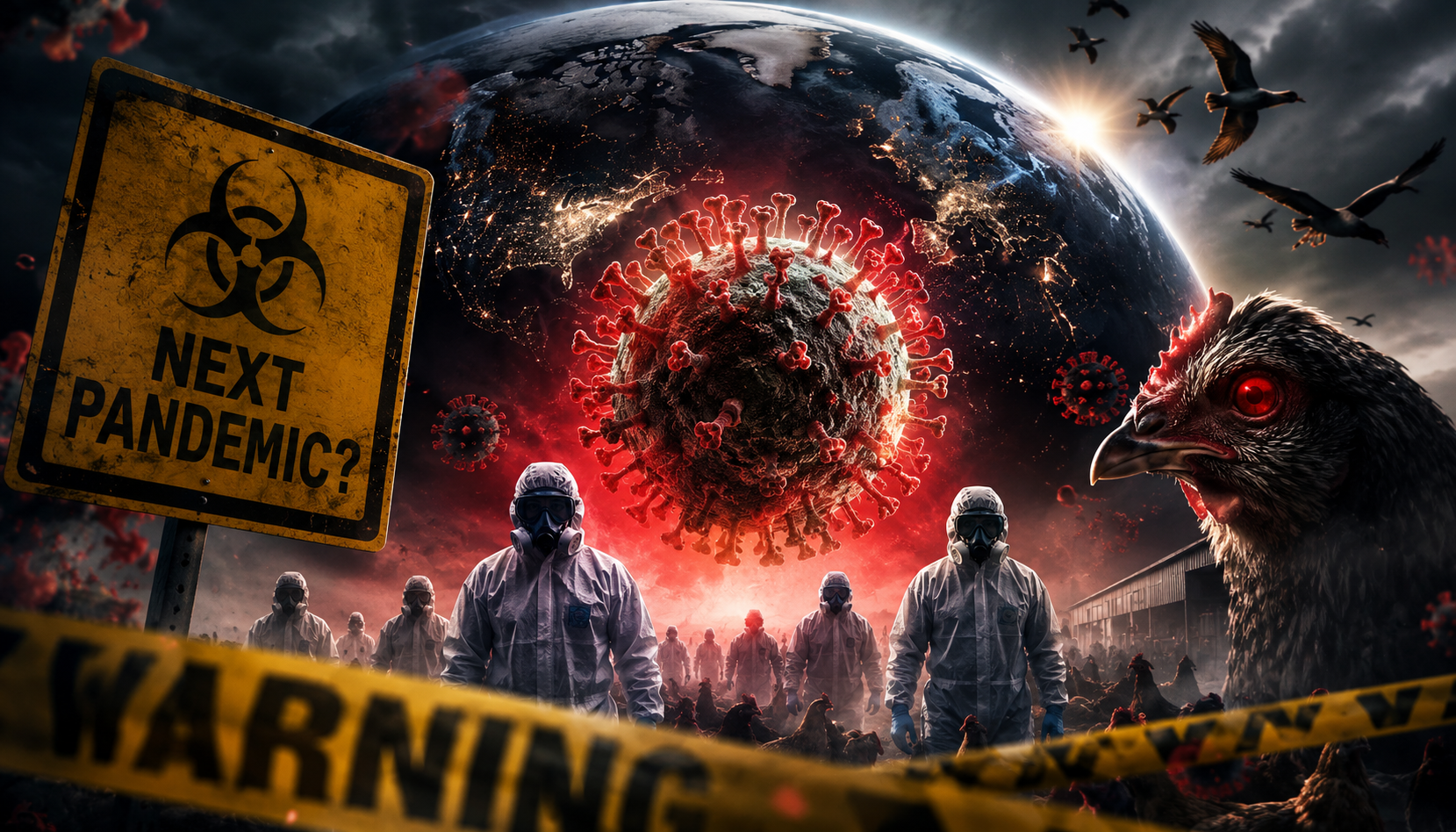
The World Is Sleepwalking Into The Next Pandemic
The Next Pandemic May Already Be Unstoppable — Scientists Are Watching One Virus Above All Others
The next pandemic is not a distant theory. It is a live statistical risk moving through birds, mammals, farms, hospitals, cities, borders and weakened public-health systems. The world is not currently in another COVID-scale pandemic, but the conditions that create one are already visible.
The most likely trigger is still a respiratory virus, because respiratory spread is what turns an outbreak into a global event before governments can see the full shape of it. UKHSA’s 2025 Health Security Risk Assessment placed an influenza pandemic and a novel coronavirus pandemic among the highest assessed risks, which means the danger is not hidden in obscure scientific speculation. It is sitting in the official risk register of a country that has already lived through COVID-19.
How Close Are We?
The cleanest answer is uncomfortable: close enough that serious planning should be treated as urgent, but not so close that a new pandemic is inevitable this year. Historical modelling suggests a COVID-scale pandemic risk of roughly 2.5% to 3.3% in any given year. That sounds small until it is compounded. Over five years, that becomes roughly 12% to 15%. Over ten years, it becomes roughly 22% to 29%. Over 25 years, it reaches roughly 47% to 57%.
That does not mean the next pandemic will arrive on a neat timetable. It means the world is playing repeated rounds of biological roulette. Most spillovers burn out. Some become regional emergencies. A small number acquire the right combination of transmissibility, immune escape, severity and timing to become global.
The central danger is not simply one virus. It is the collision between zoonotic spillover, global travel, dense food systems, hospital pressure, vaccine politics, misinformation and uneven surveillance. COVID-19 proved that the first weeks matter more than almost anything else. A pathogen that spreads efficiently before detection can outrun even rich health systems.
The Most Likely Candidate Is Influenza
Influenza remains the leading known candidate because it changes quickly, circulates widely in animals and has already caused multiple pandemics. WHO says a future influenza pandemic is inevitable because of the nature of influenza viruses. That is not a dramatic opinion. It is the basic biology of a virus family that constantly reshuffles and adapts.
H5N1 is the most watched threat inside that category. The current global H5 bird flu situation has moved beyond a poultry problem. It has affected wild birds, poultry, mammals and sporadic human cases. The CDC says the current public-health risk remains low and that there is no known person-to-person spread at this time, but the same CDC summary records 71 reported human A(H5) cases in the United States since 2024 and two deaths.
The wider historical signal is more severe. Since 1997, more than 1,000 sporadic human H5N1 infections have been reported across 25 countries, with an approximate fatality proportion of 48% among reported cases. That figure almost certainly overstates the fatality rate of a future adapted pandemic strain, because severe cases are more likely to be detected than mild ones. But it still shows why H5N1 causes such concern: it does not need to keep anything close to that reported fatality level to be catastrophic.
Australia’s 2026 detections show how far the virus has moved. As of 5 July 2026, the Australian government reported six confirmed H5 bird flu cases in wild birds across Western Australia, South Australia and New South Wales, with no evidence of mass mortality, poultry infection or wider agricultural spread, and a low current risk to human health. That is reassuring for now. It is also a reminder that H5N1 has reached places that had been largely spared.
The Second Candidate Is A New Coronavirus
The second most likely candidate is a novel coronavirus. SARS-CoV-2 did not succeed because it was the deadliest virus. It succeeded because it combined respiratory spread, pre-symptomatic transmission, global connectivity and enough severity to crush hospitals once case numbers multiplied.
A future coronavirus does not need to be identical to COVID-19. It could be milder, deadlier, more immune evasive, slower, faster or easier to contain. The danger is that coronaviruses have already shown they can cross from animals into humans and cause severe disease. MERS-CoV remains a warning sign: WHO recorded 2,635 laboratory-confirmed MERS cases and 964 associated deaths from 2012 to December 2025, a reported case-fatality ratio of 37%.
MERS itself has not become a pandemic because it has not achieved sustained efficient human transmission. That is the line separating a terrifying outbreak from a global catastrophe. The nightmare scenario is not today’s MERS pattern. It is a future coronavirus with the spread efficiency of SARS-CoV-2 and a severity profile closer to SARS or MERS.
Disease X May Be The Real Answer
The most honest pandemic forecast includes a category for the pathogen we do not yet know. WHO’s R&D Blueprint explicitly includes “Disease X,” meaning a serious international epidemic caused by a currently unknown pathogen. That label exists because history does not wait for scientists to name the next threat in advance.
Disease X is not a conspiracy term. It is a planning tool. It means the world must prepare platforms, surveillance, diagnostics, manufacturing capacity and emergency governance for a threat that may not fit the last crisis.
This is where preparedness still looks dangerously uneven. The WHO Pandemic Agreement was adopted by the World Health Assembly on 20 May 2025 after COVID-19 exposed major gaps and inequities in global response, but adoption is not the same as operational readiness. The agreement still depends on implementation, financing, trust and the unresolved practical details of pathogen access and benefit sharing.
How Unprepared Are We?
The world is better prepared scientifically than it was in 2019, but politically and operationally it remains fragile. Vaccines can be designed faster. Genomic surveillance is stronger. Global scientific networks are more alert. CEPI’s 100 Days Mission aims to produce safe, effective and accessible vaccines within 100 days of identifying a new pandemic threat.
The weak points are delivery, trust, equity, funding and speed. A vaccine design in 100 days does not automatically mean global vaccination in 100 days. It does not solve raw materials, fill-finish capacity, cold chains, regulatory alignment, misinformation, public refusal or export controls. The COVID-19 lesson was brutal: invention is not the same as access.
Financing is another major weakness. The Pandemic Fund says it has awarded US$885 million across its first two funding rounds, benefiting 75 countries and mobilising an additional US$6 billion in co-financing and country co-investments. That is useful, but the wider preparedness bill is larger and permanent. Pandemic defence is not a one-off grant cycle. It is infrastructure.
The Global Preparedness Monitoring Board’s 2024 report warned that epidemics and pandemics are now a constant danger rather than rare events. That matters because many governments behave as if the COVID-19 shock bought the world decades of safety. It did not. It simply revealed the price of delay.
The Slow Pandemic Is Already Here
Not every pandemic threat arrives as a sudden respiratory wave. Antimicrobial resistance is the slow catastrophe already eating into modern medicine. WHO’s 2024 Bacterial Priority Pathogens List covers 24 pathogens across 15 antibiotic-resistant bacterial families, including Gram-negative bacteria resistant to last-resort antibiotics and rifampicin-resistant tuberculosis.
AMR is less likely to produce a single week when the world suddenly shuts down. That makes it easier for politicians to ignore. But the long-term consequences are severe: routine surgery becomes riskier, cancer treatment becomes harder, childbirth becomes more dangerous, and hospital infections become more expensive and harder to treat.
Drug-resistant tuberculosis deserves special attention because it combines airborne spread, long treatment, social vulnerability and global inequality. It is not the most likely cause of a sudden COVID-style shock, but it is one of the most serious candidates for a grinding health-security crisis that quietly kills for years.
The Most Dangerous Known Scenario
The worst plausible known scenario is an influenza virus, especially H5N1 or another avian-origin influenza, acquiring sustained human-to-human respiratory spread while retaining even a fraction of its currently observed severity. A virus does not need a 48% fatality rate to devastate the world. A much lower fatality rate, combined with rapid spread, hospital overload and immune novelty, would be enough to create a catastrophe larger than COVID-19.
The second worst scenario is a novel coronavirus with SARS-like severity and SARS-CoV-2-like spread. This would be harder to contain than a visibly severe virus that only spreads after symptoms. The more invisible the early transmission, the more countries discover the problem only after it has already seeded multiple cities.
The third worst is not one pathogen but multiple overlapping shocks: H5N1 hitting food systems, a coronavirus wave hitting hospitals, and AMR weakening treatment at the same time. Modern societies are not built with much spare capacity. They are optimised for efficiency, not biological shock.
The Timeline That Looks Most Likely
The most likely near-term timeline is not “pandemic tomorrow.” It is a rising sequence of warnings between 2026 and 2030: more animal outbreaks, more human spillovers, more emergency declarations, more regional outbreaks, and more pressure on surveillance systems. H5N1, mpox, Ebola, MERS, Nipah and resistant bacteria will not all become pandemics. But each one tests a different failure point.
Between 2030 and 2035, the probability of a major global event becomes harder to dismiss. If the annual COVID-scale risk is around 2.5% to 3.3%, the compounded ten-year risk is already roughly one quarter. That is not prophecy. It is a warning that “once in a lifetime” thinking is mathematically lazy.
By 2050, the risk is much higher unless surveillance, early response, vaccine platforms, animal-health monitoring, hospital resilience and public trust improve sharply. Climate change, land-use pressure, urban density and international mobility all widen the interface between humans, animals and vectors. The next pandemic may not come from the place people are watching most closely.
Worldwide Implications
The first global implication would be health-system overload. Even a pathogen with moderate fatality can become devastating if it moves fast enough to fill hospitals. Intensive care, oxygen, antivirals, antibiotics, staff sickness and delayed treatment for non-pandemic disease would become the real battleground.
The second implication would be economic fracture. COVID-19 cost the global economy trillions, with the IMF previously expecting the cost to exceed US$12.5 trillion through 2024. A future pandemic with higher fatality, worse supply-chain disruption or greater political resistance could be more expensive, not less.
The third implication would be social trust. The next pandemic will not begin in a neutral information environment. It will begin in a world already primed by COVID arguments, vaccine suspicion, institutional distrust, geopolitical rivalry and algorithmic outrage. That may be one of the biggest differences between the next pandemic and the last one.
The Final Warning
The world is not helpless. It has faster vaccine science, better sequencing, clearer risk registers and recent memory of what failure looks like. But it is still too reactive, too politically divided and too dependent on emergency improvisation once a threat has already escaped.
The next pandemic is most likely to come from influenza, a novel coronavirus or a pathogen not yet named. The worst known candidate is an adapted avian influenza strain with efficient human transmission. The most dangerous weakness is not ignorance. It is the comforting belief that because COVID-19 has passed from daily headlines, the pandemic era has ended.
