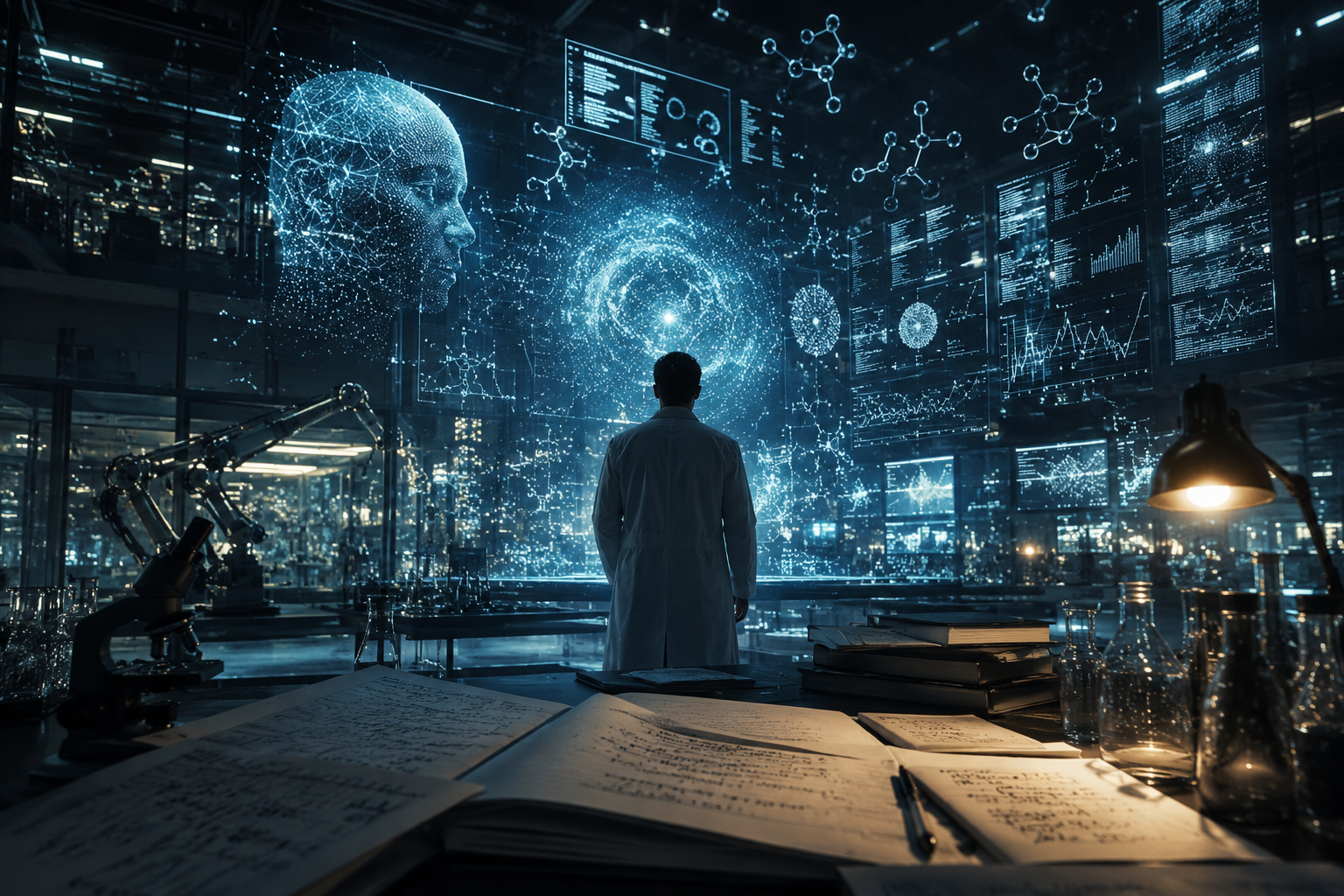
The New Scientific Arms Race Is Not About Ideas But Methods
Science Is Changing Faster Than Most People Realise And AI Is At The Centre Of It
For generations, scientific progress was often presented as a contest between theory and experiment. Great scientists developed bold ideas, then tested them against reality. That story still matters, but growing evidence suggests something fundamental is changing beneath the surface.
A major 2026 analysis of more than three million scientific papers found that research focused primarily on creating new methods has doubled since 1980. The shift appeared across disciplines, citation levels, and research fields, suggesting a broad structural change rather than a temporary trend.
The implication is striking. Increasingly, the scientists who create powerful tools, algorithms, models, and analytical techniques may be shaping the future of knowledge just as much as the scientists producing new theories.
The Rise Of The Method Economy
Methods have always mattered. The microscope transformed biology. The telescope transformed astronomy. Statistical analysis transformed medicine.
What appears different today is the scale of the change. Modern science increasingly depends on computational infrastructure, massive datasets, machine learning systems, and automated analytical tools. Research is becoming more dependent on reusable methods that can be applied repeatedly across multiple fields.
This creates a powerful feedback loop. The better the tools become, the faster discoveries can be made. The faster discoveries are made, the more valuable new tools become. Scientific progress begins to compound.
In this environment, the most influential breakthrough may not be a single discovery. It may be the creation of a tool that enables thousands of future discoveries.
Artificial Intelligence Is Accelerating The Shift
Artificial intelligence is rapidly becoming one of the most important scientific tools ever created.
Major scientific organisations now describe AI as a technology capable of transforming both the methods and nature of scientific research. AI systems are increasingly being used to analyse vast datasets, generate hypotheses, design experiments, model complex systems, and identify patterns that would be difficult for humans to detect alone.
Recent research suggests that scientific papers involving AI are more likely to achieve high levels of novelty and impact than comparable non-AI papers. Importantly, the gains appear to depend on how AI is used rather than merely whether it is present.
The significance of this trend extends far beyond efficiency. AI is increasingly becoming part of the discovery process itself.
Instead of simply helping scientists work faster, it is beginning to help them think differently.
The Opportunity And The Danger
Every powerful scientific tool changes what researchers can see.
The challenge is that tools can also change what researchers choose to look for.
Some researchers now warn that growing dependence on AI could create a form of scientific monoculture. If everyone uses similar models, similar datasets, and similar analytical approaches, science could become more efficient while simultaneously becoming less intellectually diverse.
Others worry that younger scientists may become highly effective users of AI without developing the deeper intuition that traditionally came from years of coding, experimentation, and analytical problem solving. Concerns about research integrity, reproducibility, and over-reliance on automated systems are increasingly appearing in scientific and policy discussions.
This creates an unusual tension.
The same technologies capable of accelerating discovery could also reshape the skills that future scientists need to succeed.
The Future Scientist May Look Very Different
The traditional image of the scientist is someone who spends years mastering a narrow domain before contributing new knowledge.
That model is beginning to evolve.
Emerging AI systems can already assist with literature reviews, data analysis, model generation, software development, and hypothesis exploration. Some researchers are actively exploring forms of "agentic science" in which AI systems participate in increasingly autonomous stages of the research process.
This does not mean human scientists are becoming obsolete.
Instead, the role may shift toward asking better questions, validating results, understanding context, applying judgment, and deciding which discoveries actually matter. Human creativity may become more valuable precisely because machines are becoming better at routine scientific work.
The future scientist may spend less time performing calculations and more time directing entire ecosystems of intelligent tools.
The Real Story Is About Power
The deeper story is not really about artificial intelligence.
It is about where scientific power is moving.
For centuries, power flowed primarily through knowledge. Today, an increasing share of that power may flow through methods. The researchers, institutions, and companies that build the most effective scientific tools could gain extraordinary influence over what gets studied, how discoveries are made, and which fields advance fastest.
The latest evidence suggests science is becoming progressively more methods-driven, and AI is accelerating that trend.
That does not mean theories no longer matter. It means the tools used to generate those theories are becoming more powerful than ever before.
The next scientific revolution may not arrive as a single discovery that changes the world. It may arrive as a new generation of AI-powered methods that quietly change how every discovery is made.
