

The Rise Of Robotic Surgery In The NHS Signals A Major Shift In Care
The NHS Is Doubling Down On Robotic Surgery — And It Matters
From Scalpel To Software: How Surgery Is Changing In Real Time
A fundamental change is happening inside NHS operating theaters—and most people have not fully registered it yet.
In just a short period, robotic-assisted procedures have surged, with volumes reportedly doubling from around 35,000 to 70,000. That is not a marginal improvement. It is a signal that a different model of surgery is beginning to take hold.
At the same time, the nature of those procedures is shifting. Large, open operations — once the defining image of surgery — are increasingly being replaced by “pinhole” techniques. Smaller incisions. More precise movements. Less visible trauma.
This is not a distant future shaped by experimental technology. It is already happening at scale.
What Has Actually Changed
At its core, robotic surgery does not replace surgeons. It changes how they operate.
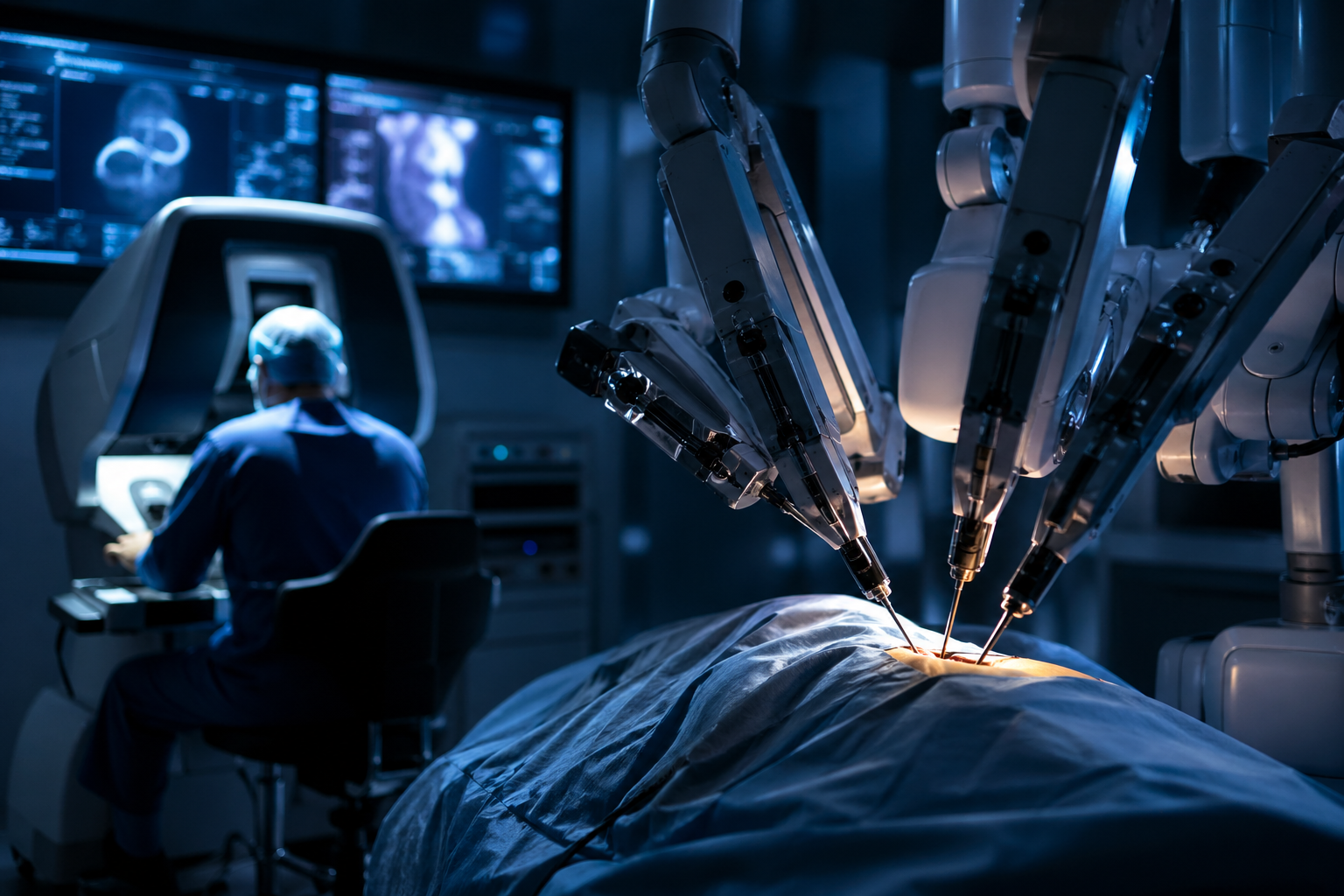
Instead of standing directly over a patient, surgeons often sit at a console, guiding robotic arms that translate hand movements into ultra-precise actions. The system can filter out tremors, scale motion, and access areas of the body that are difficult to reach using traditional techniques.
The result is a different kind of procedure:
Smaller incisions
Reduced blood loss
More controlled movements
Greater consistency in delicate operations
The rise from roughly 35,000 to 70,000 procedures suggests something important: this is no longer confined to specialist centers or niche cases. It is becoming embedded ininoutine care pathways.
That scale is what turns a technology into a system-level shift.
Why “Pinhole” Surgery Is Taking Over
The move toward minimally invasive surgery is not new. What is new is the speed and breadth of adoption.
Pinhole procedures—often involving tiny entry points rather than large openings—offer clear practical advantages:
Faster recovery times for patients
Shorter hospital stays
Lower risk of infection
Reduced strain on post-operative care resources
For a system like the NHS, under constant pressure from demand, these advantages compound quickly.
A patient who recovers faster frees up beds sooner. A procedure with fewer complications reduces follow-up care. Multiply that across tens of thousands of operations, and the impact becomes systemic rather than individual.
That is the real story behind the doubling of surgical volumes. It is not just about doing more operations. It is about doing them differently.
The AI And Robotics Layer—What Is Real And What Is Not
There is a tendency to frame robotic surgery as “AI performing operations.” That is not accurate.
Most current systems are not autonomous. They are controlled by human surgeons. The “intelligence” lies in precision engineering, enhanced visualization, and assistance tools rather than independent decision-making.
However, the direction of travel is clear.
As data accumulates—from thousands of procedures—systems can begin to support:
Better surgical planning
Real-time guidance based on previous outcomes
Identification of optimal approaches for specific cases
The shift is subtle but important. It is not about replacing surgeons. It is about augmenting them with increasingly data-informed tools.
That distinction matters, because it shapes both expectations and risk.
Why This Matters Now
The timing of this surge is not accidental.
Healthcare systems are under sustained pressure—waiting lists, staffing constraints, and rising demand. Incremental improvements are no longer enough.
Robotic and minimally invasive surgery offer something different: efficiency gains without simply increasing human workload.
If more procedures can be performed with fewer complications and faster recovery, the system unlocks capacity from within.
That is why this trend is accelerating now rather than slowly evolving over decades.
It aligns directly with the core pressures facing modern healthcare.
What Most People Will Miss
The visible story is technological: robots in operating theaters.
The deeper story is structural.
This shift changes how hospitals are designed, how surgeons are trained, and how care pathways are organized.
Training moves toward console-based skills and digital interfaces
Investment shifts toward high-cost, high-impact surgical systems
Surgical planning becomes more data-driven
Patient expectations evolve around recovery speed and outcomes
Over time, this process begins to redefine what “normal” surgery looks like.
Open surgery does not disappear. It remains essential for certain cases. But it becomes less common as a default approach.
That is thtransition that is underwayunderway.
Limits And Unknowns
Despite the momentum, the process is not a frictionless transformation.
Robotic systems are expensive. They require specialized training and infrastructure. Not every hospital can adopt them at the same pace.
There are also practical questions:
How evenly will access be distributed across regions?
Will capacity gains offset the upfront investment?
How quickly can staff be trained to meet rising demand?
And crucially, while many procedures often improve outcomes, they do not universally outperform every context.
The shift is real — but it is not uniform.
The Direction Of Travel
Even with those constraints, the trajectory is clear.
A doubling of procedures is not a temporary spike. It reflects adoption reaching a tipping point.
Once systems, training, and workflows adapt to a new model, reversal becomes unlikely.
What follows is expansion:
More procedures become eligible for robotic approaches
More hospitals integrate this technology
More patients expect minimally invasive options
The pace may vary. The direction does not.
The New Baseline For Surgery
The most important implication is psychological.
For decades, surgery has been associated with large incisions, long recoveries, and visible trauma. That image is becoming outdated.
The emerging baseline is different:
Smaller scars
Faster discharge
Precision-guided procedures
Technology embedded at the centre of care
That changes how patients think about surgery — and how healthcare systems deliver it.
Final Take
The doubling of robotic surgeries inside the NHS is not just a statistic. It is evidence that a transition is already underway.
Traditional operations are not disappearing overnight. But they are no longer the uncontested default.
A quieter, more precise model is taking their place—one that reduces physical impact while increasing technical control.
The real shift is not coming.
It is already inside the operating theater.
