The Scroll That Never Ends
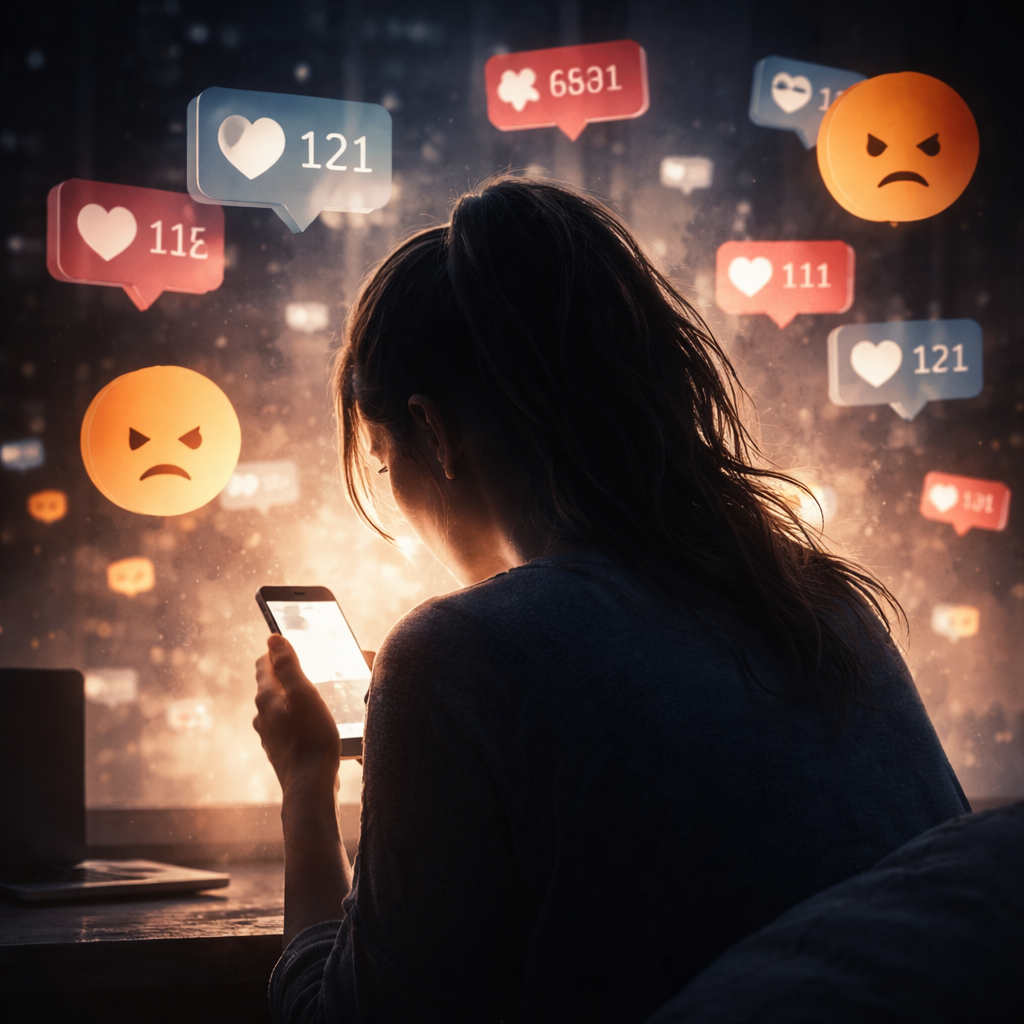
Detrimental Impacts of Social Media on Society: What’s Really Happening and Why It’s Hard to Fix
The detrimental impacts of social media on society are not just about “too much screen time.” They come from a deeper mismatch between what platforms are built to optimize and what healthy communities need to thrive.
In plain English: social media turns human attention, emotion, and relationships into measurable signals, then uses those signals to decide what billions of people see next. That design can create real benefits, but it also reliably produces side effects at scale: confusion about what’s true, pressure to perform, harsher social norms, and more friction between groups.
The central tension is that the same mechanics that make social media engaging also make it volatile. If a system rewards the content that spreads fastest, then outrage, envy, humiliation, and rumor become competitive strategies, even when nobody intends that outcome.
By the end of this guide, you’ll understand the core mechanisms that drive harm, the numbers that anchor the debate, where the evidence is strong versus genuinely uncertain, and what changes would matter most if society wants the upside without the collateral damage.
The story turns on whether we can realign platform incentives with public well-being without dismantling the connection benefits people genuinely value.
Key Points
The biggest harms come from feedback loops: what gets attention gets boosted, and what gets boosted shapes behavior.
“Time spent” is a blunt measure; compulsive, distressed, or sleep-disrupting use is where risk concentrates.
Recommendation algorithms optimize for engagement signals, which can unintentionally privilege outrage, conflict, and extreme content.
Social comparison is not a side effect; it is a structural feature of feeds built around visibility, status, and performance.
Misinformation spreads easily in high-speed networks because novelty travels well and verification is slow.
Harassment and dogpiling scale because platforms make coordination effortless and accountability uneven.
Policy efforts increasingly target design and safety systems, not just individual posts, but enforcement and measurement are hard.
The most important “fix” is not a single feature change; it’s building credible friction, transparency, and user control into the system.
What It Is
Social media is a set of digital platforms where people create, share, and react to content inside a network, and where distribution is shaped by both social connections and automated ranking. It is not just communication. It is a constantly updating public stage where attention is the currency and visibility is the reward.
What makes modern social media distinct is that it is not primarily chronological. A feed is a curated product. It is assembled in real time using signals like clicks, watch time, comments, shares, and relationships, then tuned to keep you engaged.
The societal impacts come from that mix of scale and optimization. When billions of people interact in the same attention market, small design choices turn into mass behavioral nudges.
What it is not: social media is not the same thing as the internet, and it is not the same thing as private messaging. Email, group chats, and forums can have their own problems, but the “viral feed” model changes the incentives and the speed of spread in a way that’s structurally different.
How It Works
Start with the basic bargain. Platforms offer connection, entertainment, identity, and information. In return, they compete for time, attention, and data, because those inputs are what power ad targeting and growth.
The first mechanism is measurement. Almost every interaction becomes a signal: what you pause on, what you rewatch, what you ignore, what you send to a friend, what you argue with. Even “negative engagement” can still be valuable, because it keeps you present.
The second mechanism is ranking. A recommendation system predicts what you will engage with next and builds your feed accordingly. It learns from the crowd as well as from you, so content that performs well for certain audiences gets tested on more people, then scaled if it continues to spike.
The third mechanism is reinforcement. When a post earns attention, the creator is rewarded with feedback, status, and sometimes income. That reward teaches a lesson: which tones, topics, and formats win. Over time, this selects for content that reliably triggers reaction, not content that is accurate, fair, or calming.
The fourth mechanism is social pressure. Visibility changes behavior. People curate, compare, and perform. Social approval becomes quantifiable, and the fear of missing out becomes automated through notifications, streaks, and “what you missed” summaries.
A helpful analogy is a casino that pays out in social tokens. You do not pull a lever for money. You pull a lever for belonging, validation, and certainty. That is powerful, and it can also be destabilizing.
Numbers That Matter
A useful starting benchmark is scale: the world now has well over five billion social media user identities. In practice, that means norms and narratives can cross borders quickly, but it also means a single rumor can find a global audience before a correction is even written. The common misunderstanding is to treat “users” as unique people, when identities can include duplicates, work accounts, and platform overlap.
Daily time is the next anchor. The global average sits around a couple of hours per day, which sounds modest until you remember it competes with sleep, exercise, in-person relationships, and deep focus. The usual mistake is assuming the average describes everyone. Risk tends to cluster in heavy or compulsive use, not the middle.
For adolescents, penetration is close to universal in many countries, and a sizable share report being online almost constantly. That matters because adolescence is when identity, peer status, and emotional regulation are still under construction. The misunderstanding is to treat this as a moral panic. The more grounded concern is that the environment is unusually intense for an age group that is developmentally sensitive to social evaluation.
Age thresholds also matter. Many mainstream platforms set a minimum age around the early teens, yet a meaningful minority of preteens still use social media. That gap is not just about rule-breaking. It reflects weak age verification, social pressure, and devices arriving earlier in childhood. The misunderstanding is thinking a number in a terms-of-service document functions like a real safety barrier.
Problematic use is a better metric than time alone. In surveys, a non-trivial minority of young people meet criteria that resemble addiction-like patterns: loss of control, distress when unable to use, and interference with daily life. The common mistake is using “addiction” as a casual insult. The more precise point is that certain patterns of use correlate with sleep disruption, anxiety, depression, and vulnerability to harmful content.
Finally, content exposure is not evenly distributed. People do not see “the platform.” They see a personalized slice. Vulnerable users can be shown more appearance-focused or self-harm-adjacent material than their peers, even without actively seeking it. The misunderstanding is believing that banning a hashtag fixes the underlying recommender dynamics.
Where It Works (and Where It Breaks)
Social media works well for rapid connection: maintaining relationships across distance, finding niche communities, organizing help during disasters, and giving people a voice when gatekeepers fail. Those are real gains, and dismissing them makes the analysis sloppy.
It breaks when the incentives of the system diverge from the needs of a healthy public sphere. A feed is optimized for engagement, not for truth, nuance, or long-term well-being. That becomes a problem when engagement is reliably easier to produce with fear, anger, envy, and tribal identity than with careful explanation.
It also breaks through context collapse. Offline, you show different versions of yourself to different groups. Online, a single post can be judged by employers, family, strangers, and enemies at once. That makes people more performative and more defensive, and it punishes experimentation and uncertainty.
Another failure mode is harassment at scale. In physical life, coordinating a mob is hard. On social media, it is a few taps. Dogpiling becomes a structural risk, especially for women, minorities, and public-facing professionals.
And then there is fatigue. The system trains your attention toward constant novelty. That can erode deep work, patience, and the ability to tolerate boredom, which are the mental conditions that support learning and civic reasoning.
Analysis
Scientific and Engineering Reality
Under the hood, social media is an optimization system wrapped around human psychology. It takes millions of content candidates and ranks them using predicted engagement, which is learned from past behavior. The model does not “want” to harm you. It wants to be right about what keeps you on the platform.
For harmful outcomes to occur, two things usually need to be true. First, engagement signals must correlate with emotionally intense content. Second, distribution must be fast and cheap, so a spike becomes a flood. Those conditions are often met, especially in short-form video and reshared posts.
Evidence becomes weaker when people claim a simple, universal causal story, like “social media causes depression.” The more realistic picture is conditional risk: effects vary by age, baseline mental health, sleep patterns, content type, and social environment. Stronger studies tend to find small average effects with larger impacts in vulnerable subgroups.
People also confuse demos with deployment. A platform can launch a safety feature, but if the underlying ranking still rewards sensational content, the system will route around the patch. Real safety requires measurement, enforcement, and design choices that reduce harmful reach, not just public commitments.
Economic and Market Impact
Social media is an attention marketplace. The business model rewards growth, retention, and ad performance, so the platforms are financially incentivized to keep the feed compelling. That reality shapes everything from design to moderation.
If society wants fewer harms, something must shift in cost and accountability. Safer defaults, stronger age assurance, and better moderation all require investment, and they can reduce engagement in the short term. That creates a natural reluctance unless regulation or competitive pressure forces change.
The near-term pathway is likely incremental: more safety tooling, more transparency reporting, and more restricted experiences for younger users. The long-term pathway is structural: business models and ranking objectives that include measurable well-being outcomes, not just clicks and watch time.
Total cost of ownership shows up outside the platforms. Schools, employers, health services, and families absorb the downstream burden: conflict resolution, mental health support, fraud response, and lost productivity from distraction and burnout.
Security, Privacy, and Misuse Risks
Social media is a powerful tool for manipulation because it allows microtargeting, rapid iteration, and plausible deniability. Actors can test narratives, find receptive audiences, and scale what works. That includes scams and fraud, but also political influence operations and harassment campaigns.
Privacy risks are not limited to “data leaks.” They include routine inference: platforms can learn what you care about, fear, or desire, then sell access to that targeting. Even without naming you, the system can still shape you.
Misuse also includes synthetic media. As generated images and video become more accessible, the cost of creating persuasive falsehoods drops. The core issue is not just fakes; it is the erosion of trust in authentic evidence, because people begin to assume everything could be staged.
Guardrails matter most when they are auditable: clear rules, documented enforcement, independent evaluation, and meaningful consequences for repeat failures.
Social and Cultural Impact
Social media changes culture by changing what gets rewarded. It compresses status into visible metrics and encourages identity to become a brand. That can be empowering for some people and exhausting for others.
It also changes how conflict works. Nuance performs poorly in fast feeds. Extremes perform well because they are easy to understand and easier to share. Over time, this can harden group boundaries and make compromise feel like betrayal.
Another shift is epistemic: people increasingly learn about the world through fragments, not narratives. That can reduce shared context, which is the foundation of civic life. When citizens cannot agree on basic facts, every policy dispute turns into a fight over reality itself.
At the same time, social media can widen access to knowledge and community. The challenge is that benefits are often local and personal, while harms become systemic when amplified at scale.
What Most Coverage Misses
Most coverage treats social media harm as a content problem: bad posts, bad influencers, bad politics. The deeper issue is the selection environment. If a system is designed so that emotionally charged content outcompetes calm content, then the platform does not need “bad actors” to produce negative outcomes. The system will generate them organically.
A second overlooked factor is variance. Two people can use the same app and experience different worlds. One sees cooking tips and friends’ photos. Another sees self-harm-adjacent material, grievance content, or relentless body comparison. When outcomes vary that much, public debate becomes confused, because lived experience conflicts.
Finally, many solutions fail because they target individual self-control while leaving the machine untouched. Telling people to “log off” is like telling citizens to drink from a polluted river more responsibly. Personal boundaries help, but the upstream incentives still matter.
Why This Matters
The detrimental impacts of social media on society fall hardest on groups with less power: children, adolescents, marginalised communities, and people whose work depends on public visibility. But the broader society pays too, through lower trust, higher conflict, and slower collective problem-solving.
In the short term, the key risks are sleep disruption, harassment, misinformation spikes during major events, and the normalisation of extreme content as entertainment. In the long term, the risk is institutional: a public sphere that cannot sustain shared facts, legitimate disagreement, or stable norms.
Milestones to watch are less about new apps and more about governance triggers. Look for credible age assurance at scale, independent access to platform data for researchers, transparent reporting on recommendation outcomes, and design shifts that reduce algorithmic amplification of high-risk content categories.
If those milestones do not materialize, the default trajectory is not neutral. It is deeper optimisation of the same engagement incentives, because that is what the market rewards.
Real-World Impact
A teenager in a bedroom is not just consuming content. They are living inside a social scoreboard, where popularity has numbers and comparison is constant. Sleep loss, anxiety, and body dissatisfaction can emerge as secondary effects of always being “on.”
A workplace team is not just distracted by phones. Attention fragmentation can degrade judgment, memory, and patience. Small misunderstandings become sharper when people are already emotionally primed by what they scrolled before the meeting.
A community facing a local crisis can benefit from rapid information sharing, but rumor can also outpace verification. The same channel that helps coordinate aid can also coordinate blame.
A small business can grow quickly with social media marketing, but it becomes dependent on opaque algorithms. A change in ranking can cut reach overnight, pushing businesses into paid ads or constant content production just to stay visible.
FAQ
Is social media bad for society overall?
Social media is not uniformly bad. It is a high-impact infrastructure that delivers real connection and real harm, depending on how it is used and how it is designed.
The societal risk comes from scale and incentives. When engagement is the core success metric, the system naturally selects for content that triggers strong reactions, even if that reaction damages trust and well-being.
Does social media cause depression and anxiety?
The strongest evidence does not support a simple one-size-fits-all claim. Average effects in large studies are often small, but risks can be meaningfully higher for vulnerable users, heavy users, and people whose sleep and self-esteem are already under strain.
A more accurate framing is that social media can contribute to depression and anxiety through pathways like sleep disruption, social comparison, harassment, and exposure to harmful content, especially when use becomes compulsive.
What is “problematic social media use”?
Problematic use is not just frequent use. It refers to patterns that look like loss of control and harm: difficulty cutting back, distress when unable to use, and interference with school, work, relationships, or sleep.
This distinction matters because focusing only on “screen time” can miss the real problem, which is the emotional and behavioural grip of the system on certain users.
Why does misinformation spread so easily on social media?
Misinformation often wins because it is engineered, intentionally or not, to travel well. It can be novel, emotionally charged, and simple, while truth is often slower, more conditional, and less dramatic.
Feeds also reward velocity. If early engagement is strong, content is promoted before verification catches up, and corrections rarely travel as far as the first impression.
Are social media algorithms designed to be addictive?
Platforms generally describe their goal as engagement, not addiction. But the practical outcome can resemble addiction-like behaviour for some users because the system uses intermittent rewards, social feedback, and personalised ranking to keep attention.
Whether you call it “addiction” or “compulsion,” the functional issue is the same: design choices can increase loss of control, especially in young users.
Can regulation reduce harm without becoming censorship?
It depends on what gets regulated. If regulation targets transparent safety processes, age-appropriate design, and measurable risk reduction, it can improve outcomes without policing ordinary opinion.
The hardest line to draw is political speech and “lawful but harmful” content. The safest approach focuses on systemic harms like harassment, fraud, and youth safety, alongside transparency requirements for recommendation systems.
What can parents actually do that works?
The highest-leverage move is protecting sleep. Phones out of bedrooms, predictable cutoff times, and reducing late-night notifications tend to matter more than arguing about individual posts.
It also helps to treat social media as an environment, not a moral test. Co-creating rules, discussing how feeds manipulate emotion, and building strong offline routines usually works better than bans that collapse at the first social pressure.
How can adults reduce doomscrolling without going off-grid?
Start by changing the default environment: disable non-essential notifications, remove the most triggering apps from your home screen, and set app timers that require an extra step to override.
Then replace, not just remove. If you delete an easy coping mechanism without building another one, the habit returns. The goal is to make calm alternatives frictionless and the spiral slightly harder to enter.
