The Terrifying History Of Ebola Outbreaks And Why The Virus Still Haunts The World
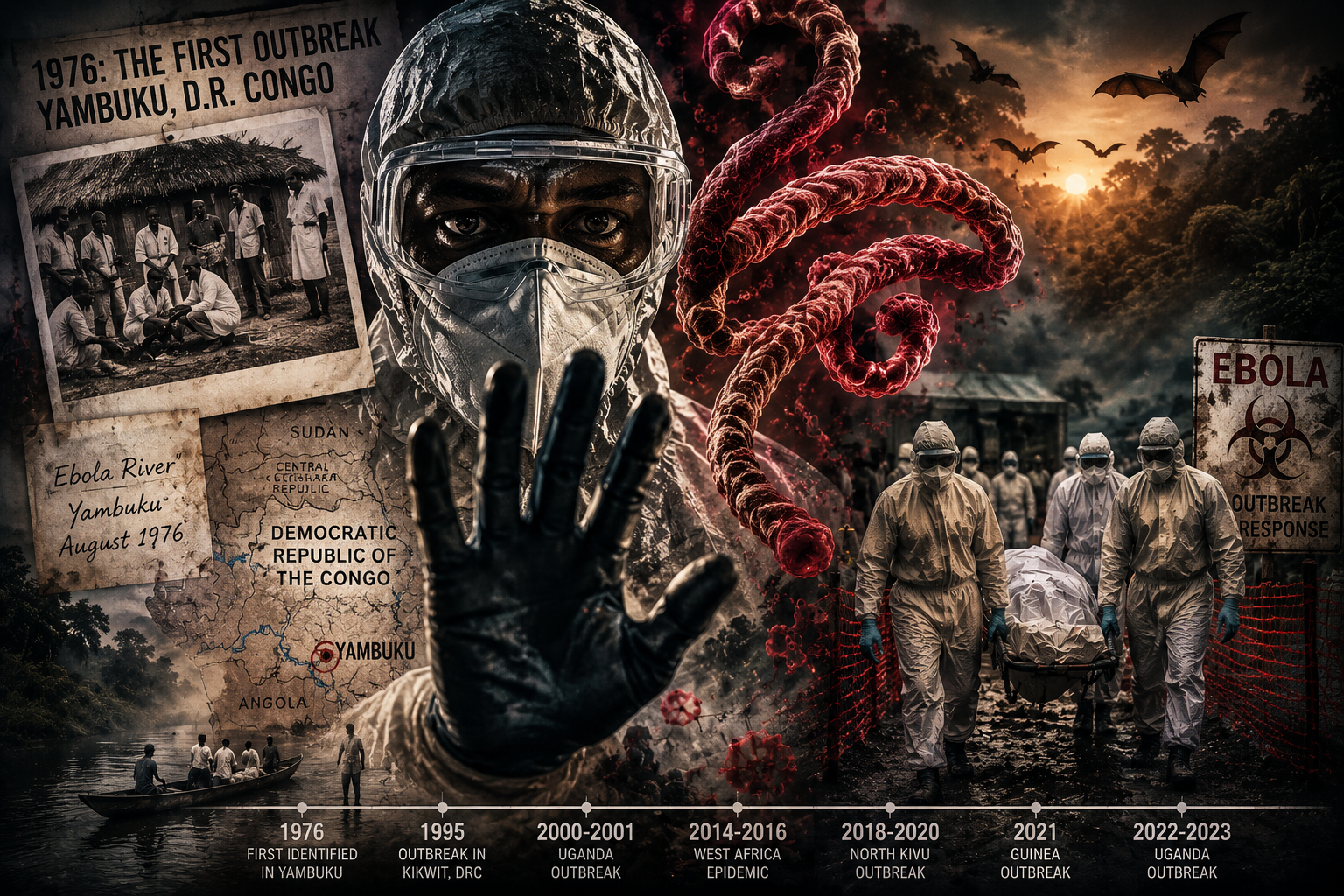
Ebola Explained: The Virus That Turns One Human Contact Into A Global Alarm
The world has known Ebola for half a century, but the virus still carries one brutal warning: the smallest contact with infected body fluids can become the start of a deadly chain.
The Virus That Made Outbreaks Feel Like Horror
Ebola is one of the most feared infectious diseases ever identified because it attacks the body in a way that feels both clinical and terrifying. It can begin like many other illnesses: fever, fatigue, aches, a headache, and a sore throat. Then, as the disease progresses, it can move into vomiting, diarrhea, rash, impaired organ function, and, in some cases, unexplained bleeding. The CDC describes the early phase as having “dry” symptoms and the later phase as having “wet” signs, with symptoms usually appearing 2 to 21 days after exposure.
That incubation window is one reason Ebola alarms health authorities so quickly. A person may appear healthy at first. Early symptoms can resemble malaria, typhoid fever, the flu, or other infections common in outbreak regions. By the time the disease is obvious, the person may already have had contact with family members, health workers, burial teams, or caregivers who did not yet know they were dealing with a high-consequence virus.
Ebola disease is caused by Orthoebolaviruses, a group of viruses that belong to the wider family of filoviruses. These are not ordinary seasonal pathogens. They are zoonotic viruses, meaning they are believed to originate in animals before spilling into humans. Scientists believe African fruit bats are likely involved in the natural ecology of Ebola viruses, although the exact reservoir relationship remains difficult to prove with complete certainty.
That is the first major fact people miss. Ebola is not simply a human disease. It is a disease that sits at the dangerous border between wildlife, human settlements, health systems, burial customs, family care, and emergency medicine. That is why Ebola belongs in the wider conversation about the next pandemic threats that are already worrying scientists, even if Ebola does not spread like COVID or influenza.
The First Known Outbreaks Began In 1976
Ebola disease first appeared in the known medical record in 1976 through two nearly simultaneous outbreaks: one in Nzara, in what is now South Sudan, and one in Yambuku, in what is now the Democratic Republic of the Congo. The Yambuku outbreak occurred near the Ebola River, which gave the disease its name.
That timing matters. Ebola has not been haunting humanity for centuries in the way smallpox, plague, or cholera have in public memory. It entered modern outbreak consciousness in the late twentieth century, at a moment when global medicine was becoming more connected, laboratories were improving, and international disease surveillance was becoming more serious. The virus looked new to science, but the more profound biological question remains harder: how long had Ebola-like viruses been circulating in wildlife before humans recognized them?
The honest answer is that Ebola almost certainly existed before 1976, but 1976 is when it was first officially recognized as a human disease. Viruses do not begin existing when humans name them. They often circulate silently in animal reservoirs for long periods, occasionally spilling into humans when ecological, behavioral, or geographic conditions make contact possible. The first known outbreaks were therefore not necessarily the beginning of Ebola’s existence; they were the beginning of humanity’s documented confrontation with it.
The early outbreaks also revealed the nightmare pattern that still defines Ebola response: sudden severe illness, frightened communities, health workers at risk, unsafe medical equipment, close family caregiving, traditional burial practices, and delayed recognition. The virus did not need mass airborne transmission to cause devastation. It needed contact, confusion, and time.
The history of outbreaks serves as a warning due to its repetitive nature.
Since 1976, Ebola outbreaks have occurred repeatedly, mainly in parts of Central and West Africa. Some outbreaks have involved dozens of cases; others have involved hundreds; one became a global shock. The 2014–2016 West Africa outbreak remains the largest Ebola outbreak recorded, with more than 28,600 cases reported across Guinea, Liberia, and Sierra Leone. The CDC identifies it as the largest Ebola disease outbreak to date.
That outbreak changed the way the world understood Ebola. Before West Africa, many Ebola outbreaks had occurred in more remote settings, and health authorities eventually contained them through isolation, contact tracing, safer burials, and infection-control measures. West Africa stood out as different. The virus reached urban areas, crossed borders, moved through strained health systems, and exposed how quickly a disease with limited transmission routes can still become a regional disaster when institutions are overwhelmed.
It also exposed the cost of delay. Ebola control depends on speed: identify cases, isolate patients, trace contacts, protect health workers, communicate clearly, and manage burials safely. When those steps come late, the outbreak gains momentum. When communities distrust responders, the virus gains space. When hospitals lack protective equipment, health workers become victims and amplifiers.
This phenomenon is why Ebola sits beside other rare but alarming pathogens in the modern disease-risk conversation. Taylor Tailored has covered how unusual outbreaks can become far more disturbing when they intersect with travel, isolation, and delayed recognition, including why rare virus scares can suddenly feel much larger than they first appear. Ebola is the classic version of that fear: not constant, not everywhere, but devastating when the chain of control breaks.
What Ebola Actually Causes Inside The Body
Ebola disease is often described as a viral hemorrhagic fever, but that phrase can mislead people into thinking bleeding is always the defining symptom. Bleeding can occur, and it is one of the reasons Ebola has such a frightening reputation, but many patients suffer severe disease through fever, vomiting, diarrhea, dehydration, organ stress, shock, and immune-system disruption. The body is not merely “bleeding out”; it is being pushed into systemic collapse.
The disease can damage blood vessels, trigger intense inflammation, and interfere with the body’s ability to regulate fluids and clotting. Severe diarrhea and vomiting can lead to dangerous fluid loss. Kidney and liver problems may develop. Patients can deteriorate rapidly, especially without aggressive supportive care such as fluids, electrolyte management, oxygen support, treatment of secondary infections, and careful monitoring.
Ebola’s fatality rate varies by outbreak, virus species, access to care, and speed of treatment. WHO states that case fatality rates have varied from 25% to 90% in past outbreaks, with an average around 50%. That range is enormous, and it matters. Ebola is not one identical outcome everywhere. The difference between rapid care and delayed care can mean the difference between survival and death.
Survivors can also face long-term complications. The CDC notes that Ebola survivors may experience chronic complications and that viral persistence can occur in parts of the body. This matters because Ebola does not always end neatly when the fever stops. Survivors may need follow-up care, and in rare circumstances, later transmission events can be linked to a persistent virus.
The transmission risk is brutally specific.
Ebola spreads through direct contact with the blood or body fluids of a person who is sick with or has died from the disease. Those fluids can include blood, vomit, feces, urine, saliva, sweat, breast milk, amniotic fluid, and semen. Transmission can also occur through contact with contaminated objects such as needles, medical equipment, bedding, or clothing. The NHS summarizes the basic risk clearly: Ebola is caught through contact with the body fluids of an infected person or wild animal.
That means human-to-human transmission has absolutely occurred. In fact, it is central to Ebola outbreak history. Family members caring for sick relatives, health workers treating patients, and people preparing bodies for burial have all been among the highest-risk groups. A person who has died from Ebola can remain highly infectious because the body still contains high levels of virus.
This is why burial practice has played such a major role in Ebola outbreaks. In many cultures, washing, touching, or preparing the body is an act of love, dignity, and duty. Ebola turns that human ritual into a transmission event. The tragedy is not simply biological. It is emotional. The people most likely to show up, hold someone, clean someone, or stay close are often those placed at greatest risk.
Ebola is not generally spread through casual air like measles, flu, or COVID. That distinction matters because it changes the public-risk calculation. But it should not make the disease sound harmless. A virus does not need to drift invisibly across a room to be catastrophic. It only needs enough close human contact, enough unsafe care, and enough delayed isolation to build a deadly chain.
The Animal Spillover Problem Never Went Away
Most Ebola outbreaks are believed to begin when the virus crosses from animals into humans. That can happen when people come into contact with infected wildlife, handle bushmeat, are exposed to infected carcasses, or contact animals that have themselves been infected. Nonhuman primates, including monkeys, gorillas, and chimpanzees, can become infected and have been linked to human infections, but they are not considered the true long-term reservoir. Bats remain the leading suspect in Ebola ecology, although the exact reservoir species and transmission pathways remain scientifically complex.
This is the ecological pressure behind Ebola. Human beings keep expanding into forests, moving through wildlife habitats, hunting animals, building roads, creating markets, mining, farming, and traveling between rural and urban areas. Each contact point is a possible bridge between animal viruses and human communities. Most bridges lead nowhere. A few become outbreaks.
The frightening part is that spillover can look ordinary at first. A hunter handles an animal. A family eats meat. A child touches a carcass. A sick person is cared for at home. A clinic treats fever without knowing the cause. Then a chain begins, and by the time the pattern becomes visible, the virus may already have reached several households.
That is why the Ebola response is never only about hospitals. It is about ecology, trust, surveillance, transport, local leadership, laboratory speed, funeral practice, and public communication. A purely medical response comes too late if the social system around the outbreak is already breaking.
Different Ebola Viruses Do Not All Carry The Same Threat
There are different Ebola virus species, and they do not all behave identically in human history. WHO identifies five Ebola virus species, with Zaire ebolavirus, Sudan ebolavirus, and Bundibugyo ebolavirus associated with large outbreaks in Africa. Zaire ebolavirus caused the 2014–2016 West Africa outbreak.
That distinction matters because the word “Ebola” flattens several different biological realities into one frightening label. Zaire ebolavirus has been associated with some of the deadliest and largest outbreaks. The Sudan virus has caused serious outbreaks. The Bundibugyo virus has also caused human disease, but with a different outbreak history. The Taï Forest virus has been associated with human infection, while the Reston virus has caused concern in animals but has not been known to cause severe human disease in the same way.
Different species may vary in case fatality patterns, outbreak size, geography, available countermeasures, and scientific readiness. That does not mean one should be treated casually. It means precision matters. A response to an Ebola outbreak must know which virus species is involved, as diagnostics, vaccines, therapeutics, and historical expectations may differ.
This situation is also where public language can become dangerous. Calling every Ebola event “the same virus” can mislead readers. Calling every Ebola event “the next pandemic” can also mislead them. The smarter view is sharper: Ebola is a family of related threats, some with proven human outbreak potential, some with different risks, and all requiring rapid identification.
Does Ebola Evolve Quickly?
Ebola is an RNA virus, and RNA viruses mutate as they replicate. That means Ebola does evolve. During large outbreaks, scientists can track viral lineages and mutations through genome sequencing. The 2013–2016 West African outbreak gave researchers a much larger dataset than earlier outbreaks because the virus infected so many people and circulated for so long.
But “evolves” does not automatically mean “becomes airborne,” “becomes unstoppable," or “turns into a new pandemic monster.” That leap is sensational, but in a negative way. Research during and after the West Africa outbreak found evidence of viral evolution and specific mutations, including changes affecting the glycoprotein, but scientists have not shown that Ebola transformed into a virus spreading like influenza or SARS-CoV-2. Some studies found no evidence that the scale of the West Africa outbreak was caused by functional evolutionary change rather than human, geographic, and health-system conditions.
The real danger is subtler. Ebola may not need a dramatic evolutionary leap to be devastating. If it enters the wrong setting, reaches dense populations, spreads before detection, or finds health systems without enough protective equipment, it can cause enormous harm while remaining transmitted mainly through direct contact with body fluids.
That is the disciplined fear. Ebola does evolve, but the greatest outbreak risks have often come from human systems failing faster than the virus needs to change. Biology matters. So do trust, hospitals, borders, funerals, and time.
The human-to-human question has a clear answer.
Human-to-human transmission has occurred repeatedly and is one of the defining features of Ebola outbreaks. Once Ebola spills into a human population, it can continue spreading through direct contact with infected body fluids, unsafe medical care, contaminated materials, caregiving, and burial practices. The 2014–2016 West Africa outbreak confirmed sustained human-to-human transmission across major chains of infection.
That does not mean Ebola spreads easily in every setting. A person usually has to be symptomatic to be contagious, and transmission requires contact with infected fluids or contaminated materials. This makes Ebola very different from common respiratory viruses that spread efficiently through everyday breathing, coughing, or shared indoor air. Ebola is terrifying not because it spreads casually but because the contact that spreads it is often intimate, compassionate, and unavoidable in places without strong infection control.
That is why health workers are so central to Ebola history. They stand directly in the path of the virus. Without protective equipment, training, and strict protocols, clinics can become amplifiers. With strong infection control, they become the wall that stops the chain.
The same pattern explains why community trust can decide the fate of an outbreak. If families hide symptoms, avoid treatment centers, or fear responders, Ebola gains time. If communities understand what is happening and believe the response is there to help rather than punish them, isolation and contact tracing become possible.
Why Ebola Still Exists As A Modern Fear
Ebola has existed in the known medical record since 1976, but its deeper animal reservoir likely predates human recognition. That means eradication is not realistic in the same way it was for smallpox. You cannot vaccinate every bat, every forest animal, every hidden reservoir, and every future contact point between wildlife and people. The world can reduce risk, detect outbreaks quickly, and stop chains of transmission, but it cannot simply delete Ebola from nature.
Vaccines and treatments have changed the situation, especially for Zaire ebolavirus. The world is better prepared than it was in 1976 and better prepared than it was before in West Africa. Yet preparedness is uneven. Some regions still face conflict, weak infrastructure, mistrust, limited laboratories, poor roads, and shortages of trained staff. Ebola thrives in the gap between what science knows and what a fragile system can deliver under pressure.
That is the deeper reason Ebola continues to command attention. It is a test of whether modern public health can move faster than fear. The disease punishes delay, denial, and disorganization. It rewards speed, honesty, trust, and discipline.
Ebola is not the most likely virus to shut down the world tomorrow. It is not built like the great respiratory pandemic threats. But it remains one of the clearest warnings in infectious disease: a rare spillover can become a human catastrophe when the first cases are missed, when caregivers are unprotected, and when communities are left scared instead of informed. For readers following Taylor Tailored’s wider science coverage of how outbreak risks can expose hidden weaknesses in modern systems, Ebola is one of the most brutal examples.
The virus has been formally known for roughly 50 years. The lesson has barely changed. Ebola does not need to be everywhere to matter. It only needs one breach, one delay, one unsafe contact, and one chain that nobody stops quickly enough.
