The Trolley Problem Explained: Why It Changes Everything You Think You Know About Right And Wrong
Why It Still Shapes AI, Politics, And Human Morality
The Moral Puzzle That Exposes The Hidden Price Of The Greater Good
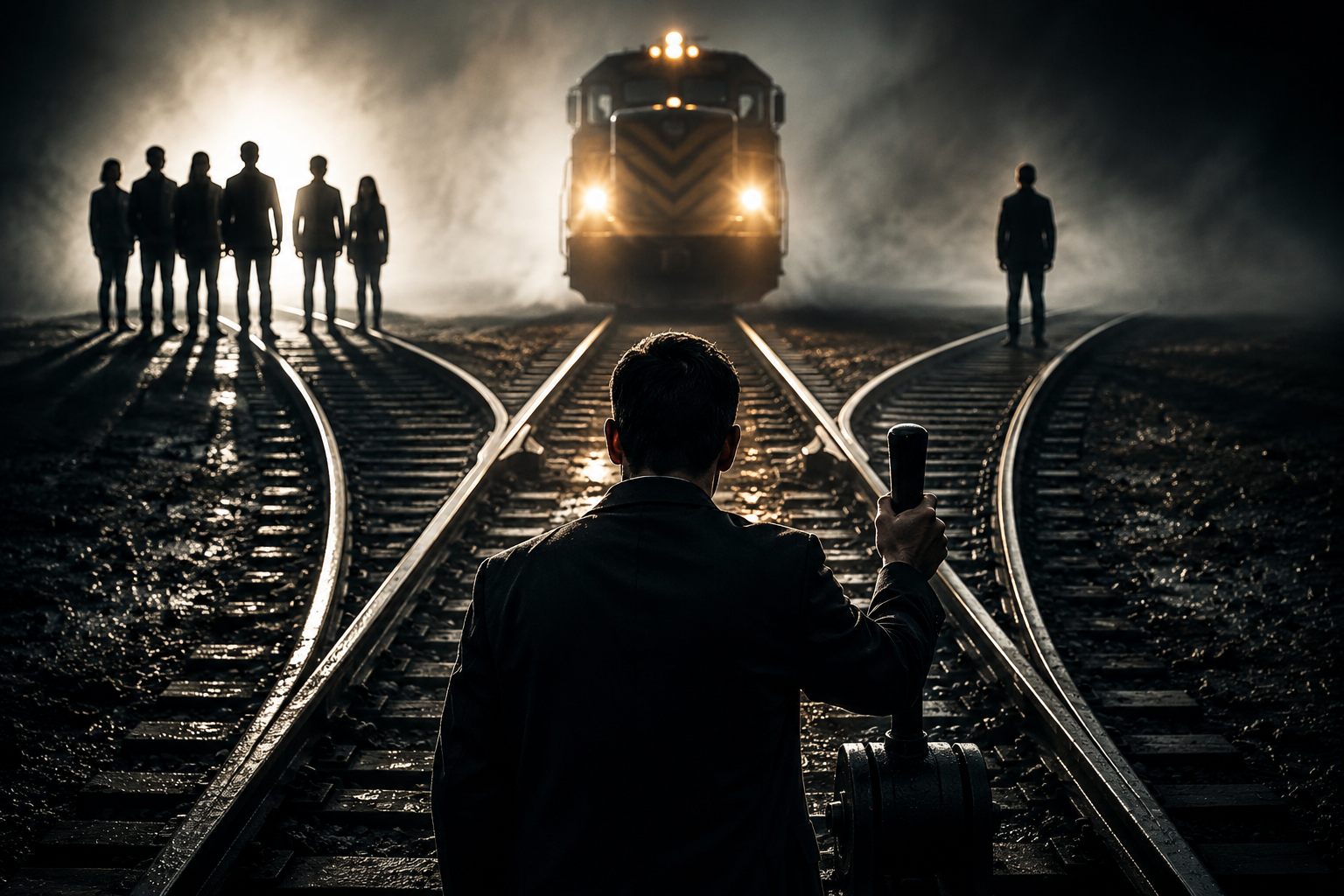
The Train Was Never The Real StoryA runaway trolley is heading toward five people. You can pull a lever and send it onto another track, where it will kill one person instead. That is the famous dilemma Michael Sandel uses at the beginning of his Harvard Justice course, asking whether it would be right to kill one person to save five others.
Most people instinctively pull the lever. The arithmetic feels obvious: five lives matter more than one. But the moment the scenario changes, and you are asked to push a man from a bridge to stop the trolley with his body, many of those same people refuse. The numbers have not changed, but the moral temperature has.
That is why the trolley problem has lasted. It is not really about trains, tracks, or imaginary workers trapped in a philosophy classroom. It is about the moment a society decides that one person can be sacrificed for a greater outcome, and the more dangerous question hiding beneath it: who gets to make that decision?
The Difference Between Redirecting Harm And Using A Person
The standard trolley problem feels cold, but manageable. You are not attacking the person on the side track. You are redirecting an already-moving danger, choosing the outcome that leaves fewer people dead. That is why many people justify the decision as tragic but necessary, a smaller harm chosen to prevent a greater one.
The bridge version feels different because the person is no longer collateral damage. He becomes the tool. His body is used as the mechanism that saves the five, and that changes the moral meaning of the act. The victim is not merely caught in the path of danger; he is turned into an instrument.
That distinction is the crack in simple utilitarian thinking. If morality were only arithmetic, the answer would remain the same every time. One death would always be preferable to five. But human beings do not judge morality by numbers alone. They also judge intention, proximity, dignity, consent, and whether a person is being treated as a human being or as a resource.
The Hospital Version Makes The Problem Harder
Sandel's lecture sharpens the dilemma by moving it into medicine. A doctor may have to choose whether to spend limited time saving one severely injured patient or use that time to save five others with less severe injuries. Many people accept the logic of saving the five because real medical systems already make hard choices under pressure.
Then comes the transplant version. Five patients need organs. A healthy man is sitting nearby. If the doctor kills him and distributes his organs, five people live. Almost everyone recoils from that conclusion, even though the numbers match the first case. One dies, five live, but the action now feels monstrous.
This is where the trolley problem becomes more than a thought experiment. It exposes a boundary most people feel before they can fully explain it. We may accept that tragic choices are unavoidable, but we resist any system that allows the innocent to be harvested, used, or destroyed simply because others might benefit.
Bentham Counts The Bodies, Kant Draws The Line
The lecture introduces two great moral instincts. The first is consequentialist: judge the action by the outcome. Jeremy Bentham's utilitarianism asks whether an act increases overall happiness or reduces suffering, often summarised as the greatest good for the greatest number.
The second is categorical. Some acts may be wrong in themselves, regardless of the result. That instinct is associated with Immanuel Kant's moral philosophy, where human beings cannot simply be treated as tools for someone else's purpose. The point is not that consequences do not matter. The point is that consequences may not be allowed to erase human dignity.
That battle is still everywhere. It appears when governments justify restrictions for public safety, when companies cut jobs to protect shareholders, when hospitals ration care, when algorithms decide risk, and when military planners talk about acceptable losses. The trolley problem survives because modern systems are constantly pulling levers while insisting they are only doing the maths.
The Shipwreck Case Shows What Happens When Theory Becomes Flesh
The real case of Queen v. Dudley and Stephens makes the issue harder to dismiss. Four men were stranded at sea without food or water. The cabin boy, Richard Parker, was ill and vulnerable. Dudley and Stephens killed him, ate his body, and later argued that necessity forced the act.
The moral horror of the case is not only the killing. It is the reasoning. The survivors decided that Parker's life could be weighed against their own survival and found wanting. They treated necessity as a kind of permission slip, as if desperation could transform murder into management.
The English court rejected that logic. The case became famous because it refused to let survival alone become a complete moral defence for killing the innocent. That matters because every society eventually faces moments of pressure where the language of emergency starts to loosen the rules that normally protect people.
Consent Is The Escape Route That Does Not Fully Save Us
The lecture then asks whether the answer changes if Parker had consented, or if the men had agreed to a lottery. That question matters because consent is one of the main ways modern society legitimises power. Contracts, elections, medical choices, employment terms, legal waivers, and democratic votes all rely on the idea that agreement changes the moral status of an action.
But consent under desperation is never simple. A starving man in a lifeboat is not negotiating from a position of freedom. A patient with no alternatives, an employee fearing dismissal, or a citizen under emergency rules may technically agree while having little real power to refuse. The moral question is not only whether someone said yes. It is whether that yes had dignity behind it.
This is where the trolley problem becomes political. Majorities often claim legitimacy because they have numbers. Institutions claim legitimacy because they have procedures. But procedure alone does not guarantee justice. A vote can still crush a minority, a contract can still exploit weakness, and a system can still be clean on paper while brutal in consequence.
AI Has Turned The Trolley Problem Into Infrastructure
The modern version of the trolley problem may not involve a person standing beside a lever. It may involve software. Autonomous vehicles, battlefield systems, medical triage models, fraud detection tools, insurance pricing, policing algorithms, and content moderation systems all force moral judgment into rules, probabilities, and thresholds.
That same pressure is visible in How AI Will Reshape Society Faster Than Most People Realise, where the central issue is not simply whether AI becomes more capable, but how quickly power moves into systems most people do not understand. Once a decision becomes automated, the moral responsibility can start to blur. The person harmed may never know who pulled the lever, who designed the track, or who decided the acceptable error rate.
The danger is not that machines suddenly become evil. The danger is that institutions become comfortable outsourcing moral discomfort to systems that appear neutral. A model does not have to hate anyone to sacrifice them. It only has to optimize for a target that treats some human cost as acceptable.
The Battlefield Version Is Even Darker
Military AI makes the problem more severe because the stakes are not abstract. When speed, threat detection, and survival are placed above hesitation, human judgment can become a bottleneck that powerful institutions are tempted to remove. The question then shifts from whether one person would pull a lever to whether a system can be built to pull it faster than conscience can intervene.
That is the deeper fear behind The Pentagon’s AI Battlefield Gamble. Even if a human technically remains involved, the pressure of machine recommendation can become overwhelming. Once the screen says one course of action saves more lives, prevents more risk, or neutralizes more danger, refusing the recommendation may start to look irrational.
This is the oldest moral problem in new clothing. The lever is no longer made of metal. It is made of data, probability, authority, and institutional pressure. The frightening part is not only that decisions may become faster. It is that they may become easier to justify.
Politics Is A Permanent Trolley Problem
Governments live inside trolley problems. Health care funding, military action, immigration enforcement, policing, taxation, pandemic rules, energy policy, and welfare systems all involve trade-offs between competing harms. Every serious political decision creates winners, losers, protected groups, and exposed groups.
The danger begins when leaders stop admitting that a moral choice is being made. They describe sacrifice as efficiency, rationing as reform, surveillance as safety, and lost livelihoods as transition. The human cost does not disappear because the language becomes cleaner. It simply moves beneath the surface, where it is harder to challenge.
That is why elite power often prefers systems to visible decisions. As explored in World Economic Forum Explained, influence does not always require formal command. Sometimes power works by shaping the agenda, defining the acceptable choices, and making certain sacrifices appear inevitable before the public has properly debated them.
The Real Question Is Who Gets Protected From The Calculation
The trolley problem endures because it reveals something uncomfortable about moral life. People want good outcomes, but they also want limits. They want fewer deaths, less suffering, and better systems, but they do not want a world where any innocent person can be destroyed because the spreadsheet says the net result is positive.
That is the line the puzzle keeps forcing back into view. A society without calculation becomes reckless, because consequences matter. But a society with only calculation becomes dangerous, because people become units inside someone else's equation. The task is not to reject trade-offs. It is to stop pretending that every trade-off is morally clean simply because the numbers look efficient.
The same tension runs through every major institution. Governments balance security against liberty. Hospitals weigh finite resources against unlimited need. Businesses decide whether efficiency outweighs loyalty. AI systems optimise for measurable outcomes while struggling to account for the value of individual lives. In each case, the question is not whether difficult choices exist, but whether there are moral boundaries that should never be crossed, regardless of the potential benefit.
That is ultimately why the trolley problem refuses to disappear. It is not an academic exercise designed to produce a clever answer. It is a mirror held up to every society that believes enough calculation can replace moral judgement. Once people become variables inside an equation, it becomes dangerously easy to justify decisions that would once have been unthinkable.
The trolley problem was never about the trolley. It was about the terrifying ease with which power can rename sacrifice as necessity, convert dignity into data, and present the final answer as nothing more than rational decision-making. The question is not whether hard choices exist. The question is whether we still have the courage to say that some people must never be pushed onto the track.
