

The Violent Cosmic Collision That Created Earth’s Gold
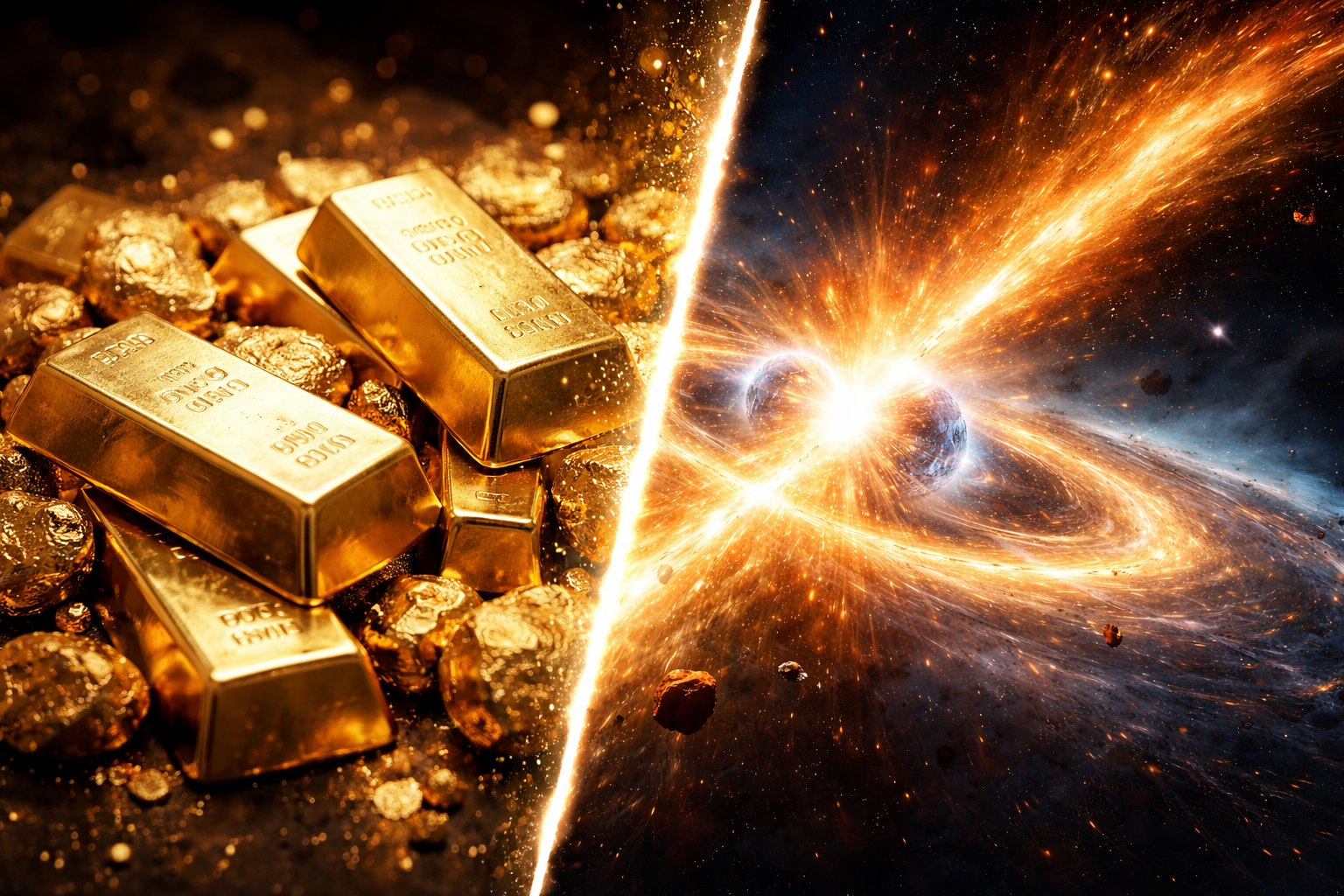
The Astrophysical Explosion That Forged the Universe’s Gold
The Stellar Collision That Built the Gold in Your Jewelry
Gold feels ancient, stable, and almost timeless. But the atoms in a gold ring were forged in one of the most violent events in the universe.
New astrophysics research continues to clarify how gold forms through rare nuclear reactions that occur during cosmic catastrophes such as neutron star collisions and exotic stellar explosions. These events create the extreme conditions needed to build heavy elements that cannot form inside normal stars.
The key mechanism is known as rapid neutron capture, or the r-process. In this process, atomic nuclei absorb huge numbers of neutrons in fractions of a second, transforming into heavier elements such as gold and platinum.
Evidence from gravitational-wave astronomy and modern simulations has strengthened the case that these rare events act as the universe’s primary gold factories.
The story turns on whether neutron star collisions alone can explain the universe’s entire supply of gold.
Key Points
Gold is created through a nuclear mechanism called the rapid neutron capture process, which builds heavy atoms by bombarding lighter nuclei with neutrons.
The most powerful known environments for this reaction are neutron star mergers, where two ultra-dense stellar remnants collide.
These events trigger explosions known as kilonovae, ejecting newly formed heavy elements, including gold, into space.
Observations in 2017 provided the first direct evidence that such collisions produce gold and similar heavy elements.
However, recent studies suggest neutron star mergers alone may not fully explain the amount of gold seen across the universe.
Researchers now suspect multiple rare astrophysical processes, such as supernovae and the rapid neutron capture process (r-process),, such as supernovae and the rapid neutron capture process (r-process), may contribute to cosmic gold production.
The Nuclear Physics That Makes Gold Possible
Gold sits near the end of the periodic table. Creating such heavy elements is extraordinarily difficult.
Inside normal stars, nuclear fusion gradually builds heavier atoms by combining lighter ones. But this process stops efficiently at iron. Past that point, fusion requires more energy than it releases.
To create elements heavier than iron, nature needs a completely different mechanism.
That mechanism is the rapid neutron capture process, often called the r-process. During this reaction, atomic nuclei are bombarded by massive floods of neutrons, allowing them to absorb neutrons faster than they can decay.
These unstable nuclei then undergo radioactive decay, transforming into heavier stable elements—including gold.
The r-process requires two extreme conditions:
enormous neutron densities
incredibly high temperatures and energies
Such environments almost never occur. But when they do, they can manufacture huge quantities of heavy elements in seconds, such as gold and platinum, through rapid neutron capture processes.
When Dead Stars Collide
The most dramatic location for r-process reactions appears to be neutron star mergers.
Neutron stars are the collapsed cores left behind when massive stars explode as supernovae. They are extraordinarily dense—so dense that a teaspoon of their matter would weigh millions of tons on Earth.
When two neutron stars orbit each other, gravitational waves slowly drain energy from the system. Over millions of years, the stars spiral inward until they collide.
The final collision releases a colossal explosion known as a kilonova. During this event, neutron-rich material is blasted into space at enormous speeds.
This debris provides perfect conditions for r-process nucleosynthesis.
Heavy elements—including gold—form rapidly in the expanding cloud before being scattered across the galaxy. Over billions of years, this material becomes part of interstellar gas clouds that later form stars, planets, and eventually worlds like Earth.
The gold in today’s jewelry likely originated in one of these ancient stellar collisions.
The Breakthrough That Confirmed the Theory
For decades, scientists suspected neutron star mergers were responsible for heavy elements. But direct evidence remained elusive.
That changed in August 2017, when gravitational-wave detectors recorded a signal from two neutron stars merging. Telescopes across the world observed the resulting kilonova, capturing light from freshly created heavy elements.
The glow matched theoretical predictions of r-process nucleosynthesis.
For the first time, astronomers could watch the cosmic forge that produces elements like gold.
The discovery was a landmark moment for astrophysics. It connected three previously separate fields:
gravitational-wave astronomy
nuclear physics
chemical evolution of galaxies
What Most Coverage Misses
The common explanation is simple: neutron star collisions create gold.
But the deeper scientific puzzle is that this explanation might not be enough.
Observed neutron star mergers appear to be too rare to account for all the gold found in the universe today. Gravitational-wave observatories have detected a merger rate that falls short of the required level to generate the known abundance of heavy elements, according to some estimates.
That gap has pushed researchers to search for additional cosmic gold factories.
Possible candidates include rare types of supernova explosions, neutron-star–black-hole mergers, and violent eruptions from magnetars—neutron stars with extremely powerful magnetic fields.
In other words, the universe may have multiple extreme mechanisms that manufacture gold.
Understanding how these sources combine is one of the central unsolved problems in nuclear astrophysics.
Why This Cosmic Alchemy Matters on Earth
The creation of gold is not just an abstract astrophysics problem.
It explains how the chemical ingredients of planets formed.
Early in the Milky Way’s history, r-process explosions scattered heavy elements across space. These elements later became part of the gas clouds that formed new stars and planetary systems.
When Earth formed about 4.5 billion years ago, it inherited a small share of these elements.
Much of the planet’s gold sank toward the core during early planetary formation. The gold we mine today likely arrived later through asteroid impacts during a period known as the late heavy bombardment.
In other words, the gold used in electronics, jewelry, and medicine has a history that stretches back billions of years and across cosmic distances.
The Next Frontier in the Search for Gold’s Origins
Astronomers are now trying to map the full cosmic supply chain of heavy elements.
Future gravitational-wave detectors will reveal many more neutron star mergers. At the same time, next-generation space telescopes will analyze the chemical signatures of kilonova explosions and ancient stars.
These observations may finally reveal how many types of cosmic events contribute to the r-process.
The ultimate goal is a complete timeline of heavy element formation—from the first stars to the atoms embedded in modern planets.
The decision is straightforward: either neutron star collisions are the primary source of gold production, or the universe depends on a broader range of rare stellar catastrophes. The answer will reshape our understanding of how the periodic table itself was built.
