The Giant Rodent Identified in a Thai Coal Mine
A Tooth Barely More Than A Centimetre Long Gave Away A Giant.
The molar measures 11.56 millimetres from front to back. You could balance it on a fingertip. Yet it is more than twice as long and twice as wide as the molars of Hulgana, previously considered the largest Asian member of its ancient rodent family. For palaeontologists studying a fossil from southern Thailand, the first clue to the animal’s size was knowing which teeth to set beside it.
The molar and a fragment of a front tooth are the known remains of Yakamys sirindhornae, a rodent that lived in what is now Krabi Province about 34 million years ago. In a study published on 4 November 2026, Yaowalak Chaimanee and colleagues estimated that the animal may have weighed around 30 kilograms, or 66 pounds. The same two fossils that support that striking figure also show why it deserves a little caution. Researchers can measure a tooth to a hundredth of a millimetre. Working out the weight of its owner is a different proposition.
What Turned Up in the Krabi Coal Mine?
The fossils came from Bang Mark Pit, where a layer of clay runs through the main coal seam of the Krabi lignite mine. One specimen is the second molar from the right side of a lower jaw. The other is part of a lower left incisor, one of the forward-facing teeth a rodent uses for gnawing. They were found close together in the same layer. Both were unusually large.
That association matters because the teeth came out of the ground separately. Their position and compatible size gave the researchers grounds to assign them provisionally to the same species. Whether they once occupied opposite sides of a single animal’s mouth remains an open question. The molar has the more secure role. Held in Bangkok by Thailand’s Department of Mineral Resources under the number TF 2942, it is the specimen against which future identifications of Yakamys sirindhornae can be checked.
The name brings together the Thai word yak, meaning giant, and the Greek mys, meaning mouse or rat. The species name honours Princess Maha Chakri Sirindhorn for her support of scientific research in Thailand. Despite the familiar animals evoked by the name, Yakamys belonged to an extinct family of early rodents called the ischyromyids. Enlarge a modern brown rat in your imagination and its ancestry, as well as the details of its appearance, will be wrong.
How Do You Recognise a Species From One Molar?
Look down on the chewing surface and the Krabi molar is almost square. Its width is 11.27 millimetres, less than a third of a millimetre short of its length. The crown rises nearly eight millimetres at its highest point. On the front and back are small contact surfaces where neighbouring teeth once touched it. Those marks reveal something about the animal while it was alive. The molar had emerged fully and taken its place in a working row of teeth.
For identification, the important details lie across the top. A small raised feature near the front sits apart from the others. One ridge ends before it reaches the cusp towards which it runs. Farther back, another ridge forks. A palaeontologist can compare each of those features with the corresponding part of another rodent’s second lower molar. A tooth that looks broadly similar at first glance can turn out to have a different arrangement at nearly every junction.
This is why an exceptionally large example of an already familiar species would have been a different discovery. Making a tooth larger does not, by itself, explain why a ridge divides or where its branches meet. It was the combination of dimensions and chewing-surface anatomy that persuaded Chaimanee’s team to describe both a new species and a new genus. A comparable exercise in reading small anatomical differences allowed researchers to identify a previously unknown dinosaur from part of a braincase.
What Was Hidden Inside the Front Tooth?
The incisor offered a second line of evidence at a much smaller scale. It measured more than 11 millimetres across in one direction, yet its enamel was only about 0.235 millimetres thick. Within that quarter of a millimetre, researchers could see how the tiny mineral prisms making up the enamel were arranged.
Under a scanning electron microscope, groups of prisms appeared in bands, some of which split or merged as they crossed the inner enamel. The arrangement matched a pattern already documented in ischyromyids. That gave the team a way to check the family identification using a feature quite separate from the prominent ridges on the molar.
There are limits to how far down a family tree those clues will take you. The Krabi tooth shares some features with another extinct rodent, Hartenbergeromys. The resemblance could reflect close ancestry, or the two animals could have evolved similar features independently. A jaw preserving several teeth would give researchers several more sets of ridges and cusps on which to test the resemblance. For now, the fossils support a family name more confidently than they identify a nearest relative.
Where Did the Estimate of 30 Kilograms Come From?
The team used seven published equations based on living rodents whose teeth can be measured and whose bodies can be weighed. The principle is straightforward. If the width of a particular tooth tends to increase with body mass across a sample of living species, its width in a fossil can provide an estimate for the extinct animal. The difficulty is that different rodents carry different amounts of body behind a tooth of a given size.
Applied to Yakamys, the molar equations produced estimates from 21.4 to 41.5 kilograms. Those based on the incisor ran from 28.2 to 47.3 kilograms. A reader relying on the lowest and highest figures alone could picture two animals differing in weight by more than a factor of two. Both figures came from measurements of the same small collection of fossils.
The familiar 30 kilograms has a precise origin. The average of the seven estimates was 31.6 kilograms. Arrange them from lightest to heaviest and the middle one was 28.6. Halfway between those two summaries lies 30.1 kilograms, which the authors rounded to about 30. None of that arithmetic makes the fossil more complete, but it tells us exactly what the headline number represents.
There is still a sound conclusion underneath the uncertainty. Even setting the equations aside, researchers can lay the Krabi molar beside that of Hulgana and measure the difference directly. Anyone who revises the weight estimate will still have to explain how an early Asian rodent came to possess such an enormous chewing tooth.
Was It a Swimmer, and What Did It Eat?
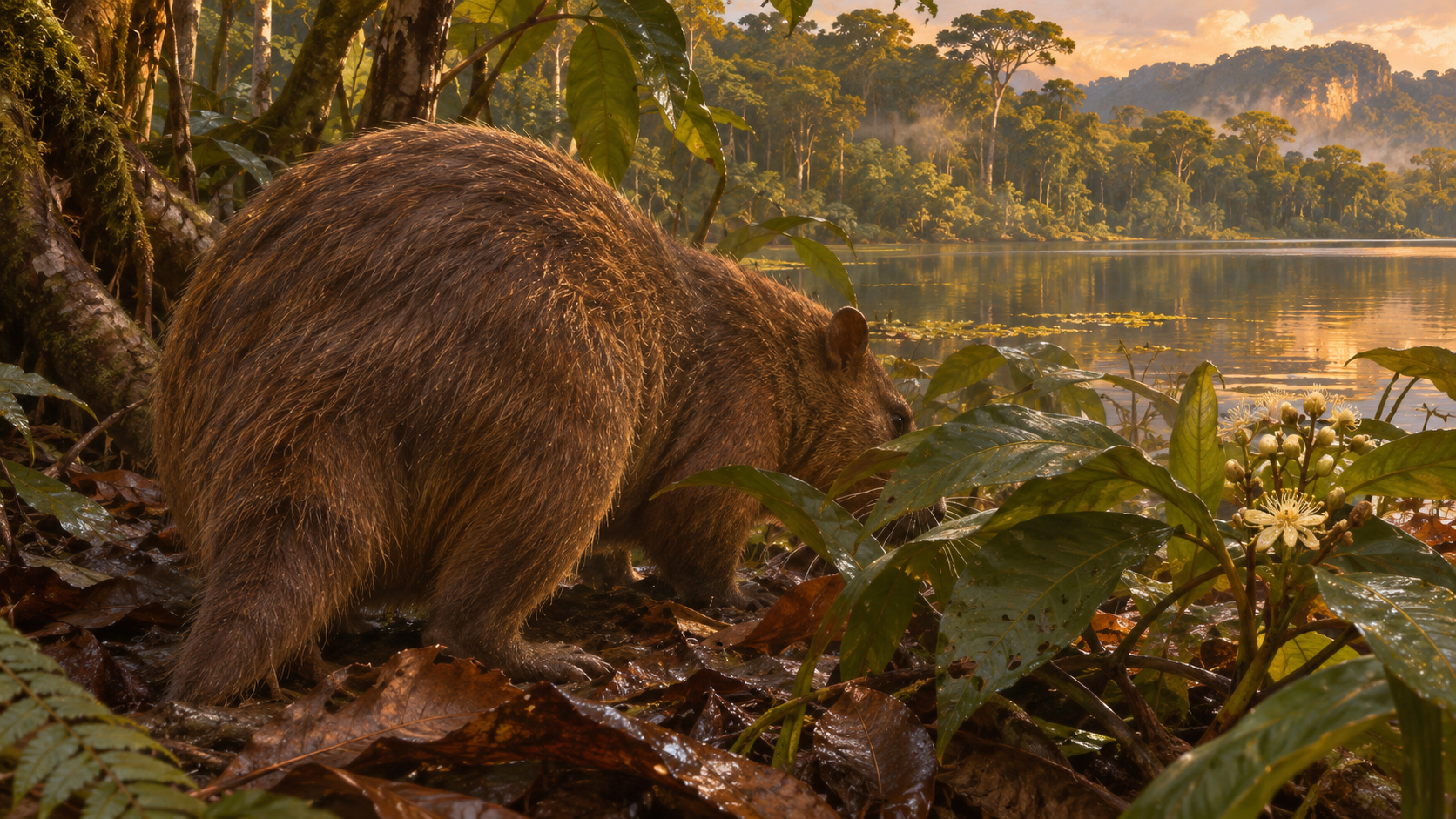
Krabi’s rocks give a better picture of the landscape than the teeth give of the animal’s habits. Earlier work in the basin identified deposits laid down by rivers and lakes, with fossil mammals and reptiles indicating a tropical environment. The clay that held the rodent teeth formed in a lake setting. A wooded shore is therefore a reasonable setting for an illustration of Yakamys. The shape of the animal’s feet, the colour of its coat and how readily it entered the water are artistic decisions.
The molar does offer one possible clue about feeding. A higher crown gives a tooth more material to lose before wear exhausts its chewing surface. The researchers suggest that the moderately high crown of Yakamys may have helped it withstand wear. Identifying what caused that wear would require another kind of evidence. For comparison, researchers investigating ancient teeth from the Indonesian island of Sulawesi had both distinctive wear and a chemical trace linked to betel nut. No comparable identification of a particular food is available for the Krabi rodent.
Why Does a Giant Rodent in Thailand Matter?
The best-known fossil giants among rodents came from South America, where a different branch of the family tree later produced animals far heavier than Yakamys. The Thai discovery earns its place in that history through its age and ancestry. By the late Eocene, an early rodent family in Southeast Asia had already produced an animal whose estimated mass ran to tens of kilograms. Large body size had a longer and more geographically varied history in rodents than the spectacular South American fossils alone would suggest.
There may even be an older clue across the border. The researchers mention an unusually large rodent incisor from the Pondaung Formation of Myanmar, in deposits older than the Krabi layer. Its owner has yet to be formally identified. A second tooth from Myanmar, especially a molar with its chewing surface intact, could help decide whether the two finds belong to related animals or record separate experiments in growing large.
That prospect gives the little Bangkok specimen a value beyond the figure of 30 kilograms. The next time somebody finds an oversized rodent tooth in Southeast Asia, there is a named animal to compare it with. A ridge that forks in the same place, or one that takes a different turn, could change the story again.
Sources
Yaowalak Chaimanee and colleagues — A giant eocene ischyromyid from Southeast Asia reveals the early evolution of rodent gigantism — The original study, including images of both teeth, the seven weight estimates and the comparison with Myanmar.
Mouloud Benammi and colleagues — Paleontology and magnetostratigraphy of the Eocene Krabi basin (Southern Thailand) — The fossil and magnetic evidence used to date the Krabi deposits and reconstruct their setting.
Journal of Vertebrate Paleontology — New fossil remains from Bang Mark locality, Krabi Basin, southern Thailand — Earlier research documenting the varied mammals identified from dental remains at the same locality.
Next Reads
Ancient Teeth May Reveal Humanity’s Earliest Habitual Drug Use — How researchers combined wear marks with chemical evidence to investigate what people once chewed.
New Dinosaur Hidden in Museum Collection for a Century Reveals Europe’s First Megaraptoran — How a fragment of skull from the Isle of Wight placed a group of predators on a new continent.
Blood-Cell Evidence Found in a 115-Million-Year-Old Dinosaur: Could We Bring It Back? — What microscopic structures inside fossil bone can preserve after millions of years.
