What Is Dark Matter? The Evidence, Leading Ideas And What Remains Unknown
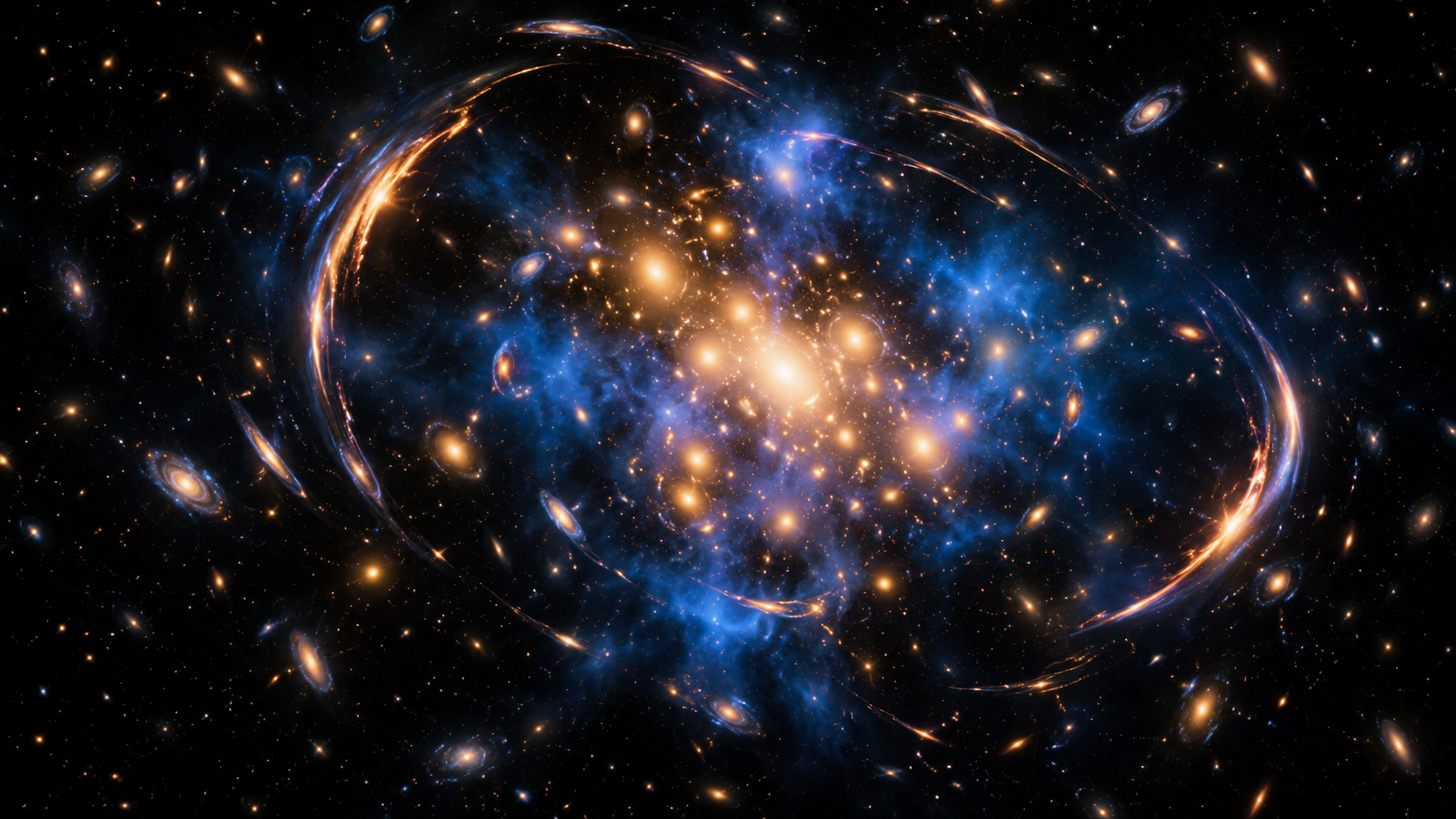
Dark Matter Explained: What Astronomers Know And What They Do Not;
Galaxies Move As Though Far More Matter Exists Than Our Telescopes Can See.
Dark matter is the name scientists give to the unseen mass inferred from its gravitational effects. It does not mean a dark cloud floating between stars, and it is not the same thing as dark energy. We have strong evidence that the universe behaves as though an additional component of matter is present. We still do not know what that component is.
The question is compelling precisely because the evidence and the mystery are both real. Galaxy motions, gravitational lensing and patterns left by the early universe can be explained together by models with dark matter. Yet decades of searches have not identified a definitive dark-matter particle. The strength of a model is not a licence to pretend its ingredient has already been caught in a detector.
What Does 'Dark' Mean?
Ordinary matter interacts with light: stars shine, gas emits or absorbs radiation, and dust can obscure a bright background. Dark matter, in the usual cosmological model, does not emit, absorb or reflect light in a way we can detect. Astronomers infer it primarily through gravity, which affects visible objects and the path of light.
NASA describes dark matter as making up most of the universe's matter. In the standard cosmological accounting, ordinary matter is only about five per cent of the total mass-energy budget, dark matter about a quarter, and dark energy roughly two thirds. Those figures concern different contributions to the universe's total mass-energy. Saying dark matter is 'most of the matter' and 'about a quarter of the universe' is therefore consistent.
Dark energy is the label for the ingredient associated with the accelerated expansion of the universe. It is a separate puzzle. Neither label identifies a known substance merely by naming its effects.
Evidence One: Galaxies Rotate Too Quickly For Visible Matter Alone
In a spiral galaxy, stars and gas circle the centre. If almost all the gravitational mass lay in its visible stars and gas, the speeds of objects far from the centre would tend to change in a predictable way. Observed rotation curves frequently show outer regions moving faster than a calculation based only on the visible matter would suggest.
One explanation is that the luminous disc sits within a much larger halo of matter that telescopes cannot directly see. The halo's gravity helps account for the observed velocities. This does not mean every star is breaking a law of motion. It means the visible inventory and the measured motion do not agree under that simple inventory.
Rotation curves are powerful, but they are not a single magic experiment. Astronomers estimate distances, the contribution of stars, the distribution of gas and the way mass is arranged. Alternative models can reproduce some galaxy-scale behaviours by modifying how gravity works under certain conditions. The wider test is whether one explanation also fits clusters, lensing, the early universe and structure formation.
Evidence Two: Gravity Bends Light Around Invisible Mass
Mass changes the geometry through which light travels. A massive galaxy cluster can distort the images of galaxies behind it, making them appear stretched or multiplied. By measuring these distortions, astronomers infer where gravitational mass lies. This is called gravitational lensing.
The important comparison is between the mass inferred from lensing and the matter visible through telescopes, including hot gas detected in X-rays. If the gravity map requires more mass than the observable components provide, the discrepancy can be mapped rather than merely asserted. Lensing does not photograph dark matter; it measures the gravitational effect attributed to it.
NASA highlights the Bullet Cluster, formed by a collision of two galaxy clusters. In observations of this system, much of the ordinary matter appears as hot gas concentrated in a different place from the principal gravitational mass inferred through lensing. The separation is particularly informative because the gas interacted and slowed during the collision, while the dominant gravitational component appears to have passed through differently.
One collision does not disclose the particle's identity. It does make the problem harder to dismiss as merely failing to count faint stars in a normal galaxy. NASA's visualisations often colour hot gas and inferred mass differently; those colours represent mapped quantities, not literal blue clouds of visible dark matter.
Evidence Three: The Early Universe Has A Distinct Pattern
The cosmic microwave background is light released when the early universe cooled enough for radiation to travel more freely. Its tiny temperature variations preserve information about the density and behaviour of the universe at that time. Models with ordinary matter, dark matter and dark energy predict a characteristic pattern in those variations.
Scientists compare that pattern with measurements and with later observations of how galaxies cluster. Dark matter's role is not merely to make individual galaxies rotate. In the standard picture, it supplies a gravitational framework into which ordinary matter gathers as cosmic structures grow.
The model's success across epochs strengthens the case for an unseen component. It does not establish that every detail is settled. Cosmological estimates depend on a theoretical framework and measured parameters. Tensions between some measurements of the universe's expansion, for example, remain active research questions and should not be turned into a premature declaration that dark matter has been disproved.
Why Can't We Just See Faint Ordinary Objects?
Some unseen mass is mundane: dim stars, cold gas, planets and black holes can escape a particular telescope. But hiding ordinary objects does not solve the full cosmological discrepancy. Independent measurements of the early universe constrain how much ordinary matter could have formed, and the combined evidence requires something beyond simply adding more familiar material.
A black hole is dark in the everyday sense, yet ordinary stellar black holes arise from normal matter and cannot simply be counted as the entire missing component. More exotic populations, including primordial black holes, are studied as possibilities under particular mass ranges and constraints. Their viability is a research question, not an established solution.
What Could Dark Matter Be?
One family of candidates consists of weakly interacting massive particles, commonly called WIMPs. They could provide mass while interacting so rarely with ordinary matter that they evade routine detection. Large underground experiments look for the faint signals that occasional collisions with detector material might leave.
Axions are another proposed class: extremely light hypothetical particles motivated by a separate problem in particle physics. Searches use different methods suited to their predicted properties. Sterile neutrinos and other hidden-sector particles are also studied. These labels represent different hypotheses, not several names for one discovered object.
CERN's collider experiments seek conditions in which a dark-matter candidate might be produced. Because an invisible particle would not light up the apparatus directly, researchers look for an imbalance in measured momentum together with visible particles. Missing momentum can have other explanations, so a suggestive event needs careful background analysis and repeatable evidence.
A non-detection is informative within the range an experiment can test. It may exclude particular combinations of particle mass and interaction strength. It cannot exclude every possible form of dark matter. The search has to adapt as sensitive tests eliminate attractive versions of old ideas.
Could Gravity Be Wrong Instead?
Some researchers investigate modified-gravity approaches that alter the assumed behaviour of gravity at low acceleration or on large scales. These ideas can describe aspects of galaxy dynamics and provide an important challenge to simple dark-matter stories. The decisive issue is whether they also account for cluster collisions, lensing maps, the cosmic microwave background and the formation of structure with equal consistency.
Scientific disagreement is not evidence of a fifty-fifty contest. The dark-matter framework remains the leading explanation across many observations, while its physical identity is unresolved. Alternative theories deserve assessment on their predictions and performance, not dismissal by slogan or promotion as if a complete replacement had already won.
What Would Count As A Discovery?
The strongest breakthrough would connect a reproducible laboratory or collider signal to a candidate that also fits astrophysical and cosmological observations. Researchers would need to rule out instrumental effects and ordinary backgrounds, establish the new phenomenon's properties and check whether independent experiments see compatible effects.
A single unexplained excess would be a clue. A striking telescope image would be evidence about the distribution of gravity. Neither alone would necessarily identify the underlying particle. Conversely, a compelling new theory must make predictions that survive tests beyond the anomaly that inspired it.
Dark matter thus sits at a useful boundary between established observation and open explanation. We can measure how galaxies move, how light bends and how cosmic structure grew. We can compare those measurements with a model that works remarkably well. The unanswered question is what physical entity, or deeper change in our understanding, supplies the missing gravitational effect.
Three Questions To Ask When The Next Headline Appears
First, what was measured: a galaxy's motion, a lensing signal, a detector event or a theoretical calculation? These are different kinds of evidence. A more precise map of inferred dark matter can greatly improve the science without being a laboratory discovery of its substance.
Second, what alternatives were tested? If a detector reports an unusual signal, the immediate task is to examine noise, known particles and calibration. If a galaxy behaves unexpectedly, researchers should test distance estimates and ordinary-matter assumptions before declaring a new law.
Third, does the result survive independent observation? A persuasive identification should explain phenomena beyond the one dataset used to propose it. That is why astronomers and particle physicists pursue several approaches at once. Their methods can constrain one another: a candidate predicted to fill galactic haloes must be compatible with what the cosmos and experiments actually show.
