When Black Holes Collide: The Universe’s Most Extreme Merger
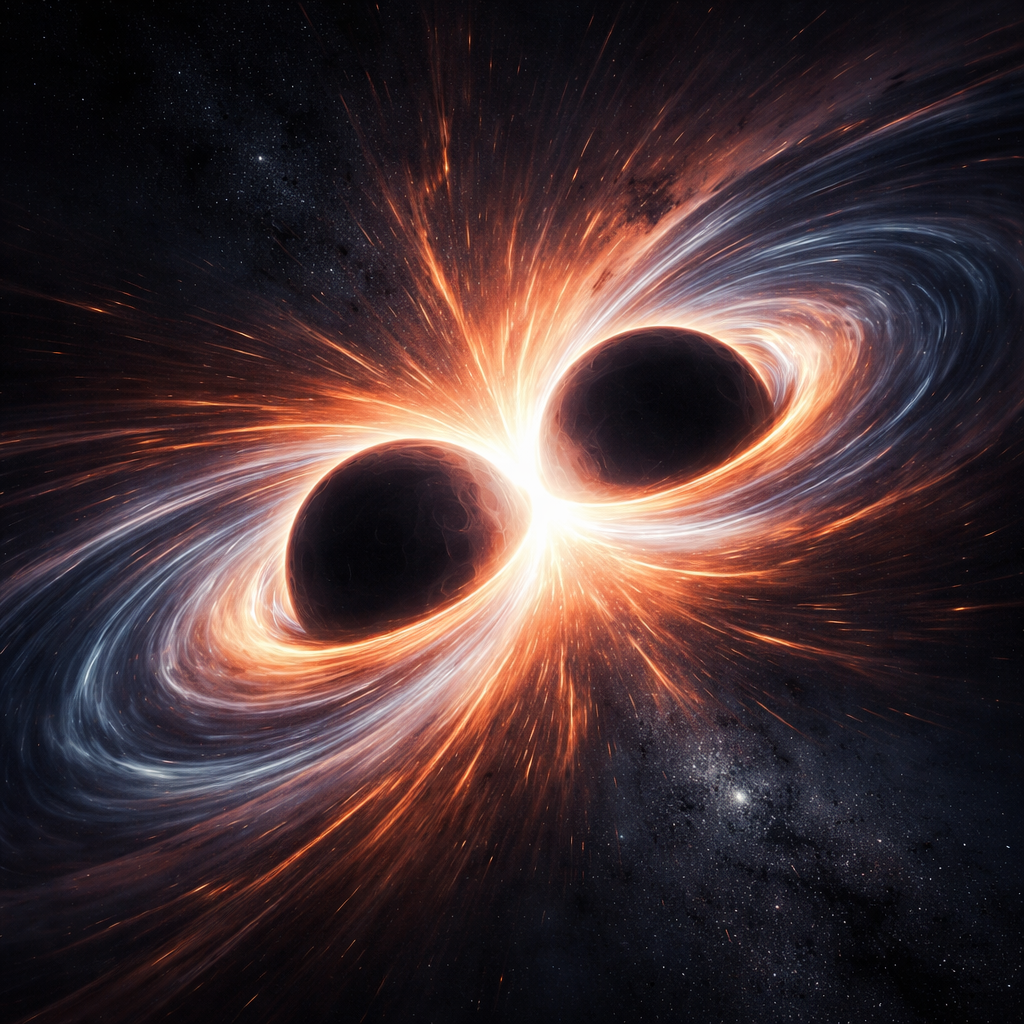
Learn what happens in a black hole merger, from inspiral to ringdown, the key numbers, limits, and why black hole collisions reshape modern astronomy.
What Happens When Black Holes Collide: The Physics of a Black Hole Merger
A black hole collision is not a smash-up of solid objects. It is a gravitational dance that ends when two event horizons become one, releasing a burst of gravitational waves and leaving behind a single, larger black hole.
This matters because black hole mergers are one of the cleanest “laboratories” we have for testing gravity under extreme conditions. They also help explain how black holes grow, how galaxies evolve, and how we can measure the universe using spacetime itself rather than light.
The central tension is that black holes are, by design, hidden: the most important action happens behind horizons we cannot see. So we must infer what occurred from the ripples the merger sends through space and from any surrounding matter that might light up as the system changes.
By the end, you will understand what a black hole merger actually is, the step-by-step physics of how it unfolds, the numbers that anchor it in reality, and what it can (and cannot) tell us about the universe.
The story turns on whether black hole collisions are clean spacetime events or messy astrophysical events shaped by gas, magnetism, and environment.
Key Points
When black holes collide, they almost always merge into one larger black hole, not two.
Most of the “signal” we can observe is gravitational waves: ripples in spacetime produced as the orbit tightens and the horizons join.
The merger has three main phases: inspiral, merger, and ringdown.
A small fraction of the total mass-energy is carried away by gravitational waves, which makes the final black hole slightly lighter than the sum of the two originals.
The merged black hole can recoil, getting a “kick” from asymmetric gravitational wave emission that can move it within, or even eject it from, its host environment.
Many mergers are effectively dark in light, but mergers occurring in gas-rich environments could produce electromagnetic signatures.
What we learn depends on detector sensitivity, waveform modeling, and how well we can disentangle mass, spin, and geometry from the signal.
What It Is
A black hole merger is the coalescence of two black holes that are gravitationally bound in a binary system. Over time, they lose orbital energy by emitting gravitational waves, spiral closer together, and eventually form a single black hole with a new mass and spin.
The phrase “black holes collide” can be misleading because it implies impact dynamics like cars or billiard balls. In reality, the defining boundary of a black hole is the event horizon, and a merger is the moment those horizons unify into one. The violent part is not matter crashing, but spacetime curvature rapidly reorganizing.
A merger is also different from a black hole simply eating a star or gas. Accretion is a process involving matter outside the horizon, heating up and radiating as it falls in. A merger, in its purest form, can happen with almost no matter at all, leaving gravitational waves as the main outward evidence.
What it is not: a black hole merger is not an explosion that blasts out the contents of the black holes. By definition, the contents remain hidden behind horizons. Any light we might see comes from matter outside the horizons, if any is present.
How It Works
The story begins long before the final moment. Two black holes must first end up in a bound pair. That can happen if they are born as the remnants of massive stars that evolved together, or if they meet later through gravitational encounters in dense environments like star clusters. Once bound, their orbit is stable but not permanent.
As the black holes orbit, the system emits gravitational waves. These waves carry away energy and angular momentum, so the orbit shrinks and the orbital speed rises. The frequency of the gravitational waves increases as the black holes draw closer, producing a characteristic “chirp” in detectors: low frequency at first, rising rapidly toward the end.
Eventually the system reaches a regime where the orbit is so tight that the usual notion of two bodies circling each other becomes less useful. The black holes plunge together, and their horizons join. This is the merger phase, where gravitational wave emission peaks because the curvature of spacetime is changing fastest.
Immediately after the horizons merge, the newly formed black hole is not perfectly smooth. It is distorted, like a struck bell that has been hit off-center. It then settles into its final state by emitting gravitational waves in a damped pattern called ringdown. The ringdown encodes the mass and spin of the final black hole, and it is one of the cleanest places to test whether the result matches the black hole solutions predicted by general relativity.
One more complication can follow: recoil. If the masses are unequal or the spins are oriented in certain ways, gravitational waves are emitted more strongly in some directions than others. Conservation of momentum then requires the final black hole to move the opposite way, potentially at enormous speeds by astrophysical standards.
Numbers That Matter
The event horizon scale is surprisingly compact. For a non-spinning black hole, the Schwarzschild radius is about 3 kilometers per solar mass, meaning a 30-solar-mass black hole has a horizon radius on the order of 90 kilometers. This matters because it highlights how “small” the merging objects are compared to the vast distances between them and us, and why the final moments are so fast.
Observed stellar-mass black hole mergers span a wide range of component masses. Cataloged events include black holes of only a few solar masses and also black holes well above 100 solar masses. This matters because different mass ranges point to different formation pathways, and because the mass controls which detectors can “hear” the merger.
The energy budget is large but precise in its meaning. A merger radiates a small fraction of the system’s mass-energy as gravitational waves, often a few percent for stellar-mass binaries. If that fraction is higher, it typically reflects strong orbital motion and favorable spin configurations; if lower, it often reflects less efficient emission because of the mass ratio or spin alignment.
Frequency is the bridge between astrophysics and instrumentation. Stellar-mass black hole mergers produce gravitational waves in the tens to hundreds of hertz near the end, which is why ground-based detectors are sensitive to them. More massive binaries merge at lower frequencies, shifting the signal toward the millihertz band targeted by space-based detectors or even nanohertz frequencies probed by pulsar timing.
Timescale is part of the misconception. The full inspiral can take millions to billions of years from wide separation, but the part we can detect can be brief: for heavier stellar-mass systems, the loudest portion may last fractions of a second to a few seconds in the most sensitive band. That is why detection depends so heavily on having templates that match the waveform.
Recoil speeds can be dramatic. Typical kicks may be modest enough that a black hole remains in its environment, but in extreme configurations, the recoil can reach thousands of kilometers per second. That matters because it determines whether merged black holes can stay put and merge again, influencing how larger black holes grow over cosmic time.
Where It Works (and Where It Breaks)
Black hole mergers are a best-case scenario for gravitational wave astronomy because the physics is relatively clean. Two compact objects orbiting in vacuum are dominated by gravity, and general relativity makes sharp predictions about how the inspiral and ringdown should look. When those predictions match the observed waveform, we gain confidence that we are truly seeing black holes and not some alternative object.
The approach works especially well for measuring masses and spins, because those properties strongly shape the waveform. It also works well for testing gravity in the strong-field regime, because the merger probes spacetime curvature far beyond anything accessible in the solar system.
Where it breaks is in the details we want most. Many different combinations of parameters can produce similar-looking signals, especially when detectors have limited sensitivity at certain frequencies. Mass ratio, spin magnitude, and spin orientation can trade off against each other in ways that create degeneracies.
It also breaks when we assume every merger is “in vacuum.” If the binary is embedded in gas, or near a supermassive black hole, or interacting with a dense stellar environment, then additional physics can matter. The gravitational wave signal still follows the same core rules, but the environment can add effects we might misinterpret if we use oversimplified models.
Finally, it breaks at the edges of the observable spectrum. Supermassive black hole mergers are expected to produce enormous gravitational wave signals, but at frequencies that ground-based detectors cannot access. That means understanding the full population requires multiple kinds of observatories that listen to different frequency bands.
Reality
Under the hood, a black hole merger is an energy-and-momentum bookkeeping problem in curved spacetime. The binary’s orbital energy decreases as gravitational waves carry energy away, and the orbital frequency rises. The late inspiral is accurately described by a combination of analytic approximations and numerical relativity simulations that solve Einstein’s equations directly.
For the claims to hold, two things must be true. First, the observed signal must be consistent with a compact binary waveform rather than an instrumental artifact. Second, the waveform models must be accurate enough that the inferred masses and spins are not biased by missing physics or poor approximations.
What would falsify or weaken the interpretation is a systematic mismatch between predicted and observed waveforms that cannot be explained by noise, calibration, or environmental effects. Ringdown is especially important here: if the post-merger signal did not match the expected damped modes of a black hole, it would force a rethink of what the final object is.
A common confusion is to treat a detection as a “photo” of the merger. It is not. It is a pattern-matching inference in which we recover the most likely parameters given noisy data. The more sensitive the detector network becomes, the more that inference shifts from “we saw a chirp” to “we can map populations, environments, and rare configurations.”
Impact
The direct “market” is small in consumer terms but large in strategic science and engineering. Gravitational wave observatories push the limits of lasers, optics, vibration isolation, timing, cryogenics, and precision manufacturing. The payoff is not a gadget; it is a capability: measuring tiny changes in distance reliably, at scale, over years.
Who benefits if this works is broader than astronomy. Precision sensing, control systems, and data analysis methods developed for gravitational wave detection often spill over into adjacent fields, from metrology to geophysics to high-performance computing.
For practical adoption, the bottleneck is not physics but reliability and cost: building, operating, and upgrading observatories is expensive, and long-term stability is hard. The near-term pathway is incremental improvements in detector sensitivity and network coverage; the longer-term pathway is space-based detection that opens entirely new frequency windows.
Total cost of ownership shows up in maintenance, downtime, and the slow cycle of upgrades. This is infrastructure science: the results depend on sustained operational excellence, not just clever theory.
There is little direct “misuse” of black hole merger knowledge in the conventional sense. The more realistic risk is misunderstanding: sensational claims about “dangerous” black holes, or confusion between gravitational waves and harmful radiation.
A second risk is overclaiming scientific certainty. Because inference relies on waveform models, there is always a temptation to interpret parameter estimates too literally, especially for unusual events near the edges of current modeling capability.
Guardrails here are mostly scientific: transparent uncertainty reporting, robust cross-checks between pipelines, and continual improvement of waveform models. Standards matter in calibration, data release practices, and reproducibility, because credibility is the currency of a field that measures signals close to the noise floor.
Significance
Black hole mergers have changed what “seeing the universe” means. For centuries, astronomy was fundamentally electromagnetic, interpreting photons across wavelengths. Gravitational wave detection adds a new channel that is sensitive to motion and mass distribution rather than light emission.
In education and public understanding, this shifts the story from “telescopes and images” to “signals and inference.” It also creates a new kind of scientific literacy: understanding how strong conclusions can come from subtle patterns when models and statistics are trustworthy.
If detection scales, it also changes research practice. Multi-messenger astronomy becomes less occasional and more systematic, demanding coordination across observatories, data standards, and rapid analysis workflows.
Who gets empowered are teams and institutions that can build and operate precision infrastructure and handle complex data analysis. Who gets squeezed are smaller groups without access to instrumentation, unless open data and collaborative structures remain strong.
Unknowns
Most coverage treats the merger as the whole event. In reality, the merger is the punctuation mark at the end of a long story: how the binary formed, how it hardened, and what environment it lived in. The gravitational wave signal tells you a great deal, but it does not automatically tell you the origin story.
Another overlooked element is that “collision” is not synonymous with “light”. Many black hole mergers are dark because there is no matter outside the horizons to glow. The scientifically exciting frontier is not just detecting more mergers, but sorting them into types: vacuum-like binaries, gas-embedded binaries, hierarchical mergers in clusters, and supermassive systems in galactic centers.
Finally, the headline drama can obscure the practical limit: what we can learn is constrained by modeling. The more extreme the spins, mass ratios, and environments, the more the interpretation depends on the quality of numerical relativity simulations and the completeness of waveform libraries. The field’s next leap is as much computational as it is observational.
Why This Matters
In the short term, black hole mergers matter because they give us a clean way to test gravity and to measure black hole populations. Each detection is a data point about how massive black holes are, how fast they spin, and how often they merge.
In the longer term, they matter because they connect small-scale stellar evolution to the large-scale structure of galaxies. If black holes can repeatedly merge and remain bound in clusters or galactic centers, that provides a pathway to building heavier black holes over time.
Milestones to watch include detector sensitivity upgrades, expansion of detector networks that improve sky localization, and better ringdown measurements that sharpen tests of black hole physics. On longer horizons, the biggest trigger is opening lower-frequency bands with space-based observatories and improved pulsar timing, which would allow us to track the growth of massive black holes across cosmic history.
Real-World Implications
A precision-measurement pipeline that can extract tiny signals from noise has relevance beyond astrophysics. Techniques developed for gravitational wave analysis inform how we build robust detection systems in other domains where signals are subtle and confounded by environmental noise.
The engineering behind isolation and stability pushes innovations in control systems and metrology. Even when the application is niche, the skillset and hardware ecosystem feed into high-precision industries.
In research workflows, black hole merger science is a model of modern collaboration: distributed teams, shared data practices, and computationally intensive inference. That culture is increasingly influential across fields that depend on large instruments and complex analysis.
Finally, there is a public impact: black hole mergers are a rare example of abstract theory becoming directly measurable. That has a durable effect on how people perceive what physics can do, even when the immediate applications are indirect.
FAQ
Do black hole collisions create explosions you can see?
Usually, no. If there is little or no gas around the black holes, the merger is effectively dark in light, and the main outward signal is gravitational waves. If the system is embedded in gas or interacts with a disk, there are plausible ways to generate electromagnetic signals, but those are expected to be rarer and harder to confirm.
Does a black hole merger make a bigger black hole?
Yes, almost always. The final black hole’s mass is close to the sum of the two original masses, minus the energy carried away by gravitational waves. The final spin depends on the masses and spins of the original pair and how they were oriented.
What are gravitational waves in a black hole merger?
Gravitational waves are ripples in spacetime produced by accelerating masses. In a merger, they are generated most strongly by the changing quadrupole moment of the orbit as the black holes spiral together. They carry energy and momentum away, which is why the orbit shrinks.
Could a black hole merger near Earth be dangerous?
Not in any realistic scenario. Gravitational waves weaken rapidly with distance, and astrophysical black hole mergers occur far away. The merger does not emit harmful radiation by itself; any danger would require an implausibly close event and an unusually bright electromagnetic environment.
What is “ringdown” after black holes collide?
Ringdown is the phase after the horizons merge when the new black hole settles into a stable state. It emits gravitational waves in damped oscillations whose frequencies depend on the black hole’s mass and spin. Measuring ringdown well is a powerful way to test whether the final object behaves like a black hole predicted by general relativity.
What is a black hole “kick,”, and why does it happen?
A kick is the recoil velocity of the final black hole caused by asymmetric emission of gravitational waves. If more gravitational wave momentum is radiated in one direction, the merged black hole must move in the opposite direction. Kicks matter because they can displace or eject black holes from star clusters or even galactic centers.
Are supermassive black hole mergers the same process?
The core physics is the same: inspiral, merger, ringdown, gravitational waves, and a final black hole. The key difference is scale: the frequencies are much lower and the timescales are longer, so different kinds of observatories are needed to detect them. The environment is also more likely to be gas-rich, which raises the chances of electromagnetic signatures.
What do black hole mergers tell us about the information paradox?
They inform the debate indirectly. Gravitational wave observations probe the dynamics of horizons and strong gravity, and ringdown tests determine whether the final object behaves like a classical black hole. But they do not yet provide a direct experimental resolution to how information is encoded or recovered in black hole evaporation, which is a different regime of physics.
The Road Ahead
A black hole merger is simple in concept but rich in inference. Two compact objects spiral together, spacetime rings, and a single black hole remains. The hard part is converting a faint, noisy signal into a reliable story about mass, spin, origin, and environment.
One scenario is steady accumulation: if detector networks improve sensitivity and coverage, we will build large catalogs that turn mergers into population science. If we see increasingly precise ringdown measurements, it could lead to sharper tests of black hole predictions and stronger constraints on alternative models of compact objects.
A second scenario is multi-band breakthroughs: if space-based observatories open the millihertz band, we could track massive binaries long before they merge and connect low-frequency and high-frequency observations. If we see that kind of coordinated detection, it could lead to a more complete picture of black hole growth across scales.
A third scenario is environmental surprises: if convincing electromagnetic counterparts to black hole mergers are established, it would reshape expectations about how often mergers happen in gas-rich settings. If we see repeated correlations between mergers and specific astrophysical environments, it could lead to new constraints on formation channels and galaxy-centre physics.
What to watch next is not just “more mergers,” but better context: clearer spin measurements, better localization, stronger ringdown detections, and evidence that separates clean vacuum mergers from mergers shaped by their surroundings.
