When the Sun Turns Hostile: How a Major Solar Flare Could Break Modern Society
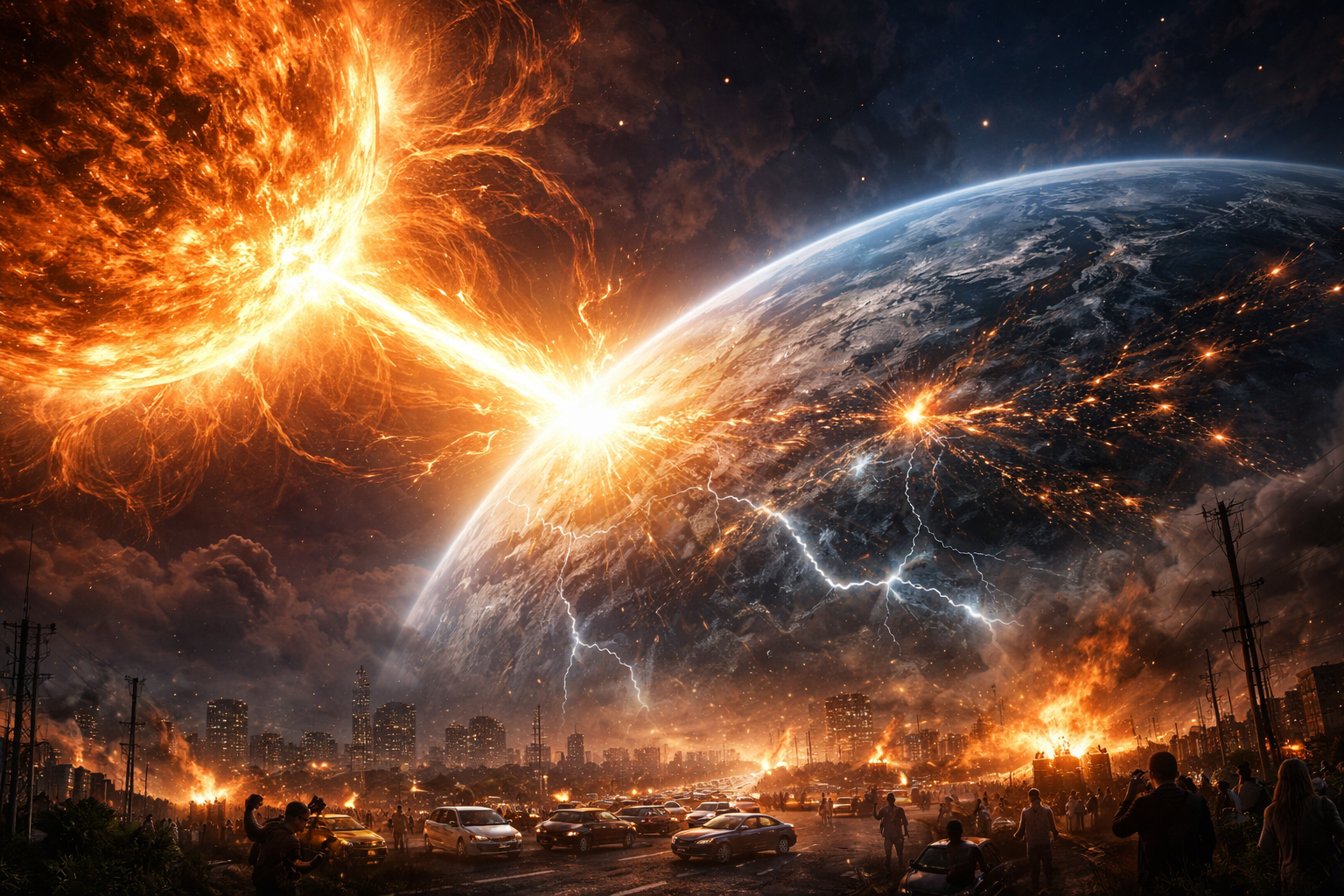
Major Solar Flare: What It Would Do to Earth and Society
The Day the Sun Tests Civilization: What a Major Solar Flare Would Really Do
No civilization-scale solar superstorm is in progress. But the risk is not science fiction: the Sun is in an active phase of its cycle, and the kinds of eruptions that trigger widespread disruption are a normal part of solar behavior.
The central confusion is language. People say “solar flare” when they mean “solar storm” and “solar storm” when they mean “weeks of chaos.” In reality, the worst outcomes usually require a specific chain reaction: a powerful eruption plus the right direction, speed, and magnetic orientation to couple strongly into Earth’s magnetic field.
Here’s the hinge most coverage skates past: you often get days of warning that a cloud is coming, but only minutes to an hour of warning about whether it will be truly damaging when it arrives.
The story turns on whether operators can shift critical systems into safe mode faster than geomagnetically induced currents can stress them.
Key Points
A major flare can cause immediate radio blackouts on the sunlit side of Earth, but the longer, wider disruption usually comes from a coronal mass ejection that arrives 1–3 days later.
Earth is largely protected at ground level; the main risks are technological: power grids, satellites, GPS, aviation routes, and timing-dependent networks.
The highest-consequence failure mode is not “the internet dies.” It’s a regional power loss that cascades into water, fuel logistics, payments, healthcare operations, and supply chains.
Extreme events are rare but plausible on human timescales. Some published estimates put Carrington-level odds at roughly “around one-in-ten per decade,” with meaningful uncertainty.
The most likely fallout is uneven: some regions get aurora and minor outages; others face transformer damage, long restoration times, and knock-on shortages.
The practical question is resilience: forecasting, rapid grid protection actions, satellite safe modes, and replacement bottlenecks for high-voltage equipment.
Background
A solar flare is a sudden burst of electromagnetic energy from the sun. It travels at the speed of light, so its effects (if Earth-facing) begin within minutes. The most immediate impact is on the ionosphere, the charged layer of the upper atmosphere that long-range radio relies on.
A coronal mass ejection (CME) is different: a massive cloud of magnetized plasma thrown into space. A swift CME can reach Earth in roughly one to three days. When it arrives, it can disturb Earth’s magnetosphere and trigger a geomagnetic storm.
A “major solar event” that matters for society is usually a flare plus a CME, but the CME is the part that can drive damaging electrical currents in long conductors—especially power transmission lines—through geomagnetically induced currents.
Solar activity rises and falls in an approximately 11-year solar cycle. During solar maximum, flares and CMEs are more frequent, and space-weather agencies issue more alerts.
Analysis
What a “major solar flare” really means
A flare is best thought of as a flash-bang of radiation. Its cleanest societal impact is communications: high-frequency (HF) radio can fade or fail on the daylight side of the planet, and some navigation signals degrade briefly. This phenomenon is why aviation and maritime operators care about flare timing.
But a flare alone is usually not the civilization-disruptor people imagine. The bigger threat is what sometimes rides along with it: a CME that is fast, Earth-directed, and magnetically configured to couple strongly with Earth’s field.
How a solar storm hits Earth: the chain reaction
The disruption pathway is mechanical, not mystical:
First, satellites and space sensors detect an eruption leaving the Sun. Forecasters can estimate whether the CME is Earth-directed and how fast it is moving.
Second, the ionosphere becomes turbulent. That can distort GPS positioning, timing signals, and radio propagation. GPS problems are not just “maps on phones.” Precise timing underpins telecom synchronization, some financial systems, and parts of industrial control.
Third, the collision of the CME's magnetic field with Earth's magnetosphere can create "doors" that allow energy to flood into near-Earth space. That drives geomagnetic disturbances and, crucially, induces electric currents in long conductors on the ground.
That last step is where high-voltage transformers start to matter.
Infrastructure at risk: grids, satellites, aviation, and cables
Power grids are exposed because they are big, connected machines made of long lines, grounded equipment, and sensitive protection systems. Geomagnetically induced currents can push transformers into abnormal operation, causing heating, harmonics, and protective trips. In the worst cases, hardware can be damaged and taken out of service.
Satellites face two problems at once: radiation and atmosphere. A strong storm can charge satellite surfaces, disrupt electronics, and interfere with communications links. At the same time, the upper atmosphere can heat and expand, increasing drag on low-Earth-orbit satellites. More drag means more fuel spent maintaining orbit and more conjunction risk in crowded orbital shells.
Three channels affect aviation: HF radio reliability (particularly on polar routes), GPS accuracy, and elevated radiation exposure at cruising altitude during radiation storms. Operational consequences include reroutes, delays, and increased fuel consumption, which quickly escalate when multiple flights need to avoid the same corridors.
People often misunderstand underwater internet cables in this context. The fiber itself is not the vulnerable point. The bigger risk is upstream: power and timing disruptions on land, plus localized issues at landing stations and repeaters. In other words, “the internet” usually suffers because the grid suffers.
How likely is it?
Small-to-moderate space-weather disruptions are routine. Severe geomagnetic storms happen occasionally in active solar periods, and they already create measurable operational problems for satellites, navigation, and grids.
The uncertainty begins when you ask about extremes: a “Carrington-level” storm—strong enough to plausibly cause widespread, prolonged grid damage. We have limited direct observations, changing infrastructure, and a long tail of rare events.
Still, published statistical work has put the probability of a Carrington-class event at roughly on the order of 10% over a decade. Treat that as a risk estimate, not a calendar prediction. The key practical point is that “rare” is not “never,” and modern dependence on electronics increases consequences even if the Sun’s behavior does not change.
Fallout scenarios: from nuisance to multi-week disruption
In a mild scenario, the main public-facing effects are beautiful auroras, patchy GPS issues, and short-lived radio interruptions. Many people never notice.
In a moderate scenario, aviation reroutes become widespread, satellite operators put spacecraft into safe modes, and some regions see grid operators reduce load or manage voltage more aggressively. You get sporadic outages, delays, and higher costs.
A severe scenario results in damage or the need to take offline a subset of high-voltage transformers. That’s when society feels it: restoration is constrained not by goodwill or overtime but by the physical availability of replacement equipment, specialist crews, and the ability to move heavy components.
In an extreme scenario, the defining feature is duration. Even if only parts of the grid are heavily damaged, the knock-on effects compound: water pumping, fuel distribution, supermarket logistics, hospital scheduling, payments, and basic communications all degrade when stable electricity and timing go soft.
What Most Coverage Misses
The hinge is not a catastrophic event. It is the replacement bottleneck for large power equipment.
A severe storm can damage a limited number of critical transformers and still create outsized disruption, because those components are specialized, heavy, and slow to replace. The grid is a network: take out the wrong nodes, and you can’t “route around” the loss without shedding load.
What would confirm this risk path in real time is not the flare class headline. It is operational language: grid operators issuing emergency voltage actions, utilities isolating regions, and repeated transformer trips that do not stabilize after the first wave. On the space side, the key signpost is the storm’s magnetic orientation at arrival—whether it turns strongly southward, which is when coupling intensifies.
Why This Matters
The most affected stakeholders are the ones whose systems assume stable electricity, precise timing, and reliable satellite services: grid operators, satellite fleets, telecoms, aviation, emergency services, and any business with just-in-time logistics.
In the short term (24–72 hours), the world is mostly in “operations mode”: forecasts update, airlines reroute, satellites shift configurations, and utilities try to reduce stress because a controlled degradation is better than uncontrolled damage.
In the longer term (weeks to months), the story becomes industrial: how fast can damaged components be repaired or replaced, how well can regions share capacity, and how long can supply chains tolerate friction?
The main consequence is cascading disruption, because electricity and timing are upstream of almost everything else.
Real-World Impact
A regional hospital runs on generators longer than planned. Elective procedures are postponed, and staff shift from care optimization to resource triage: fuel deliveries, refrigeration, and communications become the constraints.
A logistics manager at a grocery distributor watches refrigeration alarms multiply. The core problem is not food scarcity at farms. It is transport timing, cold-chain continuity, and payment systems that intermittently fail.
An airline operations center reroutes polar flights south. Travel time rises, fuel burn increases, and schedules collapse into a network problem: one delayed long-haul aircraft disrupts multiple later legs.
A telecom engineer fights time synchronization issues. The public hears “outage.” Internally, it is a timing and resilience problem: keeping networks stable when GPS-derived timing is degraded.
The Next Solar Storm Will Be a Resilience Test
A major solar flare is not a doomsday ray. It is a stressor that reveals how dependent modern life is on stable power, clean timing, and space-based services.
The dilemma lies in choosing between preparation and improvisation. Systems capable of gracefully degrading, such as shedding load, rerouting flights, safely modifying satellites, and clear communication, can transform a solar storm into a costly inconvenience. Systems that operate in a hot, tight, and blind manner can transform the same physics into a protracted civil disturbance.
Watch for three signposts: upstream solar wind monitors confirming storm arrival, a strongly southward magnetic orientation at impact, and grid operators taking protective actions early rather than after equipment starts tripping.
History will not remember the aurora. It will remember whether the lights stayed on.
