

Why Time Feels Faster As You Get Older
The Hidden Reason Time Seems To Speed Up With Age
The Clock Has Not Changed — But Your Brain Has
The Strange Science Behind Why Childhood Felt So Much Longer
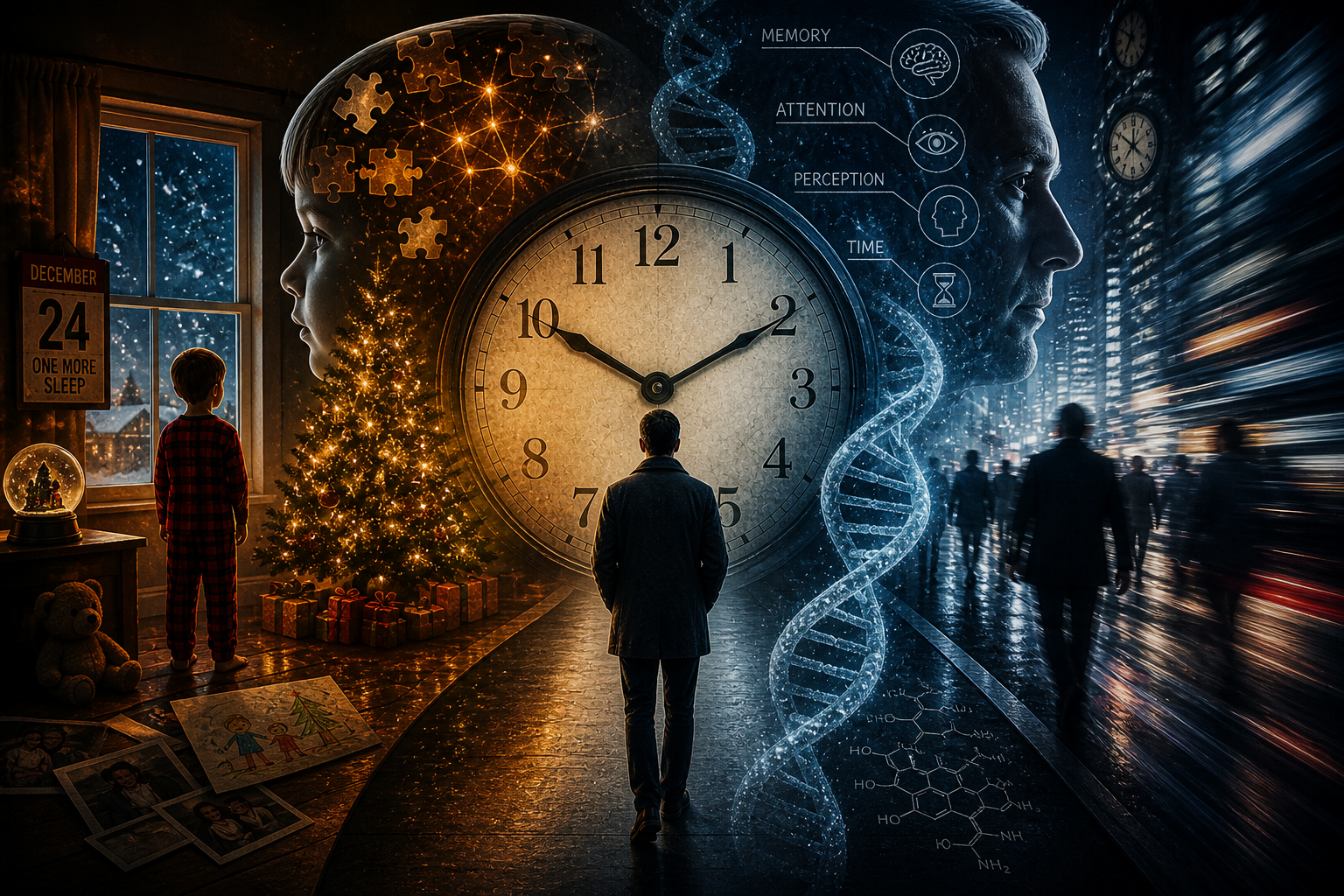
Christmas used to feel impossibly far away. As a child, December did not simply arrive; it crawled. The school term stretched, the advent calendar moved one tiny door at a time, and Christmas Eve felt like a psychological endurance test. One more sleep sounded simple to adults. To a child, it could feel like standing at the edge of eternity.
Then adulthood happens. Christmas appears again before the last one feels properly archived. Birthdays arrive faster. Summers collapse into work, errands, bank holidays, and unread messages. A year, once a vast landscape,now feelsl like a corridor.
So, does time actually speed up as you get older? Objectively, no. A minute is still a minute. A year is still a year. But subjectively, yes—life often does feel faster with age, and there are serious psychological, neurological, and even genetic reasons why. Research on time perception consistently links subjective time to attention, memory, event boundaries, and brain aging, rather than to any simple inner stopwatch.
Your Brain Does Not Experience Time Like A Clock
The mistake is thinking of the brain as measuring life like a stopwatch. It does not simply record seconds and file them neatly into memory. It builds time out of attention, novelty, emotion, expectation, and remembered detail.
This is why boring waiting can feel painfully slow in the moment, while a busy month can vanish in hindsight. Time has two faces: how long something feels in the moment and how long it feels in retrospect. Childhood Christmas exposes the difference perfectly. Waiting for it felt slow because attention was fixed on the future. Looking back, childhood itself can feel vast because it was packed with firsts.
A child is not just waiting for Christmas. A child is absorbing the smell of decorations, the strange electricity of the final school week, the ritual of cards, songs, films, family visits, food, lights, and rules temporarily breaking. The brain is flooded with novelty. Novelty creates memory. Memory imparts time weight.
Adulthood tends to do the opposite. The calendar may be full, but much of it becomes repetitive. The commute, the inbox, the supermarket, the same rooms, the same routes, the same problems, the same phone scroll. When less feels new, fewer moments are strongly encoded. Then, when the brain looks back, the period seems shorter because there are fewer distinctive markers to stretch it out.
The Proportional Theory: Why A Year Shrinks With Age
One of the simplest explanations is also one of the most powerful: each year becomes a smaller proportion of your life. When you are five, one year is 20% of your entire lived experience. When you are fifty, one year is 2%. The same calendar unit carries a less subjective scale because it occupies a smaller share of your personal timeline.
This phenomenon does not explain everything, but it explains why childhood years can feel enormous. A summer holiday at age seven is not just six weeks. It is a major percentage of the life you can remember. A school year is not one administrative cycle; it is a full era, with new teachers, new classmates, new fears, new triumphs, and new rules.
By adulthood, a year is often another lap around a familiar track. It may contain major events, but the structure is recognizable. January starts. Work resumes. Spring appears. Summer goes. Christmas returns. The repetition compresses the experience. The proportional theory does not mean adults are imagining the effect. It means the mind is scaling time against its archive.
Novelty Is The Hidden Time Expander
The strongest practical clue is this: new experiences make life feel longer in memory. A weekend in a new city can feel bigger than three ordinary weeks. The first month in a new job can feel enormous, while the ninth month can disappear. A first date, a house move, a new friendship, a strange place, a risk, a challenge, and a different routine — all of these create more mental landmarks.
Children live inside novelty by default. Adults have to create it deliberately.
That is one reason waiting for Christmas was so intense. The build-up was not just waiting; it was a complete alteration of reality. The house changed. School changed. Food changed. Music changed. Television changed. The emotional atmosphere changed. Even the rules of the day changed. Christmas had a gravitational field.
For many adults, Christmas becomes logistics. Buying, wrapping, travelling, cooking, budgeting, hosting, replying, scheduling, and cleaning up. The magic does not vanish because adults become boring; it is buried under responsibility. The brain is still capable of wonder, but wonder must compete with calendar pressure.
Attention Makes Time Stretch—And Distraction Makes It Disappear
Attention is another major part of the puzzle. When you pay close attention to time, it often slows down. That is why waiting rooms, delayed trains, and childhood countdowns can feel endless. The mind keeps checking the clock. Each verification becomes another tiny reminder that the desired moment has not arrived.
Modern adulthood pulls attention in the opposite direction. Phones, work systems, notifications, streaming, social feeds, and constant task switching can make hours vanish without producing many satisfying memories. The brain is busy, but not always deeply present. A distracted day can feel crowded while you live it and empty when you remember it.
This matters because “time flying” is not always a sign of happiness. Occasionally it means life is absorbing. Occasionally it means life is repetitive. Occasionally it means attention has been fragmented so badly that the brain has not stored enough to make the period feel rich afterwards.
The Ageing Brain May Mark Fewer Boundaries
Recent neuroscience adds another layer. A 2025 study in Communications Biology examined how aging may affect the way the brain segments continuous experience into distinct neural states. The researchers found evidence consistent with older adults showing fewer and longer-lasting shifts in brain activity states while watching a film clip, suggesting that aging may reduce the distinctiveness of event boundaries in the brain.
That matters because memory depends heavily on segmentation. A day does not become memorable just because it happened. It becomes memorable because the brain breaks it into meaningful scenes: arriving somewhere, meeting someone, hearing something surprising, making a decision, feeling danger, pleasure, embarrassment, pride, or awe. If fewer boundaries are marked, the remembered stretch can feel smoother, flatter, and shorter.
This does not mean older people are unable to form rich memories. It does not mean time perception collapses after a certain birthday. It means the machinery of attention, memory, and brain state change may shift with age, helping explain why later life can feel faster even when the person remains active and intelligent.
Where Genetics Comes In
Genetics does not contain a simple “time feels fast” gene. There is no single switch that determines whether your twenties feel slow or your forties feel like a blur. But genetics can influence some of the biological systems involved in timing, attention, sleep, circadian rhythm, and neurotransmitter function.
Research has investigated the influence of genetic variation on temporal perception, examining associations with neurotransmitter systems and circadian rhythm biology. Research also suggests both genetic and non-genetic factors can influence timing performance, which means biology matters, but it interacts with environment, behavior, age, mood, attention, and context.
Dopamine is especially relevant because it is involved in reward, motivation, attention, and timing. Circadian genes matter because the body’s daily timing system affects alertness, sleep, energy, and mental performance across the day. But the key point is restraint: genetics may shape the sensitivity of your internal timing systems, but it does not sentence you to a fast or slow life.
The better way to understand it is this: genes may influence the instrument, but experience plays the music.
Why Childhood Felt So Slow
Childhood time felt slower because it was dense. It is not always happy, not always easy, but it is dense. Familiarity had not yet compressed the world. A street could feel like a country. A school year could seem to last forever. Christmas could feel like a myth slowly approaching.
Children also have fewer long-term reference points. They do not have thirty previous Decembers to compare against. They do not think, “This again.” They think, “This is happening.” That difference is enormous. Repetition turns events into categories. Novelty turns them into memories.
There is also the emotional intensity of anticipation. A child waiting for Christmas is not waiting calmly. They are imagining presents, rituals, food, family, freedom, surprise, and status. The desired future occupies the present. That makes the waiting stretch.
Adults still anticipate things, but often with mixed emotions. A holiday may come with work deadlines. Christmas may come with money stress. A birthday may come with aging. Even excellent events are bundled with admin. Anticipation becomes less pure, and that changes how time feels.
Why Adulthood Feels Like It Is Accelerating
Adulthood accelerates because life becomes patterned. You may be doing more than ever, but much of it can become automatic. The brain is efficient; it stops intensely recording what it believes it already understands.
That efficiency is useful. You could not function if every commute felt like your first day on Earth. But the cost is compression. Familiarity saves mental energy while stealing remembered length.
This is why major disruption can make time feel slow again. A breakup, a new job, grief, travel, a house move, a crisis, a creative project, or a dramatic change in routine can make a few weeks feel huge. The mind is forced back into high-resolution recording. It starts paying attention again because the map has changed.
The uncomfortable implication is that a life can be long in calendar terms but short in remembered texture. If too many days are interchangeable, the years can disappear.
Can You Slow Time Down?
You cannot slow the clock. You can change the density of experience. The most realistic way to make life feel longer is not to chase constant chaos but to build more memory markers into ordinary time.
That means doing new things often enough for the brain to notice. Take different routes. Learn skills. Visit unfamiliar places. Build rituals that are not just obligations. Spend time with people who pull you into presence rather than passive scrolling. Create projects that divide life into chapters. Pay attention to sensory detail. Make annual events feel distinct again rather than letting them become repeat admin.
This is not motivational fluff. It follows directly from the way subjective time is built. More attention, more novelty, more emotional meaning, and more distinct memories can make a period feel fuller in retrospect. A routine life can be peaceful, but a completely textureless routine can make time feel brutally fast.
What Most People Miss
The deeper point is not simply that time speeds up with age. The deeper point is that the feeling of time is partly a measure of how much life your brain is actually encoding.
A child waiting for Christmas is living inside a high-definition world. Adults often live inside a compressed file. That does not mean childhood was better or adulthood is doomed. It means the adult brain has become efficient, predictive, and selective. It filters more. It assumes more. It records less of what seems familiar.
So the answer is both comforting and confronting. Time has not betrayed you. Your brain is doing what minds do: simplifying the known world so you can survive it. But if you want life to feel longer, you have to give it more to remember.
Christmas felt far away because you were once fully inside the waiting. Now, so much of adult life passes on autopilot, making the years fly by. The clock has not changed. The question is whether your days still contain enough moments worth marking.
