Bloody Belongings Found In Skip Bin Emerge As Key Evidence In Beau Lamarre-Condon Murder Trial
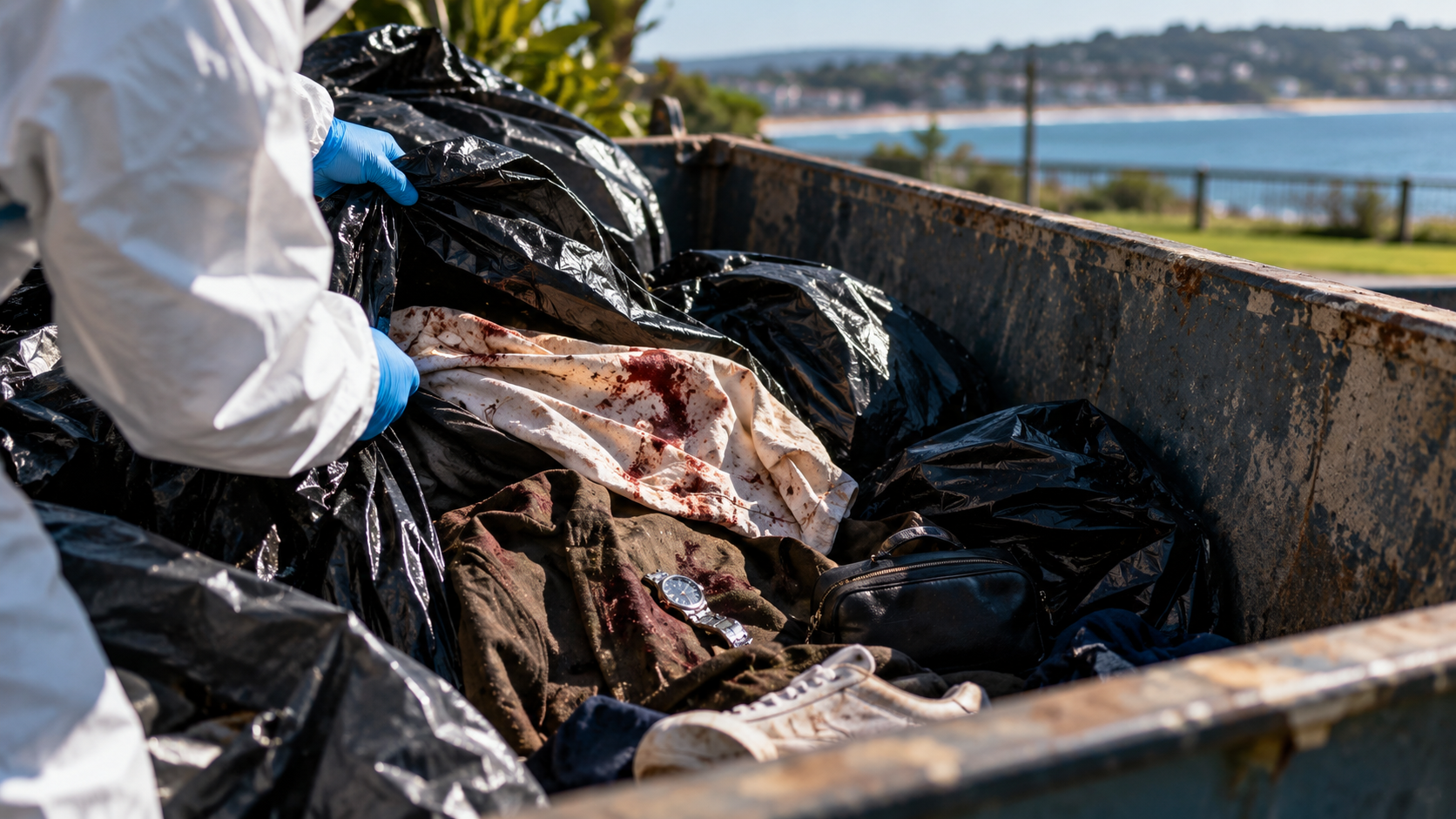
Skip-Bin Discovery Takes Centre Stage In Beau Lamarre-Condon Double-Murder Trial
The Evidence Found In A Sydney Skip
A groundskeeper opened a black plastic rubbish bag inside a skip bin in Sydney and found clothing marked with red stains.
There was more inside.
A bedsheet. A silver watch. A leather pouch. Shoes. Clothing. AFL shorts still inside their packaging. And identification belonging to Luke Davies.
Craig Scott, a groundskeeper at the Cronulla club where the items were discovered, later said in a statement read to the New South Wales Supreme Court that the staining looked like dried blood to him.
He and a colleague thought something suspicious had happened.
The discovery has now become part of the physical evidence being placed before the jury in the double-murder trial of former New South Wales police officer Beau Lamarre-Condon.
Lamarre-Condon, 31, has pleaded not guilty to murdering Jesse Baird and Baird's partner, Luke Davies, at Baird's home in Paddington on 19 February 2024. He has also pleaded not guilty to aggravated break and enter.
The prosecution alleges Lamarre-Condon deliberately killed the two men with his police service pistol and then attempted to conceal what had happened.
His lawyers are advancing a very different account.
The defence says Baird and Davies died during two separate struggles involving the gun and that Lamarre-Condon's actions afterwards, including cleaning the property and disposing of possessions, were those of a man who had panicked.
The jury has not been asked to decide between those accounts yet.
But as the trial moves deeper into its forensic evidence, jurors are beginning to see the physical traces left behind.
The Bags In The Skip
The skip-bin evidence begins away from Brown Street, Paddington, where Baird lived.
The Supreme Court heard that plastic bags containing clothing were discovered in a skip at a Cronulla bowls club after Baird and Davies disappeared.
Scott's statement described arriving at work and noticing that rubbish had appeared in the skip.
When the bags were examined, he saw clothing carrying red staining.
He and another worker also found a stained sheet, a watch, a leather pouch and identification linked to Davies.
The discovery was reported to police.
It was an important investigative moment because Baird and Davies were, at that stage, missing.
Their bodies would not be found until eight days after the alleged killings, in rural Bungonia south of Sydney. They were discovered inside surfboard bags.
The prosecution alleges Lamarre-Condon had discarded bloodied possessions belonging to the men in the Cronulla skip as part of an effort to remove evidence.
That allegation cannot be considered in isolation.
The trial is also examining what investigators later found inside Baird's home.
Blood Inside The Paddington Terrace
On Tuesday, jurors were taken through dozens of photographs captured when forensic officers examined the Paddington property.
Police attended the house several days after the alleged killings.
Among the items photographed was a dismantled bed frame near the front of the property.
Tests confirmed apparent bloodstaining on parts of the bed, while later DNA analysis suggested some stains contained profiles belonging to Baird, Davies or both men.
Investigators also photographed and tested small stains on floorboards inside Baird's bedroom.
Luminol was used in areas of the house.
The chemical is commonly used as a presumptive test for blood because it can produce a blue glow when reacting with traces that may no longer be visible to the naked eye.
The court was shown images of that glow across areas of the hallway and bedroom.
Other evidence went further.
Jurors were shown photographs of a fired bullet carrying traces of blood. A senior crime-scene officer told the court the bullet had travelled through a source of blood before penetrating wooden flooring.
Below the house, investigators photographed blood that had flowed into structural timber.
More than 200 crime-scene photographs were shown as the prosecution continued building the physical chronology of events inside the terrace.
What The Crown Says Happened
The prosecution's case is that the deaths were planned killings rather than the result of sudden struggles.
According to evidence outlined to the jury during the opening stages of the trial, investigators collected around 14,000 hours of CCTV footage while reconstructing Lamarre-Condon's movements.
The Crown says he used a hire car, activated a burner phone and waited near Baird's home for around three hours after two housemates left the property.
He had also bought a surfboard bag before the deaths.
Prosecutors allege that purchase formed part of preparations to dispose of a body.
Three gunshots were captured by nearby CCTV audio on the morning of 19 February.
The first two came several seconds apart.
A third followed roughly 50 seconds later.
The Crown alleges the first two shots killed Baird and the third killed Davies.
Prosecutors say Lamarre-Condon then began cleaning the house.
Receipts presented during the proceedings show purchases made across several hardware stores in the following days, including bleach, gloves, cable ties, tape, rubbish bags, a wheelbarrow and quick-set concrete.
Other purchases included weights and paddle-board covers.
Court reporting indicates more than $2,300 Australian dollars was spent between 17 and 23 February across the various purchases and vehicle hire referred to in evidence.
The Crown alleges the bodies were moved inside surfboard bags and that there was an unsuccessful attempt to dispose of them in a dam using weights and concrete before they were eventually left elsewhere in rural New South Wales.
The bodies were later located near a monastery property in the Bungonia area.
The Defence Account Is Fundamentally Different
The existence of cleaning, disposal and blood evidence is not necessarily the point on which the two sides disagree most sharply.
The argument is over what happened before it.
Defence counsel John Stratton SC has told the jury that Lamarre-Condon will rely on self-defence.
According to the defence opening, Lamarre-Condon went to Baird's home to retrieve possessions.
He was disguised as an Uber Eats delivery rider because, the defence says, he believed nobody would be home and wanted an explanation for his presence if somebody unexpectedly saw him.
The defence says Lamarre-Condon was surprised by Baird inside the property.
A struggle involving the police pistol followed.
According to that account, the firearm discharged twice, fatally injuring Baird.
The gun was then thrown or flung into another room.
The defence says Lamarre-Condon subsequently encountered Davies and that another struggle over the pistol took place.
Its case is that Davies fatally shot himself during that struggle.
What happened afterwards is not being presented by the defence as normal or innocent behaviour.
Instead, the defence argues Lamarre-Condon panicked because he understood the seriousness of what had happened and how the circumstances would appear.
That distinction is crucial.
Evidence of cleaning or disposal may be relied upon by prosecutors as part of a broader circumstantial case, but jurors must ultimately assess it alongside the defence explanation and all the other evidence they hear.
Stratton has specifically urged them not to reach a conclusion before the trial is complete.
The Cleaners Who Arrived Before Police Secured The House
Another unusual part of the chronology emerged through police body-camera footage.
When detectives arrived at Baird's home after the skip-bin discovery, three cleaners were already inside.
They had been hired because Baird had been preparing to move out.
Footage shown to the court recorded officers communicating with the Portuguese-speaking cleaners using Google Translate before asking them to stop cleaning.
Police then declared the property a crime scene.
The sequence introduces an important forensic complication.
Some cleaning had already begun before investigators formally secured the house.
Even so, crime-scene officers subsequently documented extensive material including blood traces, DNA evidence and ballistic evidence.
For jurors, the task will not simply be to notice that blood existed inside the house. The location, distribution, DNA profiles and relationship between blood and ballistic evidence may become important when the competing accounts of the shootings are tested.
Why The Skip-Bin Evidence Matters
A bag of bloodstained belongings can sound decisive when separated from the rest of a criminal trial.
Legally, it is one part of a much larger evidential picture.
Both sides accept that Lamarre-Condon was at the property and that Baird and Davies died after encounters involving his police pistol.
The more difficult questions concern intention, sequence and whether the shootings occurred as prosecutors allege or during the struggles described by the defence.
Post-event behaviour may help jurors assess those questions, but it does not answer them automatically.
The Crown can argue that acquiring cleaning products, removing possessions and disposing of bloodied material forms part of deliberate concealment following intentional killings.
The defence can point to its stated case that Lamarre-Condon panicked after two unexpected deaths and made irrational attempts to conceal what had occurred.
The same physical act can therefore carry a different claimed meaning depending on what jurors conclude happened immediately beforehand.
That is why the forensic evidence from Brown Street matters alongside the Cronulla discovery.
Blood patterns, the bullet, DNA, CCTV timing and the position of evidence inside the property potentially allow the jury to test the competing narratives against physical events rather than relying entirely upon later explanations.
A Trial Still Near Its Beginning
The proceedings are only in their second week.
Justice Natalie Adams is presiding over a trial expected to last about three months.
The evidence heard so far has included accounts of the relationship between Baird and Lamarre-Condon, witness testimony about events before the deaths, CCTV evidence, purchases, crime-scene material and the belongings discovered after Baird and Davies disappeared.
None of that amounts to a verdict.
Lamarre-Condon has pleaded not guilty.
The prosecution must prove the murder charges beyond reasonable doubt, while the jury will also have to consider the self-defence case advanced on his behalf.
For now, the physical evidence is beginning to establish something more limited but important: a traceable path from the Paddington house to possessions recovered kilometres away, while forensic officers reconstruct what was left inside.
The question for the jury will ultimately be what that evidence proves about how Jesse Baird and Luke Davies died.
