True Crime: Courtney Clenney—The Miami High-Rise, The Knife, And The Question A Jury Has To Answer
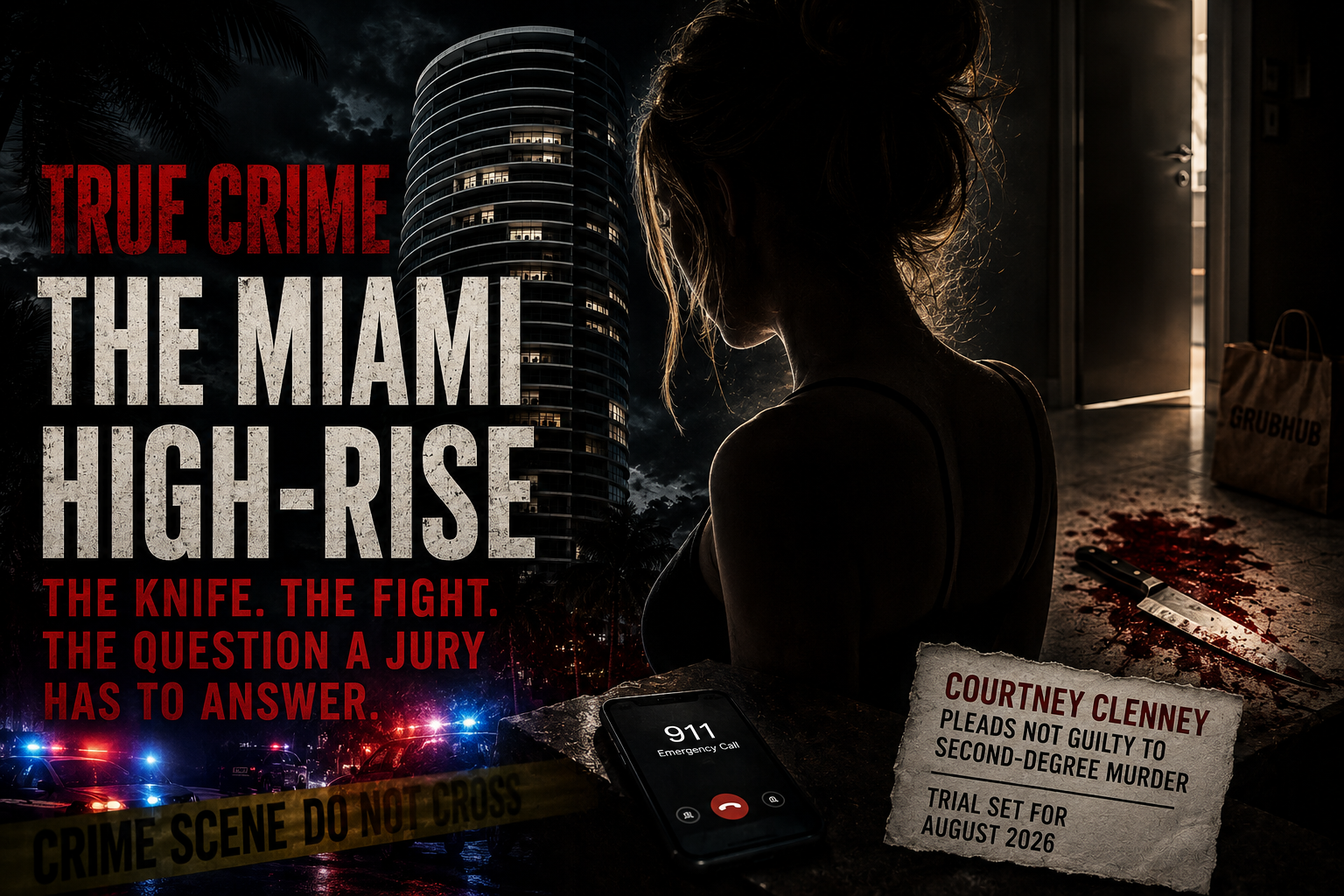
The Miami Case Built From Fragments
The Miami Apartment And The Knife Question
The apartment was high above Miami, but the first clues were ordinary.
A food bag. A phone call. A locked door. A building where neighbors had heard enough noise to call security before anyone outside the room knew what had happened.
Inside One Paraiso, the story did not begin as a courtroom question. It began as a disturbance in a private apartment, the kind that can sound like another argument until one detail makes it impossible to treat as ordinary.
Courtney Clenney and Christian “Toby” Obumseli had lived a public-looking life: social media, money, travel, Miami views, and the glossy surface of a young couple who seemed to be moving fast. But the record prosecutors later described was not glossy. It was a record of calls, complaints, prior conflict, CCTV, phone activity, and a disputed account of what happened in the minutes before help arrived.
This is not a story a reader can understand by choosing a side in the first paragraph. It is a case about evidence, self-defense, public image, relationship violence, and the difference between suspicion and proof. The legal question is still active. Clenney has pleaded not guilty to second-degree murder, maintains that she acted in self-defense, and her trial had been scheduled for the third week of August 2026 as of Court TV’s June 1 update.
The first version looked simple only from far away.
Up close, it became a question about what a knife wound could show, what a 911 call could not settle, what a building’s cameras captured, and what a jury may eventually have to decide.
The Life Before The Case
Christian Obumseli was 27 when the Miami case entered public view. Reporting identified him as a young man from Texas who had moved through the same modern world as Clenney: online identity, finance, travel, and a relationship that crossed cities before it reached Florida. Public reporting has not given the full shape of his private life. That absence should not make him feel less real. It means the article must treat the available facts carefully: a person with a life beyond the case, now discussed through records, evidence, legal argument, and the limits of what the public file can show.
Courtney Clenney, known online as Courtney Tailor, had built a large social media and OnlyFans following before her arrest. NBC Miami reported that she described herself online as a “proud Texan,” a fitness model, and someone newly moving into Miami. The public-facing version was bright, performative, and profitable. It was also incomplete.
The couple’s move into One Paraiso in Miami’s Edgewater neighborhood placed them in a luxury tower with cameras, staff, neighbors, access records, and management systems. That mattered later because this was not a case reconstructed only from memory. The building itself became part of the record.
What the public first saw was the image: the influencer, the boyfriend, the bayfront apartment. What investigators later focused on was less cinematic and more technical: who entered, who called, who heard shouting, what the wound showed, and what each side claimed those facts meant.
The People Around Them
The supporting cast was not small. There were families, building staff, neighbors, police, medical examiners, prosecutors, defense attorneys, and civil lawyers.
Obumseli’s family questioned the self-defense account early. CBS Miami reported that relatives wanted an arrest soon after the April 2022 incident and rejected the idea that the stabbing was justified. His cousin Karen Egbuna described him as soft-spoken and said the family did not believe the incident fit the version being offered by Clenney’s attorney at the time.
Clenney’s defense team framed the case differently from the beginning. Her lawyer Frank Prieto said in April 2022 that she had acted in self-defense and should not face criminal charges. He described the relationship as toxic and said she had kicked Obumseli out of the apartment before his death because of domestic abuse allegations.
The state’s later theory moved in the opposite direction. Prosecutors alleged that the relationship was “extremely tempestuous” and that Clenney’s conduct had escalated. ABC News reported that Miami-Dade State Attorney Katherine Fernandez Rundle said building staff documented repeated loud arguments after the couple moved into the building in January 2022.
That is why the case became more than one fatal moment. Each side wanted the history of the relationship to explain the apartment. The prosecution said prior conduct helped show a pattern. The defense said the same relationship history had to be read through self-defense and abuse.
The First Cracks
Before the April 3 emergency call, there had already been warning signs in the public record.
NBC Miami reported that, according to the arrest warrant affidavit, Clenney had been arrested in Las Vegas in July 2021 on suspicion of domestic battery against Obumseli after an argument at the Cosmopolitan hotel. The Clark County case was later dropped, but the incident remained part of how authorities described the couple’s history.
Inside the Miami tower, the record prosecutors described was not one isolated complaint. Rundle said tenants and staff documented many loud arguments, including complaints from residents as far as two floors above the couple. Building management was moving toward legal action to evict them because of the disturbances.
Then there was the elevator footage. Prosecutors released a February 21, 2022 surveillance video showing an altercation between Clenney and Obumseli inside the One Paraiso elevator. NBC Miami’s account of the video said Clenney appeared to hit, push, and pull at him while he tried to restrain or block her at points. The defense called the video incomplete and argued it did not show what happened before the elevator scene.
That distinction matters. Video can be powerful, but it is not omniscient. It can show motion, contact, timing, and body position. It cannot show every private argument, every prior fear, or every unseen moment that either side says explains what happened next.
The Last Ordinary Movements
The final sequence on April 3, 2022 began with movements that still looked normal.
According to NBC Miami’s summary of the affidavit, key fob records showed Obumseli left the building at about 1:15 p.m. and returned at 4:32 p.m. with Subway sandwiches. Clenney was finishing an Instagram video shortly before he returned. She called him at 4:01 p.m. and again at 4:33 p.m., just before he entered the apartment.
Those details are small only until they are placed on a timeline. A sandwich becomes proof of return. A key fob becomes a time stamp. A phone call becomes a marker close to the point where ordinary life ended and legal reconstruction began.
The next calls were to Clenney’s mother, Deborah. NBC Miami reported that Deborah told police she spoke with her daughter twice between 4:43 p.m. and 4:56 p.m., heard Clenney yelling at Obumseli to leave, and heard accusations that he was lying. The same account said Deborah did not tell police she heard her daughter being attacked or claiming she was being attacked during those calls.
Investigators concluded that the stabbing occurred during that 13-minute window. The apartment had become a narrow legal space: between a return at 4:32, calls to a mother, neighbors reporting a disturbance, and the 911 call that followed.
The First Alarm
The first alarm did not come from one source.
Rundle said tenants called the building manager on April 3 to report a disturbance, and the manager called 911. Eleven minutes later, Clenney called 911 and said Obumseli had been stabbed and needed help.
ABC News reported that Obumseli could be heard on the 911 call saying he was dying and losing feeling in his arm, while Clenney could be heard apologizing to him. That call mattered because it preserved urgency, proximity, and aftermath. It did not, by itself, decide criminal liability.
Miami police found a scene that immediately raised two competing possibilities. One was self-defense during a violent confrontation. The other was an unlawful stabbing later framed as self-defense. The legal case would turn on which version the admissible evidence could support.
The defense pointed to panic, an immediate 911 call, and Clenney’s claim that she had been attacked. Prosecutors pointed to inconsistencies, medical evidence, prior alleged conduct, and the absence of injuries they said would corroborate her account.
At that stage, the gap was not between public curiosity and public judgment. It was between what the room looked like after the stabbing and what the state could prove had happened before it.
The Search For An Explanation
Early public discussion moved quickly because the people involved were already legible to the internet.
Clenney was an influencer. Obumseli was her boyfriend. The apartment was expensive. The case involved OnlyFans, money, race, social media, domestic violence allegations, and a sudden death inside a high-rise. That combination made the story spread before the legal process had caught up with the public version.
The first defense explanation was self-defense. Prieto told CBS Miami in April 2022 that Clenney was innocent, that she had acted in self-defense, and that the state attorney would find there was no case once the review was complete.
The prosecution’s later explanation was different. Rundle said the medical examiner determined Obumseli’s cause of death was a stab wound to the chest with a knife that punctured his subclavian artery. She also said the wound was the result of a forceful downward thrust, just over three inches deep.
That medical finding became central because Clenney’s account involved distance. According to Rundle, Clenney said she grabbed a knife and threw it at Obumseli from about 10 feet away as he approached her. The medical examiner said a knife thrown from that distance would not have caused the fatal wound.
The case had narrowed to a question that sounded almost mechanical but carried enormous legal force: was the wound consistent with a thrown knife in self-defense, or with an intentional close-range stabbing?
The Evidence That Did Not Fit
The investigation escalated because the state said Clenney’s account did not fit the physical evidence.
ABC News reported that police said they observed no injuries on Clenney that corroborated her account and that she allegedly gave several inconsistent accounts of the incident. Rundle also said Clenney never stated that Obumseli had a weapon.
The defense did not accept the state’s framing. It argued that the prosecution was cherry-picking evidence and that the relationship could not be understood by treating Obumseli only as a victim and Clenney only as an aggressor. That defence position later grew into a broader courtroom dispute about witnesses, evidence, experts, and what the jury should be allowed to hear.
One of the most unusual developments came through the defense’s attempt to test the knife-throwing claim. At a 2024 hearing, Court TV reported that Clenney’s lawyers introduced a video of knives being thrown at a pig carcass. Their expert, Dr. John Marraccini, testified that his testing made it plausible, even likely, that the knife could have been thrown.
Prosecutors attacked the demonstration. Court TV reported that they highlighted differences between Clenney and the man throwing knives in the video, questioned whether the expert had examined the actual weapon, and challenged whether the test matched Clenney’s account.
The knife did not answer the case on its own. It forced the case into a deeper question: whether an expert demonstration could recreate a private, chaotic, disputed moment inside an apartment.
The Event At The Center Of The Case
The central event is one of the hardest parts of this case to write responsibly because no public source gives the reader a complete neutral recording of everything that happened inside the apartment.
The available record places Obumseli back in the building at 4:32 p.m. It places Clenney on calls with her mother between 4:43 p.m. and 4:56 p.m. It places a disturbance report before emergency response. It places the 911 call at 4:57 p.m. It places a fatal knife wound in Obumseli’s chest.
Clenney’s version, as prosecutors summarized it, was that Obumseli shoved her against a wall by the neck, threw her to the ground, allowed her to get up, and then approached as she moved to the kitchen, grabbed a knife, and threw it from about 10 feet away.
The prosecution disputes that account. Its public theory relies heavily on the medical examiner’s conclusion that the wound was not consistent with a knife thrown from that distance. It also relies on prior alleged conduct, the elevator video, building complaints, and what prosecutors described as inconsistency in Clenney’s statements.
The defense disputes the prosecution’s reading. It says the case is one of self-defense, argues Obumseli was abusive, and has tried to support the thrown-knife account through expert evidence and testing. Court TV reported that defense attorneys linked their knife-throwing setup to bodyworn camera material from the day of the incident, though the judge deferred ruling at that 2024 hearing until reviewing the material.
What remains unknown is the exact private sequence in the seconds before the wound. That unknown is not a weakness in the article. It is the reason the trial matters.
When The Story Broke Open
The story broke open because it had several kinds of public pressure at once.
There was grief from Obumseli’s family. There was Clenney’s online fame. There was debate over whether the case showed a woman defending herself from abuse or a man killed after a pattern of aggression by his girlfriend. There were also difficult public conversations about race after reporting emerged about recordings in which Clenney used a racial slur against Obumseli.
The danger in cases like this is that the internet chooses a verdict early. Social media is built for identification, not legal standards. It wants a villain, a slogan, and a finished story. A criminal court has to move more slowly.
The state did not arrest Clenney immediately. ABC News reported that she was arrested in Laupahoehoe, Hawaii, on August 10, 2022, after Miami-Dade prosecutors issued a warrant connected to the April 3 stabbing.
That delay became part of the public narrative. Obumseli’s family and supporters had questioned why no arrest had come sooner. Clenney’s lawyers argued the opposite: that the charge was unjust and that she had been in Hawaii seeking treatment for trauma and related issues.
By then, the apartment was no longer just a location. It had become the stage for a public argument about domestic violence, gender, race, money, evidence, and the limits of what outsiders can know.
The Case Built From Fragments
The case against Clenney is not built around one simple piece of evidence.
It is built from fragments: the medical examiner’s conclusion, the 911 call, key fob records, phone calls, building complaints, the elevator video, prior incidents, witness accounts, and the defense’s own effort to explain the wound through a thrown-knife theory.
The jury will not be asked whether Clenney was famous, unlikeable, sympathetic, volatile, or persuasive. It will be asked whether prosecutors have proved the charged offense beyond a reasonable doubt, and whether the self-defense claim leaves reasonable doubt under Florida law.
The medical examiner finding matters because prosecutors say the wound was inconsistent with a knife thrown from about 10 feet. The 911 call matters because it captures the immediate aftermath, but does not record the full confrontation. The key fob and phone timeline matter because they narrow the window between Obumseli’s return and the emergency call. The elevator footage matters because prosecutors say it supports a pattern, while the defense says it lacks context. The defense knife testing matters because Clenney’s lawyers say it supports the thrown-knife account, while prosecutors dispute whether it fits the actual facts.
The public version often flattens this into one question: did she mean to do it? The court version is more technical. It must weigh intent, self-defense, physical evidence, prior conduct, expert opinion, and reasonable doubt.
A pattern can support an inference. It is not the same as direct access to private thought. That is why the strongest version of the case has to be cumulative, and why the defense will try to break that accumulation strand by strand.
The Outcome That Did Not End The Story
There has not yet been a trial verdict.
Clenney is charged with second-degree murder and has pleaded not guilty. Court TV reported on June 1, 2026 that her defense had inspected knives involved in the case, that additional depositions were scheduled, and that trial was scheduled to begin in the third week of August 2026.
She remains jailed without bond. In December 2025, Judge Andrea Ricker Wolfson denied defense efforts to dismiss the charges or set bond, while also setting what was then an April 27, 2026 trial date. That April setting was later delayed after a joint continuance request, with the parties looking toward summer and then August.
The delay matters because pretrial incarceration can become part of the defense argument, especially where trial dates move and evidence disputes multiply. But delay does not decide guilt or innocence. It affects fairness, preparation, custody, and pressure.
The criminal case remains the main legal event. No jury has found Clenney guilty. No jury has acquitted her. The public may have reached opinions years ago, but the court has not yet delivered the legal answer.
The Aftermath People Still Argue About
The aftermath became tangled with a separate computer-related case.
In 2024, Courtney Clenney and her parents, Kim and Deborah Clenney, were accused in a separate case of illegally accessing Obumseli’s laptop after his death. AP reported that her parents were arrested in Texas on charges of unauthorized access to a computer, and that Courtney was also connected to that separate case.
That case did not survive. Court TV reported in July 2024 that prosecutors dropped the computer crimes charges against Courtney and her parents after a judge ruled key evidence inadmissible. The murder charge against Courtney Clenney remained.
The laptop dispute also fed into a larger defense attack on the prosecution. Court TV reported in September 2025 that Clenney’s lawyers filed a motion to dismiss, alleging prosecutors accessed privileged defense material, failed to disclose a witness, and allowed potentially helpful evidence to be destroyed.
Those claims do not prove the murder charge is false. They do, however, show why the trial has become about more than the apartment. It is also about what evidence was preserved, what was disclosed, what was privileged, and whether the defense can argue it received a fair process.
The Review, Appeal, Or Unanswered Question
Because the case has not reached a verdict, the unresolved question is not an appeal. It is the trial itself.
The prosecution must persuade a jury that the stabbing was not legally justified. The defense must create reasonable doubt or persuade jurors that Clenney acted in self-defense. The disputed knife mechanics sit at the center, but they do not stand alone.
The court may also have to decide what prior relationship evidence comes in, what expert testimony is allowed, how much of the defense’s claims about prosecutorial conduct affects the trial, and what the jury is permitted to hear about both Clenney and Obumseli.
The most common public misunderstanding is that the case can be solved from one piece of media. The elevator video does not show the apartment. The 911 call does not show the stabbing. The medical examiner’s finding does not record the argument. The defense experiment does not recreate the exact room with exact bodies, exact fear, exact movement, and exact force.
Each item narrows the question. None gives the public the right to skip the legal process.
That is the pressure of the Courtney Clenney case: the story feels visually obvious to many people, but the verdict will depend on what the court allows, what the jury believes, and whether the state can prove its charge beyond reasonable doubt.
Why This Case Still Matters
The case still matters because it sits at a difficult intersection.
It asks how courts should evaluate domestic violence claims when both sides point to conflict. It asks how much prior behavior should shape a jury’s understanding of a final encounter. It asks how social media fame can distort public judgment before trial. It asks how forensic evidence should be explained without turning science into a magic answer.
It also asks whether the public can hold two thoughts at once: Christian Obumseli was a person whose life cannot be reduced to a legal exhibit, and Courtney Clenney remains a defendant who is presumed innocent unless and until a jury finds otherwise.
The apartment, the phone calls, the knife, the food bag, and the elevator footage now carry meanings they did not have at the time. They became evidence because the ordinary world around them broke.
The last image is not the influencer feed or the courtroom camera. It is the narrow space between a door opening at 4:32 p.m. and a 911 call at 4:57 p.m., where a relationship, a life, and a legal case changed shape forever.
