A Bloodstain Half A Millimetre Across Helped Reopen A Murder Case
A Bloodstain Half A Millimetre Across Helped Reopen A Murder Case.
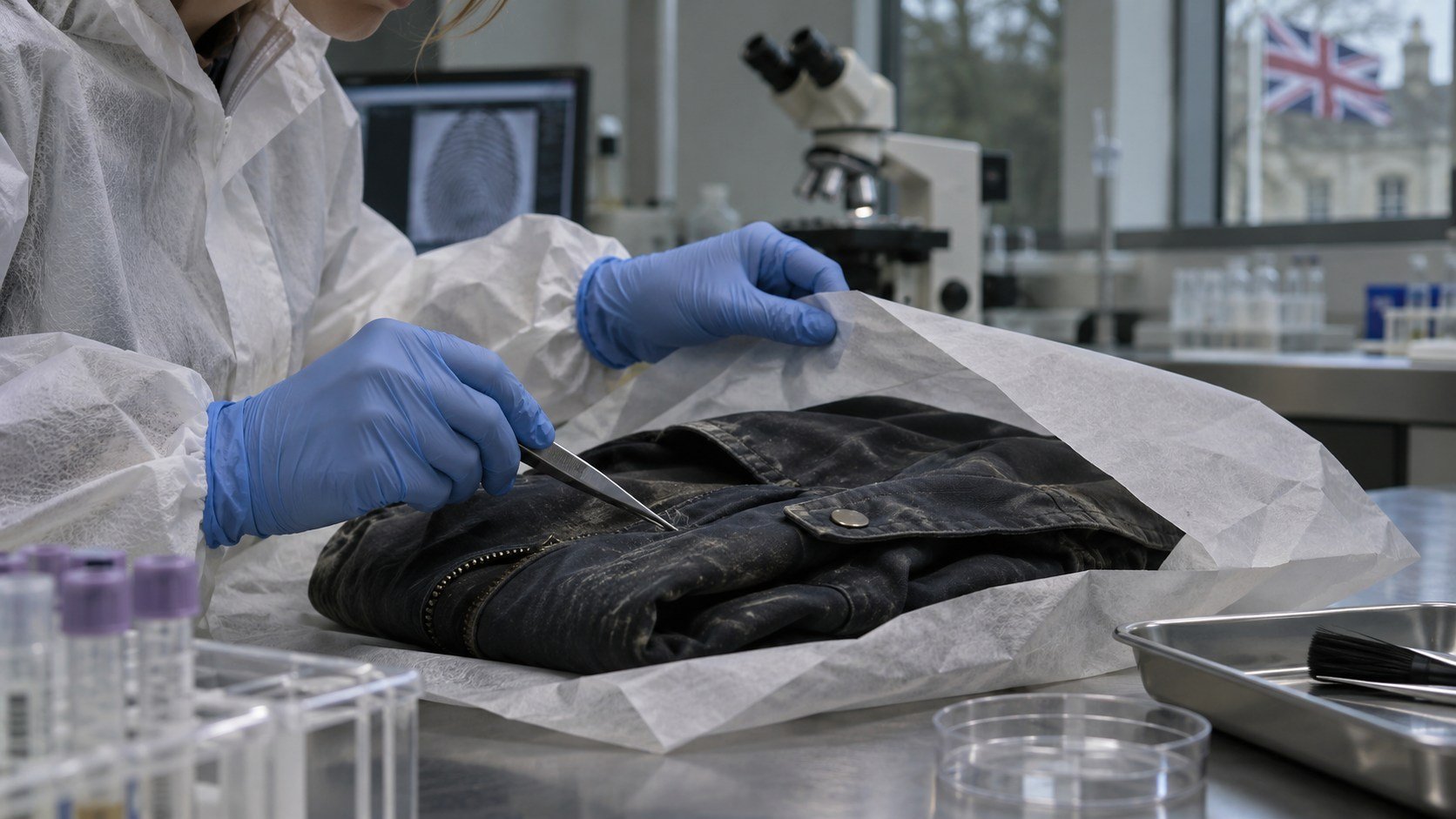
On the collar of a grey jacket, scientists found a stain with a visible area of about half a millimetre by a quarter of a millimetre. Some of the material had soaked into a white yarn. More sat on its surface. To somebody looking at a photograph the difference might seem impossibly small. To the judges considering whether Gary Dobson could be tried again for the murder of Stephen Lawrence, the distinction between blood absorbed into yarn and loose flakes adhering to a jacket mattered a great deal.
Stephen was eighteen when a group of white youths attacked him in Eltham, south-east London, on 22 April 1993. The attack was racist. Stephen had been waiting for a bus with his friend Duwayne Brooks. He wanted to become an architect. The scientific detail enters his story because the failure to secure justice after his death forced his family to pursue an investigation across much of the rest of their lives.
Gary Dobson and David Norris were convicted of murder in January 2012. The evidence did not centre on a scientist discovering a complete record of the assault. It comprised minute traces associated with clothing, the history of how those exhibits had been handled and arguments about when a transfer could have happened. Before jurors could assess any of it against Dobson, another court had to decide whether his earlier acquittal should stand.
What Happened To Stephen's Clothes
Stephen sustained stab wounds in the attack. At hospital his upper clothing had to be cut from him. The Court of Appeal recorded that the cuts went simultaneously through his layers, across an area where there was a wound. The garments were gathered into a hospital sack and police subsequently obtained them. Medical staff treating a dying young man had a different and more pressing responsibility than preserving the original relationship between each separate layer of fabric.
His clothing included a jacket, a body warmer, a cardigan, a red polo shirt and a vest. Green cord trousers also became important. Blood, loose fibres and cut hairs can move when several garments are gathered or cut. That possibility creates a necessary starting point for any later reconstruction. Someone examining a fibre on one of Stephen's own garments could not safely assume it had been in that position when the group attacked.
The more consequential question arose when material associated with Stephen was identified on items recovered from suspects. Direct transfer during close contact was one possible explanation. Transfer after seizure or during examination was another. More sensitive equipment could help establish that a trace was present and whose blood it might be. It rarely supplies a timestamp indicating when the trace reached the cloth.
That is why there are really two histories of the jacket. One concerns whoever wore it and where it had been before seizure. The other begins when police took possession and continues through packaging, transport, laboratory work and storage. A convincing prosecution had to answer questions about the second history before a jury could give the trace much weight in reconstructing the first.
Why The First Prosecution Could Not Simply Be Repeated
Stephen's parents, Doreen and Neville Lawrence, pursued a private prosecution after the original investigation failed to bring the people responsible to justice. In 1996 Dobson and two others were acquitted after identification evidence was ruled inadmissible. Norris had not been acquitted in that trial. Treating the later proceedings as a second trial for both defendants obscures an important legal difference.
An acquittal ordinarily protects a person from being tried again for the same offence. It is a substantial protection. Without finality, a state with vastly greater resources than a defendant could repeatedly bring a case until it obtained the answer it wanted. A rule allowing a further prosecution therefore has to identify exceptional circumstances and place the decision in hands other than those of the investigators who wish to try again.
Sir William Macpherson's inquiry examined the handling of Stephen's murder and identified institutional racism in the Metropolitan Police. Its report also recommended that provision be considered for a further prosecution in murder cases where sufficiently strong fresh evidence emerged. The Criminal Justice Act 2003 later introduced a procedure permitting retrial for specified serious offences. It was capable of applying to earlier acquittals.
This did not mean every controversial acquittal could be reopened once public opinion favoured it. The Court of Appeal had to consider whether the evidence was new and compelling, whether the interests of justice supported another trial and whether a fair trial remained possible. For the Lawrence family, that meant the scientific review had a double burden. Its findings had to justify asking a jury to consider guilt and first justify removing a legal barrier to asking that question at all.
The Stain And The Loose Flakes
The examination of Dobson's grey jacket produced an almost full DNA profile from the small collar stain that matched Stephen. The reported random-match figure was one in a billion. That figure concerns the rarity of a matching profile under the comparison used. It tells a court very little about the route by which the contributor's blood reached the garment. If blood from the same person had arrived by accidental transfer, its genetic profile would have been identical.
The appearance of the stain supplied a different sort of evidence. Some blood had penetrated the white yarn and some remained on the surface. Loose flakes found elsewhere on the jacket looked physically distinct. A defence suggesting contamination therefore had to be examined against the actual material. Moving a dry fragment from one surface to another is an intelligible route for a loose flake. It does not automatically explain a stain that appears partly absorbed.
The distinction did not entitle anyone to declare contamination impossible. A transfer could involve different material, conditions or handling at different stages. That is why the judges devoted attention to packaging and the history of earlier examinations. A scientific conclusion can be strong about what a stain is and more qualified about how it formed. The prosecution's case depended on the combination of those questions, rather than obtaining an impressive answer to just the first.
The jacket also yielded separate flakes of blood or apparent blood. Combining a number of fragments produced an incomplete profile matching Stephen, with far less discriminatory power than the profile from the collar. It would be a serious reporting error to attach the one-in-a-billion figure to every piece of material collected from the garment. Different samples returned different results, including some that did not yield a conclusive DNA profile.
Fibres Preserved On An Earlier Taping
A forensic taping uses an adhesive surface to collect very small loose material from an item. Investigators can preserve the collection and examine it again. A taping taken years before a new investigation has a particular advantage. If something is found on that earlier lift, a theory that it arrived on the original garment only much later cannot be the complete explanation. The taping itself still has a handling history that must be considered.
Examination of tapings from Dobson's jacket found red-orange polyester fibres and pink-orange cotton fibres microscopically indistinguishable from fibres in Stephen's polo shirt. The court distinguished the relative rarity of the particular polyester fibres from the greater commonness of the cotton. One cotton fibre gave a result suggestive of blood affecting its colour. A statement that the fibres were microscopically indistinguishable describes the outcome of a comparison; it does not make every fibre of that appearance unique to one shirt.
Why pay attention to a common fibre at all? Context can change how much the presence of an ordinary item tells us. Finding one commonplace fibre on a garment may have many explanations. Finding different fibres consistent with specified clothes, in conjunction with a separate blood finding, can call for a fuller account. A defence theory that explains one kind of material must be tested against the others before a conclusion is drawn.
Yet cumulative evidence needs careful handling in both directions. A single event during packaging could transfer several items together. If so, treating those items as independent coincidences and multiplying probabilities would exaggerate their force. Investigators had to consider whether there was a plausible common source for the transfers and what opportunities existed for it to act. The science mattered because it gave each side something specific to examine.
The Evidence Relating To David Norris
Items recovered from Norris's bedroom presented a different set of findings. A taping from a sweatshirt contained fibres matching Stephen's green cord trousers and one matching his red polo shirt. The later Court of Appeal account described six fibres consistent with the cords and a seventh consistent with the polo. A sweatshirt taping bearing seven fibres is a different exhibit from the collar stain on Dobson's jacket.
Two very short cut hairs were found in debris from an examination of jeans taken from Norris's room. One was about a millimetre long, the other about two. The longer hair lacked a root and was sent for mitochondrial DNA testing. The method examines genetic material transmitted through the maternal line. It can support an association or exclude a source, but a compatible result can be shared by maternal relatives and others in the population.
The length and condition of this exhibit are central to understanding what the laboratory could do. A two-millimetre fragment is not a full hair with a root and ample tissue for every possible test. A scientist can obtain information that was previously inaccessible while remaining unable to identify an individual to the degree a strong nuclear DNA profile might allow. Calling it simply “a DNA match” removes precisely the information a reader needs to judge its significance.
The evidence therefore connected Norris to the case by a different route from Dobson. The jury was required to consider the case against each defendant. Evidence from one man's clothing did not transfer legally to the other merely because they stood trial together. Establishing that an attack was carried out by a group makes participation a central issue, but it does not dispense with the need to prove the participation of each man accused.
Why Contamination Was A Real Issue For The Court
The defence had a substantial point to make about elapsed time. Police and forensic staff in 1993 were not handling material in anticipation of every method that would become available later. Packaging could be imperfect. Individual garments could have been examined and moved several times. Minute material can pass indirectly through a surface, a container or another item's debris. A review that treated every later discovery as though it had been freshly recovered from the street would be of little value.
The answer had to lie in the documented handling of the particular items. Which were stored together? Which were lifted or taped separately? What work had already been done when a bag was opened? Was the material found loose, attached to the surface, embedded in fabric or preserved on a lift from an earlier date? These practical questions limited the range of credible explanations, even where the record could not reconstruct every movement.
There is an important difference between showing that transfer is physically possible and identifying a route that fits the observations. Equally, it would be unfair to insist that a defendant explain a precise laboratory accident over which he had no control. The burden remained with the prosecution. A proper inquiry into contamination examines opportunities, material properties and records, then asks whether an innocent explanation leaves a reasonable doubt on the evidence as a whole.
The 2011 Court of Appeal judgment did not find Dobson guilty. It assessed whether the new evidence was sufficiently reliable, substantial and probative to warrant a retrial in the interests of justice. The judges concluded that it was. That decision removed the earlier acquittal and allowed the case to be presented in the ordinary way, with the defence able to challenge it before a jury. A threshold for holding a trial had been crossed. Guilt still had to be proved at it.
What Counted As New In A Case About Old Clothes?
Section 78 of the Criminal Justice Act defines new evidence by reference to what was presented in the proceedings that resulted in acquittal. It does not require the police to discover an entirely new garment. The grey jacket could have been available to the authorities for years while evidence obtained from a later examination of it was new for the purposes of the retrial application. That difference between the age of a thing and the age of a finding is particularly clear in Dobson's case.
The court then had to consider the quality of the evidence. The statutory requirements include reliability, substance and strong probative value in the context of the outstanding issues. An observation might be entirely reliable and still have little bearing on who committed a murder. The existence of a stain on an exhibit is one proposition. Its connection with the victim and its likely origin during contact form the more important set of propositions. The contamination evidence was relevant at this stage because it bore directly on how much the new findings could prove.
A further question concerned the interests of justice. The lapse of time was significant, as was the ability of the accused to receive a fair hearing. A defendant responding to an allegation for a second time must be able to test exhibits and challenge witnesses about matters going back many years. Parliament's exception to finality did not promise the state another chance simply because an important crime remained unsolved. The conditions required judges to confront the costs of a further trial as well as the strength of the proposed evidence.
One can see how the application might have looked with only an improved numerical estimate. Suppose an old examination had already established whose blood was present, but a new technique could state the degree of match more forcefully. If the real disagreement concerned how material reached a garment, an extra string of zeros might add relatively little. The collar examination offered evidence about the relationship between the material and the yarn itself. That is a different advance from improving a profile while leaving its route onto the cloth entirely unexplained.
The legal sequence protected an important distinction for the Lawrence family as well. They had spent years campaigning for a proper response to the murder. A decision to grant a retrial recognised that their son's case could now be heard on evidence the earlier proceedings had lacked. It avoided asking the family or the public to treat the existence of a new trial as a verdict. The prosecution still had to put witnesses before jurors who could hear the opposing account and reach their own conclusions about the exhibits.
For readers looking back, May 2011 and January 2012 therefore belong on different lines of the chronology. In the first month the appeal judges removed an obstacle to prosecution. In the second, jurors assessed guilt. The scientific evidence mattered at both points precisely because the decision to be made at each was different.
What The Verdicts Did And Did Not Establish
On 3 January 2012 the jury found both Dobson and Norris guilty of Stephen's murder. The result followed years in which his family had been required to challenge failures by the very institutions charged with investigating his death. Two men were convicted of participating in a racist group attack. The verdicts did not assign every action in the assault to a particular hand, or supply convictions against everyone who had been there.
Nor did a successful later prosecution vindicate the original police response. In an important sense its achievement highlighted the cost of that response. Evidence had to survive years of storage. Its handling became a contested issue in its own right. A change in the law was required before one accused could be tried again. None of that difficulty was visible to a reader seeing only a headline about a breakthrough with DNA.
A laboratory's power in the case was to return detail to material that once appeared to offer very little. A white yarn had absorbed blood. Fibres recovered in an old taping could be compared with a polo shirt. A hair too short for an ordinary visual identification retained information about a maternal line. Each observation mattered because someone documented where it came from and could explain under questioning what conclusion it did and did not support.
Stephen's family had insisted that his life and death deserved an investigation of that quality from the beginning. When science finally helped secure convictions, the most persuasive exhibits were in large part things the authorities had held for years. The unanswered question had never simply been whether a microscope could magnify a stain. It was whether the institutions holding the jacket would examine it closely enough, and account honestly enough for its history, to let a jury decide what it meant.
Sources
Metropolitan Police investigation into the murder of Stephen Lawrence
Remembering Stephen Lawrence 30 years on | The Crown Prosecution Service
